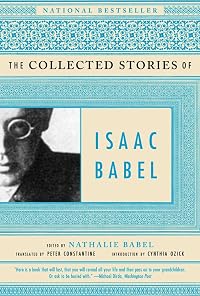
Collected Stories
by Isaac Babel
On This Page
Description
Presents the Russian author's stories in new translations, including a chronology and notes on the texts.Tags
Recommendations










Member Reviews
This is a collection of stories by Isaac Babel, a 20th century Russian writer who met his death at the hands of Stalin's secret police in 1941. The collection is divided into three segments: an autobiographical series, a series of stories taken from Babel's experience fighting the Polish army in the 1920s, and a third series revolving around a gangster hero in Babel's native Odessa. In the autobiographical series, "The Story of My Dovecot" is an absolutely gut-wrenching description of an anti-semitic pogrom carried out during Babel's youth. The Red Cavalry series is a wonderful tale of the pettiness, misery, humor, and senselessness of warfare. The Odessa stories feature the Jewish gangster, Benya Krik, and the often humorous situations show more that he and his family get themselves into in Odessa. I think Babel did a great job of conveying to the reader not only the experience of being Jewish in Russia in the early 20th century, but he also did a great job of conveying what it was to be a human being caught in the Stalinist machinery of state. show less
This was a very interesting, yet elusive, set of short stories. The setting is distant, but we are pulled into it through the details and the characters which reveal the world that Babel was operating in and how it affected, and influenced, their lives. I think it was good to read, and should be read for those interested in short stories, though I wasn't quite sure how to grasp many of the stories nuances and I feel that much of it went over my head. Nevertheless, a challenging and good read.
3 stars.
3 stars.
I'll probably get flak for this but I thought these stories very disappointing. The usual great names of short story writing are thrown around in regards to Babel but I fail to see at all why he deserves to be in such company.
Some of his early sketches are nice and some of the stories from the Red Cavalry section are decent but that's as good as it gets. There always seemed to be a lack of soul to Babel's writing. Some of the stories Babel describes are very sad but they read, to me, like simple accounts of events, rather than stories designed to move the reader. As a result many tales simply felt like the author was going through the motions. There's none of the feeling present in contemporaries like Chekhov or Joyce's short show more stories.
That made it a rather dull collection to read through, despite the short length of all the stories. Perhaps the translation didn't help but I can't see myself returning to these stories to try and discover what I missed. show less
Some of his early sketches are nice and some of the stories from the Red Cavalry section are decent but that's as good as it gets. There always seemed to be a lack of soul to Babel's writing. Some of the stories Babel describes are very sad but they read, to me, like simple accounts of events, rather than stories designed to move the reader. As a result many tales simply felt like the author was going through the motions. There's none of the feeling present in contemporaries like Chekhov or Joyce's short show more stories.
That made it a rather dull collection to read through, despite the short length of all the stories. Perhaps the translation didn't help but I can't see myself returning to these stories to try and discover what I missed. show less
Some of the most luminous short stories written, and the cavalry stories put Hemingway's pretensions to engagement to shame.
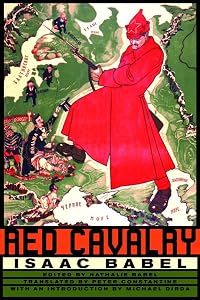
These are outstanding stories, especially the group entitled "Red Calvary," written by the enigmatic Russian-Jewish master. As a war correspondent for ROSTA, the Soviet news agency, Babel traveled with a group of Cossacks during the Civil War. "Red Calvary" is the fruit of that experience. He was swept away in one of Stalin's periodic purges and executed as a Trotskyite in 1940.
I don't know if it's the translation, or the way this particular edition is set up, or what, but I just found the stories here a slog—with a few notable exceptions, which I remember enjoying in other anthologies.
Loved the stories, but unfortunately, the translation from Russian was less than adequate. I must re-read it in original.
Members
- Recently Added By
Lists

Russian Literature
187 works; 36 members

The Top Ten: Writers Pick Their Favorite Books
240 works; 33 members

Jewish Books
367 works; 24 members

501 Must-Read Books
529 works; 72 members

Harold Bloom - The Western Canon: D. The Chaotic Age
833 works; 24 members

Philip Ward's Lifetime Reading Plan
592 works; 22 members

The 150 Greatest Novels of All Time
150 works; 6 members
Author Information

167+ Works 4,410 Members
Isaac Babel was born in Odessa, Russia, in 1894. He won early success with stories about his native Odessa and about the exploits of the Bolshevik cavalry in the Polish campaign of 1920-21. During the 1930s his output was small, but his talent remained undiminished. He was arrested in May 1939 during the Great Purge, and his manuscripts were show more confiscated. His exact fate remains unknown. Although Babel's reputation was restored in 1956, he was still published only occasionally in the Soviet Union-the very strong Jewish element in his stories, as well as the ambiguous positions he took on war and revolution, made his stories uncomfortable for Soviet authorities. For a Russian reader, the Odessa Tales (1916) are particularly exotic. Their protagonists, members of the city's Jewish underworld, are presented in romantic, epic terms. The Red Cavalry stories are noted for their account of the horrors of war. In both cycles Babel relies on precisely constructed short plots, on paradox of situation and of character response, and on nonstandard, captivating language-be it the combination of Yiddish, slang, and standard Russian in the Odessa Tales or of uneducated Cossack speech and standard Russian in the Red Cavalry cycle. The result of such features is a prose heritage rare in the history of Russian literature. Isaac Babel passed away in 1941. (Bowker Author Biography) Isaac Babel was born on July 13, 1894 in Odessa, Russia, to a middle-class Jewish family. He attended the Institute of Business Studies. His life was filled with persecution, which greatly influenced his writing. During the civil war that followed the Russian Revolution, Babel served as a soldier in Poland. This experience provided him with material for Red Cavalry, a collection of his stories. Later, in the Odessa Tales, published in 1931, Babel drew on his Jewish heritage to create colorful and memorable characters. As with many great artists in Russia, Babel's creative style was unpopular with the Stalin regime. Babel admitted to a long association with Trotskyites, but denied this testimony at his trial. He was ultimately found guilty of espionage and shot in Moscow in 1939, although, nearly a year later, his wife and the general public were told that he died in a labor camp. (Bowker Author Biography) show less
Some Editions
Awards and Honors
Series
Belongs to Publisher Series
Common Knowledge
- Canonical title
- Collected Stories
- Original publication date
- 1929 (Red Calvary) (Red Calvary); 1955
- People/Characters
- Benya Krik
- Important places
- Odessa, Russian Empire; Odesa, Ukraine
- First words
- Introduction: A good many years ago, in 1929, I chanced to read a book which disturbed me in a way I can still remember.
Crossing into Poland: The commander of the VI Division reported: Novograd-Volynsk was taken at dawn today. - Blurbers
- Farrell, James T.
- Original language
- Russian
Classifications
- Genres
- Fiction and Literature, General Fiction
- DDC/MDS
- 891.7342 — Literature & rhetoric Literatures of other languages East Indo-European and Celtic literatures Russian and East Slavic languages Russian fiction USSR 1917–1991 Early 20th century 1917–1945
- LCC
- PG3476 .B2 .A23 — Language and Literature Slavic languages and literatures. Baltic languages. Albanian language Slavic. Baltic. Albanian Russian literature Individual authors and works 1917-1960
- BISAC
Statistics
- Members
- 1,159
- Popularity
- 21,806
- Reviews
- 15
- Rating
- (4.04)
- Languages
- 5 — Dutch, English, Italian, Portuguese, Russian
- Media
- Paper, Ebook
- ISBNs
- 23
- UPCs
- 1
- ASINs
- 16