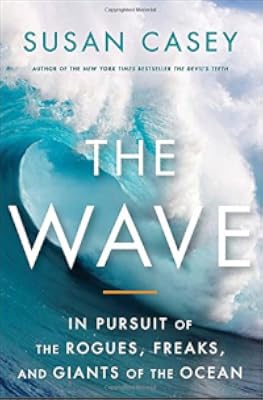
The Wave: In Pursuit of the Rogues, Freaks, and Giants of the Ocean
by Susan Casey
On This Page
Description
Investigates colossal ship-swallowing rogue waves and the surfers who seek them out. For centuries, mariners have spun tales of gargantuan waves, 100 feet high or taller. Until recently scientists dismissed these stories; waves that high would seem to violate the laws of physics. But in the past few decades, as a number of ships have vanished and new evidence has emerged, oceanographers realized something was brewing in the planet's waters. They found their proof in February 2000, when a show more British research vessel was trapped in a vortex of impossibly mammoth waves in the North Sea, including several approaching 100 feet. Scientists scramble to understand this phenomenon. Yet extreme surfers fly around the world trying to ride the ocean's ultimate challenges. The sport's pioneer, Laird Hamilton, with a group of friends in Hawaii, figured out how to board waves of 70 and 80 feet. The exploits of Hamilton and his fellow surfers are juxtaposed against scientists' urgent efforts to understand the destructive powers of waves, from the tsunami that wiped out 250,000 people in the Pacific in 2004 to the 1,740 foot wave that recently leveled part of the Alaskan coast. The book portrays human beings confronting nature at its most ferocious. -- Publisher info. show lessTags
Recommendations





















Member Recommendations
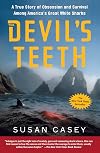
The Devil's Teeth: A True Story of Obsession and Survival Among America's Great White Sharks by Susan Casey
RidgewayGirl An in-depth look at a group of islands near San Francisco, the history of the islands, the birds who breed here and the great white sharks who patrol the surrounding waters.
Also recommended by John_Vaughan
30

noneofthis For the same topic in a visual medium.

Member Reviews
So this book actually gave me nightmares... I dreamed I was on a long narrow boat, on a lovely blue sea, watching whales... when one leaped out of the water, and the resulting splash-down caused an enormous wave that swamped our boat, and next thing you know I'm faaaaaaaaaaaaaaaalling and trying to remember not to breathe and figure out which way is up.
Anyway. I originally thought this book was about, like, giant squid and weird undersea creatures. It's not; it's an entire book about giant waves. They're a lot more common than you'd think, and now I'm pretty much sure I don't want to live anywhere near the ocean ever in my life.
But it's not written to be scary, really; it's an obscure topic that she's documented from several angles, show more one of the big ones being surfing, because for surfers, big waves are actually a positive development.
Unless the wave is 1,700 feet high, like the one that hit a bay in Alaska a few decades ago and literally sucked the barnacles off of rocks.
I'd write more -- I really did learn a lot -- but I'm still a little shellshocked. show less
Anyway. I originally thought this book was about, like, giant squid and weird undersea creatures. It's not; it's an entire book about giant waves. They're a lot more common than you'd think, and now I'm pretty much sure I don't want to live anywhere near the ocean ever in my life.
But it's not written to be scary, really; it's an obscure topic that she's documented from several angles, show more one of the big ones being surfing, because for surfers, big waves are actually a positive development.
Unless the wave is 1,700 feet high, like the one that hit a bay in Alaska a few decades ago and literally sucked the barnacles off of rocks.
I'd write more -- I really did learn a lot -- but I'm still a little shellshocked. show less
“Catch a wave and you’re sitting on top of the world.” Yes, that’s the Beach Boys and if Brian Wilson would have caught a glimpse of one of these monster waves, he might have started hitting the LSD much earlier. Like the title suggests, this is a book about waves, mostly of the freakishly large variety. Casey travels the world, visiting scientists and other experts, trying to find some answers to the origins of these deadly rogues, that can turn a super cargo ship, into a crumpled beer can in a matter of seconds, but even with satellite tracking and other advanced technology, these answers can be elusive. The one thing that is clear though, due to climate change, the oceans are getting warmer and more volatile. The author ends show more up zeroing in on the big-wave surfing community, a ballsy group of mavericks, who hunt down these “giants”, for the ultimate thrill. Her descriptions of what is called tow-surfing, (where the surfer is hauled up to the wave by jet ski) are very exciting and quite scary. “Everything‘s okay until it isn’t.” goes a famous saying, which seems to sum up this dangerous sport, very nicely. Recommended. show less
 This review was written for LibraryThing Early Reviewers.
This books touches on many fascinating topics that I love to read about - big wave surfing, Hawaii, oceanography and climate change. Susan Casey's meticulous research blends them all seamlessly together in an absorbing read that asks the questions: What causes rogue or freak waves? Are they getting worse? What effect do they have on us?
Her research takes her among the big wave surfing elite of Laird Hamilton & David Kalama to an international conference of oceanographers and physicists to Lloyd's of London and to high risk ocean salvage operators in South Africa. The descriptions of huge waves will astound you, and the statistics of ocean accidents will make you think twice before booking your next cruise. I couldn't put this book down show more and I highly recommend it to anyone with an interest in science, climate change, the sea or surfing.
I received this as a galley proof from the publisher, and my only wish is that I could have seen the final version because the proof had no photos or maps, only blank pages that indicated maps would be included at a later date. show less
Her research takes her among the big wave surfing elite of Laird Hamilton & David Kalama to an international conference of oceanographers and physicists to Lloyd's of London and to high risk ocean salvage operators in South Africa. The descriptions of huge waves will astound you, and the statistics of ocean accidents will make you think twice before booking your next cruise. I couldn't put this book down show more and I highly recommend it to anyone with an interest in science, climate change, the sea or surfing.
I received this as a galley proof from the publisher, and my only wish is that I could have seen the final version because the proof had no photos or maps, only blank pages that indicated maps would be included at a later date. show less
This review was written for LibraryThing Early Reviewers.I have mixed feelings about Susan Casey's newest book, The Wave. She's the author of one of my favorite non-fiction books last year, The Devil's Teeth, which was one of those scattershot approaches to science and history that are so popular right now. You know, the kind of book which gives you a bunch of fun facts and exciting anecdotes about a subject, without going into too much detail or challenging the reader with difficult bits of the science. It sounds terrible, but when it works, it's entertaining and gives the reader a good jumping off point for further reading. In the case of The Devil's Teeth, Casey took the Farallons, a group of hostile islands west of San Francisco, and created an enticing mix of history and natural science show more (birds, sharks and currents) that was hard to put down.
She's less successful in The Wave and I'm not sure whether it was that the topic was too broad to be handled as the stream of consciousness of someone who is easily distracted, or because the heart of the book was not in a place that interested me. The concept of the book is that until recently it was believed that waves of 100 feet or more were simply impossible from the point of view of basic physics; the weight of the water would cause the wave to collapse upon itself before it grew that high, and eyewitness accounts (which are rare, for reasons of drowning) were overstated due to understandable excitement. Then an 850-foot long cargo ship went down in a storm and the wreck showed damage high up on it's structure. An oil platform was also hit by a rogue wave of over 100 feet high and damage to the structure proved the oil workers were not making things up.
Half of the chapters are about how scientists are studying the physics of waves, how global warming is influencing the size of waves (hint: they are getting bigger), describing instances of giant waves and their aftermath and in discussing how we are reacting to the challenge of rogue waves. This was all excellent, although I would have liked a great deal more. She only describes one event in any detail and the book would have benefited from describing more dramatic events and with paying more attention to them. I would have also liked more of the science, which seems to be complex and speculative.
The other half of the book, told in alternating chapters, was a sort of sports article about a year in the life of surfing king Laird Hamilton, who developed something called tow-surfing. As waves get bigger, they also get faster, so that traditional surfing, where the surfer paddles out to the wave and "catches" it no longer works. Instead, the surfer is chauffeured out to the wave on a jet ski and sort of flung at speed onto its face. The jet ski then drives round the wave to rescue the surfer at the end of his ride. This would have made a great twenty pages or so, but Casey looooves the daredevil romance of it all, in which Hamilton and his entourage of fellow surfers and photographers travel the world to ride the enormous waves generated by storms at sea, and describes day after day of Hamilton's surfing exploits in Hawai'i, California, Mexico and Tahiti. Frankly, Hamilton comes across as an entitled asshat and I quickly grew tired of his complaints about how surfing is no longer the pure sport he practices (as supported by his corporate sponsorships), or how he hates competitions (as he travels with photographers on hand to film his majestic rides) and anyone surfing where he wants to surf. I'm not someone who would pick up a sports biography, so I'm clearly not the right person to comment on that half of the book, but it became a little repetitive over time.
Still, the central topic is fascinating and anything written about our changing oceans is worth a read. show less
She's less successful in The Wave and I'm not sure whether it was that the topic was too broad to be handled as the stream of consciousness of someone who is easily distracted, or because the heart of the book was not in a place that interested me. The concept of the book is that until recently it was believed that waves of 100 feet or more were simply impossible from the point of view of basic physics; the weight of the water would cause the wave to collapse upon itself before it grew that high, and eyewitness accounts (which are rare, for reasons of drowning) were overstated due to understandable excitement. Then an 850-foot long cargo ship went down in a storm and the wreck showed damage high up on it's structure. An oil platform was also hit by a rogue wave of over 100 feet high and damage to the structure proved the oil workers were not making things up.
Half of the chapters are about how scientists are studying the physics of waves, how global warming is influencing the size of waves (hint: they are getting bigger), describing instances of giant waves and their aftermath and in discussing how we are reacting to the challenge of rogue waves. This was all excellent, although I would have liked a great deal more. She only describes one event in any detail and the book would have benefited from describing more dramatic events and with paying more attention to them. I would have also liked more of the science, which seems to be complex and speculative.
The other half of the book, told in alternating chapters, was a sort of sports article about a year in the life of surfing king Laird Hamilton, who developed something called tow-surfing. As waves get bigger, they also get faster, so that traditional surfing, where the surfer paddles out to the wave and "catches" it no longer works. Instead, the surfer is chauffeured out to the wave on a jet ski and sort of flung at speed onto its face. The jet ski then drives round the wave to rescue the surfer at the end of his ride. This would have made a great twenty pages or so, but Casey looooves the daredevil romance of it all, in which Hamilton and his entourage of fellow surfers and photographers travel the world to ride the enormous waves generated by storms at sea, and describes day after day of Hamilton's surfing exploits in Hawai'i, California, Mexico and Tahiti. Frankly, Hamilton comes across as an entitled asshat and I quickly grew tired of his complaints about how surfing is no longer the pure sport he practices (as supported by his corporate sponsorships), or how he hates competitions (as he travels with photographers on hand to film his majestic rides) and anyone surfing where he wants to surf. I'm not someone who would pick up a sports biography, so I'm clearly not the right person to comment on that half of the book, but it became a little repetitive over time.
Still, the central topic is fascinating and anything written about our changing oceans is worth a read. show less
Waves can be thought of small and harmless, as they wash gently against your feet on a sun kissed beach. But they have a darker side, an ability to become an enormous destructive force that can obliterate landscapes, cities and ships.
Fifteen years ago scientists did not believe the reports of 100 foot high waves that appeared from nowhere in calm seas to sink boats. Their models didn’t show them, and they thought they were myths or just wrong estimates of the height of the wave. But then there were two instances, an oil rig that had sensors fitted to record the heights of the waves beneath the platform, and a research ship in the Atlantic that was caught in a horrendous storm. The measurements proved what scientists didn’t believe show more was possible; that not only did these monster waves exist, and they occurred frequently.
Each year a number of ships disappear completely without trace. It was thought that it was because of maintenance or other factors, but it is now believed that some of them are completely overwhelmed by these freak waves. Casey visits Lloyds in London to see the register of lost ships and talk to the insurance giant about ship losses. It is thought that around two big ships a week are lost, mostly bulk carriers, and there are pictures in the book of ships with their bows ripped off, and 70 foot high decks being covered with water
She spends a lot of time with those at the leading edge of surfing. This select group are the guys who only want to surf the giant 60 foot plus waves. This is a dangerous game, and even though the safety equipment has improved since the beginning, lives are lost every year. A lot of these waves are formed by the geology in particular coastal areas and this forces the wave higher and increases the danger as they are above reefs or close to cliffs. To even get onto these wave require the surfer to be towed onto the wave behind a jet ski..
Even thought this is a nonfiction book about the sea, it reads like a thriller. Casey’s writing add drama and eloquence to the drama of being on a ship that is at the mercy of the sea, the anticipation of the surfers waiting for that perfect 100 foot wave and the scientists who are humbled by the power of the natural world. show less
Fifteen years ago scientists did not believe the reports of 100 foot high waves that appeared from nowhere in calm seas to sink boats. Their models didn’t show them, and they thought they were myths or just wrong estimates of the height of the wave. But then there were two instances, an oil rig that had sensors fitted to record the heights of the waves beneath the platform, and a research ship in the Atlantic that was caught in a horrendous storm. The measurements proved what scientists didn’t believe show more was possible; that not only did these monster waves exist, and they occurred frequently.
Each year a number of ships disappear completely without trace. It was thought that it was because of maintenance or other factors, but it is now believed that some of them are completely overwhelmed by these freak waves. Casey visits Lloyds in London to see the register of lost ships and talk to the insurance giant about ship losses. It is thought that around two big ships a week are lost, mostly bulk carriers, and there are pictures in the book of ships with their bows ripped off, and 70 foot high decks being covered with water
She spends a lot of time with those at the leading edge of surfing. This select group are the guys who only want to surf the giant 60 foot plus waves. This is a dangerous game, and even though the safety equipment has improved since the beginning, lives are lost every year. A lot of these waves are formed by the geology in particular coastal areas and this forces the wave higher and increases the danger as they are above reefs or close to cliffs. To even get onto these wave require the surfer to be towed onto the wave behind a jet ski..
Even thought this is a nonfiction book about the sea, it reads like a thriller. Casey’s writing add drama and eloquence to the drama of being on a ship that is at the mercy of the sea, the anticipation of the surfers waiting for that perfect 100 foot wave and the scientists who are humbled by the power of the natural world. show less
I had reservations about this book. I've been skateboarding and snowboarding for nearly two decades now, but have never surfed . . . I would and I'd probably do alright if it weren't for the fact that I'd do REALLY well with the drowning part since I'm a horrible swimmer.
Anyway, enough about me and more about the book. Casey does a great job with the stories here. She follows, for the most part, living surf legend Laird Hamilton on a number of big wave excursions. She draws enough others into the mix as well and really gives enough detail about each that I was concerned when a chapter gives a hint that someone actually died on a particular day in the waves. Casey does a great job of providing a number of cliffhangers throughout the show more book, making me want to keep reading just one more chapter to see how things went before putting the book down for the night. Of course, that "one more chapter" turned into two or three more often than not.
In addition to the surfing, she also included interviews with scientists studying the ocean, waves and the environment. Wisely, this information wasn't too overwhelming. It was really interesting to me, but in small doses - which Casey manages to deliver. Overall, I really enjoyed this book and there's a lot of different reasons others might as well - from the extreme sports enthusiasts to the environmentally conscious to those who just love a good cliffhanger. show less
Anyway, enough about me and more about the book. Casey does a great job with the stories here. She follows, for the most part, living surf legend Laird Hamilton on a number of big wave excursions. She draws enough others into the mix as well and really gives enough detail about each that I was concerned when a chapter gives a hint that someone actually died on a particular day in the waves. Casey does a great job of providing a number of cliffhangers throughout the show more book, making me want to keep reading just one more chapter to see how things went before putting the book down for the night. Of course, that "one more chapter" turned into two or three more often than not.
In addition to the surfing, she also included interviews with scientists studying the ocean, waves and the environment. Wisely, this information wasn't too overwhelming. It was really interesting to me, but in small doses - which Casey manages to deliver. Overall, I really enjoyed this book and there's a lot of different reasons others might as well - from the extreme sports enthusiasts to the environmentally conscious to those who just love a good cliffhanger. show less
This review was written for LibraryThing Early Reviewers.The Wave is really two books. More to the point, it really should have been two books . . . and one of them should have been written by someone besides Susan Casey.
The first book -- the one that gets more than half the space, the one that (doubtless) sold the publisher on this project, and the one where Casey's heart was in -- is about big-wave surfers, who drop everything to travel to distant corners of the world and ride 50, 60, and even 70-foot waves. It is to surfing what climbing Mount Everest without supplemental oxygen is to mountaineering: Possible, if you're very, very good and know exactly what you're doing, but insanely dangerous even then. Casey writes about the subculture from the inside, all gee-whiz enthusiasm and gushy show more description of what amazing guys these surfers are, but she makes it work. The surfing chapters of The Wave (even those involving death and serious injury) somehow manage to persuade you, the reader, that top big-wave surfers approach their craft like the test pilots in Tom Wolfe's The Right Stuff.
The second book -- the one that should have been written by somebody else -- deals with the science of "big" waves, which for Casey includes not only freak mid-ocean waves, but also tsunamis and storm surges (coastal flooding caused by hurricanes and typhoons, certain to get worse as the polar ice recedes and sea levels rise). All those are fascinating subjects, but they're different subjects . . . from one another and from the storm-driven, shore-breaking waves that Casey's beloved surfers ride. She touches on all of them, but because they collectively get less than half the book there's not enough room to do justice to any of them, or to their implications for ships and coastal cities. A writer like John McPhee or Laurie Garrett -- comfortable with science, and gifted at explaining the complex clearly -- could have made this second book sing. In Casey's hands, it thuds. The science doesn't resonate, for her, the way the surf and the surfers do, and it shows.
The Wave succeeds as a surf-bum version of Into Thin Air or The Perfect Storm . . . but not as a piece of popular science. Here's hoping that some enterprising writer, and some astute publisher, get together and give the big waves the (science) book they deserve. show less
The first book -- the one that gets more than half the space, the one that (doubtless) sold the publisher on this project, and the one where Casey's heart was in -- is about big-wave surfers, who drop everything to travel to distant corners of the world and ride 50, 60, and even 70-foot waves. It is to surfing what climbing Mount Everest without supplemental oxygen is to mountaineering: Possible, if you're very, very good and know exactly what you're doing, but insanely dangerous even then. Casey writes about the subculture from the inside, all gee-whiz enthusiasm and gushy show more description of what amazing guys these surfers are, but she makes it work. The surfing chapters of The Wave (even those involving death and serious injury) somehow manage to persuade you, the reader, that top big-wave surfers approach their craft like the test pilots in Tom Wolfe's The Right Stuff.
The second book -- the one that should have been written by somebody else -- deals with the science of "big" waves, which for Casey includes not only freak mid-ocean waves, but also tsunamis and storm surges (coastal flooding caused by hurricanes and typhoons, certain to get worse as the polar ice recedes and sea levels rise). All those are fascinating subjects, but they're different subjects . . . from one another and from the storm-driven, shore-breaking waves that Casey's beloved surfers ride. She touches on all of them, but because they collectively get less than half the book there's not enough room to do justice to any of them, or to their implications for ships and coastal cities. A writer like John McPhee or Laurie Garrett -- comfortable with science, and gifted at explaining the complex clearly -- could have made this second book sing. In Casey's hands, it thuds. The science doesn't resonate, for her, the way the surf and the surfers do, and it shows.
The Wave succeeds as a surf-bum version of Into Thin Air or The Perfect Storm . . . but not as a piece of popular science. Here's hoping that some enterprising writer, and some astute publisher, get together and give the big waves the (science) book they deserve. show less
Members
- Recently Added By
Lists

Recommend the 20 best books you've read in the last five years
2,168 works; 606 members

Books We Discovered On LibraryThing
530 works; 130 members
Author Information

10+ Works 2,649 Members
Susan Casey is the editor in chief of O, The Oprah Magazine. She is the former editor in chief of Sports Illustrated Women and former development editor of Time Inc. She is a National Magazine Award-winning journalist. Her work has appeared in numerous publications including Esquire, Sports Illustrated, Fortune, Outside, and National Geographic. show more She has written several books including The Devil's Teeth: A True Story of Obsession and Survival Among America's Great White Sharks and Voices in the Ocean: A Journey into the Wild and Haunting World of Dolphins. (Bowker Author Biography) show less
Some Editions
Awards and Honors
Awards
Distinctions
Notable Lists
Common Knowledge
- Canonical title
- The Wave: In Pursuit of the Rogues, Freaks, and Giants of the Ocean
- Alternate titles
- The Wave
- Original publication date
- 2010
- People/Characters
- Laird Hamilton
- Important places
- Hawai'i, USA; North Sea
- Epigraph
- When you look into the abyss,
the abyss also looks into you.
Friedrich Nietzsche - Dedication
- In memory of my father,
Ron Casey - First words
- The clock read midnight when the hundred-foot wave hit the ship, rising from the North Sea out of the darkness.
- Last words
- (Click to show. Warning: May contain spoilers.)"That's what I'm talking about! You know what? That sums it up: 'You made it through.'"
- Blurbers
- Sides, Hampton; Kolbert, Elizabeth; Roach, Mary; Millard, Candice; Stanton, Doug
Classifications
- Genres
- Science & Nature, General Nonfiction, Nonfiction, Sports and Leisure
- DDC/MDS
- 551.463 — Natural sciences & mathematics Earth sciences; geology Geology, Hydrology Meteorology Landforms / Bodies of Water Oceans Gulf of Mexico; Caribbean
- LCC
- GC227 .C37 — Geography, Anthropology and Recreation Oceanography Oceanography Dynamics of the ocean Waves
- BISAC
Statistics
- Members
- 1,038
- Popularity
- 24,877
- Reviews
- 80
- Rating
- (3.81)
- Languages
- English, German, Portuguese
- Media
- Paper, Audiobook, Ebook
- ISBNs
- 17
- ASINs
- 7
