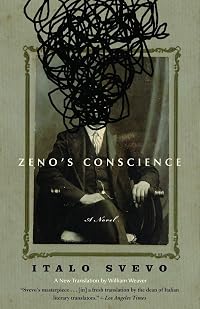
Zeno's Conscience
by Italo Svevo
On This Page
Description
Known for inspiring James Joyce's Leopold Bloom from Ulysses, Zeno Cosini is the bumbling yet charming alter ego of Italo Svevo, who here lays bare a hilarious litany of neuroticisms about his health, friendships, family and women. Having submitted himself to Freudian psychoanalysis, the narrator keeps a diary with the aim of conquering his addiction to smoking. He describes his marriage to the woman he didn't want to marry, how he drives his business partner to despair, and how his 'last show more cigarette' turns out to be one of many. Zeno is the classic 'schlemiel'; his erratic foibles, his questionable logic and his curious inclination to self sabotage help shine a light on human behaviour in general, and reveal the many subtle half-truths people may tell themselves in order to defend their own actions and egos. show lessTags
Recommendations












Member Recommendations
fspyck Ik vond er eenzelfde terughoudenheid in, Machado de Assis is misschien wat grimmiger, en speelt nog meer met vorm en intertekstualiteit, Svevo is ietwat hilarischer
Also recommended by DieFledermaus
40

Member Reviews
Consumido pela imensa ansiedade de um país que se aproxima em passo rápido pra ruína e pela confusão burocrática que está sendo dele fugir para Israel, decidi, também inspirado em Evangelion, que queria ler algo mais ~psicológico~. Aí a pedida de ler o tal romance psicológico, sobre as confissões feitas por um homem na psicanálise. Eu me enganei completamente, mas foi pra melhor, porque quando comecei eu queria algo super profundo e psicológico e não um livro engraçado e irônico. Só que no estado de ânimo que eu tô agora, eu precisava exatamente do segundo, e Zeno entrega.
A Consciência de Zeno, como disse, são os escritos de Zeno rememorando certas questões específicas da sua vida durante um trabalho de show more psicanálise que ele eventualmente abandona (o livro é a publicação vingativa de seu psicanalista, em tese). Zeno é um homem neurótico, fracassado e extremamente leniente consigo mesmo. Zeno não consegue largar o cigarro, e descreve sua saga de inúmeros últimos cigarros, marcados por datas significativas ou combinações aleatórias do calendário. Um belo dia ele decide que sua saúde será resolvida se se casar com uma das filhas do negociante que admira. Ele toma um fora de uma, no mesmo dia tenta a outra irmã e não conseguindo topa casar com a outra irmã que o ama mas ele acha feia. No. mesmo. dia. ele. pede. 3. irmãs. em. casamento. Ele permanece apaixonado pela Ada, mesmo casando com Augusta, e depois vai trabalhar de parceiro pro marido dela, Guido, que ele gosta/odeia como amigo. Guido e ele são bastante tontos com negócios, só perdem dinheiro, o que faz com que Ada, que está bancado parte do prejuízo com sua grana E suspeita que Guido pegou a secretária pra amante, peça ajuda pra Zeno. Ele, que é completamente cismado nela, fica lendo cada gesto dela como uma declaração secreta, e não sabe se decidir se quer ela ou não, já que ela ficou feia com a doença (mas ele claramente quer).
É o tipo de situação que só tem a graça que tem pelo jeito que o Zeno conduz seu relato, insiste nas suas obsessões, e justifica suas próprias estupidezes. Ele fala umas paradas também geniais. Como ele é super egoísta, e faz o que tá afim (ele corneia a coitada da mulher também, ela só não sabe), ele acha ter filhos um saco. Em momento nenhum ele descreve algo como amor paternal. Ele simplesmente só fala em dar umas porradas nos filhos, xingar eles no ouvido quando choram ou um pacto genial com Augusta: colocar um trem em casa que leve o filho de um canto pro outro da casa quando ele começar a chorar pra ficar só de barulhinho de fundo.
Uma frase absurdamente boa do livro é quando ele tá falando pro psicanalista dele, lá pro fim do livro, sobre o desejo dele de pegar as duas irmãs de sua mulher. Zeno acha que o psicanalista tá cheio de enganação pra cima dele, e escreve: "No entanto, acho que ele há de ser a única pessoa neste mundo, percebendo que eu queria ir para a cama com duas belíssimas mulheres, capaz de perguntar: - "Vejamos por que ele quer ir para cama com elas". Muito boa crítica da moral burguesa, claro, mas é um livro engraçado por si só. show less
A Consciência de Zeno, como disse, são os escritos de Zeno rememorando certas questões específicas da sua vida durante um trabalho de show more psicanálise que ele eventualmente abandona (o livro é a publicação vingativa de seu psicanalista, em tese). Zeno é um homem neurótico, fracassado e extremamente leniente consigo mesmo. Zeno não consegue largar o cigarro, e descreve sua saga de inúmeros últimos cigarros, marcados por datas significativas ou combinações aleatórias do calendário. Um belo dia ele decide que sua saúde será resolvida se se casar com uma das filhas do negociante que admira. Ele toma um fora de uma, no mesmo dia tenta a outra irmã e não conseguindo topa casar com a outra irmã que o ama mas ele acha feia. No. mesmo. dia. ele. pede. 3. irmãs. em. casamento. Ele permanece apaixonado pela Ada, mesmo casando com Augusta, e depois vai trabalhar de parceiro pro marido dela, Guido, que ele gosta/odeia como amigo. Guido e ele são bastante tontos com negócios, só perdem dinheiro, o que faz com que Ada, que está bancado parte do prejuízo com sua grana E suspeita que Guido pegou a secretária pra amante, peça ajuda pra Zeno. Ele, que é completamente cismado nela, fica lendo cada gesto dela como uma declaração secreta, e não sabe se decidir se quer ela ou não, já que ela ficou feia com a doença (mas ele claramente quer).
É o tipo de situação que só tem a graça que tem pelo jeito que o Zeno conduz seu relato, insiste nas suas obsessões, e justifica suas próprias estupidezes. Ele fala umas paradas também geniais. Como ele é super egoísta, e faz o que tá afim (ele corneia a coitada da mulher também, ela só não sabe), ele acha ter filhos um saco. Em momento nenhum ele descreve algo como amor paternal. Ele simplesmente só fala em dar umas porradas nos filhos, xingar eles no ouvido quando choram ou um pacto genial com Augusta: colocar um trem em casa que leve o filho de um canto pro outro da casa quando ele começar a chorar pra ficar só de barulhinho de fundo.
Uma frase absurdamente boa do livro é quando ele tá falando pro psicanalista dele, lá pro fim do livro, sobre o desejo dele de pegar as duas irmãs de sua mulher. Zeno acha que o psicanalista tá cheio de enganação pra cima dele, e escreve: "No entanto, acho que ele há de ser a única pessoa neste mundo, percebendo que eu queria ir para a cama com duas belíssimas mulheres, capaz de perguntar: - "Vejamos por que ele quer ir para cama com elas". Muito boa crítica da moral burguesa, claro, mas é um livro engraçado por si só. show less
As part of his psychoanalytic treatment, Zeno is encouraged to keep a journal and write about various aspects of his life. This begins with the apparently banal subject of Zeno’s cigarette addiction. But each further attempt turns to more serious subjects — the death of Zeno’s father, the story of Zeno’s marriage, his mistress, and his business partnership with his brother-in-law. Zeno concludes with a final section written during the first world war decrying psychoanalysis itself, . Throughout, Zeno is sceptical about the efficacy of this writing component of his cure. Yet he becomes increasingly enamoured of the story of his own life, regardless of how poorly he understands himself or others. Indeed, Zeno is the kind of show more unreliable narrator who is sceptical of his own narration. And so he often undercuts his accounts, sometimes even in the following sentence. And yet there is a charm here that captivates. Zeno is assuredly a fool. But no more so than each of the men he encounters in his life. Meanwhile all of the women he encounters (his wife, her sisters, their mother, his mistress) are paragons of virtue, kindness and forgiveness. Yet he also insists both that they know nothing, and worse that he knows nothing about what goes on in their heads. As you might suspect, we are moving swiftly in the territory of farce. So it is all the more surprising to find, by the end, how much pathos surrounds Zeno.
An unremitting, self-absorbed, untrustworthy first-person narrator can get tedious even over the short run. Yet Zeno continues to fascinate even as he drones on. Plus, with the level of self-effacement at hand, and the outright lies (enough of which get revealed to hint of more), it is hard to fathom what exactly to make of Zeno’s confessions here. His weaknesses, it seems, are his strength. And his all-too-human frailty, is in the end what confirms his humanity.
Well worth reading for its place in the history of modernism. But also worth reading because it is often very funny. And so, gently recommended. show less
An unremitting, self-absorbed, untrustworthy first-person narrator can get tedious even over the short run. Yet Zeno continues to fascinate even as he drones on. Plus, with the level of self-effacement at hand, and the outright lies (enough of which get revealed to hint of more), it is hard to fathom what exactly to make of Zeno’s confessions here. His weaknesses, it seems, are his strength. And his all-too-human frailty, is in the end what confirms his humanity.
Well worth reading for its place in the history of modernism. But also worth reading because it is often very funny. And so, gently recommended. show less
This is a fascinating book which has a lot working against it (old views, old contexts lending themselves to some unfortunate views like sexism, light racism, etc) but, like an able dialectic, these only serve to augment this book's positives.
The story of Zeno and his battle with, essentially, himself and his litany of neurotic obsessions (and how this is reflected by and caused by and a cause of his external circumstances) is one that is uniquely, and enjoyably maddening. Though not always funny, it's witty. And conversely when it isn't witty, it's funny. If I can sum up this book is one of those rare birds that succeeds almost because of its shortcomings.
Now, I hadn't heard of this text until some random reading gleaned for me the show more fact that the novel's author, Italo Svevo, was a student of James Joyce (yes, THAT Joyce). And upon reading that (and reading that he was a Secular Jewish author, a personal attachment of mine) I had to read it. And I'm glad I did despite some translation issues; namely, my edition was proofread by someone who either wasn't getting paid enough or simply was having a long series of bad days because it's pretty shoddy in places.
But all of that is immaterial to the meat of this text which is, at its heart, a perennially Jewish and concomitantly quintessentially human endeavor showcasing the very worst and, at times, the very best of human success. This human success is nothing grand in the vein of a Joyce or a Thomas Mann but something much more easy to relate to and universal, that of the success of living day to day with one's growing memorial pile of failures and successes, losses and triumphs, loves, obsessions, and finally death. As stated earlier though, this is a dialectic. And since it is a dialectic the book's final passages (wherein SPOILER Zeno muses in a darkly ironic shade of social darwinism ) is really only best understood as part of an equation of various integers. When Zeno ruminated about the world shaking off humanity like a disease (akin to a Carlin observation) I was left desiccated and more than a little down (a credit to the pathos Svevo was and is able to evince) and this was made more piquant with the idea of mortality, an idea that this book places glib, funny, and ultimately Kafkaesque with. We all die if we're not dying. It's the rare few that actually live (and escape mention in this novel).
To focus only on Zeno's final observations is to miss the forest for the trees, however. And much like a classic Woody Allen film the pathos and the humor interweave to form an image of what it means to be a thinking person in any (neurotic) age, that is to say worried and ceaseless in wondering what it is to be sure of anything. show less
The story of Zeno and his battle with, essentially, himself and his litany of neurotic obsessions (and how this is reflected by and caused by and a cause of his external circumstances) is one that is uniquely, and enjoyably maddening. Though not always funny, it's witty. And conversely when it isn't witty, it's funny. If I can sum up this book is one of those rare birds that succeeds almost because of its shortcomings.
Now, I hadn't heard of this text until some random reading gleaned for me the show more fact that the novel's author, Italo Svevo, was a student of James Joyce (yes, THAT Joyce). And upon reading that (and reading that he was a Secular Jewish author, a personal attachment of mine) I had to read it. And I'm glad I did despite some translation issues; namely, my edition was proofread by someone who either wasn't getting paid enough or simply was having a long series of bad days because it's pretty shoddy in places.
But all of that is immaterial to the meat of this text which is, at its heart, a perennially Jewish and concomitantly quintessentially human endeavor showcasing the very worst and, at times, the very best of human success. This human success is nothing grand in the vein of a Joyce or a Thomas Mann but something much more easy to relate to and universal, that of the success of living day to day with one's growing memorial pile of failures and successes, losses and triumphs, loves, obsessions, and finally death. As stated earlier though, this is a dialectic. And since it is a dialectic the book's final passages (wherein SPOILER Zeno muses in a darkly ironic shade of social darwinism ) is really only best understood as part of an equation of various integers. When Zeno ruminated about the world shaking off humanity like a disease (akin to a Carlin observation) I was left desiccated and more than a little down (a credit to the pathos Svevo was and is able to evince) and this was made more piquant with the idea of mortality, an idea that this book places glib, funny, and ultimately Kafkaesque with. We all die if we're not dying. It's the rare few that actually live (and escape mention in this novel).
To focus only on Zeno's final observations is to miss the forest for the trees, however. And much like a classic Woody Allen film the pathos and the humor interweave to form an image of what it means to be a thinking person in any (neurotic) age, that is to say worried and ceaseless in wondering what it is to be sure of anything. show less
Literary masterpiece, with a shocking final twist.
"Confessions of Zeno" is the journal of a middle-aged man in Trieste, Italy (in the NE, near Croatia, Slovenia and Austria). He first describes briefly his difficult relationship with his father, and his problems quitting smoking, but then moves to the heart of his narrative, which concerns his life spent with a successful merchant-class family, with whose father he has a business relationship, and whose two daughters he desires a personal relationship.
He courts each daughter in turn, eventually marrying one, but keeps a mistress for a time, and comes to befriend the man who marries the other daughter, even entering into a business relationship with him. He manages to have a child, and show more lives a relatively quiet bourgeois existence.
The problem is, he is utterly detached, self-absorbed, and hypocritical. A narcissist's narcissist. When I say "business relationship", I use the term loosely. He despises honest labor!
Worse, during the various troubles he has with his friends and family, he cannot see it is his personality which causes them. The book is subtle and clever, describing the story through his eyes, but still making it clear he is usually the trouble-maker. The unreliability of a narcissist's narrative is its own undoing.
The journal was supposed to have been written for the sake of a psychologist, who is now publishing it to convince his patient he requires more therapy. For the greater part, it is a generally plain book, with interesting characters who take us through interesting adventures, even if those adventures are made comical by the man writing the tale, unaware what a clown he truly is.
But only by the end of the book does the book's full effect dawn on us, and we finally understand the psychologist. The ending is quite subtle. I was shocked enough to re-read the last few pages a few times before actually believing what it seemed to say. But the book's message was that much more effective because of this subtlety. After reading a "plain" book for so many pages, the ending is that much more powerful.
The book's style is clear and engaging, the characters well drawn and endearing, and the stories charming. Many readers will be happy enough to follow this "tragicomic" story for its own sake, but patient and insightful readers will be rewarded with a conclusion that forces them to question what the book had told them all along, and reflect on the meaning of life, love, family, and friendship. show less
"Confessions of Zeno" is the journal of a middle-aged man in Trieste, Italy (in the NE, near Croatia, Slovenia and Austria). He first describes briefly his difficult relationship with his father, and his problems quitting smoking, but then moves to the heart of his narrative, which concerns his life spent with a successful merchant-class family, with whose father he has a business relationship, and whose two daughters he desires a personal relationship.
He courts each daughter in turn, eventually marrying one, but keeps a mistress for a time, and comes to befriend the man who marries the other daughter, even entering into a business relationship with him. He manages to have a child, and show more lives a relatively quiet bourgeois existence.
The problem is, he is utterly detached, self-absorbed, and hypocritical. A narcissist's narcissist. When I say "business relationship", I use the term loosely. He despises honest labor!
Worse, during the various troubles he has with his friends and family, he cannot see it is his personality which causes them. The book is subtle and clever, describing the story through his eyes, but still making it clear he is usually the trouble-maker. The unreliability of a narcissist's narrative is its own undoing.
The journal was supposed to have been written for the sake of a psychologist, who is now publishing it to convince his patient he requires more therapy. For the greater part, it is a generally plain book, with interesting characters who take us through interesting adventures, even if those adventures are made comical by the man writing the tale, unaware what a clown he truly is.
But only by the end of the book does the book's full effect dawn on us, and we finally understand the psychologist. The ending is quite subtle. I was shocked enough to re-read the last few pages a few times before actually believing what it seemed to say. But the book's message was that much more effective because of this subtlety. After reading a "plain" book for so many pages, the ending is that much more powerful.
The book's style is clear and engaging, the characters well drawn and endearing, and the stories charming. Many readers will be happy enough to follow this "tragicomic" story for its own sake, but patient and insightful readers will be rewarded with a conclusion that forces them to question what the book had told them all along, and reflect on the meaning of life, love, family, and friendship. show less
I liked this because Zeno seemed more like a regular guy than just about anyone I've ever found in literature: mild, self-interested, inconsistent, given to dramatic gestures and hypocrisy, eager to be esteemed and loved and fairly lovable except when under duress. Says more about what I think a regular guy is than anything perhaps, and his self-satisfied little pensées did run thin after a certain time (about where he starts to get all cod-Mussolinian, all "the only cry to be respected is that of the victor," but again, because we've been with him a bit and know he is a regular guy, we forgive him it more or less because we remember our own moments of lame-assedly trying on tough-guy armour in our own heads). That and the painterly, show more by which I mean workmanlike, painter-as-in-house-painter, rendering of family dynamics and business matters in Italo-Austro-Slavonic Trieste in the immediate pre-WWI, make this a pleasant entertainment. show less
Zeno is the ultimate unreliable narrator, a man encouraged by his psychoanalyst Dr S. to write his memories. The latter holds him hostage to them and wishes that "he might enjoy the many truths and the many lies he has assembled here!" Zeno recounts his deep anxieties about his ailments and aging, in particular linked to his ceaseless smoking. The next cigarette is often meant to be the last one, but of course never is. He is always on the precipice in judging whether his actions are good or bad and finding justifications after the fact. Although a difficult, unreliable character, somehow he is not quite dislikeable. After all, don't we all play these revisionist games in our minds. The resolution indeed is that humanity is inevitably show more prone to sickness and weakness. Although I glazed over some of the musings, I also enjoyed the wry humor and style. show less
Someone needs to do a gigantic public service announcement and then create a computer virus that will delete all the sentences grouping this together with Ulysses and Proust and Woolf, all of whom are chiefly known for their formalism and prose.
This is Sterne in the late nineteenth century, no more, except with workmanlike prose, rather than Sterne's endlessly propulsive rush of words. The chapters go on for far too long, and although they're quite funny, that's really about all there is to it. The unreliability of the narrator doesn't make the book a modernist masterpiece; that's how comic novels (and, indeed, poems) have always worked.
Having said all that, it is genuinely funny, and some of the scenes have stayed with me far more show more strongly than I would have expected. I just don't to spend hours looking back through the book to find those bits again. show less
This is Sterne in the late nineteenth century, no more, except with workmanlike prose, rather than Sterne's endlessly propulsive rush of words. The chapters go on for far too long, and although they're quite funny, that's really about all there is to it. The unreliability of the narrator doesn't make the book a modernist masterpiece; that's how comic novels (and, indeed, poems) have always worked.
Having said all that, it is genuinely funny, and some of the scenes have stayed with me far more show more strongly than I would have expected. I just don't to spend hours looking back through the book to find those bits again. show less
Members
- Recently Added By
Published Reviews
ThingScore 75
Zenos Handschrift ist die eines Triestiner Kaufmannes am Anfang dieses Jahrhunderts. Durchschnittlich gebildet, erfolglos in der Arbeit und anfangs unglücklich verheiratet, gibt Svevos Protagonist mehr Anlass zu Mitleid und oberflächlicher Belustigung als zu ernsthaftem Interesse. Gerade dieses scheinbar allzu langweilige Durchschnittsschicksal macht auch die Schwierigkeit des Romans aus, show more der seine Qualitäten erst auf Umwegen preisgibt. Wer Zeno, wer Svevo verstehen will, muss bereit sein, nicht nur über ihn zu lachen, sondern ihn gar auszulachen. Lachen über diesen verschrobenen Hypochonder, diesen schrulligen Egoisten, diesen unfähigen Ehebrecher, diesen naiven Feigling, diesen Antihelden durch und durch. Wer ihn dann auslacht, erkennt, dass auch Zeno Zeno durchschaut und auch Zeno über Zeno lacht. show less
added by Indy133
Lists

The Guardian's 1000 Novels Everyone Must Read
1,005 works; 552 members

1001 Books You Must Read Before You Die
1,448 works; 1,137 members
501 Must-Read Books
529 works; 72 members

The 100 Best Books of All Time by Norwegian Book Club (World Library)
104 works; 23 members

Italian Literature
558 works; 43 members
20th Century Literature
1,161 works; 54 members

Favourite Books
1,820 works; 311 members

Philip Ward's Lifetime Reading Plan
592 works; 22 members

Books Set in Italy
167 works; 19 members

Stream of Consciousness
87 works; 8 members
Canon de la narrativa universal del siglo XX
254 works; 6 members

In and About the 1920s
181 works; 31 members
Unreliable Narrators
170 works; 43 members

Western World's Greatest Books - Project Gutenberg
295 works; 15 members

Five star books
1,767 works; 110 members
LibraryThingers' 1001 Books You Must Read Before You Die
442 works; 30 members

Best Antiheroes and Antiheroines
119 works; 7 members
1,001 BYMRBYD Concensus
723 works; 27 members

Modernism
140 works; 9 members
1920s
141 works; 6 members

Best Italian Novels
25 works; 3 members

Books Read in 2020
4,379 works; 123 members
Reading LIst
648 works; 1 member

The 150 Greatest Novels of All Time
150 works; 6 members

DigitalDreamDoor top 300
300 works; 4 members
Lista dei 100 migliori libri italiani degli ultimi 200 anni
100 works; 1 member
Canon de la narrativa universal del s. XX (cicutadry)
499 works; 3 members
Harold Bloom - The Western Canon: D. The Chaotic Age
833 works; 24 members

Mustich's 1000 Books to Read Before You Die: A Life Changing List
1,001 works; 20 members

Found manuscripts
35 works; 2 members

Books Read in 2021
5,361 works; 113 members
Penguin Random House
458 works; 4 members

For Further Reading: A List of 160 Novels from 15 Literatures
160 works; 4 members

Trinity College Booklist (1951): Class Nine, Foreign Literatures
161 works; 3 members
.
396 works; 1 member
Talk Discussions
Past Discussions
Group Read, December 2023: Zeno’s Conscience in 1001 Books to read before you die (December 2023)
Author Information

126+ Works 7,406 Members
Born in Austrian Trieste of a Jewish Italian-German family, Svevo spoke German fluently and pursued a business career before taking up fiction under a pseudonym that means "Italus the Swabian" or South German. His Italian had indeed something foreign about it, as did the characterizations of heroes and heroines in his novels. His first novel, A show more Life (1893), published at his own expense, and his second, Senilita (As a Man Grows Older) (1898), were virtually ignored. Svevo might have despaired had it not been for his friendship with the expatriate Irish novelist James Joyce (see Vol. 1), with whom he exchanged language lessons in Trieste. Joyce's intervention eventually found a foreign audience for Svevo's third and perhaps best novel, The Confessions of Zeno (1923), first published and very well received in France. As Svevo's reputation spread, he was called the Italian Proust in France, the Italian Musil in Germany, and the Italian Joyce in England. Italian critics now point out that, despite Svevo's foreign success, it was an Italian, Eugenio Montale, who wrote the first significant critical appraisal in 1925. Still, by then Montale had already steeped himself in foreign literatures and could assume a foreign perspective, while more natively rooted Italian critics, including even Benedetto Croce, continued to discount Svevo as a writer writing to be translated. (Bowker Author Biography) Italo Svevo (1861-1928), ne' Ettore Schmitz, was born in Trieste and lived there all of his life. (Bowker Author Biography) show less
Some Editions
Awards and Honors
Awards
Notable Lists
Series
Belongs to Publisher Series
Venècies (1)
Biblioteca Folha (12)
Clube de Literatura Clássica (CLC) (38 [June 2023])
Perpetua reeks (15)
Gyldendals små grå (28)
Gallimard, Folio (439-5816)
Work Relationships
Common Knowledge
- Canonical title
- Zeno's Conscience
- Original title
- La coscienza di Zeno
- Alternate titles
- Confessions of Zeno; A Consciência de Svevo: Orazio Cima, A Novela do Bom Velho e da Bela Moça; Zeno's Conscience
- Original publication date
- 1923 (original Italian) (original Italian)
- People/Characters
- Zeno Cosini; Guido Speier; Carla Gerco; Giovanni Malfenti; Ada Malfenti; Augusta Malfenti (show all 14); Alberta Malfenti; Anna Malfenti; Dottor Muli; Dottor Coprosich; Olivi; Enrico Copler; Carmen; Nilini
- Important places
- Trieste, Friuli-Venezia Giulia, Italy
- Important events
- World War I
- Related movies*
- Le parole di mio padre (2001 | IMDb); La coscienza di Zeno (1988 | IMDb); La coscienza di Zeno (1966 | IMDb)
- First words
- Preface: I am the doctor who is sometimes spoken of in rather unflattering terms in this novel.
Introduction: See my childhood?
When I spoke to the doctor about my weakness for smoking he told me to begin my analysis by tracing the growth of that habit from the beginning. - Quotations
- Misunderstanding women is a clear sign of scant virility.
- Last words
- (Click to show. Warning: May contain spoilers.)There will be a tremendous explosion, but no one will hear it and the earth will return to its nebulous state and go wandering through the sky, free at last from parasites and disease.
- Blurbers
- Bennett, Arnold; Kronenberger, Louis; Josephson, Matthew
- Original language
- Italian
*Some information comes from Common Knowledge in other languages. Click "Edit" for more information.
Classifications
- Genres
- Fiction and Literature, General Fiction
- DDC/MDS
- 853.8 — Literature & rhetoric Italian, Romanian & related literatures Italian fiction Later 19th century 1859–1900
- LCC
- PQ4841 .C482 .C613 — Language and Literature French, Italian, Spanish and Portuguese literatures Italian literature Individual authors, 1900-1960
- BISAC
Statistics
- Members
- 4,114
- Popularity
- 3,775
- Reviews
- 58
- Rating
- (3.78)
- Languages
- 20 — Catalan, Czech, Danish, Dutch, English, Estonian, Finnish, French, German, Hebrew, Italian, Lithuanian, Norwegian (Bokmål), Russian, Serbian, Spanish, Swedish, Turkish, Portuguese (Portugal), Portuguese (Brazil)
- Media
- Paper, Audiobook, Ebook
- ISBNs
- 203
- ASINs
- 70