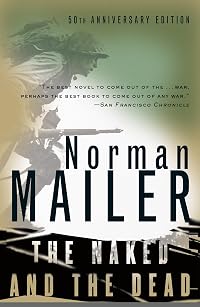
The Naked and the Dead
by Norman Mailer 
On This Page
Description
Hailed as one of the finest novels to come out of the Second World War, The Naked and the Dead received unprecedented critical acclaim upon its publication and has since enjoyed a long and well-deserved tenure in the American canon. This fiftieth anniversary edition features a new introduction created especially for the occasion by Norman Mailer. Written in gritty, journalistic detail, the story follows a platoon of Marines who are stationed on the Japanese-held island of Anopopei. Composed show more in 1948 with the wisdom of a man twice Mailer's age and the raw courage of the young man he was, The Naked and the Dead is representative of the best in twentieth-century American writing. show lessTags
Recommendations











Member Recommendations
by roby72
Member Reviews
Norman Mailer’s The Naked and the Dead, when it was published in 1948, was proclaimed as one of the first great novels that described the reality on the ground for U.S. soldiers on the front lines during World War II. The novel recreates an imagined invasion of a Japanese held island in the Pacific in the later stages of the war. What made the novel special at the time was Mailer’s ability to present the vernacular of the common soldier as they dealt with the stresses of the daily threat of death and the interaction of various cultures working side by side. This includes the prejudices against soldiers from the South, northern Jews, and Mexican-Americans trying to prove their loyalty to a country that had yet to accept their show more presence. It depicts not a melting pot, but rather its uncomfortable fit.
The book’s cast focuses on a single platoon, a major sent to lead them on a recon mission, and a general in charge of the island’s invasion. Mailer includes flashbacks in the lives of individual soldiers to provide the reader with portraits that help to explain their thoughts and actions during the attack. Instead of focusing on the intensity of battle, he reveals the boredom that accompanies these soldiers fearing what might await them on the next day. When death does present itself, it takes the soldiers and reader by surprise. These sections stand out, but what makes this novel special is its ability to present the daily actions of the soldiers who are intent on survival, having realized how fragile their courage is.
The Naked and the Dead recreates the toll of warfare, not by detailing the horrors of actual battle, but by showing the effects of its near presence. It evokes in each soldier their prejudices, the desire for self preservation, and the crippling effects of fear. Despite this, it shows how such a multicultural platoon continues to obey orders even if it means death might result. This is a novel that continues to resound despite all the other war novels that have followed it. It was Mailer’s first, and certainly his best. show less
The book’s cast focuses on a single platoon, a major sent to lead them on a recon mission, and a general in charge of the island’s invasion. Mailer includes flashbacks in the lives of individual soldiers to provide the reader with portraits that help to explain their thoughts and actions during the attack. Instead of focusing on the intensity of battle, he reveals the boredom that accompanies these soldiers fearing what might await them on the next day. When death does present itself, it takes the soldiers and reader by surprise. These sections stand out, but what makes this novel special is its ability to present the daily actions of the soldiers who are intent on survival, having realized how fragile their courage is.
The Naked and the Dead recreates the toll of warfare, not by detailing the horrors of actual battle, but by showing the effects of its near presence. It evokes in each soldier their prejudices, the desire for self preservation, and the crippling effects of fear. Despite this, it shows how such a multicultural platoon continues to obey orders even if it means death might result. This is a novel that continues to resound despite all the other war novels that have followed it. It was Mailer’s first, and certainly his best. show less
An incredible read. This is probably the fastest I’ve ever read a 700 page book, and most likely the only time I’ve felt that not a single word of it was wasted. True it’s dated, and again, true, many if not all of the characters exist on the unlikable side of realistic depictions. But for me it all added up to a grand epic of the pacific theatre in world war 2. Made much more profound by how much of it is trivialized by both the day to day drudgeries of military life (with idealism left for the cynics to tear a part or as propaganda for posters) and the turns of the story. Many characters are introduced and just as many are killed off. Some events and people are detailed, others aren’t. But it all holds together more or less show more seamlessly. With this book Mailer has created one of the most profound, humbling, and bleak images of warfare since “All Quiet on the Western Front”. Give it a chance (and a lot of time) and you won’t be disappointed. show less
The Naked and the Dead is considered a classic novel of WWII. One of its strengths is that it presents the war at several different levels: an Army general in command of a Pacific island invasion, a HQ officer, an experienced sergeant leading a platoon and the soldiers who are the implements of everyone else, some who aspire to become a noncom, while others aspire to nothing more than survival. At each of these levels, the novel is very introspective, exploring different individuals’ motivations, emotions and fears, to the extent that conversations often describe not only what is said, but what is thought and specifically not said. This internal world of the characters is as important in the novel as external events.
The events of the show more novel follow the invasion by the Americans of a Pacific island during WWII and focuses on the experiences of a Recon and Intelligence platoon. The novel provides unique insight into the strange combination of boredom, common physical labor, extreme physical exertion, extensive physical discomforts and ailments and periods of incredible fear that in combination make up military life, especially at the level of the regular Army soldier. It also explores the methods by which the Officers maintain control over the soldiers, how the separation between the Officers and the soldiers is created.
With all of its strengths, my first reaction to the novel was that the characters are simple caricatures that feel both bland and unlike real people. I moved past this first impression to a degree as you explore the inner lives of the various characters, but I never felt I got away completely away from this generic categorization that was insulting to race, religion, country of origin and individuality. The ugly opinion of women presented consistently throughout the novel by almost all of the male characters was quite difficult to swallow. There were characters with whom I could certainly empathize but none that I really liked or respected. The novel is effective at giving us war in all of its horror, but we also get man with all of his weaknesses and insecurities. The outcome of the campaign, both for the Army and the Recon platoon is effective at driving home the cross-purposes of individual career motivations and the objectives of the military while emphasizing the insignificance of the individual. show less
The events of the show more novel follow the invasion by the Americans of a Pacific island during WWII and focuses on the experiences of a Recon and Intelligence platoon. The novel provides unique insight into the strange combination of boredom, common physical labor, extreme physical exertion, extensive physical discomforts and ailments and periods of incredible fear that in combination make up military life, especially at the level of the regular Army soldier. It also explores the methods by which the Officers maintain control over the soldiers, how the separation between the Officers and the soldiers is created.
With all of its strengths, my first reaction to the novel was that the characters are simple caricatures that feel both bland and unlike real people. I moved past this first impression to a degree as you explore the inner lives of the various characters, but I never felt I got away completely away from this generic categorization that was insulting to race, religion, country of origin and individuality. The ugly opinion of women presented consistently throughout the novel by almost all of the male characters was quite difficult to swallow. There were characters with whom I could certainly empathize but none that I really liked or respected. The novel is effective at giving us war in all of its horror, but we also get man with all of his weaknesses and insecurities. The outcome of the campaign, both for the Army and the Recon platoon is effective at driving home the cross-purposes of individual career motivations and the objectives of the military while emphasizing the insignificance of the individual. show less
Near the end of this book Sgt. Brown says that part of war is "finding out things about yourself that, by God, it don't pay to know."
The key to this book is viewing it as an examination of man's warring impulses. The General, Lt. Hearn and each man in the platoon fight an internal war, between what he believes he is and what he really is.
The plot concerns a campaign to control the South Pacific island of Anopopei, but the plot, like Mount Anaka, is the tip of the psychological iceberg.
The island itself can be seen as the mind of one man, and the soldiers as the ideas, and ideals, that inhabit it. Goldstein and Ridges embody the superego, or the Judeo-Christian values that we give lip service to. Croft embodies the bloodthirsty id, the show more male urge to explore and conquer. Wilson is the libido. The General and Hearn are the intellect, carrying on a philosophical war between ideas of liberalism and fascism.
In the end, no one facet predominates. The Army, like the mind itself, behaves as it does as a result of these warring impulses, urges, and ideas. The conclusion is that man is very much an animal, despite his ability to analyze and scheme. show less
The key to this book is viewing it as an examination of man's warring impulses. The General, Lt. Hearn and each man in the platoon fight an internal war, between what he believes he is and what he really is.
The plot concerns a campaign to control the South Pacific island of Anopopei, but the plot, like Mount Anaka, is the tip of the psychological iceberg.
The island itself can be seen as the mind of one man, and the soldiers as the ideas, and ideals, that inhabit it. Goldstein and Ridges embody the superego, or the Judeo-Christian values that we give lip service to. Croft embodies the bloodthirsty id, the show more male urge to explore and conquer. Wilson is the libido. The General and Hearn are the intellect, carrying on a philosophical war between ideas of liberalism and fascism.
In the end, no one facet predominates. The Army, like the mind itself, behaves as it does as a result of these warring impulses, urges, and ideas. The conclusion is that man is very much an animal, despite his ability to analyze and scheme. show less
This is not what I expected when I triumphantly found this book in a flea market book stall. I had heard about this classic book on WWII in the Pacific theater for decades and I eagerly grabbed it to read.
I was however disappointed. It is the story of a platoon of recon soldiers during the invasion of a fictional island somewhere in the Pacific. The problem is that there is no likeable character in this book, from the commanders down to privates, they all universally hate blacks, the jewish soldiers hate/distrust the gentile and vice versa, officers look down on the common soldier and the common soldier distrust the officers. With very few exceptions they hate their wives/girlfriends believing they are cheating on them while they are at show more war while they have no conscience about their cheating on their wives/girlfriends. These hates/dislikes dominate the story.
The book constantly flashes back in time to give the background of each character... which is interesting at first but almost every character!!! The battle scenes are few and far between and most usually a page or two in length.
This is a pretty depressing view of the American army during this war. It is hard for me to imagine that this is the way it always was in this theater of war. I was not looking for the gung-ho John Wayne style of patriotic fervor but this book is the exact opposite and it was a struggle to finish it. show less
I was however disappointed. It is the story of a platoon of recon soldiers during the invasion of a fictional island somewhere in the Pacific. The problem is that there is no likeable character in this book, from the commanders down to privates, they all universally hate blacks, the jewish soldiers hate/distrust the gentile and vice versa, officers look down on the common soldier and the common soldier distrust the officers. With very few exceptions they hate their wives/girlfriends believing they are cheating on them while they are at show more war while they have no conscience about their cheating on their wives/girlfriends. These hates/dislikes dominate the story.
The book constantly flashes back in time to give the background of each character... which is interesting at first but almost every character!!! The battle scenes are few and far between and most usually a page or two in length.
This is a pretty depressing view of the American army during this war. It is hard for me to imagine that this is the way it always was in this theater of war. I was not looking for the gung-ho John Wayne style of patriotic fervor but this book is the exact opposite and it was a struggle to finish it. show less
Meet General Cumming, arrogant and blundering. Gallagher is only twenty years old with a pregnant wife back home. Look out for Sergeant Croft because he is mean. Red grew up in a mining town. The idea that any man, from any walk of life, can experience the horror of war as equals.
Norman Mailer takes you inside the mind of a solider. The long nights in a foxhole keeping watch and the raging thoughts that go through a soldier's head: paranoid about the enemy's location, wondering about his girl back home. The twisted sense of right and wrong: a soldier can be devastated after the torture and killing of an insect, but feel nothing for doing the same to his Japanese enemy. Writing letters back home: being diplomatic about what a soldier show more could or could not say. Even though they were not sure what they were fighting for, a soldier could not admit that to his family. By stepping back in time before each character became a soldier was a way for Mailer to humanize his characters even further. Some escaped fatherhood by enlisting. Others needed to prove their toughness for fear of seeming too sensitive and weak as little boys.
Mailer's attention to detail brings his reader right into the jungle fighting. The way water seeps into greased "waterproof" shoes. The way a forty pound pack gets heavier with the weight of water. What they carried and how they carried it. Obviously, Mailer speaks with experience. Heartbreakingly so. show less
Norman Mailer takes you inside the mind of a solider. The long nights in a foxhole keeping watch and the raging thoughts that go through a soldier's head: paranoid about the enemy's location, wondering about his girl back home. The twisted sense of right and wrong: a soldier can be devastated after the torture and killing of an insect, but feel nothing for doing the same to his Japanese enemy. Writing letters back home: being diplomatic about what a soldier show more could or could not say. Even though they were not sure what they were fighting for, a soldier could not admit that to his family. By stepping back in time before each character became a soldier was a way for Mailer to humanize his characters even further. Some escaped fatherhood by enlisting. Others needed to prove their toughness for fear of seeming too sensitive and weak as little boys.
Mailer's attention to detail brings his reader right into the jungle fighting. The way water seeps into greased "waterproof" shoes. The way a forty pound pack gets heavier with the weight of water. What they carried and how they carried it. Obviously, Mailer speaks with experience. Heartbreakingly so. show less
Don’t ask me what I was thinking, but I could have sworn “The Naked and the Dead” was a noir detective novel. Whoops. Wrong. I open up the pages and find myself on a Pacific Island in the middle of the war with Japan. So, I think to myself, here comes the war novel – hang on for the battle. Nope, wrong again.
Instead, what I found was a story about tedium and boredom interspersed with rare moments of panic. Real war. Eventually, the story turns and becomes one of men sent on a senseless recon. In other words, an anti-war novel. It does its job well.
A few battles stories are told, and there is the story of men responding to unquestioned authority. But this is not a story that focuses on those aspects. Rather, it focuses on the show more stories that are the men that populate this tale; men – most of them not particularly nice – thrown together by a cataclysmic event. And, as such, the book is a reminder that heroic war stories are much more fiction than we want to admit. The story of a band of brothers who bond is turned on its ear in this book. Instead, the men pull together, but only when they really have to. And there is no love lost, only the false camaraderie that comes from experiencing hell and stupidity together. They work together, they survive together, they buddy together, but they still do not like each other
At times, the tedium of the book becomes wearying and, while the characters are vividly drawn (the flashbacks to their previous lives are quite effective), it was still possible to occasionally mix up some of the bigger dolts. The anti-war aspects are well drawn and the message is delivered in the proper amounts, but there is something (maybe it is just too real) that makes me unsure whether I really like this book or not. show less
Instead, what I found was a story about tedium and boredom interspersed with rare moments of panic. Real war. Eventually, the story turns and becomes one of men sent on a senseless recon. In other words, an anti-war novel. It does its job well.
A few battles stories are told, and there is the story of men responding to unquestioned authority. But this is not a story that focuses on those aspects. Rather, it focuses on the show more stories that are the men that populate this tale; men – most of them not particularly nice – thrown together by a cataclysmic event. And, as such, the book is a reminder that heroic war stories are much more fiction than we want to admit. The story of a band of brothers who bond is turned on its ear in this book. Instead, the men pull together, but only when they really have to. And there is no love lost, only the false camaraderie that comes from experiencing hell and stupidity together. They work together, they survive together, they buddy together, but they still do not like each other
At times, the tedium of the book becomes wearying and, while the characters are vividly drawn (the flashbacks to their previous lives are quite effective), it was still possible to occasionally mix up some of the bigger dolts. The anti-war aspects are well drawn and the message is delivered in the proper amounts, but there is something (maybe it is just too real) that makes me unsure whether I really like this book or not. show less
Members
- Recently Added By
Published Reviews
My first reaction to The Naked and the Dead was: it’s a fake. A clever, talented, admirably executed fake. I have not changed my opinion of the book since, though I have considerably changed my opinion of Mailer, as he himself has changed. Now I confess I have never read all of The Naked and the Dead. I do recall a fine description of soldiers carrying a dying man down a mountain (done show more almost as well as the same scene in Malraux’s earlier work). Yet every time I got going in the narrative I would find myself stopped cold by a set of made-up, predictable characters taken not from life, but from the same novels all of us had read, and informed by a naïveté which was at its worst when Mailer went into his Time-Machine and wrote those passages which resemble nothing so much as smudged carbons of a Dos Passos work. show less
added by SnootyBaronet
Los desnudos y los muertos" apareció en los Estados Unidos en mayo de 1948, exactamente tres años después del día de la victoria de los aliados en la Segunda Guerra Mundial. Norman Mailer tenía entonces veintiséis años, y tras graduarse en Harvard y alistarse en el ejército había estado entre las tropas que ocuparon Japón después de la derrota. La crítica calificó su obra como show more «la más grande novela de guerra escrita en este siglo», que con el tiempo se ha convertido en un libro mítico. Mailer fue comparado con Hemingway y Tolstói y se situó de inmediato entre los grandes de la literatura americana. En Anopopei, un pequeño islote del Pacífico en forma de ocarina, un universo cerrado donde rigen leyes y sentimientos muy diferentes de los de la vida de los civiles, una patrulla de jóvenes soldados, microcosmos de la sociedad americana están Hearn, un joven intelectual que lee a Rilke; el realista e implacable sargento Croft; Ridges, un campesino sureño; Red Valsen, minero de Montana y anarcosindicalista; Gallagher, un irlandés católico de los barrios bajos de Boston y, planeando sobre todos ellos, la poderosa sombra del general Cummings, nacido en la América más profunda e integrista, secretamente fascinado por el nuevo orden del fascismo..., es enviada en una misión de reconocimiento, una larga marcha por un terreno desconocido y lleno de minas que acabará en una pesadilla de abyección y heroísmo, posiblemente tan gratuita como la guerra misma. Empujados al último límite, permanentemente desnudos ante la muerte, los héroes de Mailer cuestionan las verdades del pasado y la vigencia de los ideales americanos, viven obsesionados por el sexo y padecen y hacen padecer a otros las corrupciones y arbitrariedades del poder. show less
added by Pakoniet
Lists

The Guardian's 1000 Novels Everyone Must Read
1,005 works; 551 members

1001 Books You Must Read Before You Die
1,448 works; 1,135 members

Radcliffe's 100 Best Novel of the 20th Century
100 works; 32 members

Great American Novels
158 works; 40 members

Favorite Long Books
330 works; 42 members
20th Century Literature
1,161 works; 55 members
Larry McCaffery's 20th Century Greatest Hits: 100 English-Language Books
103 works; 12 members
1940s
221 works; 25 members

Best War Stories
87 works; 16 members
Books About World War II
102 works; 29 members

Unread books
1,063 works; 87 members

Canon de la narrativa universal del siglo XX
254 works; 6 members
The American Experience
173 works; 18 members

Books Featured on Gilmore Girls
307 works; 21 members

Banned Books Week 2014
268 works; 63 members

War Literature
101 works; 18 members

Books recommended by Barack Obama
295 works; 28 members

Stories of War and Revolution
143 works; 54 members

Books about World War II
241 works; 22 members
Fiction For Men
142 works; 11 members

Anthony Burgess 99 Post War Novels
99 works; 7 members
Best of American Literature
146 works; 9 members
LibraryThingers' 1001 Books You Must Read Before You Die
442 works; 30 members
The Modern Library's 100 Best Novels: The Board's List
85 works; 6 members

Rory Gilmore Book Club
193 works; 5 members
My list of 100 books to read next
100 works; 4 members

Publisher's Weekly Bestsellers - Part II - 1940 - 1979
355 works; 5 members

Discontinued
19 works; 4 members

Obama Reads
181 works; 3 members
American Lit for Eng 11 Research Project
368 works; 6 members
The Complete Rory Gilmore Reading List
506 works; 5 members
Works Cited in The History of White People by Nell Irvin Painter
321 works; 2 members

SWORDS GUNS BATTLES
30 works; 3 members

The Torchlight List
95 works; 1 member
THE WAR ROOM
813 works; 24 members

The Art of Manliness' 100+ Books Every Man Should Read
108 works; 2 members
Best War Fiction Books
41 works; 4 members

Literary Works Read in College
316 works; 15 members
Modern Library's 100 Best Novels
100 works; 2 members
Author Information

160+ Works 24,794 Members
Norman Kingsley Mailer was born on January 31, 1923 in Long Branch, N. J. and then moved with his family to Brooklyn, N. Y. Mailer later attended Harvard University and graduated with a degree in aeronautical engineering. Mailer served in the Army during World War II, and later wrote, directed, and acted in motion pictures. He was also a show more co-founder of the Village Voice and edited Disssent for nine years. Mailer has written several books including: The Armies of the Night, which won the National Book Award, the Pulitzer Prize, and a Polk Award; and The Executioner's Song, which won the Pulitzer Prize. In 2005, he won the Medal for Distinguished Contribution to American Letters from the National Book Foundation. He published his last novel, The Castle in the Forest, in 2007. He died of acute renal failure on November 10, 2007. (Bowker Author Biography) show less
Norman Mailer has a Legacy Library. Legacy libraries are the personal libraries of famous readers, entered by LibraryThing members from the Legacy Libraries group.
Some Editions
Awards and Honors
Distinctions
Notable Lists
Torchlight List (36)
Series
Belongs to Publisher Series
Clássicos Modernos (22)
Work Relationships
Has the adaptation
Is abridged in
Has as a student's study guide
Common Knowledge
- Canonical title
- The Naked and the Dead
- Original title
- The Naked and the Dead
- Original publication date
- 1948
- People/Characters
- Sam Croft
- Important places
- The Philippines
- Important events
- World War II (1939-1945)
- Related movies
- The Naked and the Dead (1958 | IMDb)
- Dedication
- "To my Mother and Bea"
- First words
- Nobody could sleep. When morning came, assault craft would be lowered and a first wave of troops would ride through the surf and charge ashore on the beach at Anopopei. All over the ship, all through the convoy, there was a k... (show all)nowledge that in a few hours some of them were going to be dead.
- Quotations
- Any war that requires the suspension of reason as a necessity for support is a bad war.
There is no greater importance in all the world like knowing you are right and that the wave of the world is wrong, yet the wave crashes upon you. - Last words
- (Click to show. Warning: May contain spoilers.)Heaven help us when we do.
- Original language*
- Engels
- Disambiguation notice
- The Naked and the Dead has been published also in two parts. Please, don't combine the parts with the whole work.
*Some information comes from Common Knowledge in other languages. Click "Edit" for more information.
Classifications
- Genres
- General Fiction, Fiction and Literature, Historical Fiction
- DDC/MDS
- 813.54 — Literature & rhetoric American literature in English American fiction in English 1900-1999 1945-1999
- LCC
- PS3525 .A4152 .N34 — Language and Literature American literature American literature Individual authors 1900-1960
- BISAC
Statistics
- Members
- 4,549
- Popularity
- 3,227
- Reviews
- 49
- Rating
- (3.89)
- Languages
- 18 — Catalan, Czech, Danish, Dutch, English, Estonian, Finnish, French, German, Hungarian, Italian, Japanese, Norwegian (Bokmål), Polish, Portuguese, Slovak, Spanish, Swedish
- Media
- Paper, Audiobook, Ebook
- ISBNs
- 111
- ASINs
- 89