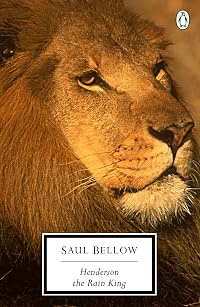
Henderson the Rain King
by Saul Bellow
On This Page
Description
Saul Bellow evokes all the rich colors and exotic customs of a highly imaginary Africa in this acclaimed comic novel about a middle-aged American millionaire who, seeking a new, more rewarding life, descends upon an African tribe. Henderson's awesome feats of strength and his unbridled passion for life win him the admiration of the tribe-but it is his gift for making rain that turns him from mere hero into messiah. A hilarious, often ribald story, Henderson the Rain King is also a profound show more look at the forces that drive a man through life. show lessTags
Recommendations








Member Recommendations

Member Reviews
Eugene Henderson is a man who seems to have everything — he's a millionaire pig farmer with a beautiful wife and a big family — yet he still wants something, even if he doesn't know what that something is. And thus we have the situation in Saul Bellow's 1959 novel “Henderson the Rain King.”
Henderson's quest for what turns out to be his purpose in life takes him to one of the most isolated parts of central Africa, where he befriends two chieftains and tries to help solve their tribes' water problems. In the first village he only makes matters worse and has to leave in disgrace. In the second, his presumed success in bringing rain turns him into the honored rain king and a close confident of the tribe's king, who slowly teaches show more Henderson how to roar like a lion, both literally and figuratively.
This is a big, brawling novel, like Henderson himself, yet its message is simple: to find yourself, lose yourself. By the time he leaves Africa, Henderson has decided to give up pigs and go to medical school. He may be in his mid-50s, but for him life has just begun. show less
Henderson's quest for what turns out to be his purpose in life takes him to one of the most isolated parts of central Africa, where he befriends two chieftains and tries to help solve their tribes' water problems. In the first village he only makes matters worse and has to leave in disgrace. In the second, his presumed success in bringing rain turns him into the honored rain king and a close confident of the tribe's king, who slowly teaches show more Henderson how to roar like a lion, both literally and figuratively.
This is a big, brawling novel, like Henderson himself, yet its message is simple: to find yourself, lose yourself. By the time he leaves Africa, Henderson has decided to give up pigs and go to medical school. He may be in his mid-50s, but for him life has just begun. show less
In my favorite Bullwinkle cartoon that greatest of Moosylvanian mooses joins the Peace Corps. As he struggles to engage the African villagers in learning to build wells they are working on a secret project of their own. We eventually find they are building a rocket to blast Bullwinkle into space. I thought about that a lot as I read Henderson the Rain King. Jay Ward, the creator of the cartoon series, was skeptical of America's world's savior post-war aspirations and delighted in skewering the very idea of American supremacy. I grew up watching Bullwinkle reruns and perhaps as a result when I first read this book, in the 80s I think, I loved it. Since then my worldview has changed some, and my tastes as a reader have changed wildly. show more There is still a lot to revere in this book, but it did not live up to my memories.
Briefly, Eugene Henderson is a bumbling rich fool, a graduate of Princeton largely because of his wealth (it certainly is not due to his intellectual facility.) He was the least distinguished of three children of an accomplished physician, and the only one to survive to adulthood. He thereby becomes the head of the family, much to his father's chagrin. Henderson is a large man in every way and he throws around his gigantic personality, his enormous wealth, and his monumental physical size as bullies do. He is cruel, clueless, destructive and inconstant, and boy does he dislike women (as it is clear in every book Bellow did) and golly gee is he racist and does he ever fetishize blackness? Henderson's roots are very different than Bellow's, but in many ways I suspect Henderson is quite like Bellow. I suspect that because there is no satirical remove when Bellow talks about Henderson's relationships to women or to the African characters (even when he is discussing the size of black women's asses.) If I am right about this, and we are seeing Bellow in the Henderson character, it must be said that it appears Bellow was a right prick. Eventually, Henderson gets it into his head that he needs to find himself so he leaves his wife and many children and jets off to Africa with loads of money and vanity but no preparation or clear purpose. There he finds out who he is his after his arrogance causes calamity and he meets a tribal king named Dahfu who is educated, brilliant, and also despotic and insane in a lot of the same ways Henderson is despotic and insane. Suffice to say his impressions of what he has done and learned in Africa through experience and lengthy discussions with Dahfu on the meaning of life (mostly these are metaphysical discussions) may differ from the reader's impressions.
Henderson is a loudmouth, and his are the eyes we see this through. As a result, there is nothing in the way of pretty or elegant language here. There is a lot of bluster and misinformation. That though paints the picture of this character, and what a character! Yes, this is satire so there is a lot of exaggeration, but Henderson at his heart feels pretty real. Being vile does not mean one is not entertaining and edifying. Henderson is both. Bellow certainly knows how to write.
I really try not to judge literature by my own political and social beliefs or by social norms that did not exist when books were written. I think Bellow accomplished what he wished to accomplish and did so brilliantly, but I had a really hard time enjoying this after the action moved to Africa. Apparently, when I read this 40 years ago I was more intellectual in my reading, or maybe I just brought less life experience to the task. This is 5-star craft, but I can't go higher than a 3 when I factor in my enjoyment and the absence of the timelessness I hope to find in books considered modern classics. show less
Briefly, Eugene Henderson is a bumbling rich fool, a graduate of Princeton largely because of his wealth (it certainly is not due to his intellectual facility.) He was the least distinguished of three children of an accomplished physician, and the only one to survive to adulthood. He thereby becomes the head of the family, much to his father's chagrin. Henderson is a large man in every way and he throws around his gigantic personality, his enormous wealth, and his monumental physical size as bullies do. He is cruel, clueless, destructive and inconstant, and boy does he dislike women (as it is clear in every book Bellow did) and golly gee is he racist and does he ever fetishize blackness? Henderson's roots are very different than Bellow's, but in many ways I suspect Henderson is quite like Bellow. I suspect that because there is no satirical remove when Bellow talks about Henderson's relationships to women or to the African characters (even when he is discussing the size of black women's asses.) If I am right about this, and we are seeing Bellow in the Henderson character, it must be said that it appears Bellow was a right prick. Eventually, Henderson gets it into his head that he needs to find himself so he leaves his wife and many children and jets off to Africa with loads of money and vanity but no preparation or clear purpose. There he finds out who he is his after his arrogance causes calamity and he meets a tribal king named Dahfu who is educated, brilliant, and also despotic and insane in a lot of the same ways Henderson is despotic and insane. Suffice to say his impressions of what he has done and learned in Africa through experience and lengthy discussions with Dahfu on the meaning of life (mostly these are metaphysical discussions) may differ from the reader's impressions.
Henderson is a loudmouth, and his are the eyes we see this through. As a result, there is nothing in the way of pretty or elegant language here. There is a lot of bluster and misinformation. That though paints the picture of this character, and what a character! Yes, this is satire so there is a lot of exaggeration, but Henderson at his heart feels pretty real. Being vile does not mean one is not entertaining and edifying. Henderson is both. Bellow certainly knows how to write.
I really try not to judge literature by my own political and social beliefs or by social norms that did not exist when books were written. I think Bellow accomplished what he wished to accomplish and did so brilliantly, but I had a really hard time enjoying this after the action moved to Africa. Apparently, when I read this 40 years ago I was more intellectual in my reading, or maybe I just brought less life experience to the task. This is 5-star craft, but I can't go higher than a 3 when I factor in my enjoyment and the absence of the timelessness I hope to find in books considered modern classics. show less
Did you ever cry over a man and a broken old bear riding a rollercoaster together? No? Then you’ve never read Henderson the Rain King. Eugene Henderson is a hulk of a man faced with his mortality. All his life he’s tried to master life, but nothing he does avails. In the throes of a mental breakdown, he heads to the East African interior to sort himself out. The antic, rollicking adventure that ensues will make you scowl, laugh, marvel, and even weep. Eugene isn’t an easy man to like, but in his mad, brash vitality he reveals a yearning to love and be loved, despite his human frailty, which is familiar to us all.
MR ANGRY DREAMS OF BEING A LION KING
Difficult to know just what to make of this shaggy dog story written by Saul Bellow and published in 1959. It certainly bears all the hallmarks of a Bellow novel in that passages of fine descriptive writing and intense storytelling are infused with some turgid philosophical ramblings. The story of Eugene Henderson's vivid sojourn amongst remote African tribes is so laced with the unreal that I could only think that it was a feverish dream of a rash, blundering man fearful of holding it all together. That the dream is not in the end a nightmare gives the novel a feel of a bildungsroman especially as it is written in the first person.
"When I think of my condition at the age of fifty-five when I bought show more the ticket, all is grief. The facts begin to crowd me and soon I get a pressure in the chest . A disorderly rush begins - my parents, my wives, my girls, my children, my farm, my animals, my habits, my money, my music lessons, my drunkenness, my prejudices, my brutality, my teeth, my face, my face, my soul! I have to cry, No, no, get back, curse you, let me alone! But how can they let me alone? They belong to me. They are mine, and they pile into me from all sides. It turns into chaos."
This is Henderson explaining why he bought that ticket to Africa and why he chose to strike out in search of primitive tribes who were out of reach of civilisation. It is not the language or the actions of a college professor and by and large Bellow hits the right note in his portrayal of a man who is rash and unlucky and acts without sufficient reflection. He bulldozes his way through life perhaps breaking heads and certainly treading on toes in the process, describing himself as a high spirited kind of guy and we all probably know people just like him.
Henderson almost on a whim travels with a married couple to Africa in search of something else. He soon splits from them hiring a guide (Romilayu) to take him outside the scope of civilised Africa. He is led to the tribe of Anewi and finds them in despair because their cattle are dying of thirst. They treat their cattle as part of the family, sitting up with them and caring for them when ill. A species of frogs have invaded the water cistern and Henderson believes that he can solve their problems by rigging up a bomb from the ammunition he is carrying. First he has to wrestle with the tribe's champion and when he wins he comes under the spell of his auntie the queen; an enormous African woman who is prepared to buy him with her dowry. Henderson thinks she can straighten him out with her simple philosophy of the love of life.Things do not go well and soon Henderson and Romilayu are forced to seek out a neighbouring tribe the Wariri. Their king Dahfu is guarded and cosseted by over fifty naked Amazon women and he explains to Henderson that he can only survive as long as he can service his harem. He has other problems; the tribe believes that the previous king exists as a lion and Dahfu must capture this lion to keep his kingship, however he has already caught a lioness who the tribe believes is bewitching their king. Henderson is befriended by the king who sees in the powerful American an ally. Dahfu is an educated man and has theories about how the soul shapes the outward appearance of a man and that all men bear a close relationship to a species of animal, soon Henderson is being encouraged to walk in the lions den..........
The portrayal of the African tribes is pure anthropological fantasy, something that might have been invented by Edgar Rice Burroughs, but Bellow seems to want his readers to believe in the unreality as one of the themes of his novel is reality and unreality. How real is the world of Henderson? Of course one could accuse Bellow in wallowing in some racial fantasy, but I think this would be missing the point and of course the Amazon women have to be naked. Henderson thinks he may have found some answers to his search for meaning in his life through the chief Dahfu, but the readers of the novel will soon be convinced that Dahfu is as much of a crackpot as the culture of the tribe in which he is intrinsically part of. However much energy Bellow spends in trying to make Dhafu's philosophy palatable he really only succeeds in miring up the novel, if it is supposed to be funny then it was lost on me.
This is a novel that loses it's grip on reality by straying too far into the world of hokum. It is hokum that could also cause offence, but then the character of Henderson is just as likely to cause offence. Is Bellow being deliberately provocative and if so does he get away with it? I think this is very much for the individual to decide. I have read that this is one of his most popular novels, perhaps this is because of the attractions of the anti-hero or perhaps the fantasy world African primitivism appeals. I have mixed feelings, while I admire some of the writing I really cannot see where it is going other than a parody of novels which feature a hero's redemption through coming to terms with primitive cultures, there are plenty of those on the bookshelves. A generous 3.5 stars. show less
Difficult to know just what to make of this shaggy dog story written by Saul Bellow and published in 1959. It certainly bears all the hallmarks of a Bellow novel in that passages of fine descriptive writing and intense storytelling are infused with some turgid philosophical ramblings. The story of Eugene Henderson's vivid sojourn amongst remote African tribes is so laced with the unreal that I could only think that it was a feverish dream of a rash, blundering man fearful of holding it all together. That the dream is not in the end a nightmare gives the novel a feel of a bildungsroman especially as it is written in the first person.
"When I think of my condition at the age of fifty-five when I bought show more the ticket, all is grief. The facts begin to crowd me and soon I get a pressure in the chest . A disorderly rush begins - my parents, my wives, my girls, my children, my farm, my animals, my habits, my money, my music lessons, my drunkenness, my prejudices, my brutality, my teeth, my face, my face, my soul! I have to cry, No, no, get back, curse you, let me alone! But how can they let me alone? They belong to me. They are mine, and they pile into me from all sides. It turns into chaos."
This is Henderson explaining why he bought that ticket to Africa and why he chose to strike out in search of primitive tribes who were out of reach of civilisation. It is not the language or the actions of a college professor and by and large Bellow hits the right note in his portrayal of a man who is rash and unlucky and acts without sufficient reflection. He bulldozes his way through life perhaps breaking heads and certainly treading on toes in the process, describing himself as a high spirited kind of guy and we all probably know people just like him.
Henderson almost on a whim travels with a married couple to Africa in search of something else. He soon splits from them hiring a guide (Romilayu) to take him outside the scope of civilised Africa. He is led to the tribe of Anewi and finds them in despair because their cattle are dying of thirst. They treat their cattle as part of the family, sitting up with them and caring for them when ill. A species of frogs have invaded the water cistern and Henderson believes that he can solve their problems by rigging up a bomb from the ammunition he is carrying. First he has to wrestle with the tribe's champion and when he wins he comes under the spell of his auntie the queen; an enormous African woman who is prepared to buy him with her dowry. Henderson thinks she can straighten him out with her simple philosophy of the love of life.Things do not go well and soon Henderson and Romilayu are forced to seek out a neighbouring tribe the Wariri. Their king Dahfu is guarded and cosseted by over fifty naked Amazon women and he explains to Henderson that he can only survive as long as he can service his harem. He has other problems; the tribe believes that the previous king exists as a lion and Dahfu must capture this lion to keep his kingship, however he has already caught a lioness who the tribe believes is bewitching their king. Henderson is befriended by the king who sees in the powerful American an ally. Dahfu is an educated man and has theories about how the soul shapes the outward appearance of a man and that all men bear a close relationship to a species of animal, soon Henderson is being encouraged to walk in the lions den..........
The portrayal of the African tribes is pure anthropological fantasy, something that might have been invented by Edgar Rice Burroughs, but Bellow seems to want his readers to believe in the unreality as one of the themes of his novel is reality and unreality. How real is the world of Henderson? Of course one could accuse Bellow in wallowing in some racial fantasy, but I think this would be missing the point and of course the Amazon women have to be naked. Henderson thinks he may have found some answers to his search for meaning in his life through the chief Dahfu, but the readers of the novel will soon be convinced that Dahfu is as much of a crackpot as the culture of the tribe in which he is intrinsically part of. However much energy Bellow spends in trying to make Dhafu's philosophy palatable he really only succeeds in miring up the novel, if it is supposed to be funny then it was lost on me.
This is a novel that loses it's grip on reality by straying too far into the world of hokum. It is hokum that could also cause offence, but then the character of Henderson is just as likely to cause offence. Is Bellow being deliberately provocative and if so does he get away with it? I think this is very much for the individual to decide. I have read that this is one of his most popular novels, perhaps this is because of the attractions of the anti-hero or perhaps the fantasy world African primitivism appeals. I have mixed feelings, while I admire some of the writing I really cannot see where it is going other than a parody of novels which feature a hero's redemption through coming to terms with primitive cultures, there are plenty of those on the bookshelves. A generous 3.5 stars. show less
Told from the point of view of one of the more larger than life characters in literary history, Bellow's novel portrays a search for the kernel of life, the desire for the good. Henderson explores the further reaches of Africa (at least in his mind) and comes closer to understanding his own deepest desires. While demonstrating rough edges in his somewhat flawed character, Bellow achieves a delightful synergy of comic and philosophic reflection that, in the end, redeems Henderson and uplifts the reader (at least this one).
This being my first experience reading Saul Bellow, I didn’t know quite what to expect. But the outlook was hopeful knowing "Henderson the Rain King" is number 21 on Modern Library’s list of best 100 novels ever written.
One can glean as much or as little as they wish from this eclectic tale. Bellow provides a lot of food for thought- but aside from all the philosophical musings and psychological elements- there is an intense plot within his adventurous story.
The tale is told by Henderson himself… a rather non-likable character. He’s arrogant, egotistical, rude and intentionally thoughtless. In other words… he’s a jerk. A pompous ass to be certain. He’s living on inherited wealth, farming pigs for a hobby… mostly show more because it amuses him to annoy the neighbors with pigs running around the yard. He’s a war veteran, has a troubled (second) marriage, and is disappointed in his children. In a nutshell, he’s bored and dissatisfied with his life.
At the onset of the novel, Henderson decides impulsively that he needs to get as far away as possible to work out his feelings and make some sense of his unfulfilled life. Not that he blames anyone for his ennui. He just feels the need to grow, spiritually and emotionally… and perhaps break his lifelong spell of bad luck.
Henderson’s adventure leads him to a remote village in Africa where he quickly manages to offend, upset, and distress the primitive natives. And that leads him even further into the bush to a second, even more remote, more primitive village where he receives life’s ultimate test.
At times "Henderson the Rain King" reads like a Stephen King horror story. The reader is carried along through unimaginable scenes of mysterious events, and life threatening occult religious ceremonies.
The reader gets the distinct impression that Henderson does not have a sense of humor. Yet there are many downright funny one-liners and undertones of subtle humor throughout the story that create an odd combination with the sheer terror Henderson continually experiences.
Henderson is a man’s man and "Henderson the Rain King" is a tough, macho guy’s type of novel- the kind of book my deceased Dad and my Uncle Ralph would have loved. However, even I… pretty much a girlie-girl… thoroughly appreciate Bellow’s finely crafted storytelling. show less
One can glean as much or as little as they wish from this eclectic tale. Bellow provides a lot of food for thought- but aside from all the philosophical musings and psychological elements- there is an intense plot within his adventurous story.
The tale is told by Henderson himself… a rather non-likable character. He’s arrogant, egotistical, rude and intentionally thoughtless. In other words… he’s a jerk. A pompous ass to be certain. He’s living on inherited wealth, farming pigs for a hobby… mostly show more because it amuses him to annoy the neighbors with pigs running around the yard. He’s a war veteran, has a troubled (second) marriage, and is disappointed in his children. In a nutshell, he’s bored and dissatisfied with his life.
At the onset of the novel, Henderson decides impulsively that he needs to get as far away as possible to work out his feelings and make some sense of his unfulfilled life. Not that he blames anyone for his ennui. He just feels the need to grow, spiritually and emotionally… and perhaps break his lifelong spell of bad luck.
Henderson’s adventure leads him to a remote village in Africa where he quickly manages to offend, upset, and distress the primitive natives. And that leads him even further into the bush to a second, even more remote, more primitive village where he receives life’s ultimate test.
At times "Henderson the Rain King" reads like a Stephen King horror story. The reader is carried along through unimaginable scenes of mysterious events, and life threatening occult religious ceremonies.
The reader gets the distinct impression that Henderson does not have a sense of humor. Yet there are many downright funny one-liners and undertones of subtle humor throughout the story that create an odd combination with the sheer terror Henderson continually experiences.
Henderson is a man’s man and "Henderson the Rain King" is a tough, macho guy’s type of novel- the kind of book my deceased Dad and my Uncle Ralph would have loved. However, even I… pretty much a girlie-girl… thoroughly appreciate Bellow’s finely crafted storytelling. show less
Azért csuda egy könyv ez. Bellow az egyik legnehezebb én-elbeszélő típust választja főszereplőül: egy olyan anti-irodalmi ürgét*, aki nem pusztán pozitív vagy negatív indulatokat vált ki az olvasóból, hanem felettébb komplex érzelmeket. Henderson ugyanis tőrőlmetszett amerikai tapló (ezt mondhattam volna szebben: falstaff-i jelenség), akit azonban mégsem lehet felhőtlenül utálni, mert közben irdatlan nagy szíve van. Handabandázik, kötözködik, beletenyerel mindenbe, jobbára kínos és kellemetlen szituációkban találja magát. (Amúgy az efféle kínos szituációk nem igazán barátaim, a filmekben is legszívesebben áttekernék rajtuk, de ez legyen az én bajom. Kétségtelen, hogy ez is a komplex show more érzelmi hatás egyik összetevője.) Bellow mesterségbeli tudását jelzi, hogy ennek a személyiségnek egységesen harsány, ugyanakkor a maga módján igen lírai nyelvi közeget tud teremteni, amitől az egész szöveg valahogy a börleszkek világával lesz rokon. (Ez a harsányság amúgy néha szintén finoman idegesített, de ez is legyen az én bajom. Végül is az olvasó idegessége is a komplex érzelmi hatás egyik összetevője.)
Amúgy e regény egy botegyszerű allegóriaként is értelmezhető: fehér ember menni Afrika, és jól elbarmolni mindent. Persze nem feltétlenül rossz szándékból: egyszerűen azt hiszi, az általa ismert nyugati civilizációs szabályok egyetemesek, és el sem tudja képzelni, hogy a világ bármelyik szegletében nem fogadják el ezeket evidenciaként. Ám számomra ennél is érdekesebb, hogy ez a könyv tulajdonképpen egy fejlődésregény ígérete: miközben Bellow csűri-csavarja, én mint olvasó végig azon drukkoltam, hogy ennek a sok megaláztatás és kínlódásnak legyen valami értelme, mondjuk nevelődjön hatásukra Hendersonból valamiféle magasabb létforma, vagy ahogy ő megfogalmazza: készülőből létező. Hogy ez az ígéret végső soron beváltódik-e, értelmezés kérdése. Minden olvasó döntse el magának.
* Aki mintha szándékosan ellentéte lenne az amerikai irodalmi hagyomány nagy entellektüel-szereplőinek, mint amilyen például Philip Roth Zuckermanja. show less
Amúgy e regény egy botegyszerű allegóriaként is értelmezhető: fehér ember menni Afrika, és jól elbarmolni mindent. Persze nem feltétlenül rossz szándékból: egyszerűen azt hiszi, az általa ismert nyugati civilizációs szabályok egyetemesek, és el sem tudja képzelni, hogy a világ bármelyik szegletében nem fogadják el ezeket evidenciaként. Ám számomra ennél is érdekesebb, hogy ez a könyv tulajdonképpen egy fejlődésregény ígérete: miközben Bellow csűri-csavarja, én mint olvasó végig azon drukkoltam, hogy ennek a sok megaláztatás és kínlódásnak legyen valami értelme, mondjuk nevelődjön hatásukra Hendersonból valamiféle magasabb létforma, vagy ahogy ő megfogalmazza: készülőből létező. Hogy ez az ígéret végső soron beváltódik-e, értelmezés kérdése. Minden olvasó döntse el magának.
* Aki mintha szándékosan ellentéte lenne az amerikai irodalmi hagyomány nagy entellektüel-szereplőinek, mint amilyen például Philip Roth Zuckermanja. show less
Members
- Recently Added By
Published Reviews
ThingScore 50
L. EUGENE HENDERSON, a multimillionaire by trade and a pathetic, swaggering clown by nature, reached an imaginary point of no return when he was 55 years old and felt that he had to go to Africa. His incessant follies, his alcoholism (he was often drunk before lunch) and his mordant discontent were more than he could bear. Henderson was “moody, rough, tyrannical and probably mad.” But he show more was bored. He was unhappy. Raising pigs, learning to play the violin, doing hard physical labor on his estate near Danbury--nothing could soothe his tedium vitae and general agony of spirit. Henderson was a champion sufferer, a fabulously strong giant of a man with a sentimental heart and no common sense whatever. He is the hero and narrator of “Henderson the Rain King,” a peculiar, prolix and exasperating novel by Saul Bellow.
Saul Bellow is a talented and ambitious writer best known for his “The Adventures of Augie March,” which was published six years ago. The comic extravaganza about the absurdities and trials of modern life was also written in the first person by a narrator a trifle touched in the head. But rhapsodic, tedious and stupefying as “Augie” often was, it was also intermittently funny and spangled with examples of Mr. Bellow’s richly inventive imagination. As much cannot be said for “Henderson the Rain King,” which is an unsuccessful experiment, noble in purpose but dismal in result.
Threefold Wellspring of Prose
"Henderson the Rain King" contains three major elements: grotesque comedy, which hardly ever seems comic; fantasy and adventure in Central Africa, an Africa deliberately distorted so far from reality that one half expects to meet Tarzan and his faithful Waziri on any page, and a solemn quest for “the great principles of life”--for spiritual peace, happiness and communion with truth and deity. All three elements are mixed thoroughly together, with Henderson writing a supercharged prose unlike anything ever recorded in print before, with conversations between. . . . show less
Saul Bellow is a talented and ambitious writer best known for his “The Adventures of Augie March,” which was published six years ago. The comic extravaganza about the absurdities and trials of modern life was also written in the first person by a narrator a trifle touched in the head. But rhapsodic, tedious and stupefying as “Augie” often was, it was also intermittently funny and spangled with examples of Mr. Bellow’s richly inventive imagination. As much cannot be said for “Henderson the Rain King,” which is an unsuccessful experiment, noble in purpose but dismal in result.
Threefold Wellspring of Prose
"Henderson the Rain King" contains three major elements: grotesque comedy, which hardly ever seems comic; fantasy and adventure in Central Africa, an Africa deliberately distorted so far from reality that one half expects to meet Tarzan and his faithful Waziri on any page, and a solemn quest for “the great principles of life”--for spiritual peace, happiness and communion with truth and deity. All three elements are mixed thoroughly together, with Henderson writing a supercharged prose unlike anything ever recorded in print before, with conversations between. . . . show less
added by PLReader
Lists

1001 Books You Must Read Before You Die
1,448 works; 1,136 members

Novels from The Guardian's Great American Novelist Tournament
148 works; 24 members

20th Century Literature
1,161 works; 54 members

It Just Wasn't Worth the Effort
21 works; 8 members

National Book Award Finalists - Fiction
377 works; 12 members
The Modern Library's 100 Best Novels: The Board's List
85 works; 6 members

A Novel Cure
742 works; 23 members

Authors from Canada
18 works; 1 member

Biggest Disappointments
606 works; 168 members

Books With Water Words in the Title
186 works; 12 members

Lucy's Long List
69 works; 1 member
Reading LIst
648 works; 1 member
Modern Library's 100 Best Novels
100 works; 2 members
Author Information

143+ Works 33,904 Members
Saul Bellow was born in Lachine, Quebec, Canada on June 10, 1915. He attended the University of Chicago, received a Bachelor's degree in sociology and anthropology from Northwestern University in 1937, and did graduate work at the University of Wisconsin. He taught at several universities including the University of Minnesota, Princeton show more University, the University of Chicago, New York University, and Boston University. His first novel, Dangling Man, was published in 1944. His other works include The Victim, Seize the Day, Henderson the Rain King, Mosby's Memoirs and Other Stories, To Jerusalem and Back: A Personal Account, Him with His Foot in His Mouth and Other Stories, More Die of Heartbreak, and Something to Remember Me By. He received numerous awards including the 1975 Pulitzer Prize for Humboldt's Gift, the 1976 Nobel Prize in Literature, and three National Book Awards for fiction for The Adventures of Augie March in 1954, Herzog in 1964, and Mr. Sammler's Planet in 1970. Also a playwright, he wrote The Last Analysis and three short plays, collectively entitled Under the Weather, which were produced on Broadway in 1966. He died on April 5, 2005. (Bowker Author Biography) show less
Some Editions
Awards and Honors
Awards
Distinctions
Series
Belongs to Publisher Series
Work Relationships
Is contained in
Has as a study
Common Knowledge
- Canonical title
- Henderson the Rain King
- Original title
- Henderson the Rain King
- Original publication date
- 1958
- People/Characters
- Henderson
- Important places
- Africa; England, UK
- Dedication
- To my son, Gregory
- First words
- What made me take this trip to Africa? There is no quick explanation. Things got worse and worse and worse and pretty soon they were too complicated.
- Quotations
- I want, I want
- Last words
- (Click to show. Warning: May contain spoilers.)I felt it was my turn now to move, and so went running - leaping, leaping, pounding, and tingling over the pure white lining of the grey Arctic silence.
- Original language
- English
Classifications
Statistics
- Members
- 3,136
- Popularity
- 5,618
- Reviews
- 58
- Rating
- (3.73)
- Languages
- 17 — Catalan, Czech, Danish, Dutch, English, Estonian, Finnish, French, German, Hungarian, Italian, Polish, Romanian, Spanish, Swedish, Turkish, Portuguese (Portugal)
- Media
- Paper, Audiobook, Ebook
- ISBNs
- 68
- ASINs
- 42