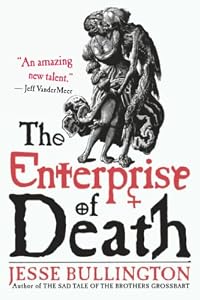
The Enterprise of Death
by Jesse Bullington
On This Page
Description
As the witch-pyres of the Spanish Inquisition blanket Renaissance Europe in a moral haze, a young African slave finds herself the unwilling apprentice of an ancient necromancer. Unfortunately, quitting his company proves even more hazardous than remaining his pupil when she is afflicted with a terrible curse. Yet salvation may lie in a mysterious tome her tutor has hidden somewhere on the war-torn continent. She sets out on a seemingly impossible journey to find the book, never suspecting show more her fate is tied to three strangers: the artist Niklaus Manuel Deutsch, the alchemist Dr. Paracelsus, and a gun-slinging Dutch mercenary. As Manuel paints her macabre story on canvas, plank, and church wall, the young apprentice becomes increasingly aware that death might be the least of her concerns. show lessTags
Recommendations





Member Recommendations
gonzobrarian Interesting supporting characters and good, old-fashioned mayhem. Oh, and the Plague as well.
Member Reviews
Jesse Bullington's follow-up to The Sad Tale Of The Brothers Grossbart is just as energetic, muscular, horrific, violent, inventive, fast-paced and icky as his debut. What wrong-footed me slightly was the sympathetic lead characters when I had mentally braced myself for more in the way of entertainingly sociopathic monsters wreaking havoc on the innocent and the guilty and the spectacularly evil alike. Instead we get Awa, an ex-slave forced into an apprenticeship by a necromancer, as nasty a piece of work as any Bullington has yet invented, and Niklaus Manuel Deutsch, an artist turned mercenary who, against his better judgement and self-interest, rescues said trainee necromancer from the attentions of some of his fellow soldiers. The show more unlikely pair become friends and, with the aid of a another mercenary, a female gunner, set out to thwart the ultimate and extremely horrific schemes of the necromancer. Touring the battlefields, graveyards and whorehouses of a war-torn Renaissance Europe, pursued by a rogue witch-hunter, the ambulatory corpse of Awa's former mistress, a doctor of questionable ethics hungry for hidden knowledge and a particularly horrific corpse-hungry monster.
With corpses galore, in various degrees of decomposition, the grue and gore and ghastly fluids are plentiful, and with war raging all around and the inquisition in full flight there's violence and injustice and poverty and inhumanity to spare, but the warm heart of the book is the friendship between Deutsch and Awa and the things they do to help each other find some measure of redemption and salvation in a savage world. A strong, satisfying second novel that manages to revisit many elements of the Brothers Grossbart and yet remain utterly different. Recommended. show less
With corpses galore, in various degrees of decomposition, the grue and gore and ghastly fluids are plentiful, and with war raging all around and the inquisition in full flight there's violence and injustice and poverty and inhumanity to spare, but the warm heart of the book is the friendship between Deutsch and Awa and the things they do to help each other find some measure of redemption and salvation in a savage world. A strong, satisfying second novel that manages to revisit many elements of the Brothers Grossbart and yet remain utterly different. Recommended. show less
I’d never heard of Jesse Bullington before stumbling across The Enterprise of Death, so I had the pleasure of entering into it with no expectations. To be honest, I’m not sure having heard of him previously (or having read The Sad Tale of the Brothers Grossbart), would have made a lick of difference. This is the kind of book that beats you over the head, robs you of your expectations, and then forces you to watch as it tears those expectations to shreds, stomps upon them, and gleefully urinates upon the mess . . . all while you nod delightedly and ask to do it all again.
Yes, this is a wonderfully messed-up book, set in a wonderfully messy world, that comes across as a mixture of Terry Gilliam’s most surreal, Tim Burton’s most show more unusual, and Clive Barker’ most sexual . It’s a book of nightmares and fantasies that are as much the Brothers Grimm as they are the Marquis de Sade. This is a darkly cynical tale of human history, told not by the historians (and not even by the victors), but by the sad souls forced to live out its cruelties and delights, armed only with an unflinching eye and a very dark sense of humour.
As readers, this is a story that demands of us an empty stomach and an open mind, as it repeatedly gives rise to open eyes and open mouths – as often in delight as in disgust. The world of The Enterprise of Death is one populated almost entirely by the scum of society - soldiers, slaves, eunuchs, prostitutes, and criminals without an ounce of morality between them. Even those characters who don’t revel in evil and brutality are often casually cruel, and at least amoral, if not immoral.
Of course, when the choices available are between the supernatural horrors of zombies and vampires, and the all-too-human horrors of necrophilia, bestiality, and cannibalism, it’s really hard to fault the characters for not being paragons of virtue. They are, however, disturbingly endearing characters (particularly Awa and Monique) with whom we are more than happy to tag along on this journey through the horrors of the Inquisition, even if we’d prefer not to shake hands at the end of said journey.
The only thing that initially bothered me about the book was the writing style. The story regularly leaps between past and present, a narrative device that is further confused by frequent jumps in viewpoint from one character to another. As far as the language goes, it’s a story that’s written in a 15th century style (with some quirky turns of phrase), but full of very 21st century dialogue (that, at one time or another, is guaranteed to make every reader blush at least once). Yet, despite the contradictions and confusions, it all works . . . once the story comes together in your head, it holds fast for the duration.
Quite possibly the strangest book I’ve read in a very long time, it’s also one I find myself thinking about reading once again (something I rarely do). I’d love to get my hands on a physical copy, to smell the ink, to feel the paper, to suffer the weight of it in my hands, and to get lost in the experience of reading. Perhaps too dark and morose for a beach read, I suspect it would be an entirely fitting read for a hot, stuffy, candlelit room during a violent summer thunderstorm. While not for everybody, if the subject matter and storytelling style present any appeal, then it’s worth investing the time in a read. show less
Yes, this is a wonderfully messed-up book, set in a wonderfully messy world, that comes across as a mixture of Terry Gilliam’s most surreal, Tim Burton’s most show more unusual, and Clive Barker’ most sexual . It’s a book of nightmares and fantasies that are as much the Brothers Grimm as they are the Marquis de Sade. This is a darkly cynical tale of human history, told not by the historians (and not even by the victors), but by the sad souls forced to live out its cruelties and delights, armed only with an unflinching eye and a very dark sense of humour.
As readers, this is a story that demands of us an empty stomach and an open mind, as it repeatedly gives rise to open eyes and open mouths – as often in delight as in disgust. The world of The Enterprise of Death is one populated almost entirely by the scum of society - soldiers, slaves, eunuchs, prostitutes, and criminals without an ounce of morality between them. Even those characters who don’t revel in evil and brutality are often casually cruel, and at least amoral, if not immoral.
Of course, when the choices available are between the supernatural horrors of zombies and vampires, and the all-too-human horrors of necrophilia, bestiality, and cannibalism, it’s really hard to fault the characters for not being paragons of virtue. They are, however, disturbingly endearing characters (particularly Awa and Monique) with whom we are more than happy to tag along on this journey through the horrors of the Inquisition, even if we’d prefer not to shake hands at the end of said journey.
The only thing that initially bothered me about the book was the writing style. The story regularly leaps between past and present, a narrative device that is further confused by frequent jumps in viewpoint from one character to another. As far as the language goes, it’s a story that’s written in a 15th century style (with some quirky turns of phrase), but full of very 21st century dialogue (that, at one time or another, is guaranteed to make every reader blush at least once). Yet, despite the contradictions and confusions, it all works . . . once the story comes together in your head, it holds fast for the duration.
Quite possibly the strangest book I’ve read in a very long time, it’s also one I find myself thinking about reading once again (something I rarely do). I’d love to get my hands on a physical copy, to smell the ink, to feel the paper, to suffer the weight of it in my hands, and to get lost in the experience of reading. Perhaps too dark and morose for a beach read, I suspect it would be an entirely fitting read for a hot, stuffy, candlelit room during a violent summer thunderstorm. While not for everybody, if the subject matter and storytelling style present any appeal, then it’s worth investing the time in a read. show less
I wouldn't say this was the masterpiece level that Bullington achieved in The Sad Tale of the Brothers Grossbart: 5.5 or A Crown for Cold Silver writing as Alex Marshall, but still a hell of a lot of fun. If I only had one word to describe it, I would say "quirky". The 2nd word would be dark. It's filled with necromancy, humor, witchcraft, necrophilia, monsters, violence, and great, memorable characters.
My only complaint is that he/his characters sometimes used modern phrases like "I'll end you" and that took me out of the story temporarily. It wasn't that often though.
My only complaint is that he/his characters sometimes used modern phrases like "I'll end you" and that took me out of the story temporarily. It wasn't that often though.
Enterprise is definitely less gory than The Brothers Grossbart, however, it does contain many more sexual scenes (many of them lesbian, and many more involving corpses), and so this book still isn't for the faint of heart. Sex scenes aside, I still enjoyed the tale of Awa, a young necromancer who must beat a curse put upon her by her teacher before he comes back to claim her body. It's during the time of the Spanish Inquisition, so along with being a woman, Awa must be extra careful because she is a Moor as well. Along the way she makes a few living (and dead) friends, such as the artist Manuel, the gun-slinger Monique, and the crazed "doctor" Paracelsus. I loved the way the story jumped between past and present until the two paths show more merged, and the more I got to know Awa, the more I hoped she beat her curse. The plot moved along at a good pace, and I enjoyed the humor, dark though it was. I will definitely keep reading what Bullington writes. show less
This is like no Renaissance-based novel you've ever read before: shocking, profane, grotesque, gory, revolting...and yet funny. A swashbuckling tale filled with dark sorcery, graphic violence, mayhem, and unforgettable - and sympathetic - characters. I could not put this book down. Jesse Bullington has a ripe and witty (if twisted) imagination and knows how to put a story together.
This story was gross enough that I considered stopping reading several times but I continued on because I just had to know what was going to happen to the main character, Awa, and I looked forward to the pistol-toting Dutch mercenary character (not what I was expecting, but the character turned out pretty well anyway).
As the story unfolded, and I became more and more caught up in Awa's quest, I came to really appreciate the author's imagination. I can't say I enjoyed all aspects of the main characters but that just made them more realistic and, ultimately, I came away really liking how the story turned out and I'm willing to go back and read the author's first book (which I've had on my shelves for a year or so), though I will wait show more until I've read a few other things before I sample more of the Bullington charm, heh. show less
As the story unfolded, and I became more and more caught up in Awa's quest, I came to really appreciate the author's imagination. I can't say I enjoyed all aspects of the main characters but that just made them more realistic and, ultimately, I came away really liking how the story turned out and I'm willing to go back and read the author's first book (which I've had on my shelves for a year or so), though I will wait show more until I've read a few other things before I sample more of the Bullington charm, heh. show less
This is historical fantasy like I’ve never read before. When a ship wreck leaves teenagers Awa, a Moorish slave, Omorose, her harem girl master, and Halim, a eunuch, stranded on what is probably the Rock of Gibralter, they are found, imprisoned, and trained by a necromancer. His attendants- including his mistress- are animated corpses ranging from the recently dead to skeletons and they prevent any escape. In the end, only Awa is left alive as the necromancer’s protégé. He leaves her for ten years to await a horrible fate, which she hopes to avert by finding the necromancer’s book- which could be anywhere.
Set around 1500, Awa has three strikes against her as she searches Europe for the book: she’s Moorish, she’s a lesbian, show more and she’s a necromancer. The Spanish Inquisitors don’t like any of those things, and neither does the general population of the time. But thankfully not everyone has these prejudices, and she finds a few friends who help her along the way as she searches graveyards, fights a demon, is hunted by Omorose and an Inquisitor, and gets caught up in battles.
I really enjoyed the story, but I suspect not all will. There is lots of vividly described gore, lots of sex (including with the dead), and most of the characters can’t utter a sentence without swear words in it, most often the F bomb and frequently the verboten C bomb. But watching the characters grow- especially Awa- through the story is engaging and it’s a fine comrades-in-arms chanson de geste. A few of the characters are plucked from history, such as Paracelsus, and Awa’s friend the artist and mercenary Niklaus Manuel Deutsch, and that, along with reference to the rulers and battles of the time, allow the reader to have a sense of the time and place. I stayed up late reading this one. show less
Set around 1500, Awa has three strikes against her as she searches Europe for the book: she’s Moorish, she’s a lesbian, show more and she’s a necromancer. The Spanish Inquisitors don’t like any of those things, and neither does the general population of the time. But thankfully not everyone has these prejudices, and she finds a few friends who help her along the way as she searches graveyards, fights a demon, is hunted by Omorose and an Inquisitor, and gets caught up in battles.
I really enjoyed the story, but I suspect not all will. There is lots of vividly described gore, lots of sex (including with the dead), and most of the characters can’t utter a sentence without swear words in it, most often the F bomb and frequently the verboten C bomb. But watching the characters grow- especially Awa- through the story is engaging and it’s a fine comrades-in-arms chanson de geste. A few of the characters are plucked from history, such as Paracelsus, and Awa’s friend the artist and mercenary Niklaus Manuel Deutsch, and that, along with reference to the rulers and battles of the time, allow the reader to have a sense of the time and place. I stayed up late reading this one. show less
Members
- Recently Added By
Lists

Top Five Books of 2013
1,562 works; 721 members
Author Information

18+ Works 1,832 Members
Awards and Honors
Awards
Common Knowledge
- Dedication
- For
All Those Who Go Before Us - First words
- Pity Boabdil.
- Last words
- (Click to show. Warning: May contain spoilers.)Each year, on the Autumn Solstice, Awa and Monique made the pilgrimmage to the churchyard to lay eledweiss at the head of the artist, and then the two women would walk hand in hand between the moonlit tombstones, back to their home.
Classifications
Statistics
- Members
- 271
- Popularity
- 118,730
- Reviews
- 13
- Rating
- (3.97)
- Languages
- English, German
- Media
- Paper, Ebook
- ISBNs
- 5
- ASINs
- 3