
On This Page
Description
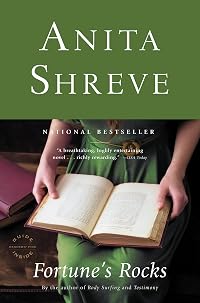
In 1890s Boston, a 15-year-old upper-class girl is banished to a convent following an affair with a married doctor which left her pregnant. The girl is forced to surrender the child for adoption, but she subsequently goes to court to recuperate it, and eventually marries the doctor. A study in the mores and manners of the day.Tags
Recommendations




Member Recommendations

Member Reviews
Open the pages of Fortune’s Rocks by Anita Shreve and you’ll think you’ve stepped into the world of Edith Wharton, Kate Chopin or any number of other turn-of-the-century women writers whose novels were set in refined, confining Victorian society.
Do not be fooled for an instant. Shreve’s novel is a pale imitation of those Grande Dames of Literature.
Oh sure, Fortune’s Rocks—much like Wharton’s The Age of Innocence—is filled with scenes that would startle modern readers with their conservatism. An exposed ankle in 1899 was akin to Julia Roberts flinging off her clothes and running out on the 50-yard line during the Super Bowl. It was just not good manners. Turn-of-the-century society was polite, discreet and above all show more sexless. At least on the surface. But beneath the corsets, my how those bosoms heaved with passion!
Edith Wharton certainly knew how to capture all that restrained eroticism. Kate Chopin (in The Awakening) founded a literary reputation with her tale of unbridled sexuality. And now, nearly a century later, Anita Shreve (author of The Pilot’s Wife) tries to follow in their buttoned-up bootsteps.
She fails miserably.
Fortune’s Rocks has all the appearance of a Wharton wannabe with scenes of oh-so-proper dinner parties, an independent-spirited heroine and a foul set of circumstances that would do Charles Dickens proud. What Shreve doesn’t realize is that there is no longer a market for this type of narrative. One of the reasons I find Wharton so engaging is because I knew she was trying to write her way out of the very culture she was describing. Novels like The Age of Innocence and Summer are good precisely because they are like time capsules of early 19th-century New York with all of its stiff, upper-class prejudices. Not to mention the fact that Wharton’s prose has a depth that resonates off the page.
By comparison, Shreve is splashing around in the shallow end of the wading pool.
To be fair, Shreve does show she’s done a lot of research into the manners and customs of the era. Her descriptions of dinner parties and afternoon teas and sensuous strolls along the beach are complete to the nth degree. They’re also very dull.
Fortune’s Rocks starts on what seems to be a promising first sentence:
"In the time it takes for her to walk from the bathhouse at the seawall of Fortune’s Rocks, where she has left her boots and has discreetly pulled off her stockings, to the waterline along which the sea continually licks the pink and silver sand, she learns about desire. Desire that slows the breath, that causes a preoccupied pause in the midst of uttering a sentence, that focuses the gaze absolutely on the progress of naked feet walking toward the water."
Ladies and gentlemen, meet Olympia Biddeford. She’s fifteen years old and, as she walks along the New Hampshire beach, "she has passed from being a girl, with a child’s pent-up and nearly frenzied need to sweep away the rooms and cobwebs of her winter, to being a woman."
Now, if you’ve enjoyed those two brief passages I’ve quoted, then I suggest you stop reading right now and go buy yourself a copy of this bodice-ripper. If, however, those cucumber sandwiches you ate at the ladies’ society tea are starting to rise in your gorge, then you’ll know what I mean when I say there is nothing to recommend this book.
The story, which at times reads like a feminized Lolita, tells how Olympia discovers her womanhood (at fifteen!) by seducing a married man twenty-six years her senior. The resulting adulterous scandal brings plenty of misfortune to those who live at Fortune’s Rocks, the seaside resort where Olympia lives. The rest of the novel is too maudlin for words. Suffice to say, there’s plenty of back-of-the-hand-to-the-forehead scenes and long stretches of stilted dialogue. For good measure—just to wake us from our torpor, I suppose—Shreve throws in a couple of grittily-detailed childbirth scenes which read like a cross between ER and a midwife’s handbook.
The whole book is written in a faux Victorian prose style, making the already unbearable unreadable. show less
Do not be fooled for an instant. Shreve’s novel is a pale imitation of those Grande Dames of Literature.
Oh sure, Fortune’s Rocks—much like Wharton’s The Age of Innocence—is filled with scenes that would startle modern readers with their conservatism. An exposed ankle in 1899 was akin to Julia Roberts flinging off her clothes and running out on the 50-yard line during the Super Bowl. It was just not good manners. Turn-of-the-century society was polite, discreet and above all show more sexless. At least on the surface. But beneath the corsets, my how those bosoms heaved with passion!
Edith Wharton certainly knew how to capture all that restrained eroticism. Kate Chopin (in The Awakening) founded a literary reputation with her tale of unbridled sexuality. And now, nearly a century later, Anita Shreve (author of The Pilot’s Wife) tries to follow in their buttoned-up bootsteps.
She fails miserably.
Fortune’s Rocks has all the appearance of a Wharton wannabe with scenes of oh-so-proper dinner parties, an independent-spirited heroine and a foul set of circumstances that would do Charles Dickens proud. What Shreve doesn’t realize is that there is no longer a market for this type of narrative. One of the reasons I find Wharton so engaging is because I knew she was trying to write her way out of the very culture she was describing. Novels like The Age of Innocence and Summer are good precisely because they are like time capsules of early 19th-century New York with all of its stiff, upper-class prejudices. Not to mention the fact that Wharton’s prose has a depth that resonates off the page.
By comparison, Shreve is splashing around in the shallow end of the wading pool.
To be fair, Shreve does show she’s done a lot of research into the manners and customs of the era. Her descriptions of dinner parties and afternoon teas and sensuous strolls along the beach are complete to the nth degree. They’re also very dull.
Fortune’s Rocks starts on what seems to be a promising first sentence:
"In the time it takes for her to walk from the bathhouse at the seawall of Fortune’s Rocks, where she has left her boots and has discreetly pulled off her stockings, to the waterline along which the sea continually licks the pink and silver sand, she learns about desire. Desire that slows the breath, that causes a preoccupied pause in the midst of uttering a sentence, that focuses the gaze absolutely on the progress of naked feet walking toward the water."
Ladies and gentlemen, meet Olympia Biddeford. She’s fifteen years old and, as she walks along the New Hampshire beach, "she has passed from being a girl, with a child’s pent-up and nearly frenzied need to sweep away the rooms and cobwebs of her winter, to being a woman."
Now, if you’ve enjoyed those two brief passages I’ve quoted, then I suggest you stop reading right now and go buy yourself a copy of this bodice-ripper. If, however, those cucumber sandwiches you ate at the ladies’ society tea are starting to rise in your gorge, then you’ll know what I mean when I say there is nothing to recommend this book.
The story, which at times reads like a feminized Lolita, tells how Olympia discovers her womanhood (at fifteen!) by seducing a married man twenty-six years her senior. The resulting adulterous scandal brings plenty of misfortune to those who live at Fortune’s Rocks, the seaside resort where Olympia lives. The rest of the novel is too maudlin for words. Suffice to say, there’s plenty of back-of-the-hand-to-the-forehead scenes and long stretches of stilted dialogue. For good measure—just to wake us from our torpor, I suppose—Shreve throws in a couple of grittily-detailed childbirth scenes which read like a cross between ER and a midwife’s handbook.
The whole book is written in a faux Victorian prose style, making the already unbearable unreadable. show less
I don't get the obsession between Olympia and John Haskell; their behaviour is more than love. It's lust. Thankfully, the book was redeemed by Shreve's insertion of dramatic scenes at the appropriate juncture (when you are beginning to be bored by the book) and its themes (what is right and wrong, and parental love). Most readers must have read with bated breadth at the scene where Olympia's and John's relationship was uncovered. Shreve did not went into detail on what they went through but you can imagine. I am glad Shreve chose to deal with this important juncture in the book in this way, sparing you the ugly scenes.
Shimmering, atmospheric writing drew me in, but is excellent technique enough? No. Linen sheets cannot compensate for a lumpy straw mattress.
I slogged along hoping that a bright twist would turn the narrative toward an insightful, meaningful course, but alas.
The premise: a privileged, educated 15-year-old finds her romantic and intellectual match in a married-with-children 40-something. Really? Really?!?
Off to cleanse my palate with [b:Difficult Women|28818921|Difficult Women|Roxane Gay|https://images.gr-assets.com/books/1478773519s/28818921.jpg|51184496], by Roxanne Gay.
I slogged along hoping that a bright twist would turn the narrative toward an insightful, meaningful course, but alas.
The premise: a privileged, educated 15-year-old finds her romantic and intellectual match in a married-with-children 40-something. Really? Really?!?
Off to cleanse my palate with [b:Difficult Women|28818921|Difficult Women|Roxane Gay|https://images.gr-assets.com/books/1478773519s/28818921.jpg|51184496], by Roxanne Gay.
Shreve tells a compelling story about forbidden love, and about the shame and dishonour levelled at a young woman who gives birth to a child out of wedlock in 1899. It was interesting to observe the Christian-driven, absolute moral indignation of society over childbirth out of wedlock while, simultaneously, it turned a blind eye to horrendous child poverty, abuse, and labour.
Holy Moly.
I had no idea what I was getting into when I started this book, and I feel that really helped draw me into the story. It seems to be divided into almost a play, with three parts... the romance, the fallout, and the future. At times, I found myself over-invested in the last act of the novel, and kept trying to think about how I would handle the same situation. It is SO HARD for me to hear about children being taken from their mothers, and then while I sympathized with Olympia so so much, I don't know if I could have taken Pierre from his foster parents either. Ughhhh my heart This was an emotional roller coaster of a book, and once I actually sat down with the intent to just have a quiet afternoon full of reading, it sucked show more me in and I couldn't put it down. show less
I had no idea what I was getting into when I started this book, and I feel that really helped draw me into the story. It seems to be divided into almost a play, with three parts... the romance, the fallout, and the future. At times, I found myself over-invested in the last act of the novel, and kept trying to think about how I would handle the same situation.
The time is the turn of the last century, the setting a rocky New Hampshire coastline resort area nicknamed "Fortune's Rocks." Olympia Biddeford, age 15, is walking the beach, feeling the first stirrings of her womanhood. The strong-willed daughter of an upstanding Boston couple, she soon "learns of desire" as she begins a passionate affair with a married writer, John Haskell, three times her age. From the moment they meet (he is a visiting friend of her father's), they experience a sexual sparkAOlympia feels "liquid" in his presence. Soon, they fall into sinful trysting. Shreve (The Pilot's Wife) serves up these opening events with breathless immediacy. Once the plot gets a chance to developAOlympia gets pregnant, gives up child, show more fights to get child backAit settles down considerably, turning into a modernized The Scarlet Letter, a tale of a woman attaining feminist independence by living outside her period's societal mores. show less
Shreve is truly a master. Her tale of a Victorian era adulterous relationship between a teenage girl-woman and a middle-aged physician is beautifully told. What is Shreve's strength? Well, her descriptions are wonderful. Precise, elegant, not a needed word unwritten but not a word extra either. I could see, hear and smell the locale of Fortune's Rocks and the former convent. In fact, I'm carrying in my mind visions of the mother's room and Olympia's spare redecoration of the house even now.
But Shreve's strengths could just as easily be in writing of relationships. I could understand and even be drawn in to Olympia's relationship with her lover as well as with her father. Even when I intensely disliked her actions, I felt as if I fully show more understood and could share her pains and her exaltations.
Finally, Shreve's plot excelled. The story moved from the unexpected to the totally predictable and back again.
I enjoyed the book far more than I expected. show less
But Shreve's strengths could just as easily be in writing of relationships. I could understand and even be drawn in to Olympia's relationship with her lover as well as with her father. Even when I intensely disliked her actions, I felt as if I fully show more understood and could share her pains and her exaltations.
Finally, Shreve's plot excelled. The story moved from the unexpected to the totally predictable and back again.
I enjoyed the book far more than I expected. show less
Members
- Recently Added By
Lists

Literature About Adultery
69 works; 10 members

Blue Pyramid 1,276 Best Books of All Time
1,248 works; 32 members
Author Information

30+ Works 43,757 Members
Anita Shreve grew up in Dedham, Massachusetts. After receiving a bachelor's degree in English from Tufts University, she taught high school English for five years before becoming a full-time author. She worked for an English-language magazine in Nairobi and wrote for everything from Cosmopolitan magazine to The New York Times. Her nonfiction books show more included Remaking Motherhood and Women Together, Women Alone. Her novels included Eden Close, Strange Fits of Passion, Where or When, Fortune's Rocks, Rescue, Stella Bain, and The Stars are Fire. Several of her books were made into movies including The Pilot's Wife, Resistance, and The Weight of Water. She died from cancer on March 29, 2018 at the age of 71. (Bowker Author Biography) show less
Some Editions
Series

Belongs to Publisher Series
Serie Piper (4117)
Common Knowledge
- Canonical title
- Fortune's Rocks
- Original title
- Fortune's Rocks
- Original publication date
- 1999-12-02
- People/Characters
- Olympia Biddeford; Phillip Arthur Biddeford; Rosamund Biddeford; John Haskell; Catherine Haskell
- Important places
- New Hampshire, USA
- Dedication
- For John Osborn gifted reader, great cook
- First words
- In the time it takes for her to walk from the bathhouse at the seawall of Fortune's Rocks, where she has left her boots and has discreetly pulled off her stockings to the waterline along which the sea continually licks the pi... (show all)nk and silver sand, she learns about desire.
- Last words
- (Click to show. Warning: May contain spoilers.)But here there is a boy, and his name is Pierre.
- Original language
- English
Classifications
- Genres
- Fiction and Literature, General Fiction, Romance, Historical Fiction
- DDC/MDS
- 813.54 — Literature & rhetoric American literature in English American fiction in English 1900-1999 1945-1999
- LCC
- PS3569 .H7385 .F67 — Language and Literature American literature American literature Individual authors 1961-
- BISAC
Statistics
- Members
- 3,070
- Popularity
- 5,736
- Reviews
- 45
- Rating
- (3.67)
- Languages
- 11 — Catalan, Danish, Dutch, English, Estonian, French, German, Italian, Portuguese, Spanish, Swedish
- Media
- Paper, Audiobook, Ebook
- ISBNs
- 63
- UPCs
- 1
- ASINs
- 18