Specimen Days
by Walt Whitman
On This Page
Description
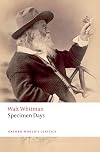
b'I obey my happy hour's command, which seems curiously imperative. May-be, if I don't do anything else, I shall send out the most wayward, spontaneous, fragmentary book ever printed.'/bOne of the best kept secrets of modern autobiographical literature, Whitman's autobiography moves in brisk, episodic fashion to chronicle the life of one of the world's best loved and most influential poets. Experimental in form, lyrical in expression, and rich in experiential content, Specimen Daysstill show more awaits a much wider readership than it has hitherto commanded. Whitman gives us his life as lived in relation to the shifting urban and rural ecologies of a young nation -a nation that had freshly emerged from catastrophic civil war and that was assuming the vanguard of artistic,technological, economic, political, and philosophical modernity.ABOUT THE SERIES: For over 100 years Oxford World's Classics has made available the widest range of literature from around the globe. Each affordable volume reflects Oxford's commitment to scholarship, providing the most accurate text plus a wealth of other valuable features, including expertintroductions by leading authorities, helpful notes to clarify the text, up-to-date bibliographies for further study, and much more. show lessTags
Recommendations















Member Reviews
Walt Whitman is mainly known as a poet, and hardly known for his prose writings. Specimen days in America, published in 1882 is his second work of prose that was published in his lifetime. In the 1830s the young Whitman, as a teenager, working as a printer's assistant, started contributing articles to newspapers, and in 1838 he founded a newspaper and worked on it as its first editor. He continued working on various other newspapers. Whitman is known to have been seriously writing poetry during the second half of the 1840s, but it wasn't until 1855 when his first volume of poetry was published, a slim volume of just 12 poems entitled Leaves of Grass.
In fact, Whitman wrote a lot more prose, but some of that wasn't discovered until 2016. show more Walt Whitman wrote a novel, Life and Adventures of Jack Engle, which was serialized in 1852. He also wrote a series of articles Manly Health and Training, literally "Man's Health". In 1877, he published Democratic Vistas, a book partly about America and partly literary criticism.
Specimen Days is likewise hard to pinpoint. What kind of book is it, really? It seems to be a bit of everything, some parts are most likely diary entries, and some are memoirs, some are essay-like meditations. Whitman wrote that he first wanted to call it "Cedar-Plums Like" and he describes it as "a melange of loafing, looking, hobbling, sitting, traveling—a little thinking thrown in for salt, some literary meditations, some of my own caprices, meditations, egotism (...).
The first entry or first passage of Specimen Days seems to be an editorial note by Whitman. It is dated July 2nd, 1882, and observes that the work before us is "incongruous and full of skips and jumps (...) a huddle of diary-jottings, war-memoranda of 1862-'65, Nature-notes of 1877-'81, with Western and Canadian observations". On the whole, the work seems very spontaneous, as free of restraints as the best parts of Leaves of Grass. However, the work as a whole is thoroughly edited, as is shown by the extensive notes that are provided. They are called "end notes", but they aren't collected at the end of the book, but rather at the end of each passage. The touch of the editor is also noticeable in the first section of the book, which appears to provide a chronological early life of the author, describing his hometown.
The collection of prose fragments is a bit of a jumble, although it does seem to be in chronological order. It doesn't have "parts" as I suggested above. In as far as there are portions or sections distinguishable in the work, these segments do not have a length that is representative for the period they refer to. The first portion is devoted to his youth is relatively long, but there is one short passage that seems to sum up all operas Whitman saw or remembered during a period of almost ten years in his life.
The whole book consists of "jottings" short prose entries or passages that are usually only about 200 or 300 words long. In some cases they are dated, but usually only with the day and the month, it often isn't clear which year.
For all the quirks and oddities of the work, Specimen days in America is a wonderful work to read. Regardless of whether it is really about Walt Whitman (although it seems to be), it gives a great impression of life in America during the mid to late nineteenth century, with intense descriptions of Whitman's experiences visiting the wounded soldiers during the American Civil War, and later his lyrical descriptions of nature.
Published late in his life, it seems Whitman was aware that his strength lay in spontaneous, unedited works. It seems he wanted to publish these diary jottings as pure as possible. In many ways, Walt Whitman seems to have been a truly free man, who would not let him be bound or tied down by convention. This unhemmed freedom is strongly felt in Leaves of Grass and it is equally strongly present in Specimen Days. show less
In fact, Whitman wrote a lot more prose, but some of that wasn't discovered until 2016. show more Walt Whitman wrote a novel, Life and Adventures of Jack Engle, which was serialized in 1852. He also wrote a series of articles Manly Health and Training, literally "Man's Health". In 1877, he published Democratic Vistas, a book partly about America and partly literary criticism.
Specimen Days is likewise hard to pinpoint. What kind of book is it, really? It seems to be a bit of everything, some parts are most likely diary entries, and some are memoirs, some are essay-like meditations. Whitman wrote that he first wanted to call it "Cedar-Plums Like" and he describes it as "a melange of loafing, looking, hobbling, sitting, traveling—a little thinking thrown in for salt, some literary meditations, some of my own caprices, meditations, egotism (...).
The first entry or first passage of Specimen Days seems to be an editorial note by Whitman. It is dated July 2nd, 1882, and observes that the work before us is "incongruous and full of skips and jumps (...) a huddle of diary-jottings, war-memoranda of 1862-'65, Nature-notes of 1877-'81, with Western and Canadian observations". On the whole, the work seems very spontaneous, as free of restraints as the best parts of Leaves of Grass. However, the work as a whole is thoroughly edited, as is shown by the extensive notes that are provided. They are called "end notes", but they aren't collected at the end of the book, but rather at the end of each passage. The touch of the editor is also noticeable in the first section of the book, which appears to provide a chronological early life of the author, describing his hometown.
The collection of prose fragments is a bit of a jumble, although it does seem to be in chronological order. It doesn't have "parts" as I suggested above. In as far as there are portions or sections distinguishable in the work, these segments do not have a length that is representative for the period they refer to. The first portion is devoted to his youth is relatively long, but there is one short passage that seems to sum up all operas Whitman saw or remembered during a period of almost ten years in his life.
The whole book consists of "jottings" short prose entries or passages that are usually only about 200 or 300 words long. In some cases they are dated, but usually only with the day and the month, it often isn't clear which year.
For all the quirks and oddities of the work, Specimen days in America is a wonderful work to read. Regardless of whether it is really about Walt Whitman (although it seems to be), it gives a great impression of life in America during the mid to late nineteenth century, with intense descriptions of Whitman's experiences visiting the wounded soldiers during the American Civil War, and later his lyrical descriptions of nature.
Published late in his life, it seems Whitman was aware that his strength lay in spontaneous, unedited works. It seems he wanted to publish these diary jottings as pure as possible. In many ways, Walt Whitman seems to have been a truly free man, who would not let him be bound or tied down by convention. This unhemmed freedom is strongly felt in Leaves of Grass and it is equally strongly present in Specimen Days. show less
Treasured gift from many years ago. Reads as a loose diary of entries in the 1860s. Highly recommend it if you can get hold of a copy...!
Ratings
Members
- Recently Added By
Lists

Harold Bloom - The Western Canon: C. The Democratic Age
336 works; 15 members

Book Titles Mentioned In Newberry Medal And Honor Books
884 works; 3 members
Author Information

630+ Works 32,376 Members
Walt Whitman was born on Long Island and raised in Brooklyn, New York, the son of a carpenter. He left school when he was 11 years old to take a variety of jobs. By the time he was 15, Whitman was living on his own in New York City, working as a printer and writing short pieces for newspapers. He spent a few years teaching, but most of his work show more was either in journalism or politics. Gradually, Whitman became a regular contributor to a variety of Democratic Party newspapers and reviews, and early in his career established a rather eccentric way of life, spending a great deal of time walking the streets, absorbing life and talking with laborers. Extremely fond of the opera, he used his press pass to spend many evenings in the theater. In 1846, Whitman became editor of the Brooklyn Eagle, a leading Democratic newspaper. Two years later, he was fired for opposing the expansion of slavery into the west. Whitman's career as a poet began in 1885, with the publication of the first edition of his poetry collection, Leaves of Grass. The book was self-published (Whitman probably set some of the type himself), and despite his efforts to publicize it - including writing his own reviews - few people read it. One reader who did appreciate it was essayist Ralph Waldo Emerson, who wrote a letter greeting Whitman at "the beginning of a great career." Whitman's poetry was unlike any verse that had ever been seen. Written without rhyme, in long, loose lines, filled with poetic lists and exclamations taken from Whitman's reading of the Bible, Homer, and Asian poets, these poems were totally unlike conventional poetry. Their subject matter, too, was unusual - the celebration of a free-spirited individualist whose love for all things and people seemed at times disturbingly sensual. In 1860, with the publication of the third edition on Leaves of Grass, Whitman alienated conventional thinkers and writers even more. When he went to Boston to meet Emerson, poet Henry Wadsworth Longfellow, essayist Oliver Wendell Holmes, and poet James Russell Lowell, they all objected to the visit. With the outbreak of the Civil War, Whitman's attentions turned almost exclusively to that conflict. Some of the greatest poetry of his career, including Drum Taps (1865) and his magnificent elegy for President Abraham Lincoln, "When Last in the Dooryard Bloom'd" (1865), was written during this period. In 1862, his brother George was wounded in battle, and Whitman went to Washington to nurse him. He continued as a hospital volunteer throughout the war, nursing other wounded soldiers and acting as a benevolent father-figure and confidant. Parts of his memoir Specimen Days (1882) record this period. After the war, Whitman stayed on in Washington, working as a government clerk and continuing to write. In 1873 he suffered a stroke and retired to Camden, New Jersey, where he lived as an invalid for the rest of his life. Ironically, his reputation began to grow during this period, as the public became more receptive to his poetic and personal eccentricities. Whitman tried to capture the spirit of America in a new poetic form. His poetry is rough, colloquial, sweeping in its vistas - a poetic equivalent of the vast land and its varied peoples. Critic Louis Untermeyer has written, "In spite of Whitman's perplexing mannerisms, the poems justify their boundless contradictions. They shake themselves free from rant and bombastic audacities and rise into the clear air of major poetry. Such poetry is not large but self-assured; it knows, as Whitman asserted, the amplitude of time and laughs at dissolution. It contains continents; it unfolds the new heaven and new earth of the Western world." American poetry has never been the same since Whitman tore it away from its formal and thematic constraints, and he is considered by virtually all critics today to be one of the greatest poets the country has ever produced. (Bowker Author Biography) show less
Some Editions
Awards and Honors
Distinctions
Work Relationships
Is contained in
Common Knowledge
- Original publication date
- 1882
Classifications
Statistics
- Members
- 197
- Popularity
- 166,619
- Reviews
- 2
- Rating
- (3.90)
- Languages
- 5 — English, German, Hebrew, Italian, Spanish
- Media
- Paper, Audiobook, Ebook
- ISBNs
- 17
- ASINs
- 9