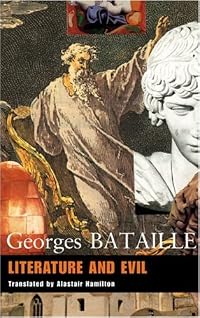
Literature and Evil
by Georges Bataille
On This Page
Description
'Literature is not innocent,' stated Georges Bataille in this extraordinary 1957 collection of essays, arguing that only by acknowledging its complicity with the knowledge of evil can literature communicate fully and intensely. These literary profiles of eight authors and their work, including Emily Brontë's Wuthering Heights, Baudelaire's Les Fleurs du Mal and the writings of Sade, Kafka and Sartre, explore subjects such as violence, eroticism, childhood, myth and transgression, in a work show more of rich allusion and powerful argument. show lessTags
Recommendations












Member Reviews
On balance, I am going to have to class this 1957 collection of eight essays on significant literary figures as rather dreadful. Not that there are not occasional insights but the essays are largely obscurantist attempts to engage with the fashionable theories of the age and not much more.
Sartre hangs like a pall over the book, notably in the essays on Baudelaire and Genet. Bataille plays with Christian notions, Marxism, existentialism, contemporary anthropology and whatever is to hand to say not a great deal - or rather to write a great deal that seems to say little.
The problem is with his starting point - the assumption, without any attempt at serious definition, that the notions of Good and Evil are more than rhetorical gestures. The show more claim that literature is evil by its very nature is actually arguable but it needs far more consideration of terms than this.
The essays are variable and suggest the self indulgence of someone on the fringes of French intellectual life trying to shout out to his peers that he is present and that he can be judged by his ability to 'intellectualise' like the best of them.
The essays do, as I note, have insights but then descend into obscurantism. His creative and worthwhile theory of economics (wrong-headed but stimulating), based (in effect) on the potlach where excess or luxury has its role, gets its exposition in passing but only in passing.
The essay on Kafka is mostly rather good. His thesis on the consonance of literature and evil is best articulated, yet not yet articulated fully, in dealing with Emily Bronte. He usefully helps introduce Willian Blake to a French audience with some acute insights. So there are good things to say - just!
But the sections on Baudelaire, Michelet, Sade Proust and Genet are speaking to local, almost provincial in time and place, literary disputes and concerns. It is Bataille's lack of clarity when clarity is possible that I find most problematic - but then I am an Anglo-Saxon so what do I know.
No doubt the essays might have been amusing and even insightful to a Rive Gauche-aspirant in the late 1950s but they do not inspire now if only because Bataille never allows you to see the wood of his argument for the trees of games-playing wordiness.
This negative review it is not intended to criticise Bataille for more than this book. He falls into that category of people - Alesteir Crowley is another - who may not be great systematic thinkers but who tap into a zeitgeist and become great provocateurs and so changers of cultural norms.
But I do feel that the nearly four hours of my life spent on this book was not the most productive. As you get older, patience begins to start to run out. Indeed, I almost gave up after the third essay because its obscurity and intellectual narcissism was almost beyond endurance.
I am glad (I think) that I did not give up. Only be reading the whole was I able to get a sense of just how useless a culture of intellectualism could become when it is indulged by the wider literary community. Still, there were a few insights and half the Kafka essay was actually enjoyable. show less
Sartre hangs like a pall over the book, notably in the essays on Baudelaire and Genet. Bataille plays with Christian notions, Marxism, existentialism, contemporary anthropology and whatever is to hand to say not a great deal - or rather to write a great deal that seems to say little.
The problem is with his starting point - the assumption, without any attempt at serious definition, that the notions of Good and Evil are more than rhetorical gestures. The show more claim that literature is evil by its very nature is actually arguable but it needs far more consideration of terms than this.
The essays are variable and suggest the self indulgence of someone on the fringes of French intellectual life trying to shout out to his peers that he is present and that he can be judged by his ability to 'intellectualise' like the best of them.
The essays do, as I note, have insights but then descend into obscurantism. His creative and worthwhile theory of economics (wrong-headed but stimulating), based (in effect) on the potlach where excess or luxury has its role, gets its exposition in passing but only in passing.
The essay on Kafka is mostly rather good. His thesis on the consonance of literature and evil is best articulated, yet not yet articulated fully, in dealing with Emily Bronte. He usefully helps introduce Willian Blake to a French audience with some acute insights. So there are good things to say - just!
But the sections on Baudelaire, Michelet, Sade Proust and Genet are speaking to local, almost provincial in time and place, literary disputes and concerns. It is Bataille's lack of clarity when clarity is possible that I find most problematic - but then I am an Anglo-Saxon so what do I know.
No doubt the essays might have been amusing and even insightful to a Rive Gauche-aspirant in the late 1950s but they do not inspire now if only because Bataille never allows you to see the wood of his argument for the trees of games-playing wordiness.
This negative review it is not intended to criticise Bataille for more than this book. He falls into that category of people - Alesteir Crowley is another - who may not be great systematic thinkers but who tap into a zeitgeist and become great provocateurs and so changers of cultural norms.
But I do feel that the nearly four hours of my life spent on this book was not the most productive. As you get older, patience begins to start to run out. Indeed, I almost gave up after the third essay because its obscurity and intellectual narcissism was almost beyond endurance.
I am glad (I think) that I did not give up. Only be reading the whole was I able to get a sense of just how useless a culture of intellectualism could become when it is indulged by the wider literary community. Still, there were a few insights and half the Kafka essay was actually enjoyable. show less
A primeira parte fala sobre Emily Bronte, de como O Morro dos ventos uivantes é um romance de expiação e de como o mal lhe era intrínseco, versa sobre a morte como renovação do eu. Também debate uma suposta experiência mística de Bronte comparada à Teresa D'Avila e como isso a traz ainda mais perto da experiência com a morte, como bem a experiência hipermoral.
Na segunda parte sobre Baudelaire Bataille contrapõe sua visão sobre o mesmo com a do livro de Sartre, este Bataille indica que enxerga sua poesia sob um olhar da individualidade, quando é necessário enxergar a poesia baudeleriana e a vida do autor sob um viés materialista historicizado.
Na terceira parte Bataille nos traz suas considerações sobre A Feiticeira de show more Jules Michelet, de como este tirou as bruxas de sua posição de opróbrio, o que me fez ter uma ânsia em conhecer tal livro.
Na quarta parte o autor discorre sobre William Blake e deixa bem claro que este é um de seus mais queridos representantes da literatura inglesa muito em virtude de seu linguajar caótico, Bataille ainda esclarece ser muito interessante analisar Blake sob a luz da psicologia, seja pelo viés freudiano ou junguiano.
Na quinta parte Bataille nos fala de Sade, sobretudo de sua obra-prima 120 dias de Sodoma e infere que Sade se instalaria mais na posição do masoquista do que na de sádico, se Flaubert era Bovary, Sade era Justine.
Na sexta e melhor parte Bataille discorre sobre Proust, mesclando considerações sobre Jean Santeuil, Recherche e questões pessoais do próprio Proust como seu socialismo de juventude e o papel da moralidade e mentira em sua vida e obra.
Na sétima parte o autor explicita as dimensões antirrevolucionárias presentes na obra de Kafka, como O Castelo e O Processo e como essa passividade de seus protagonistas/alter-egos se vê refletida no relacionamento com seu pai.
Na oitava e última parte Bataille acaba por manter um diálogo com o livro de Sartre, Saint Genet, e aborda o mal em Genet enquanto soberano refletindo na incomunicabilidade de sua escrita. show less
Na segunda parte sobre Baudelaire Bataille contrapõe sua visão sobre o mesmo com a do livro de Sartre, este Bataille indica que enxerga sua poesia sob um olhar da individualidade, quando é necessário enxergar a poesia baudeleriana e a vida do autor sob um viés materialista historicizado.
Na terceira parte Bataille nos traz suas considerações sobre A Feiticeira de show more Jules Michelet, de como este tirou as bruxas de sua posição de opróbrio, o que me fez ter uma ânsia em conhecer tal livro.
Na quarta parte o autor discorre sobre William Blake e deixa bem claro que este é um de seus mais queridos representantes da literatura inglesa muito em virtude de seu linguajar caótico, Bataille ainda esclarece ser muito interessante analisar Blake sob a luz da psicologia, seja pelo viés freudiano ou junguiano.
Na quinta parte Bataille nos fala de Sade, sobretudo de sua obra-prima 120 dias de Sodoma e infere que Sade se instalaria mais na posição do masoquista do que na de sádico, se Flaubert era Bovary, Sade era Justine.
Na sexta e melhor parte Bataille discorre sobre Proust, mesclando considerações sobre Jean Santeuil, Recherche e questões pessoais do próprio Proust como seu socialismo de juventude e o papel da moralidade e mentira em sua vida e obra.
Na sétima parte o autor explicita as dimensões antirrevolucionárias presentes na obra de Kafka, como O Castelo e O Processo e como essa passividade de seus protagonistas/alter-egos se vê refletida no relacionamento com seu pai.
Na oitava e última parte Bataille acaba por manter um diálogo com o livro de Sartre, Saint Genet, e aborda o mal em Genet enquanto soberano refletindo na incomunicabilidade de sua escrita. show less
Most writers define evil in terms of actions; Bataille defines it in terms of motive. “Sadism is Evil,” he writes. “If a man kills for a material advantage his crime only really becomes a purely evil deed if he actually enjoys committing it, independently of the advantage to be obtained from it.” I winced at the Machiavellian notion that deliberately hurting others to accomplish economic gain is not evil because the pleasure comes from accomplishing the goal and not from the hurtful act itself.
Bataille uses Wuthering Heights as the model for Evil in literature. (He always capitalizes Evil to great effect. Capitalized, it becomes bolder, stronger, more threatening. As reader, I react, unable to think of the concept in purely show more intellectual terms.) Emily Brontë’s dark story of a spurned lover who destroys his own life in the process of executing his revenge seems a classic tale of Good versus Evil and, quite literally, the wages of sin are death. Bataille looks beyond that, proposing that Brontë’s characters are an expression of her own rebellion against the strict Christianity of her home life—in other words, a way to morally embrace evil thoughts.
I found the text awkward, sometimes obtuse. I suspect that my problems lie in an awkward translation. This little book is a reduced-size facsimile of a nicely typed text, suggesting a bargain publishing job for a limited audience. show less
Bataille uses Wuthering Heights as the model for Evil in literature. (He always capitalizes Evil to great effect. Capitalized, it becomes bolder, stronger, more threatening. As reader, I react, unable to think of the concept in purely show more intellectual terms.) Emily Brontë’s dark story of a spurned lover who destroys his own life in the process of executing his revenge seems a classic tale of Good versus Evil and, quite literally, the wages of sin are death. Bataille looks beyond that, proposing that Brontë’s characters are an expression of her own rebellion against the strict Christianity of her home life—in other words, a way to morally embrace evil thoughts.
I found the text awkward, sometimes obtuse. I suspect that my problems lie in an awkward translation. This little book is a reduced-size facsimile of a nicely typed text, suggesting a bargain publishing job for a limited audience. show less
This is an analytic study of seven writers. The primary focus is on each of the writers' preoccupation with the problem of evil.
La presente serie de ensayos, unidos bajo una misma sombra, recoge gran parte de los postulados filosóficos y estéticos que rigieron el quehacer creador de Bataille: el exceso, la soberanía, la transgresión, la libertad. Conceptos dispuestos aquí al servicio del desciframiento del lenguaje y de la literatura.
Aug 15, 2011Spanish
Ratings
Members
- Recently Added By
Author Information

239+ Works 12,324 Members
Georges Bataille was a French poet, novelist, and philosopher. He was born in Billon, Puy-de-Dome, in central France on September 10, 1897. His father was already blind and paralyzed from syphilis when Bataille was born. In 1915, Bataille's father died, his mind destroyed by his illness. The death marked his son for life. While working at the show more Bibliotheque National in Paris during the 1920s, Bataille underwent psychoanalysis and became involved with some of the intellectuals in the Surrealist movement, from whom he learned the concept of incongruous imagery in art. In 1946 he founded the journal Critique, which published the early work of some of his contemporaries in French intellectual life, including Roland Barthes and Jacques Derrida. Bataille believed that in the darkest moments of human existence-in orgiastic sex and terrible death-lay ultimate reality. By observing them and even by experiencing them, actually in sex and vicariously in death, he felt that one could come as close as possible to fully experiencing life in all its dimensions. Bataille's works include The Naked Beast at Heaven's Gate (1956), A Tale of Satisfied Desire (1953), Death and Sensuality: A Study of Eroticism and the Taboo (1962), and The Birth of Art: Prehistoric Painting (1955). Bataille died in Paris on July 8, 1962. (Bowker Author Biography) show less
Some Editions
Series
Belongs to Publisher Series
Common Knowledge
- Original title
- La littérature et le mal
- People/Characters
- Emily Brontë; Charles Baudelaire; William Blake; Jules Michelet; Franz Kafka; Marcel Proust (show all 7); Jean Genet
Classifications
- Genres
- Literature Studies and Criticism, Nonfiction, Philosophy, Fiction and Literature
- DDC/MDS
- 809.9338 — Literature & rhetoric Literature, rhetoric & criticism History, description, critical appraisal of more than two literatures Literature displaying specific features, miscellaneous writings Literature displaying other aspects Literature dealing with specific themes and subjects Philosophic and abstract concepts
- LCC
- PN56 .E75 .B313 — Language and Literature Literature (General) Literature (General) Theory. Philosophy. Esthetics
- BISAC
Statistics
- Members
- 602
- Popularity
- 48,275
- Reviews
- 5
- Rating
- (3.84)
- Languages
- 11 — English, French, German, Italian, Japanese, Polish, Portuguese, Russian, Spanish, Swedish, Turkish
- Media
- Paper, Ebook
- ISBNs
- 29
- ASINs
- 10