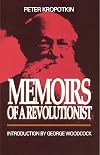
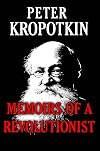
Memoirs of a Revolutionist
by Peter Kropotkin
On This Page
Description
Introduction by George Woodcock This precious work, which first appeared in the Atlantic Monthly, was published in book form in 1899. Having delighted readers as varied as Leo Tolstoy and Lewis Mumford, Memoirs continues to be a classic in this literary genre. Peter Alexeivich Kropotkin (1842-1921) was born into the highest rank of the Russian aristocracy. This fascinating account of his dramatic conversion from prince to anarchist is more than an autobiography; it is an extraordinary show more portrait of the old Russia, both before and after the liberation of the serfs. Kropotkin was a remarkable writer in the Russian tradition, and this work stands as a non-fictional counterpart of the novels in which Turgenev and other great Russian writers portray the development of social conscience among the youth in autocratic society. Having renounced his title, Kropotkin pursued his work as a scientist and won international acclaim as a geographer as well as a radical. Memoirs is also a study of the early anarchist movement in Western Europe, in which Kropotkin played a part after his escape from a Russian prison - thereby earning a second imprisonment, this time in France. George Woodcock, one of Canada's most distinguished men of letters has written biographies of such monumental figures as Gandhi, Aldous Huxley, George Orwell, and Pierre-Joseph Proudhon.Table of Contents AN INTRODUCTION by George Woodcock PREFACE TO THE SECOND EDITION I. CHILDHOOD II. THE CORPS OF PAGES III. SIBERIA IV. ST. PETERSBURG - FIRST JOURNEY TO WESTERN EUROPE V. THE FORTRESS - THE ESCAPE VI. WESTERN EUROPE1989: 504 pages show lessTags
Recommendations


















Member Recommendations
Member Reviews
Kropotkin certainly had an interesting life: quite apart from telling us about the complexities of anarchist politics, secret societies and being a political prisoner in several different countries, he gets to describe his experiences growing up in an aristocratic family in Moscow, serving as a page at Alexander II's court in St Petersburg, taking part in all sorts of exciting expeditions into unknown country as a young officer on the Amur river, and doing important scientific research (he was a physical geographer). So these are by no means dull memoirs! But they are sometimes a little bit frustrating. Kropotkin was writing from English exile in 1899, with the Russian revolutions still to come, and at a time when many of his friends show more and political associates were still in danger of reprisals from the Russian authorities. So there are plenty of important things in his life he doesn't tell us about because they haven't happened yet, and others that he's forced to leave rather vague. And others again that he's written about elsewhere and doesn't repeat - this isn't a work of political philosophy, although of course the whole text is informed by his political ideals.
And there are also a surprising number of normal, practical things in his life he simply seems to have forgotten to write about, so that, for example, his wife pops up in the text for the first time about three hundred pages in, as though she's always been there, but he in fact he has never told us her name or anything about when they married. (English Wikipedia doesn't mention her at all, but the German version tells us she was Sophie Ananiew, and they married in 1878, when he was living in Switzerland. From what Kropotkin tells us himself, we can deduce that she was a scientist and had studied at Geneva university.)
The book was written in English (he later made a Russian version as well), but it never feels like a book written in the author's second language. Especially in the earlier parts of the book, there's a lot that is moving, entertaining, exciting, and exotic, but it's never - at least once it gets out of the classroom - boastful. Kropotkin must have been a remarkable man, and he presumably knew it, but he doesn't want to be the one to say it. There's a lovely moment shortly after he has arrived in England for the first time, under a false name because he's on the run from the Russian police, and is doing some scientific journalism. The editor of Nature asks him to review a couple of new Russian books that have come into the office. Of course, they turn out to be publications of his own scientific work, written whilst he was in prison, and he is put into something of a quandary: should he blow his cover or infringe scientific ethics by reviewing his own work? He compromises by summarising the books without expressing an opinion on their merits (which would of course have got him anathematised here on LibraryThing...).
Worthwhile, definitely, but a bit patchy. The opening chapters are marvellous, and I can see how you might become a dedicated fan of this book, but it's probably not the book you should turn to first if you want to learn about anarchist political ideas or the history of the workers' movement. show less
And there are also a surprising number of normal, practical things in his life he simply seems to have forgotten to write about, so that, for example, his wife pops up in the text for the first time about three hundred pages in, as though she's always been there, but he in fact he has never told us her name or anything about when they married. (English Wikipedia doesn't mention her at all, but the German version tells us she was Sophie Ananiew, and they married in 1878, when he was living in Switzerland. From what Kropotkin tells us himself, we can deduce that she was a scientist and had studied at Geneva university.)
The book was written in English (he later made a Russian version as well), but it never feels like a book written in the author's second language. Especially in the earlier parts of the book, there's a lot that is moving, entertaining, exciting, and exotic, but it's never - at least once it gets out of the classroom - boastful. Kropotkin must have been a remarkable man, and he presumably knew it, but he doesn't want to be the one to say it. There's a lovely moment shortly after he has arrived in England for the first time, under a false name because he's on the run from the Russian police, and is doing some scientific journalism. The editor of Nature asks him to review a couple of new Russian books that have come into the office. Of course, they turn out to be publications of his own scientific work, written whilst he was in prison, and he is put into something of a quandary: should he blow his cover or infringe scientific ethics by reviewing his own work? He compromises by summarising the books without expressing an opinion on their merits (which would of course have got him anathematised here on LibraryThing...).
Worthwhile, definitely, but a bit patchy. The opening chapters are marvellous, and I can see how you might become a dedicated fan of this book, but it's probably not the book you should turn to first if you want to learn about anarchist political ideas or the history of the workers' movement. show less
This is a great portrait of Russia under late tsarist rule and parts of Europe in the earliest days of socialism. The first 3/4 are fairly riveting, while the ending falls kind of flat as happens in so many memoirs. Yes, it's the nature of the format. But he had a fascinating life and is a surprisingly engaging writer for having lived so long ago. There were several points where I wanted to hug him so much. And then others where I was really head-scratchy over his definition of Anarchism and how that has changed in modern context. I wonder if he would have felt the same toward a modern social democracy with a strong track record of justice and human rights.
Isn't it fascinating that that didn't exist yet on a large scale in the known show more western world? (WTF feudalism?)
gender politics tag because this was GORGEOUSLY feminist, even by modern standards, much less standards of the time. (WTF modern misogyny?) show less
Isn't it fascinating that that didn't exist yet on a large scale in the known show more western world? (WTF feudalism?)
gender politics tag because this was GORGEOUSLY feminist, even by modern standards, much less standards of the time. (WTF modern misogyny?) show less
I've read this every few years since I was ten (equals: I've read this a lot of times..). Ah dear me! The romance of czarist Russia! His walk with the serfs on the annual trek to his family's summer residence! (He is *Prince* Peter Kropotkin to you, and I'll thank you to remember it..:-) The whole work bedazzled me when I was young, and even now, the life of this anarchist saint is a wonderful read, full of drama and the fervour for a better world. To this day tour guides at the great prison fortress of St Peter still tell the story of Kropotkin's escape, but hear you can read it in the first person, but that story is only one of many treasures to be found here...
A wide-eyed observer of mid-19th Century Russia turns to science then socialism and then anarchism. An amazing autobiography, this is one of the most interesting overviews of a life I have ever read. The section on his escape from the Fortress of St. Peter and St. Paul is positively riveting.
329. Memoirs of a Revolutionist, by Peter Kropotkin (read 9 May 1947) When I finished reading this book I said: "Finished tonight Kropotkin's Memoirs, written in 1899. He was an anarchist. Not much of a book, sllghtly interesting sometimes."
Compare with edition from Grove Press, same information. This 1899 edition not found on shelves.
Available as a free audio book from librivox.org
Members
- Recently Added By
Lists

Best Biographies, Autobiographies and Memoirs
465 works; 160 members

Books Read in 2016
4,666 works; 199 members
Author Information

178+ Works 5,801 Members
Some Editions
Series
Belongs to Publisher Series
Common Knowledge
- Original publication date
- 1889
- Original language
- Russian
Classifications
Statistics
- Members
- 532
- Popularity
- 56,486
- Reviews
- 11
- Rating
- (3.89)
- Languages
- 10 — Danish, Dutch, English, French, German, Italian, Japanese, Russian, Spanish, Swedish
- Media
- Paper, Ebook
- ISBNs
- 38
- UPCs
- 1
- ASINs
- 33