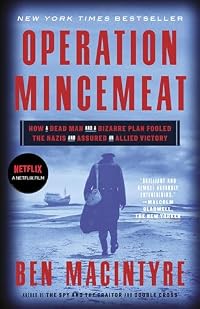
Operation Mincemeat
by Ben Macintyre
On This Page
Description
From the acclaimed author of "Agent Zigzag" comes an extraordinary account of the most successful deception--and certainly the strangest--ever carried out in World War II, one that changed the prospects for an Allied victory. The purpose of the plan--code named Operation Mincemeat--was to deceive the Nazis into thinking that Allied forces were planning to attack southern Europe by way of Greece or Sardinia, rather than Sicily, as the Nazis had assumed, and the Allies ultimately chose.Tags
Recommendations

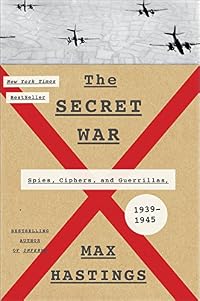

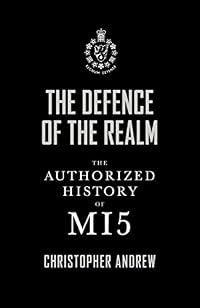
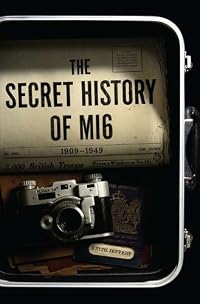
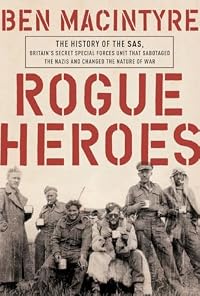
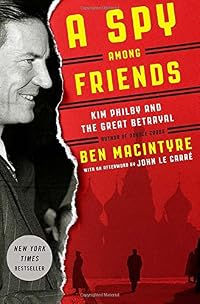


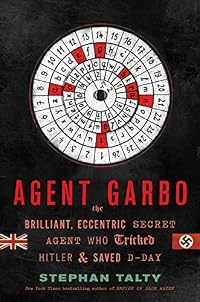
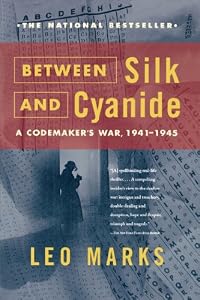

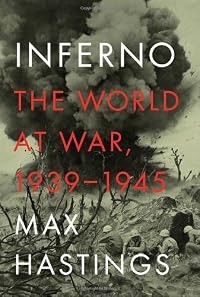







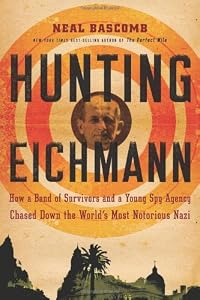
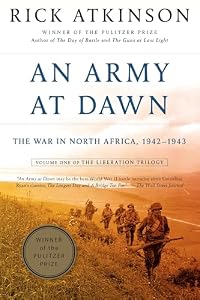
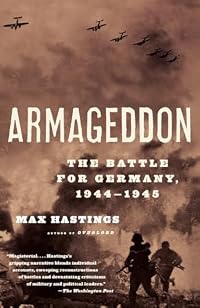


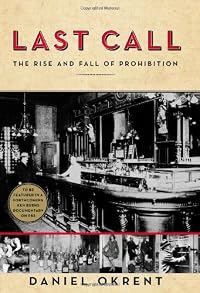


Member Recommendations

abdoujaparov Operation Mincemeat is an updated retelling of the story originally told in The Man Who Never Was
50

Member Reviews
This book about a World War II intelligence operation proves once again that truth is stranger than fiction. In the spring of 1943, the Allies hoped to invade a Europe that was firmly in control of the Nazis. The obvious target for an invasion was Sicily, but unfortunately, the Germans knew this all too well. So a few creative members of British intelligence came up with a daring plan, codenamed "Operation Mincemeat": They would float a dead body wearing a British uniform onto a Spanish beach. This corpse would be carrying top-secret -- and totally false -- documents stating that the Allies were planning to launch a two-pronged attack against Greece and Sardinia; Sicily would only be a "decoy" target. Since neutral Spain had pro-German show more sympathies, it was hoped that the Spaniards would turn over these documents to the Germans and thus convince the Axis to rearrange their defensive forces. This book tells the story of this extraordinary plan and its even more extraordinary success.
I'm not normally a big reader of nonfiction, but the premise of this book caught my attention right away, and I'm really glad it did! This is an extremely readable and entertaining account of a plan so farfetched, it couldn't possibly be true -- except it is. The book covers every aspect of Operation Mincemeat with meticulous attention to detail, describing everything from the difficulties of acquiring an appropriate body to the creation of a fictitious identity for the corpse to the various personalities who contributed to the formation of the plan. To me, one of the most astonishing things about the operation was how easily everything could have gone wrong. What if the Spanish authorities had returned the documents to the British immediately (as, indeed, some of them tried to do)? What if the Germans had been skeptical of this intelligence instead of eagerly grasping at a welcome piece of news? In short, this is a well-written account of an absolutely fascinating subject. I definitely plan to read more by Ben Macintrye -- Double Cross: The True Story of the D-Day Spies is already on my wishlist! show less
I'm not normally a big reader of nonfiction, but the premise of this book caught my attention right away, and I'm really glad it did! This is an extremely readable and entertaining account of a plan so farfetched, it couldn't possibly be true -- except it is. The book covers every aspect of Operation Mincemeat with meticulous attention to detail, describing everything from the difficulties of acquiring an appropriate body to the creation of a fictitious identity for the corpse to the various personalities who contributed to the formation of the plan. To me, one of the most astonishing things about the operation was how easily everything could have gone wrong. What if the Spanish authorities had returned the documents to the British immediately (as, indeed, some of them tried to do)? What if the Germans had been skeptical of this intelligence instead of eagerly grasping at a welcome piece of news? In short, this is a well-written account of an absolutely fascinating subject. I definitely plan to read more by Ben Macintrye -- Double Cross: The True Story of the D-Day Spies is already on my wishlist! show less
This is the gripping true story of the Second World War deception operation by which the Allies managed to convince the Germans that the planned invasion of Sicily in 1943 was in fact a decoy and that the real invasion was to be targeted at Greece in the eastern Mediterranean and Sardinia in the western Mediterranean. The success of the operation paved the way towards the invasion of Italy, toppling Mussolini and taking that country out of the war, the first major breach in the Axis coalition. The whole story reads like a rather unlikely thriller, disguising a dead body in a Marines uniform, planting a carefully constructed series of fake documents on him, drafted and presented in such a way that they would convince the enemy of their show more genuineness. The key was "not merely to conceal what you are doing, but to persuade the other side that what you are doing is the reverse of what you are actually doing." To do this they had to create a whole backstory for the fictional dead Marines officer, Major William Martin, and concoct supporting evidence for the documents and other materials found in his possession that would withstand investigation by any German or other enemy agent in Britain.
The effectiveness of the plan also relied on understanding the psychology of individuals and nations, not just of the Germans, but also of the officially neutral Spaniards, juggling between those who were really pro-Axis and those (such as the Spanish navy) who were often pro-Allies. A lot of its success also depended on wishful thinking by those in the chain, wanting to believe the information, or wanting to ingratiate themselves by submitting the prized and explosive information further up the chain. It even convinced Hitler, supporting his entrenched belief that the Balkans was the soft underbelly of the Nazi Empire (ironically, Goebbels was the only leading Nazi who didn't fall for the deception).
We meet a rich and varied cast of characters from all the participating nations, including on the British side a wide variety of people who were also novelists, most famously Ian Fleming, who took the original idea for the misleading corpse from a minor novel by a former top policeman published in 1937. (That said, this connection may not be so surprising as "the greatest writers of spy fiction have, in almost every case, worked in intelligence before turning to writing [.] Somerset Maugham, John Buchan, Ian Fleming, Graham Greene, John le Carré.") We also come across the crucial role played by non-existent agents to deceive the other side and draw attention away from the activities of real agents - "Real agents tended to become truculent and demanding; they needed feeding, pampering, and paying. An imaginary agent, however, was infinitely pliable, and willing to do the bidding of his ....... handlers at once, and without question."
One of the other tensions and fine balances the Allies needed to show once the body had been discovered was that of seeming to be reasonably alarmed when the papers were lost, but without making too serious an effort to recover them, and hoping that they would not be returned unopened by a friendly Spaniard. In the author's words, "in reality if top-secret plans really had fallen into enemy hands, and the breach of security was detected, then those plans might well be abandoned, or at least substantially altered. The Germans must be made to believe that they had gained access to the documents undetected; they should be made to assume that the British believed the Spaniards had returned the documents unopened, and unread. Operation Mincemeat would only work if the Germans could be fooled into believing that the British had been fooled." Such multiple levels of motivations go to make this such a fascinating and thrilling read - if a spy novel published today had this plot it might well be dismissed as too far-fetched to be believable.
The leading instigators of the deception Ewen Montague and Charles Cholmondeley deserve great credit for their massive, but necessarily secret, contribution to ensuring the Allied victory on the European continent. After the war, the details of the deception were kept under wraps for years, partly to protect Anglo-Spanish relations, though Montagu published a partial account in 1953, and a film version was released in 1956 in which, bizarrely, Montagu played the minor role of a senior military officer, while his own role was played by an American actor. The final mystery of the real identity of the dead body - a poor and luckless Welshman, Gwyndyr Michael, who probably committed suicide through ingesting - was not revealed until the 1990s, when an inscription was added to the Spanish grave of Major William Martin, the most fictional person to make a major contribution to winning a war. show less
The effectiveness of the plan also relied on understanding the psychology of individuals and nations, not just of the Germans, but also of the officially neutral Spaniards, juggling between those who were really pro-Axis and those (such as the Spanish navy) who were often pro-Allies. A lot of its success also depended on wishful thinking by those in the chain, wanting to believe the information, or wanting to ingratiate themselves by submitting the prized and explosive information further up the chain. It even convinced Hitler, supporting his entrenched belief that the Balkans was the soft underbelly of the Nazi Empire (ironically, Goebbels was the only leading Nazi who didn't fall for the deception).
We meet a rich and varied cast of characters from all the participating nations, including on the British side a wide variety of people who were also novelists, most famously Ian Fleming, who took the original idea for the misleading corpse from a minor novel by a former top policeman published in 1937. (That said, this connection may not be so surprising as "the greatest writers of spy fiction have, in almost every case, worked in intelligence before turning to writing [.] Somerset Maugham, John Buchan, Ian Fleming, Graham Greene, John le Carré.") We also come across the crucial role played by non-existent agents to deceive the other side and draw attention away from the activities of real agents - "Real agents tended to become truculent and demanding; they needed feeding, pampering, and paying. An imaginary agent, however, was infinitely pliable, and willing to do the bidding of his ....... handlers at once, and without question."
One of the other tensions and fine balances the Allies needed to show once the body had been discovered was that of seeming to be reasonably alarmed when the papers were lost, but without making too serious an effort to recover them, and hoping that they would not be returned unopened by a friendly Spaniard. In the author's words, "in reality if top-secret plans really had fallen into enemy hands, and the breach of security was detected, then those plans might well be abandoned, or at least substantially altered. The Germans must be made to believe that they had gained access to the documents undetected; they should be made to assume that the British believed the Spaniards had returned the documents unopened, and unread. Operation Mincemeat would only work if the Germans could be fooled into believing that the British had been fooled." Such multiple levels of motivations go to make this such a fascinating and thrilling read - if a spy novel published today had this plot it might well be dismissed as too far-fetched to be believable.
The leading instigators of the deception Ewen Montague and Charles Cholmondeley deserve great credit for their massive, but necessarily secret, contribution to ensuring the Allied victory on the European continent. After the war, the details of the deception were kept under wraps for years, partly to protect Anglo-Spanish relations, though Montagu published a partial account in 1953, and a film version was released in 1956 in which, bizarrely, Montagu played the minor role of a senior military officer, while his own role was played by an American actor. The final mystery of the real identity of the dead body - a poor and luckless Welshman, Gwyndyr Michael, who probably committed suicide through ingesting - was not revealed until the 1990s, when an inscription was added to the Spanish grave of Major William Martin, the most fictional person to make a major contribution to winning a war. show less
"Once you eliminate the impossible, whatever remains, no matter how improbable, must be the truth" - Arthur Conan Doyle
An absorbing book showing, once again, that truth is stranger than fiction. As part of an effort to deceive the Axis about the true target of an Allied invasion in the Mediterranean, the British obtained a dead body, concocted a completely new identity for it, and equipped it with forged documents detailing plans for battles that would never take place in reality. They released it off the coast of Spain, where German spies found it and the papers, which eventually ended up on Hitler's desk and were taken into account as the Axis formulated its strategy in the Mediterranean. The whole thing sounds like it could have been show more lifted from an international spy thriller, and Ian Fleming (who went on to create James Bond) came up with the kernel of the idea, and was one of the people who had to approve the final scheme.
The ruse was ultimately successful, and of the 160,000 Allied troops that invaded Sicily, 153,000 survived, and the groundwork for the successful invasion of the Italian peninsula was laid. show less
An absorbing book showing, once again, that truth is stranger than fiction. As part of an effort to deceive the Axis about the true target of an Allied invasion in the Mediterranean, the British obtained a dead body, concocted a completely new identity for it, and equipped it with forged documents detailing plans for battles that would never take place in reality. They released it off the coast of Spain, where German spies found it and the papers, which eventually ended up on Hitler's desk and were taken into account as the Axis formulated its strategy in the Mediterranean. The whole thing sounds like it could have been show more lifted from an international spy thriller, and Ian Fleming (who went on to create James Bond) came up with the kernel of the idea, and was one of the people who had to approve the final scheme.
The ruse was ultimately successful, and of the 160,000 Allied troops that invaded Sicily, 153,000 survived, and the groundwork for the successful invasion of the Italian peninsula was laid. show less
I am fascinated with the deception campaigns and espionage that went on in WW2. As a freshman in high school, my first research paper was on this topic, and the more I read the more I wanted to learn. I read Ewen Montague's book The Man Who Never Was at least three times while I was in high school, and I've read it at least twice more since then.
The story in short: British command needs to divert Nazi attention from a planned invasion of Sicily. The plan is formed -- suppose the Nazi sympathisers in Spain found the body of a British officer with authentic-looking plans for a DIFFERENT invasion. They give those plans (or photographed copies of those plans) to the Germans, and the real invasion goes off without a hitch. Simple, right? show more
Montague's book tells the tale of the plan, and a lot of the behind the scenes details. Macintyre's new book goes even further behind the scenes. Who knew that British Intelligence was full of budding spy novelists (including Ian "James Bond" Fleming himself). Who knew that Montague's own brother was a Soviet agent? Macintyre was given access to ALL of Montague's personal papers from that time period -- including papers that Montague was allowed to take with him when he retired; papers that really should have been classified Top Secret.
Macintyre's work shows the problems as well as the successes. He goes into great detail with mini-biographies of all the major players involved in Operation Mincemeat, including the Spanish and German officers who swallowed the tale hook, line, and sinker. Even if you've read all about Operation Mincemeat, you will learn something when you read this book. It is outstanding, from the writing style to the scholarship and research involved. show less
The story in short: British command needs to divert Nazi attention from a planned invasion of Sicily. The plan is formed -- suppose the Nazi sympathisers in Spain found the body of a British officer with authentic-looking plans for a DIFFERENT invasion. They give those plans (or photographed copies of those plans) to the Germans, and the real invasion goes off without a hitch. Simple, right? show more
Montague's book tells the tale of the plan, and a lot of the behind the scenes details. Macintyre's new book goes even further behind the scenes. Who knew that British Intelligence was full of budding spy novelists (including Ian "James Bond" Fleming himself). Who knew that Montague's own brother was a Soviet agent? Macintyre was given access to ALL of Montague's personal papers from that time period -- including papers that Montague was allowed to take with him when he retired; papers that really should have been classified Top Secret.
Macintyre's work shows the problems as well as the successes. He goes into great detail with mini-biographies of all the major players involved in Operation Mincemeat, including the Spanish and German officers who swallowed the tale hook, line, and sinker. Even if you've read all about Operation Mincemeat, you will learn something when you read this book. It is outstanding, from the writing style to the scholarship and research involved. show less
Reading Operation Mincemeat has just convinced me that there are 1. Many more spy novels out there that I have yet to read (example: Ian Fleming) and 2. My obsession with World War II is completely justified because it was so convoluted, intriguing, and shrouded in secrecy (many of these secrets remain today). As the title suggests, this book focused on a singular operation which in itself was just a piece of a much bigger operation entitled Operation Husky (attached to another called Operation Barclay + others that were mere decoys). If nothing else, once you've finished reading this book you come away with an appreciation for the skills and ingenuity of those involved in fighting a war which for the majority of its duration seemed show more absolutely impossible to win. The taking of Sicily, however, proved to be a turning point in the war and Ewen Montagu and his team had a hand in the victory because they pulled off what many still believe to be the greatest feat of deception ever. If you've ever read The Man Who Never Was or seen the film version of it then you're aware of this story...except it's not the entire story because Montagu was censored by the British government (you'll see why when you read Operation Mincemeat). Sufficed to say, if you've ever fancied yourself a spy then you should read this to find out just exactly what that means. Hint: It's a lot more bureaucracy than James Bond has led you to believe. show less
A great piece of narrative history, Ben Macintyre's Operation Mincemeat is well-researched and intensely readable. The story is one of the more well-known and celebrated deception operations from the 'secret war' in World War Two, but Macintyre shows us that there was much more to it than the one line or two the operation is usually afforded in history books. You'd never think it would be so hard to just dump a body off the Spanish coast.
On the face of it, the British plan was simple: put a dead body in a military uniform with bogus intelligence documents into the hands of the 'neutral' Spanish, who would pass the intel – suggesting the Allies would attack Greece and Sardinia in 1943 rather than the real target, Sicily – onto their show more fellow fascist friends in Nazi Germany. Macintyre shows us just how much thought went into this. Even leaving aside the bureaucratic wranglings to get the outlandish plan approved in the first place, you have to source a suitable body of the right size, with no living relatives and with no one asking questions. You have a narrow window in which to use it (decomposition). You have to make it look like the corpse died of drowning by compromising any potential autopsy without compromising the integrity of the corpse. You have to generate a complete and thorough cover story for the corpse – military career and personal life – that helps sell the story and that can be verified by a German agent. The documents themselves have to hint at an invasion of Sardinia/Greece so that you can be sure the Germans will see the link without being so obvious that they get suspicious. You have to actually transport the rapidly decomposing body to the drop site.
But that's not all. You have to ensure the body gets into the hands of the right Spaniards – i.e. the wrong Spaniards (those who will deliver it to the Germans). You have to ensure the German intelligence analysts – and their generals – draw the right conclusions. To maintain the cover, you have to make diplomatic noises to Spain protesting the return of the body and the (untampered) documents but not so vigorously that they actually do so. You have to convince the enemy that, when they are returned, that you are satisfied the documents were not tampered with (when they totally were) and that the invasion" plan has not changed. There's myriad other things that can go wrong that you have to anticipate. (Some of the details that the Mincemeat operatives accounted for were, quite simply, ingenious.) And you have to do all this without anyone beyond a select few finding out.
Phew. It really gives you a sense of the staggering complexity of a single intelligence operation that, as I have said, would only constitute a line or two in a history book about the war. Macintyre navigates us through all these compelling and detailed angles of the operation with engaging prose, rigorous scholarship and welcome doses of humour and anecdote. At times, I thought it was a little too detailed on things which did not really serve the story – such as family histories whenever a new player was introduced – but this was a minor quibble. It is a truly thrilling book that would be of equal service to both the dedicated academic historian and the armchair buff looking for great entertainment. It also serves as a keystone linking intelligence fact to how the secret world is often portrayed in fiction. Many of those involved in the operation were, or went on to become, writers (including one Ian Fleming) and the idea itself came from a pre-war spy thriller. Maybe there has always been (and will always be) a clear disconnect between intelligence fact and fiction, but Ben Macintyre in Operation Mincemeat brings us as close as possible to a time when the line was blurred." show less
On the face of it, the British plan was simple: put a dead body in a military uniform with bogus intelligence documents into the hands of the 'neutral' Spanish, who would pass the intel – suggesting the Allies would attack Greece and Sardinia in 1943 rather than the real target, Sicily – onto their show more fellow fascist friends in Nazi Germany. Macintyre shows us just how much thought went into this. Even leaving aside the bureaucratic wranglings to get the outlandish plan approved in the first place, you have to source a suitable body of the right size, with no living relatives and with no one asking questions. You have a narrow window in which to use it (decomposition). You have to make it look like the corpse died of drowning by compromising any potential autopsy without compromising the integrity of the corpse. You have to generate a complete and thorough cover story for the corpse – military career and personal life – that helps sell the story and that can be verified by a German agent. The documents themselves have to hint at an invasion of Sardinia/Greece so that you can be sure the Germans will see the link without being so obvious that they get suspicious. You have to actually transport the rapidly decomposing body to the drop site.
But that's not all. You have to ensure the body gets into the hands of the right Spaniards – i.e. the wrong Spaniards (those who will deliver it to the Germans). You have to ensure the German intelligence analysts – and their generals – draw the right conclusions. To maintain the cover, you have to make diplomatic noises to Spain protesting the return of the body and the (untampered) documents but not so vigorously that they actually do so. You have to convince the enemy that, when they are returned, that you are satisfied the documents were not tampered with (when they totally were) and that the invasion" plan has not changed. There's myriad other things that can go wrong that you have to anticipate. (Some of the details that the Mincemeat operatives accounted for were, quite simply, ingenious.) And you have to do all this without anyone beyond a select few finding out.
Phew. It really gives you a sense of the staggering complexity of a single intelligence operation that, as I have said, would only constitute a line or two in a history book about the war. Macintyre navigates us through all these compelling and detailed angles of the operation with engaging prose, rigorous scholarship and welcome doses of humour and anecdote. At times, I thought it was a little too detailed on things which did not really serve the story – such as family histories whenever a new player was introduced – but this was a minor quibble. It is a truly thrilling book that would be of equal service to both the dedicated academic historian and the armchair buff looking for great entertainment. It also serves as a keystone linking intelligence fact to how the secret world is often portrayed in fiction. Many of those involved in the operation were, or went on to become, writers (including one Ian Fleming) and the idea itself came from a pre-war spy thriller. Maybe there has always been (and will always be) a clear disconnect between intelligence fact and fiction, but Ben Macintyre in Operation Mincemeat brings us as close as possible to a time when the line was blurred." show less
Ben Macintyre’s “Operation Mincemeat: How a Dead Man and a Bizarre Plan Fooled the Nazis and Assured an Allied Victory” is a spellbinding account of one of the more remarkable feats of wartime deception.
At a critical moment in World War II, British Intelligence devises Operation Mincemeat, a plot whereby the corpse of a poor Welshman is ingeniously reincarnated as the dead (and fictional) Major William Martin, equipped with top secret (albeit false and misleading) papers and correspondence detailing a planned Allied invasion of Greece and Sardinia (when in fact an invasion of Sicily has been planned). The body is deposited off the coast of Spain with the hope that the Germans take the bait. If the ruse is successful, Axis forces show more will deploy their troops to defend according to Martin’s bogus papers, allowing the Allies to push through Sicily with little resistance.
Thoroughly researched and very well-written, Macintyre has crafted a classic World War II narrative. The many characters are vividly brought to life with personality traits, mannerisms, and their backstories in proper detail. Nuances of the complex Operation Mincemeat are clearly explained and contextualized within its broad scope; and the implications and consequences of operation itself are appropriately placed within the overall war effort and eventual Allied success in World War II. show less
At a critical moment in World War II, British Intelligence devises Operation Mincemeat, a plot whereby the corpse of a poor Welshman is ingeniously reincarnated as the dead (and fictional) Major William Martin, equipped with top secret (albeit false and misleading) papers and correspondence detailing a planned Allied invasion of Greece and Sardinia (when in fact an invasion of Sicily has been planned). The body is deposited off the coast of Spain with the hope that the Germans take the bait. If the ruse is successful, Axis forces show more will deploy their troops to defend according to Martin’s bogus papers, allowing the Allies to push through Sicily with little resistance.
Thoroughly researched and very well-written, Macintyre has crafted a classic World War II narrative. The many characters are vividly brought to life with personality traits, mannerisms, and their backstories in proper detail. Nuances of the complex Operation Mincemeat are clearly explained and contextualized within its broad scope; and the implications and consequences of operation itself are appropriately placed within the overall war effort and eventual Allied success in World War II. show less
Members
- Recently Added By
Published Reviews
ThingScore 88
The story of Major William Martin is the subject of the British journalist Ben Macintyre’s brilliant and almost absurdly entertaining “Operation Mincemeat”. The cast of characters involved in Mincemeat, as the caper was called, was extraordinary, and Macintyre tells their stories with gusto.
added by Shortride
A terrific book with exceptional photographs of everybody, including the corpse. Students of the second world war have been familiar with Mincemeat for many years, but Macintyre offers a mass of new detail, and enchanting pen portraits of the British, Spanish and German participants. His book is a rollicking read for all those who enjoy a spy story so fanciful that Ian Fleming — himself an show more officer in Montagu’s wartime department — would never have dared to invent it. show less
added by Shortride
The complexities and the consequences of the story that Macintyre tells in Operation Mincemeat are compelling — a tribute to his impressive abilities as a sleuth (ones that we’ve witnessed in his previous books) and to his capacities as a writer. He has the instincts of a novelist rather than an historian when it comes to elision, exposition, narration and pace, and his depiction of show more character is vividly alive to nuance and idiosyncrasy. show less
added by Shortride
Lists

Top Five Books of 2013
1,564 works; 722 members

Best Espionage (Non-Fiction)
32 works; 6 members

Books About World War II
102 works; 29 members

al.vick-wishlist-history
70 works; 2 members

Best Spy Fiction
156 works; 103 members

Books Read in 2022
5,164 works; 113 members

THE WAR ROOM
813 works; 24 members

Books Read in 2024
4,623 works; 126 members

Books Read in 2025
4,090 works; 97 members

Unhinged History
14 works; 1 member
Author Information

30+ Works 14,184 Members
Some Editions
Awards and Honors
Awards
Distinctions
Work Relationships
Is contained in
Has the adaptation
Common Knowledge
- Canonical title
- Operation Mincemeat
- Original publication date
- 2010
- People/Characters
- Major William Martin; Ewen Montagu; Charles Cholmondeley; Sir Bernard Spilsbury; Thomas Argyll Robertson; Alexis Freiherr von Roenne (show all 59); Franklin Delano Roosevelt; Edgar Sanders; Field Marshal Sir Harold Rupert George Alexander, 1st Earl Alexander of Tunis; George S. Patton; Kim Philby; Juan Pujol Garcia "Agent Garbo"; Lieutenant General Sir Archibald Edward Nye; Benito Mussolini; Louis Mountbatten Earl Mountbatten of Burma; Admiral Salvador Moreno; Bernard Law Montgomery; Ivor Montagu; Iris Solomon Montagu; Glyndwr Michael; John Cecil Masterman; Patricia Trehearne; Henry Maitland Wilson; Rear-Admiral Sir David Scott; Vice-Admiral Edmund Gerard Noel Rushbrooke; Joachim von Ribbentrop; Erwin Rommel; Sir William Bentley Purchase; Mariano Pascual del Pobil; Ramón Pardo Suárez; Guy Liddell; Major Derrick Leverton; Jean Leslie; Wilhelm Leissner; Hester Leggett; Simon Davidovich Kremer; Major Karl-Erich Kühlenthal; Captain Norman Limbury Auchinleck Jewell; Alfred Jodl; Albert Kesselring; Adolf Hitler; Captain Alan Hugh Hillgarth; Francis Haselden; Salvador Gomez-Beare; Joseph Goebbels; John Henry Godfrey; Charles Fraser-Smith; Francisco Franco; Ian Fleming; Andrew Browne Cunningham; Brigadier General William Orlando Darby; Hans-Heinrich Dieckhoff; Dwight D. Eisenhower; Winston Churchill; Brigadier Dudley Wrangel Clarke; Adolf Clauss; Wilhelm Franz Canaris; John Henry Bevan; Eddie Chapman "Agent Zigzag"
- Important places
- Sicily, Italy; London, England, UK; Spain; Cairo, Egypt; North Africa
- Important events
- World War II (1939 | 1945); Operation Mincemeat
- Related movies
- Operation Mincemeat (2021 | IMDb)
- Epigraph
- 'Who in war will not have his laugh amid the skulls?'
Winston Churchill, Closing the Ring - Dedication
- For
Kate & Melita
and
Magnus & Lucie - First words
- [Preface] In the early hours of July 10, 1943, British and North American troops stormed ashore on the coast of Sicily in the first assault against Hitler's "Fortress Europe."
[Chapter 1] Jose Antonio Rey Maria had no intention of making history when he rowed out into the Atlantic from the coast of Andalusia in southwest Spain on April 30, 1943. - Last words
- (Click to show. Warning: May contain spoilers.)Something in the words of his wartime girlfriend - recalling him so fondly, so many years later - reminded me of the fictional relationship between "Pam" and "Bill," the doomed wartime love affair that never was.
Classifications
- Genres
- History, General Nonfiction, Nonfiction
- DDC/MDS
- 940.548641 — History & geography History of Europe History of Europe 1918- Military history of World War II Other Topics Unconventional warfare of Allies Europe British Isles
- LCC
- D810 .S7 .M246 — History of Europe, Asia, Africa and Oceania History (General) World War II (1939-1945)
- BISAC
Statistics
- Members
- 2,297
- Popularity
- 8,589
- Reviews
- 105
- Rating
- (3.88)
- Languages
- 10 — Danish, Dutch, English, French, Hungarian, Italian, Polish, Portuguese, Spanish, Swedish
- Media
- Paper, Audiobook, Ebook
- ISBNs
- 41
- ASINs
- 16