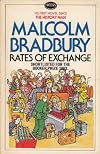
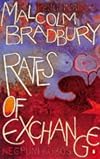
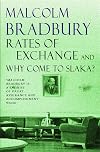
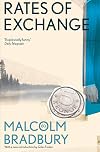
Rates of Exchange
by Malcolm Bradbury
On This Page
Description
Shortlisted for the Man Booker Prize: In this comedic novel, an English professor collides with disaster at the peak of the Cold War Shortly after his plane first grazes the tarmac in the eastern European nation of Slaka, Dr. Angus Petworth is beset by a cavalcade of misadventures. A university lecturer and seasoned international traveler, Petworth is nevertheless unprepared for the oddities of culture and circumstance that await him on the other side of the iron curtain. In two eventful show more weeks, Petworth gives an incendiary interview, is seduced by a femme fatale, and becomes embroiled in a plot of international intrigue, all of which conspire to give the mild, unassuming professor way more than he bargained for. Satirizing everything from critics and diplomats to Marxism and academia, Malcolm Bradbury's Rates of Exchange is a witty and lighthearted novel of cultural interchange at the height of the Cold War. show lessTags
Recommendations



























Member Recommendations
Member Reviews
This one is written pleasantly enough, but it has not aged well. In "Rates of Exchange," our hero, a professor who deBy als with less-than-pressing linguistic controversies at a third-rate British university, finds himself somewhat adrift during a two-week visit to an invented but vaguely Balkan Soviet satellite. Adventures with an irresponsible Foreign Office couple, an alluring, vaguely hippie-ish dissident writer, and, inevitably, his official guide, who easily slots herself into the role of a strict-but-fond mother, follow. By the time that this one came out, I can't imagine that most of the satire here hit too hard, and the dissident writer's impassioned paean to creative spontaneity seems a trifle romantic in the second decade in show more the twenty-first century. One gets the idea that "Rates of Exchange" is supposed to be about one rather bored British man's reawakening after a quiet midlife crisis, but Pettworth, our protagonist, is seldom interesting enough to sustain our interest, even in that context. How he manages to attract the amorous attentions of the Eastern European women he meets is another question without any real answers, though the relationship between him and his guide is left ambiguous enough -- and drawn well enough -- to give us a reason to keep reading. "Rates of Exchange" is good enough for a plane or a beach, but only just. Thank God I read it in quarantine. show less
I found this novel entertaining and enjoyable, given its academic protagonist on an European academic jaunt. Plausible and humorous barely-satirical situations worthy of a quiet afternoon read.
Ratings
Members
- Recently Added By
Published Reviews
His last novel, ''The History Man'' (1975), was celebrated in England as an indictment of the excesses of the academic revolution of the 1960's. Its celebrity grew after it was adapted into a popular television serial.
''Rates of Exchange,'' which was a finalist in the prestigious Booker Prize competition in Britain this year, is a very different sort of book. Suddenly, here the professor of show more English is the theorist. This densely written book, in which dialogue appears on the page in unparagraphed chunks, is a novel about an idea. It is an astonishing tour de force. Mr. Bradbury has invented an entire country, essentially mythic although Eastern European in origin, to sustain a proposition laid out before us in various forms in the course of the book.... While ''Rates of Exchange'' may not be an altogether successful work, it is nevertheless one of the most exciting, original and worthwhile novels to appear in Britain recently. show less
''Rates of Exchange,'' which was a finalist in the prestigious Booker Prize competition in Britain this year, is a very different sort of book. Suddenly, here the professor of show more English is the theorist. This densely written book, in which dialogue appears on the page in unparagraphed chunks, is a novel about an idea. It is an astonishing tour de force. Mr. Bradbury has invented an entire country, essentially mythic although Eastern European in origin, to sustain a proposition laid out before us in various forms in the course of the book.... While ''Rates of Exchange'' may not be an altogether successful work, it is nevertheless one of the most exciting, original and worthwhile novels to appear in Britain recently. show less
added by KayCliff
Lists

Booker Prize
491 works; 62 members

Best Campus Novels
99 works; 18 members

Man Booker Prize Longlist 1983
6 works; 1 member

Booker Prize Shortlist: Titles Not Yet Read
161 works; 4 members

Fictional European countries
58 works; 2 members
Author Information

66+ Works 5,686 Members
A professor of English literature and American studies who has published numerous critical works, Malcolm Bradbury is also a novelist whose protagonists are academics who make muddles of their personal and professional lives. He maintains that his main concern is to explore problems and dilemmas of liberalism and issues of moral responsibility. show more The targets of Bradbury's satires include intellectual pretension, cultural myopia, and official smugness. His protagonists are largely sympathetic, if comic, failures at mastering their own fates in a world of absurd rules and regulations. His major novels include Eating People Is Wrong (1959), Stepping Westward (1965), and The History Man (1975). This last, a novel of intellectual and political conflict at an English university in the late 1960s, was made into a successful television minidrama. More recent novels include Rates of Exchange (1983) and Cuts (1987). (Bowker Author Biography) Malcolm Bradbury is a novelist, critic, television dramatist, & satirist. His many books include "Rates of Exchange", which was short-listed for the Booker Prize, & "The Modern American Novel". (Publisher Provided) show less
Awards and Honors
Awards
Notable Lists
Common Knowledge
- Original title
- Rates of Exchange
- Original publication date
- 1983
- Important places*
- Bulgarije
- Epigraph
- 'You have a quarrel on hand, I see,' said I, 'with some of the algebraists of Paris; but proceed.'
- Edgar Allan Poe, The Purloined Letter
The language of this country being always upon the flux, the Stru... (show all)ldbruggs of one age do not understand those of another, neither are they able after two hundred years to hold any conversation (farther than by a few general words) with their neighbours the mortals, and thus they lie under the disadvantage of living like foreigners in their own country.
- Jonathan Swift, Gulliver's Travels
It seems to me the further east you go the more unpunctual are the trains.
- Bram Stoker, Dracula - Dedication
- For my brother Basil with all my love
- First words
- If you should ever happen to make the trip to Slaka, that fine flower of middle European cities, capital of commerce and art, wide streets and gipsy music, then, whatever else you plan to do there, do not, as the travel texts... (show all) say, neglect to visit the Cathedral of Saint Valdopin: a little outside the town, at the end of the tramway-route, near to the power station, down by the slow, marshy, mosquito-breeding waters of the great River Niyt.
- Quotations
- "A pen. Please, your pen," says the man. Agleam with the glow of literate contact, Petworth reaches into his pocket and produces his silver Parker ballpoint: an old travelling companion.... the man bows, smiles, holds up the ... (show all)silver pen, and moves off into the crowd with it.
He is an expert on real, imaginary and symbolic exchange among skin-bound organisms working on the linguistic interface.
information without context becomes redundancy, or noise.
The car begins to move; Petworth notices a pair of human hands scraping at the window ... a small hand wriggles in, waving in the fingers a bright silvery pointed object ... "It's my pen," says Petworth.... "You lent to him t... (show all)his, your good pen?" ... "Well, I think you are lucky he brings it back to you. That is Parker, very good."
*Some information comes from Common Knowledge in other languages. Click "Edit" for more information.
Classifications
Statistics
- Members
- 350
- Popularity
- 90,233
- Reviews
- 2
- Rating
- (3.82)
- Languages
- 6 — Danish, English, Finnish, German, Polish, Spanish
- Media
- Paper, Ebook
- ISBNs
- 21
- ASINs
- 5