On This Page
Description
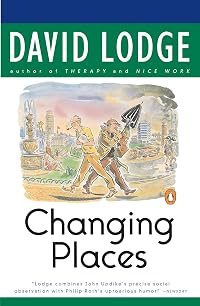
When Philip Swallow and Professor Morris Zapp participate in their universities Anglo-American exchange scheme, the Fates play a hand, and each academic finds himself enmeshed in the life of his counterpart on the opposite side of the Atlantic. Nobody is immune to the exchange: students, colleagues, even wives are swapped as events spiral out of control. And soon both sundrenched Euphoric State university and rain-kissed university of Rummidge are a hotbed of intrigue, lawlessness and broken show more vows." show lessTags
Recommendations




















Member Recommendations




Member Reviews
I've probably read this four or five times since the mid-seventies, and it still manages to make me laugh: like Bradbury's The history man, it has become a period piece, but in a good way. By no means the first "British academic in America" novel, nor the last, but it must be one of the cleverest.
Even though he's only writing a couple of years later, Lodge manages to get enough perspective on les évènements of 1969 (Berkeley- and Brummagem-style) to be able to laugh at them a bit. It's interesting to see that the one bit of sixties counter-culture that he allows to speak quite seriously is the women's movement — in fact, you could almost read it as a feminist novel in the way the plot is largely driven by women taking decisions show more about their own lives. But perhaps only to the extent that you could call Lysistrata a feminist play... show less
Even though he's only writing a couple of years later, Lodge manages to get enough perspective on les évènements of 1969 (Berkeley- and Brummagem-style) to be able to laugh at them a bit. It's interesting to see that the one bit of sixties counter-culture that he allows to speak quite seriously is the women's movement — in fact, you could almost read it as a feminist novel in the way the plot is largely driven by women taking decisions show more about their own lives. But perhaps only to the extent that you could call Lysistrata a feminist play... show less
In Changing Places, David Lodge’s 1975 novel, American and British college professors exchange teaching positions for part if the 1969 academic year. Mousy Philip Swallow finds himself basking in California sunshine in Berkeley, but embroiled in campus shenanigans, student protests, and an exciting new world of counterculture experimentation. On the other side of the Atlantic, Morris Zapp, a flamboyant and famous Austen scholar takes his new “red brick” college by storm, wowing the English Department as well as the wife of his colleague.
Lodge guides the reader along the crisscrossed paths of the two scholars, from one comical escapade to the next, but never shies away from the difficulties that arise. This is the type of story at show more which Lodge excels – examining how people react when outside events force them to reexamine what they believe in and hold dear.
He makes it funny, but the underlying dilemmas are as serious as they come. For example, the scene where Zapp realizes that his flight to England was so cheap because it was a charter flight of pregnant women taking advantage of Britain’s newly relaxed abortion laws, includes this passage:
For Morris Zapp is a twentieth-century counterpart of Swift’s Nominal Christian – the Nominal Atheist. Underneath that tough exterior of the free-thinking Jew. . . there is a core of old-fashioned Judaeo-Christian fear-of-the-Lord. If the Apollo astronauts had reported finding a message carved in gigantic letters on the backside of the moon, “Reports of My death are greatly exaggerated,” it would not have surprised Morris Zapp unduly, merely confirmed his deepest misgivings.
Religion? References to Jonathon Swift and Mark Twain (and, in the omitted section, T.S. Elliot)? Not typical fodder for a lighthearted novel, scenes like this makes readers laugh, but leave them with plenty to think about.
Lodge eventually followed Changing Places with a sequel called Small World (1984). He wrapped up his academia trilogy with Nice Work (1988).
Also posted on Rose City Reader. show less
Lodge guides the reader along the crisscrossed paths of the two scholars, from one comical escapade to the next, but never shies away from the difficulties that arise. This is the type of story at show more which Lodge excels – examining how people react when outside events force them to reexamine what they believe in and hold dear.
He makes it funny, but the underlying dilemmas are as serious as they come. For example, the scene where Zapp realizes that his flight to England was so cheap because it was a charter flight of pregnant women taking advantage of Britain’s newly relaxed abortion laws, includes this passage:
For Morris Zapp is a twentieth-century counterpart of Swift’s Nominal Christian – the Nominal Atheist. Underneath that tough exterior of the free-thinking Jew. . . there is a core of old-fashioned Judaeo-Christian fear-of-the-Lord. If the Apollo astronauts had reported finding a message carved in gigantic letters on the backside of the moon, “Reports of My death are greatly exaggerated,” it would not have surprised Morris Zapp unduly, merely confirmed his deepest misgivings.
Religion? References to Jonathon Swift and Mark Twain (and, in the omitted section, T.S. Elliot)? Not typical fodder for a lighthearted novel, scenes like this makes readers laugh, but leave them with plenty to think about.
Lodge eventually followed Changing Places with a sequel called Small World (1984). He wrapped up his academia trilogy with Nice Work (1988).
Also posted on Rose City Reader. show less
Changing Places chronicles the adventures of two professors who switch universities for a short period of time and find their lives swapped dramatically in this hilariously witty tale. Most entertaining parts of the book come from the author's way of putting his characters in situations that demand each of them to change the way they have been conditioned to think and act in their native countries.
The genius of David Lodge can be discovered in the way Changing Places blends wit with social observations. The narrative gets playful with letters, newspaper snippets and even movie script form. And surprisingly all these changes in style work in favor of the story.
This is one brilliant book...
The genius of David Lodge can be discovered in the way Changing Places blends wit with social observations. The narrative gets playful with letters, newspaper snippets and even movie script form. And surprisingly all these changes in style work in favor of the story.
This is one brilliant book...
One of the advantages of a reading group is that you are forced (really much too harsh a word) to read books you’ve always meant to and that many people have recommended but that you’ve just never gotten around to. Such was the case with David Lodge’s Changing Places.
What a delight. This is one of the funniest books I have read in a long time. It chronicles the events in the lives of two professors, Philip Swallow, of Rummidge College in England, and Morris Zapp, professor of English at Euphoric State University, the Jane Austen expert whose ambition it is to write the definitive work in multiple volumes summarizing all that has been and could be said or written about Jane Austen. They are participating in an exchange program. show more Morris discovers, after wondering what the odds are that he could be the only male on a planeload of women flying to England, that it is a special charter flight for pregnant women on their way to England for abortions. He then has the misfortune to wander into a striptease club (and to discover he is the only one there) where the artiste is Mary Makepeace, his seatmate from the plane who decided not to go through
with the abortion. Of course, she recognizes him and it’s all downhill from there.
Phillip, meanwhile, grants special permission to a student to enter his class late, only to have the student lead the entire class out on strike — it takes place during the sixties — “no offense intended.”
Lodge makes constant spirited fun of all the academic stereotypes. One of many favorite scenes takes place in Zapp’s lodging house, where the young daughter of his landlord has gotten ahold of Zapp’s Playboy. Zapp, of course, would like it back, but Shea, his landlord, retorts he has destroyed the magazine. The skeptical Zapp “didn’t believe him. Inside thirty minutes he would be holed up somewhere, jerking himself off and drooling over the Playboy pix. Not the girls, of course, but the full-colour ads for whiskey and hi-fi equipment. . . .” show less
What a delight. This is one of the funniest books I have read in a long time. It chronicles the events in the lives of two professors, Philip Swallow, of Rummidge College in England, and Morris Zapp, professor of English at Euphoric State University, the Jane Austen expert whose ambition it is to write the definitive work in multiple volumes summarizing all that has been and could be said or written about Jane Austen. They are participating in an exchange program. show more Morris discovers, after wondering what the odds are that he could be the only male on a planeload of women flying to England, that it is a special charter flight for pregnant women on their way to England for abortions. He then has the misfortune to wander into a striptease club (and to discover he is the only one there) where the artiste is Mary Makepeace, his seatmate from the plane who decided not to go through
with the abortion. Of course, she recognizes him and it’s all downhill from there.
Phillip, meanwhile, grants special permission to a student to enter his class late, only to have the student lead the entire class out on strike — it takes place during the sixties — “no offense intended.”
Lodge makes constant spirited fun of all the academic stereotypes. One of many favorite scenes takes place in Zapp’s lodging house, where the young daughter of his landlord has gotten ahold of Zapp’s Playboy. Zapp, of course, would like it back, but Shea, his landlord, retorts he has destroyed the magazine. The skeptical Zapp “didn’t believe him. Inside thirty minutes he would be holed up somewhere, jerking himself off and drooling over the Playboy pix. Not the girls, of course, but the full-colour ads for whiskey and hi-fi equipment. . . .” show less
David Lodge was recommended to me by a retired English professor; "Be sure to start with 'Changing Places.'" So of course, I did. I usually don't like humorous novels, even ones with serious underlying themes, but "Changing Places" turned out to be an exception. I thoroughly enjoyed it -- on a variety of levels. For example, Philip Swallow is assigned to teach a course called Writing the Novel, about which he knows absolutely nothing. He remembers that he owns a book called "Let's Write a Novel," which he asks his wife Hilary to find in his office and send to him. She goes to his office, where she meets Morris Zapp, the professor with whom Philip has changed places, but she can't find the book. Morris soon finds it and brings it to show more Hilary's house, hoping for a home-cooked meal. In a chapter called Corresponding,comprised of letters -- yes, back when people actually wrote them -- between the spouses Hilary writes to Philip, "Do you still want me to send on 'Let's Write a Novel?' What a funny little book it is. There's a whole chapter on writing an epistoary novel, but surely no one has done that since the eighteenth century?" But of course, someone has written at least part of a novel in epiosotary form, our very own David Lodge. At times the book had me laughing out loud, although much of it deals with issues that are decidedly not funny, unplanned pregnancy, protests and bombings, women's liberation, adultery, and more.
First published in 1975 and set in 1969, the book is definitely of its time. I was not an adult yet but growing up in Southern California and only visiting the Bay Area, I remember how exotic and extreme Berkeley seemed at the time. In the early seventies I worked with some married men who felt the same way that Philip does about the "sexual revolution" and how disappointed they were that he was missing out on it. Well, now that Philip is in Berkeley, that doesn't last long.
The book was not quite as satisfying as I was expecting but I loved the milieu. The late 1960s. Academia. Berkeley. England. I also loved the way Lodge played with style, including the above-mentioned epistolary chapter and the final chapter, which is written as a screenplay. Even before I got to that chapter, the book was reminding me of a movie from the same time period, "Bob and Carol and Ted and Alice," released in 1969.
I did not especially like any of the character in "Changing Places," which now that I reflect upon it usually kills a book for me. But Lodge is such an excellent writer and the book is so thought-provoking. And then there's the game that Philip invented called "Humiliaton." You win by humiliating yourself. It takes awhile for the Berkeley faculty to get the hang of it... show less
First published in 1975 and set in 1969, the book is definitely of its time. I was not an adult yet but growing up in Southern California and only visiting the Bay Area, I remember how exotic and extreme Berkeley seemed at the time. In the early seventies I worked with some married men who felt the same way that Philip does about the "sexual revolution" and how disappointed they were that he was missing out on it. Well, now that Philip is in Berkeley, that doesn't last long.
The book was not quite as satisfying as I was expecting but I loved the milieu. The late 1960s. Academia. Berkeley. England. I also loved the way Lodge played with style, including the above-mentioned epistolary chapter and the final chapter, which is written as a screenplay. Even before I got to that chapter, the book was reminding me of a movie from the same time period, "Bob and Carol and Ted and Alice," released in 1969.
I did not especially like any of the character in "Changing Places," which now that I reflect upon it usually kills a book for me. But Lodge is such an excellent writer and the book is so thought-provoking. And then there's the game that Philip invented called "Humiliaton." You win by humiliating yourself. It takes awhile for the Berkeley faculty to get the hang of it... show less
Engaging and a zippy read. I've spent my entire adult--and adolescent--life at colleges and universities, as a student and/or instructor and/or faculty member and/or librarian, which probably has a great deal to do with my enjoyment of 'the campus novel.' (Kingsley Amis's Lucky Jim, for instance, is freakin' hilarious to disenchanted or near-disenchanted academics such as myself.) Changing Places is a novel of university (and English department) culture; it's also a novel of the late 1960s and the 'sexual revolution.' All very interesting and fun to read!
Lodge's novels are always comically and disturbingly on-the-mark about perennial academic situations and characters. This one contrasts British and American academic lives, and his humorous account still seems accurate to me.
Members
- Recently Added By
Published Reviews
Not since Lucky Jim has such a funny book about academic life come my way.
added by GYKM
Lists

The Guardian's 1000 Novels Everyone Must Read
1,005 works; 550 members

Recommend the 20 best books you've read in the last five years
2,168 works; 606 members

Best Campus Novels
99 works; 18 members

Best School Stories
219 works; 22 members

Books I've Read More Than Once
602 works; 49 members
Best Satire
188 works; 28 members
Best First Lines
133 works; 8 members

Academia in Fiction
158 works; 23 members

TML 200 Best Books 1950-1999
202 works; 10 members

To Read Shortlist
20 works; 1 member

Austenland
165 works; 12 members

501 Must-Read Books
529 works; 71 members

The Modern Library (The Two Hundred Best Novels....
202 works; 1 member
Talk Discussions
Past Discussions
Epistolary comedy - read in the 90s in Name that Book (August 2019)
Author Information

55+ Works 19,256 Members
Some Editions
Awards and Honors
Notable Lists
Series

Work Relationships
Is contained in
Common Knowledge
- Canonical title
- Changing Places
- Original title
- Changing Places
- Original publication date
- 1975 (1e édition originale anglaise, Secker and Warburg) (1e é | dition originale anglaise, Secker and Warburg); 1990 (1e traduction et édition française, Rivages) (1e traduction et é | dition franç | aise, Rivages)
- People/Characters
- Morris Zapp; Philip Swallow; Hilary Swallow; Desirée Zapp
- Important places
- Rummidge, England, UK (fictionalised Birmingham); Euphoria, California, USA; Birmingham, England, UK; Berkeley, California, USA
- Dedication
- For Lenny and Priscilla, Stanely and Adrienne and many other friends on the West Coast
- First words
- High, high above the North Pole, on the first day of 1969, two professors of English Literature approached each other at a combined velocity of 1200 miles per hour.
- Last words
- (Click to show. Warning: May contain spoilers.)PHILIP shrugs. The camera stops, freezing him in mid-gesture.
- Original language*
- Anglais (Royaume-Uni) (Royaume-Uni)
*Some information comes from Common Knowledge in other languages. Click "Edit" for more information.
Classifications
Statistics
- Members
- 2,093
- Popularity
- 9,835
- Reviews
- 40
- Rating
- (3.71)
- Languages
- 14 — Catalan, Czech, Danish, English, French, German, Greek, Hungarian, Italian, Polish, Portuguese, Serbian, Spanish, Turkish
- Media
- Paper, Audiobook, Ebook
- ISBNs
- 44
- ASINs
- 17