
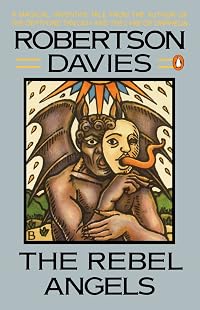
There is 1 current discussion about this work.
On This Page
Description
The first book in the acclaimed Cornish Trilogy. Davies weaves together the destinies of this remarkable cast of characters, creating a wise and witty portrait of love, murder, and scholarship at a modern university in this first book of The Cornish Trilogy. A goodhearted priest and scholar, a professor with a passion for the darker side of medieval psychology, a defrocked monk, and a rich young businessman who inherits some troublesome paintings are all helplessly beguiled by the same coed. show more The story is set in motion by the death of eccentric art patron and collector Francis Cornish. Hollier, McVarish, and Darcourt are the executors of Cornish's complicated will, which includes material that Hollier wants for his studies. The deceased's nephew, Arthur Cornish, stands to inherit the fortune. show lessTags
Recommendations



















Member Recommendations
KayCliff the sequel to Rebel Angels.

jakebornheimer A character in the Rebel Angels is obsessed with this book - and it turns out that Aubrey's writings are actually interesting and humourous!
shaunie This and its two sequels are set in academia like The Rebel Angels, full of much learned discourse which doesn't distract from the fact that they're great fun to read. for me, Davies has the edge as a writer.
Member Reviews
This is a book that really feels like the first volume of a trilogy-of-ideas: there are all sorts of different intellectual threads being laid out for us to follow through the next two books. But it's also an extremely playful book, with a parody of a conventional romantic plotline mixed up with a parody of a murder mystery against an Oxbridge-style collegiate background (at one point we even get a sketch plan of where the guests at an academic dinner were sitting). And for good measure we also get a bizarre twist on the literary cliché of the missing manuscript.
From time to time it all gets a bit much, and you wonder whether it's Matthew Arnold with ear-rings or Inspector Morse with maple syrup, but on the whole I think Davies is a show more writer more than good enough to get away with occasional excesses. If anything, you end up wishing that you knew a bit more about Rabelais and Paracelsus. And looking forward to the next two parts of the trilogy. show less
From time to time it all gets a bit much, and you wonder whether it's Matthew Arnold with ear-rings or Inspector Morse with maple syrup, but on the whole I think Davies is a show more writer more than good enough to get away with occasional excesses. If anything, you end up wishing that you knew a bit more about Rabelais and Paracelsus. And looking forward to the next two parts of the trilogy. show less
¡Qué bueno es Robertson Davies! Lo descubrí por medio de la Trilogía de Deptford, mención especial para el primer libro perteneciente a la misma, 'El quinto en discordia', y he de decir que es un escritor absolutamente delicioso. Mientras leía 'Ángeles rebeldes', no dejaba de pensar en llamar a todos mis conocidos para leerles algún fragmento memorable, por su humor y por su inteligencia. Y es que este libro, y la obra de Davies en general, se caracteriza por la variedad de temas que trata, siempre desde un punto de vista erudito pero ni pesado ni farragoso de leer.
Si tuviese que escoger dos palabras para definir 'Ángeles rebeldes', serían humor y erudición. La novela está impregnada de humor, es inevitable reírse con show more algunas escenas. Me recordó la obra de David Lodge, tanto por las situaciones humorísticas como por donde transcurren, que es el ambiente universitario y todo lo que conlleva. En cuanto a la erudición, Davies está versado en muchas materias, desde la alquimia, a la vida académica, pasando por las tradiciones gitanas y el medievalismo. Pero todo está tan bien insertado en la trama, que lees el libro de manera compulsiva.
'Ángeles rebeldes' es también el primer libro de la llamada Trilogía de Cornish, formada también por 'Lo que arraiga en el hueso' y 'La lira de Orfeo', aunque pueden ser leídas de manera independiente. 'Ángeles rebeldes' comienza con el regreso a la Universidad de San Juan y el Espíritu Santo, llamada por algunos La Entelequía, de Parlabane, un ser malvado para muchos. La vida en la Universidad se ve alterada tanto por este retorno como por el legado que recibe del difunto Francis Cornish, coleccionista y mecenas de artistas, a cuyo cargo y revisión quedan los profesores Dancourt, Hollier y McVarish. Todo se complica con el descubrimiento de un manuscrito inédito de Rabelais... La historia esta narrada desde dos puntos de vista, el del padre Dancourt y el de la estudiante Maria, que se verá atrapada enmedio de estos ángeles rebeldes.
No puedo decir nada más, únicamente... pasen y disfruten. show less
Si tuviese que escoger dos palabras para definir 'Ángeles rebeldes', serían humor y erudición. La novela está impregnada de humor, es inevitable reírse con show more algunas escenas. Me recordó la obra de David Lodge, tanto por las situaciones humorísticas como por donde transcurren, que es el ambiente universitario y todo lo que conlleva. En cuanto a la erudición, Davies está versado en muchas materias, desde la alquimia, a la vida académica, pasando por las tradiciones gitanas y el medievalismo. Pero todo está tan bien insertado en la trama, que lees el libro de manera compulsiva.
'Ángeles rebeldes' es también el primer libro de la llamada Trilogía de Cornish, formada también por 'Lo que arraiga en el hueso' y 'La lira de Orfeo', aunque pueden ser leídas de manera independiente. 'Ángeles rebeldes' comienza con el regreso a la Universidad de San Juan y el Espíritu Santo, llamada por algunos La Entelequía, de Parlabane, un ser malvado para muchos. La vida en la Universidad se ve alterada tanto por este retorno como por el legado que recibe del difunto Francis Cornish, coleccionista y mecenas de artistas, a cuyo cargo y revisión quedan los profesores Dancourt, Hollier y McVarish. Todo se complica con el descubrimiento de un manuscrito inédito de Rabelais... La historia esta narrada desde dos puntos de vista, el del padre Dancourt y el de la estudiante Maria, que se verá atrapada enmedio de estos ángeles rebeldes.
No puedo decir nada más, únicamente... pasen y disfruten. show less
I think my first reaction to this book was to marvel at how such erudition can be made so fun. This is not at all a heavy read, and yet it's a novel of such depth and breadth as rarely goes into a modern novel. The Rebel Angels is playful and intelligent, witty and wise, sincere and cerebral all at once.
All that I've read of Robertson Davies so far has shown me someone I'd love to be like myself one day. He is widely read, sincere, kind, and clear-sighted. He doesn't subscribe to the all too common idea that the only real intelligence is critical, if not scathing. The ideas he explores through his characters are fresh and full of truth.
So here's the set-up: a university, complete with scholars. Our two narrators are Maria, a student show more of the works of Rabelais, and Simon Darcourt, a professor and priest. The lives of both become involved with certain other characters, including two men who serve as the villains of the piece: Parlabane, an ex-monk, a repulsive and utterly original character; and Urquhart McVarish, slimy and full of intellectual spite. Another professor has died, leaving behind enormous quantities of art and manuscript all of varying degrees of value, uncatalogued and an enormous mess. Amongst all this is found an otherwise unknown and very precious manuscript by Rabelais himself. This is the catalyst that sets off the many events that follow, all complicated and not needing to be described here.
This book is an uncommon thing in my experience - a scholarly page-turner. One must read on to see what happens next. One cares for the characters in an immediate, human kind of way. There are twists and surprises of the type which could be attributed to fluffy adventure stories. And yet every word and sentence is a fine work of both language and ideas. A work of art.
Oh, and humour. I nearly forgot humour, it's so intrinsic to the book. This is not a satirical academic comedy, or a campus drama, or any of those neatly-ticked boxes that so many books slot neatly into. But it is set at a university, and it's funny, and it's dramatic. It's everything the perfect novel should be (in my humble opinion).
Some unfashionable ideas are explored here so marvellously well that it was a real experience for me to read them. I was touched and fascinated by the depiction of a fat oldish man's overwhelming plunge into love for a beautiful young woman. Every word of it breathes truth. It's full of poetic sincerity and also the realistic self-awareness and conscious absurdity of an intelligent man in this situation. It's beautiful. And in another section, we read about a professor who is studying human faeces, and believe me, Davies makes it fascinating.
In brief, I love this book. It's virtuosic, sensitive, gripping, and wonderfully clever. show less
All that I've read of Robertson Davies so far has shown me someone I'd love to be like myself one day. He is widely read, sincere, kind, and clear-sighted. He doesn't subscribe to the all too common idea that the only real intelligence is critical, if not scathing. The ideas he explores through his characters are fresh and full of truth.
So here's the set-up: a university, complete with scholars. Our two narrators are Maria, a student show more of the works of Rabelais, and Simon Darcourt, a professor and priest. The lives of both become involved with certain other characters, including two men who serve as the villains of the piece: Parlabane, an ex-monk, a repulsive and utterly original character; and Urquhart McVarish, slimy and full of intellectual spite. Another professor has died, leaving behind enormous quantities of art and manuscript all of varying degrees of value, uncatalogued and an enormous mess. Amongst all this is found an otherwise unknown and very precious manuscript by Rabelais himself. This is the catalyst that sets off the many events that follow, all complicated and not needing to be described here.
This book is an uncommon thing in my experience - a scholarly page-turner. One must read on to see what happens next. One cares for the characters in an immediate, human kind of way. There are twists and surprises of the type which could be attributed to fluffy adventure stories. And yet every word and sentence is a fine work of both language and ideas. A work of art.
Oh, and humour. I nearly forgot humour, it's so intrinsic to the book. This is not a satirical academic comedy, or a campus drama, or any of those neatly-ticked boxes that so many books slot neatly into. But it is set at a university, and it's funny, and it's dramatic. It's everything the perfect novel should be (in my humble opinion).
Some unfashionable ideas are explored here so marvellously well that it was a real experience for me to read them. I was touched and fascinated by the depiction of a fat oldish man's overwhelming plunge into love for a beautiful young woman. Every word of it breathes truth. It's full of poetic sincerity and also the realistic self-awareness and conscious absurdity of an intelligent man in this situation. It's beautiful. And in another section, we read about a professor who is studying human faeces, and believe me, Davies makes it fascinating.
In brief, I love this book. It's virtuosic, sensitive, gripping, and wonderfully clever. show less
Robertson Davies was a prolific author and a man of considerable professional breadth (novelist, newspaperman, academic, actor/playwright). Above all else, though, he was a remarkable story-teller. Few have been able to match his ability to combine the humor, erudition, and insights into human nature that mark all of his work. At their best, Davies’ novels are both enlightening and highly entertaining; they are the kind of books that, as one critic put it, you cannot wait to tell your friends about.
The Rebel Angels is the first volume in the author’s celebrated Cornish Trilogy and it is a wonderful example of the Campus Novel. Set in a fictional Canadian college—apparently based on University of Toronto, where Davies spent many show more years on the faculty—the plot revolves around the disposition of a considerable estate that has been bequeathed to the school by an eccentric patron of the arts. A highly coveted unpublished manuscript by Rabelais has gone missing, which leads to love, lust, considerable mayhem and, eventually, murder. Along the way, the reader is introduced to an unforgettable cast of characters, including a defrocked monk, academics of various merits, a priest, a graduate student and her gypsy relatives, a violin restorer, and a scatology expert.
I really love this book. I have savored it on multiple occasions over the years and if there is such a thing as the written equivalent of comfort food, this would be it for me. I learn something new each time and the morale of the story—“Be not another if thou canst be thyself,” which comes courtesy of the Swiss alchemist Paracelsus—never fails to resonate on a different level. In fact, when asked whether he ever read the same book a second time, Davies himself remarked: “Nobody ever reads the same book twice.” That is certainly true for me with this one. show less
The Rebel Angels is the first volume in the author’s celebrated Cornish Trilogy and it is a wonderful example of the Campus Novel. Set in a fictional Canadian college—apparently based on University of Toronto, where Davies spent many show more years on the faculty—the plot revolves around the disposition of a considerable estate that has been bequeathed to the school by an eccentric patron of the arts. A highly coveted unpublished manuscript by Rabelais has gone missing, which leads to love, lust, considerable mayhem and, eventually, murder. Along the way, the reader is introduced to an unforgettable cast of characters, including a defrocked monk, academics of various merits, a priest, a graduate student and her gypsy relatives, a violin restorer, and a scatology expert.
I really love this book. I have savored it on multiple occasions over the years and if there is such a thing as the written equivalent of comfort food, this would be it for me. I learn something new each time and the morale of the story—“Be not another if thou canst be thyself,” which comes courtesy of the Swiss alchemist Paracelsus—never fails to resonate on a different level. In fact, when asked whether he ever read the same book a second time, Davies himself remarked: “Nobody ever reads the same book twice.” That is certainly true for me with this one. show less
ribald. rich. erudite. character-driven but with a plot - sort of.
the academic lives of Canadian medievalists and closely related scholars in the late 1970s seen by two personages in the story. it’s a bit heavy on the dialogue but not really because i’ve met quite a few verbose academicians who can rattle on for quite a while and tend to be one myself. it’s probably why the enjoyment centers in my brain lit up with this book even though i would say it’s nearly plotless and a smidge wtf in some of its wanderings. but “plotless” could describe some of the best stories out there because they are simply potrayals of a life, more of a watched journey than a plot.
character-dense and character-driven, the story is loose and open, show more much more about depicting life than about taking you on a staged journey. the academic life is, if not laid bare, unzipped so you can seen some of the stuffing.
anyway, the dialogue sustains this book as much as the mental machinations of the two narrators, Maria and Simon. the women in the book are attempts at strong-willed, independent women before the author knew what one really looked like. a damned good attempt- and, really, there isn’t anything wrong with it. his portrayal seems well-done except that marriage seems to override things a bit in the end but not quite. for having been published in 1981, i am impressed with the job he did.
many of the people are unforgettable. Parlabane, in particular, and Ozy Froats (one of the best names i’ve come across in fiction for some time) make the top of the list. the former is a practicing “sceptic” in the archaic sense: a scholarly homosexual philosopher turned Anglican monk turned AWOL monk turned part-time professor turned novelist and a couple of other things. he is the main imp driving the wheel of the story. the latter, Froats, serves as comic relief but only because his research is so serious and potentially fruitful and derived from the basest of things. i just really like his name, too.
Maria, one of the narrators and protagonists, has a gypsy family but wants desperately to live in the gadji world and suppress her Romany roots. we even get to see some very interesting artisan culture because her mother and uncle are master secret luthiers and practice gypsy magic.
wonderful stuff. like a convoluted myth grafted onto a fairy tale, the inner workings of the main characters are paramount rather than their day to day doings. we hear about class but only see it one time. we hear about Maria’s friends but never see them at all. Simon’s sermons and duties as Anglican priest are mentioned but never really seen. etc. etc. part of the story is held at arm’s length while other parts are brought up close where we can smell the sweat and blood and bile. show less
the academic lives of Canadian medievalists and closely related scholars in the late 1970s seen by two personages in the story. it’s a bit heavy on the dialogue but not really because i’ve met quite a few verbose academicians who can rattle on for quite a while and tend to be one myself. it’s probably why the enjoyment centers in my brain lit up with this book even though i would say it’s nearly plotless and a smidge wtf in some of its wanderings. but “plotless” could describe some of the best stories out there because they are simply potrayals of a life, more of a watched journey than a plot.
character-dense and character-driven, the story is loose and open, show more much more about depicting life than about taking you on a staged journey. the academic life is, if not laid bare, unzipped so you can seen some of the stuffing.
anyway, the dialogue sustains this book as much as the mental machinations of the two narrators, Maria and Simon. the women in the book are attempts at strong-willed, independent women before the author knew what one really looked like. a damned good attempt- and, really, there isn’t anything wrong with it. his portrayal seems well-done except that marriage seems to override things a bit in the end but not quite. for having been published in 1981, i am impressed with the job he did.
many of the people are unforgettable. Parlabane, in particular, and Ozy Froats (one of the best names i’ve come across in fiction for some time) make the top of the list. the former is a practicing “sceptic” in the archaic sense: a scholarly homosexual philosopher turned Anglican monk turned AWOL monk turned part-time professor turned novelist and a couple of other things. he is the main imp driving the wheel of the story. the latter, Froats, serves as comic relief but only because his research is so serious and potentially fruitful and derived from the basest of things. i just really like his name, too.
Maria, one of the narrators and protagonists, has a gypsy family but wants desperately to live in the gadji world and suppress her Romany roots. we even get to see some very interesting artisan culture because her mother and uncle are master secret luthiers and practice gypsy magic.
wonderful stuff. like a convoluted myth grafted onto a fairy tale, the inner workings of the main characters are paramount rather than their day to day doings. we hear about class but only see it one time. we hear about Maria’s friends but never see them at all. Simon’s sermons and duties as Anglican priest are mentioned but never really seen. etc. etc. part of the story is held at arm’s length while other parts are brought up close where we can smell the sweat and blood and bile. show less
The word "erudite" appears in nearly every positive review of this novel, and what that means to me is this: if you're not familiar with Rabelais and Paracelsus you're not going to get the most out of reading it. It is true "literary fiction", and not the drivel that passes for that so often these days. But I couldn't say I enjoyed reading Davies this time. Aside from missing so many of his references, a single line from one reviewer kind of sums up my reaction to his characters: "For some reason, I felt a little dirty after I finished this one." I have a feeling that some of the distasteful bits are the parts where other readers have found humor, but since no one gave examples of what they considered funny, I can't be sure of that. show more I've never appreciated scatalogical humor, although I realize its appeal is wide and ancient in human culture generally, and in literature specifically. I feel a little like that kid watching the Emperor's parade...I see that the Emperor has clothes, but I just don't like them very much.
Review written in 2013 show less
Review written in 2013 show less
Robertson Davies’ The Rebel Angels is an engaging and energetic novel with a vigorous sense of humor. The novel reads quickly and never feels weighed down by ideas or seriousness. This is deceptive.
Davies gives us a novel populated by Medieval and Renaissance scholars. Their intellectual landscape is thus not unnaturally populated by Paracelsus and Rabelais, two constant figures in the dialectic of the novel. Of the two, Rabelais seems the most significant. He is a figure frequently claimed by both sides of the numerous arguments in the novel. He provides a lens through which we see into the characters a bit more deeply than they might hope. Parlabane and McVarish make him a model of vulgarity and misogyny, or perhaps more accurately, show more misanthropy. To Hollier, he represents an object for his own academic ambition. For Maria and Darcourt—and Davies—he is a model of the best sort of scholar, as we hear from Maria:
It may be wrong to include Darcourt here—as a priest scholar, his greater reference is St. Augustine:
In Maria’s translation:
This erudite amusement is a hallmark of everything I have yet read by Davies, and it is tempting to think that the best part of what Davies gives us in this novel is Davies, himself. Davies is more wise than a mere intellectual, and more alive than a modernist. He brings with him the Middle Ages and the Renaissance, and with these life fuller than which we are accustomed today.
What we get from Davies is not a hair shirted historicism, but a sense of wholeness for a consciousness which is fermented in the broadness of human experience. Maria says of Hollier that he studies the Middle Ages because they are truly middle—a vantage from which he can look backward to antiquity, and forward to our post-Renaissance present. This dynamic of looking backward and forward, contrasting each with the other, is at the very heart of The Rebel Angels, a book which makes attractive Paracelsus’ “second paradise.”
Davies gives us a novel populated by Medieval and Renaissance scholars. Their intellectual landscape is thus not unnaturally populated by Paracelsus and Rabelais, two constant figures in the dialectic of the novel. Of the two, Rabelais seems the most significant. He is a figure frequently claimed by both sides of the numerous arguments in the novel. He provides a lens through which we see into the characters a bit more deeply than they might hope. Parlabane and McVarish make him a model of vulgarity and misogyny, or perhaps more accurately, show more misanthropy. To Hollier, he represents an object for his own academic ambition. For Maria and Darcourt—and Davies—he is a model of the best sort of scholar, as we hear from Maria:
Rabelais was gloriously learned because learning amused him, and so far as I am concerned that is learning’s best justification. Not the only one, but the best.
It may be wrong to include Darcourt here—as a priest scholar, his greater reference is St. Augustine:
Conloqui et conridere et vicissim benevole obsequi, simul leger libros dulciloquos, simul nugari et simul honestari.
In Maria’s translation:
Conversations and jokes together, mutual rendering of good services, the reading together of sweetly phrased books, the sharing of nonsense and mutual attentions.
This erudite amusement is a hallmark of everything I have yet read by Davies, and it is tempting to think that the best part of what Davies gives us in this novel is Davies, himself. Davies is more wise than a mere intellectual, and more alive than a modernist. He brings with him the Middle Ages and the Renaissance, and with these life fuller than which we are accustomed today.
What we get from Davies is not a hair shirted historicism, but a sense of wholeness for a consciousness which is fermented in the broadness of human experience. Maria says of Hollier that he studies the Middle Ages because they are truly middle—a vantage from which he can look backward to antiquity, and forward to our post-Renaissance present. This dynamic of looking backward and forward, contrasting each with the other, is at the very heart of The Rebel Angels, a book which makes attractive Paracelsus’ “second paradise.”
show less
The striving for wisdom is the second paradise of the world.
Members
- Recently Added By
Published Reviews
ThingScore 50
" ... when I read at the start of 'The Rebel Angels' that, according to Paracelsus, the 15th-century alchemist, 'The striving for wisdom is the second paradise of the world,' a kind of fog invaded my head. And for the rest of the story, I felt like a restless, inattentive boy who has been told to sit still and pay attention in an overheated lecture hall."
added by GYKM
Lists

20th Century Literature
1,161 works; 54 members

Books Set in Canada
80 works; 16 members

Harold Bloom - The Western Canon: D. The Chaotic Age
833 works; 24 members

Anthony Burgess 99 Post War Novels
99 works; 7 members

Books Read in 2017
4,249 works; 129 members

Canon de la narrativa universal del s. XX (cicutadry)
499 works; 3 members

Michael Dirda's 100 Best Comic Novels
100 works; 1 member
Talk Discussions
Current Discussions
Found: Secret society in a university? Religious title? in Name that Book (August 2025)
Past Discussions
Davies - The Cornish Trilogy - discussion in Literary Centennials (December 2012)
Author Information

89+ Works 24,724 Members
William Robertson Davies was born in Thamesville, Ontario in 1913. He taught English at the University of Toronto and was an actor, journalist, and newspaper editor before winning acclaim as a novelist with Tempest-Tost, the first of his Salterton trilogy. His most famous trilogy, The Deptford Trilogy--Fifth Business, The Manticore, and World of show more Wonders--develops the earlier Salterton novels. The locale is a fictitious Ontario city that prizes its English tradition, including the Anglican Church and the genealogy of the old families. Robertson's novels have been translated into approximately 20 languages. His masterful story-telling encompasses such issues as evil, love, fear, tradition, and magic as he brings his characters to life with wisdom and humor. Robertson Davies died in 1995. (Bowker Author Biography) Robertson Davies (1913-1995) had three successive careers during the time he became an internationally acclaimed author: first as an actor with the Old Vic Company in England; then as publisher of "The Peterborough Ontario Examiner"; & finally as professor & first master of Massey College at the University of Toronto. With twelve novels & several volumes of essays & plays to his credit, Davies was the first Canadian to be inducted to the American Academy & Institute of Arts & Letters. His last novel, "The Cunning Man" (Viking 1995), was a national bestseller. (Publisher Provided) show less
Some Editions
Awards and Honors
Awards
Series

Work Relationships
Is contained in
Common Knowledge
- Canonical title
- The Rebel Angels
- Original publication date
- 1981
- People/Characters
- Maria Theotoky; Simon Darcourt; Clement Hollier; John Parlabane; Arthur Cornish; Urquhart McVarish (show all 12); Hulda Schnakenburg; Mamusia; Gunilla Dahl-Soot; Ozias Froats; E. T. A. Hoffmann; Geraint Powell
- Important places
- Stratford, Ontario, Canada; University of Toronto, Toronto, Ontario, Canada; Toronto, Ontario, Canada
- First words
- `Parlabane is back.'
- Quotations
- I'll bet Adam and Eve left the Garden laughing and happy with their bargain; they had exchanged a know-nothing innocence for infinite choice.
`I have read official lives of people I have known well, and they never seem to be about the person I knew. ... It is part of the received doctrine of modern biography that all characters are Flawed ... but the Flaws the biog... (show all)raphers exhibited usually meant that the person under discussion had not seen eye to eye with the biographer.'
"Maker, mender, lover, mother, bondwoman of violins and all the viol family.... It's keeping violins alive. Who wants a new violin? A child. You make half-size and quarter-size for children, yes, but the big artist doesn't wa... (show all)nt a new fiddle; he wants an old one. But old fiddles are like old people, they get cranky, and have to be coaxed, and sent to the spa, and have beauty treatments and all that.... It goes beyond repairing. It means resting; it means restoring youth."
Francis Cornish was undoubtedly the foremost patron of art and appreciator and understander of art this country has ever known. Immensely rich, and spent lavishly on pictures.... He was also a discriminating collector of book... (show all)s ... he was a not-so-discriminating collector of manuscripts.... He had three apartments. They occupied a whole floor of the building, which he owned. And they are crammed from floor to ceiling with works of art.
Part of our problem was the accumulation, in apartment number one, of a mass of pictures, drawings, and lithographs, as well as quite a lot of small sculpture ... apartment number two was so full of pictures that it was neces... (show all)sary to edge through the door ... we could make out that almost every important name of the past fifty years was represented there.... My own Aladdin’s cave was apartment number three, where the books and manuscripts were. - Original language
- English
Classifications
Statistics
- Members
- 1,778
- Popularity
- 12,307
- Reviews
- 29
- Rating
- (3.93)
- Languages
- 8 — Danish, English, Estonian, French, German, Italian, Spanish, Swedish
- Media
- Paper, Audiobook, Ebook
- ISBNs
- 34
- ASINs
- 16