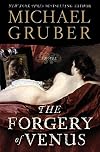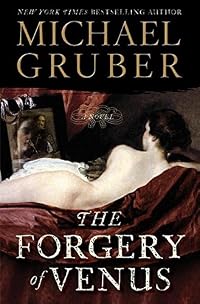
The Forgery of Venus
by Michael Gruber
On This Page
Description
Having inherited his father's considerable artistic talents but unable to find buyers for his works, Chaz Wilmot accepts a commission to restore an antique fresco in a European castle, a job that brings unexpected success and a sinister offer.Tags
Recommendations
















Member Recommendations

Member Reviews
Brilliant in many respects, Gruber takes the reader on an unusual journey toggling back and forth from the present to the days of the famous Spanish artist, Velasquez. The catch is that the mind of the central character, Chaz Wilmot may or may not be how this journey is experienced. Extremely well researched, the characters engage at a deep level offering art history in parallel with the underworld of art forgery. With a lifelong appreciation for great art while lacking the knowledge of the masters, this story has inspired me to learn more about them! But it's the journey that will continually raise questions in your mind, the central theme being, What is real? This is a great story and unique in many respects. Highly recommend, whether show more art is of interest or not! show less
I must confess, I come to this review with a heavy heart. Blurbs on the dust jacket were unanimously positive. Moreover, The Forgery of Venus was recommended to me by a fellow poet whose work I quite respect. Her accolades were ample. I, unfortunately, don’t share them.
Let me say from the outset that Michael Gruber’s prose is quite respectable — in most instances. However, his editing skills leave a lot to be desired. Whether it’s the result of drugs, alcohol, weariness or indifference, I can’t know — and cannot be the judge. But whatever it may be, he needs a little something the morning after—to set his story back on track.
To quote from p. 284: “I might be Chaz Wilmot, hack artist, forger of a painting now hailed as show more one of the great works of Velázquez, hiding out from criminals. I might be Chaz Wilmot, successful New York painter, now insane and under treatment, with a load of false memories, just as false as that conversation with a baroque dwarf. Or I might be Diego Velázquez, caught in a nightmare. Or some combination. Or someone else entirely. Or maybe this was hell itself. How would I tell?”
This was precisely the problem with The Forgery of Venus. It was simply too difficult to follow Gruber’s narrative time and time again—and to know which of his many characters (and from which time period) was speaking.
I read this book under almost ideal circumstances — i.e., virtually without distraction and, cover to cover, within 72 hours. And yet, I got lost on several occasions.
Under the best of circumstances, a reasonably good reader should not have to guess at what the author intended. But very few of us have the privilege of reading under the best of circumstances. To my way of thinking — as a writer myself — Michael Gruber did not serve his readers well with this book.
RRB
4/07/13
Brooklyn, NY show less
Let me say from the outset that Michael Gruber’s prose is quite respectable — in most instances. However, his editing skills leave a lot to be desired. Whether it’s the result of drugs, alcohol, weariness or indifference, I can’t know — and cannot be the judge. But whatever it may be, he needs a little something the morning after—to set his story back on track.
To quote from p. 284: “I might be Chaz Wilmot, hack artist, forger of a painting now hailed as show more one of the great works of Velázquez, hiding out from criminals. I might be Chaz Wilmot, successful New York painter, now insane and under treatment, with a load of false memories, just as false as that conversation with a baroque dwarf. Or I might be Diego Velázquez, caught in a nightmare. Or some combination. Or someone else entirely. Or maybe this was hell itself. How would I tell?”
This was precisely the problem with The Forgery of Venus. It was simply too difficult to follow Gruber’s narrative time and time again—and to know which of his many characters (and from which time period) was speaking.
I read this book under almost ideal circumstances — i.e., virtually without distraction and, cover to cover, within 72 hours. And yet, I got lost on several occasions.
Under the best of circumstances, a reasonably good reader should not have to guess at what the author intended. But very few of us have the privilege of reading under the best of circumstances. To my way of thinking — as a writer myself — Michael Gruber did not serve his readers well with this book.
RRB
4/07/13
Brooklyn, NY show less
The first few times I heard about this popular novel, I thought the plot sounded too contrived for me to enjoy it. But after numerous strong reviews from diverse sources I added it to my list. As soon as I started reading it I couldn't put it down. It's the story of a painter in present day New York City whose style and technique belong in an older era. When he joins a clinical trial for a new drug designed to increase creativity, he finds himself traveling back first to his own youth and then to that of a famous painter. Soon he's not sure what is real, past and present, and when a painting by an old master is discovered the reader no longer knows who the real artist is. It was an unexpected page turner!
What a fun read, chock full of juicy art history tidbits that I gobbled up like candy spread before a child. I read Gruber first novel years ago and enjoyed that also - less for its dark suspense than for the anthropological detail. This is a better book, I think. Art and madness are often partners, are they not? The Forgery of Venus tells the tale of one artist who, unlike so many, has real genius; but like so many, fails to achieve anything close to his potential. A dalliance with a drug study program sets him on the road to madness. Unable to provide for his ailing son and generally get his life together, he takes a lucrative commission in Italy to repaint a Tiepolo on a palazzo ceiling. As he completes the job and more irresistible show more commissions are offered, his life dips in and out of madness...he loses touch with who he is...or is something more sinister going on? This is a fun read, a genuine suspense novel that builds up slowly, and Gruber skillfully paints all those wonderful art history details (well, details of all kinds). Honestly, nothing got done around this house until I finished it. Ratings are relative and I have rated this relative to other suspense novels I have read (as opposed to rating it against classic literature...etc.).
eta to delete redundancy of title. . . show less
eta to delete redundancy of title. . . show less
Tales of temporal bi-location and the madness it often brings are a lot of fun, add old masters paintings and forgery and you have a pretty interesting novel. If one doesn’t clutter it up with a lot of ax-grinding or preaching that is and thankfully Gruber does neither. The tale is presented as a fait accompli as related from the main character to someone else who basically presents this weird story to us. His narrative at the start and end of the book is sufficiently different from that of the main narrative to make it work. He’s disinterested in the protagonist, surprised by getting this story dumped on him and glad to be left out of it largely.
Without going into a lot of plot details, basically this is a tale of insanity and how show more an artist can deal with it by channeling it into art. There is also an element of the metaphysical in exactly what makes him able to paint the way he does. It wasn’t presented in a gawd-awful way and so didn’t annoy. It served as a teasing mystery all on its own and provided some ambiguity in which to think. Well-written and apparently well researched as well, not that I’m an expert, but from what I could google, Gruber appears to have done his homework.
Now the plot details. Don’t read further if you want to get the most out of this novel.
Chaz Wilmot is the son of Charles Wilmot and he’s not happy about it. Dad is well known as a commercial painter (sort of a second rate Norman Rockwell) and according to Chaz, wasted his talent. A few early works of extreme emotion and depth exist, but CW Senior chose to ignore that in pursuit of ready money. Not that he felt he would need it long as he stayed married a rich woman who would no doubt let him at her fortune. She doesn’t and he realizes he has to keep churning out smarmy magazine covers and private portraits.
So instead of learning from this and embracing his greater talent, Chaz becomes a second rate hack even worse than his father. He works for magazines and turns his back on any promise his one or two small shows might have produced. This is a major theme within this story. The father son relationship and all that can twist and distort it. The hypocritical and largely empty-hearted art world and how it has changed to a profit-making enterprise not a creative or expressive outlet. He longs for the days of the old masters where one could indulge in a specific vision as an exploration of the craft. Even though these had to check up with what a patron wanted (often kings or popes), he feels this is more honest that the grasping art dealers and auctions of today. He ruins one marriage with children and then another. He does a lot of drugs. He feels self-righteous about his choices feeling justified in avoiding any commercial success for his deeper art. Bitter self-destructiveness steeped in self-pity ensue.
He gets an out of the blue call from an old college buddy who is now running an experimental drug trial. The upshot is that he needs input from someone he can gauge the creative output of, and since he knows Chaz’s track record (basically zip with glimmers of brilliance) he’s a perfect subject. Chaz agrees and the drug works his creative output into overdrive. There is one side effect; he has long and elaborate hallucinations that he is the great 17th century master Velazquez. At first he only lives through moments in time, seeing as the painter does and doing as well. When he wakes up, he’s also done these things in his real life although in a trance. People freak out because he’s uncontrollable, unresponsive and occasionally violent. This last being shown through a frenetic vignette in which Chaz wakes from a Velazquez interlude to find himself not in his down-and-nearly-out position, but one of a major artist of our time; successful and rich. He freaks.
When he’s sprung from the mental ward by his college buddy turned art dealer, Mark, he’s made an offer he can’t refuse. Flat broke with a sick kid and two ex-wives, he needs cash, something Mark can guarantee in spades. During this project he gets involved with the real architect of the deal, a very shady illegal art dealer named Krebs. It seems Krebs made his fortune and reputation by ‘discovering’ lost masterpieces confiscated by the Nazis. By diverting shipments and forging providence during the war, he builds up a nice little supply for future use. Now he wants Chaz to forge a Velazquez.
So now through much angst, increased hallucinogenic episodes as Velazquez and paranoid delusions, Chaz complies. Whole months are missing from his present. He believes himself to really believe he was Velazquez. His present actions mirror his “past” almost exactly and the cracks are starting to show. Krebs keeps him a virtual prisoner saying it is for his own good; that his backers often lose interest in a pet artist and, to protect their interests, put down pet artist. Krebs doesn’t want to lose another one. Which brings us to his condition as a whole. A madman is far less dangerous as a forger because of his low credibility. This state satisfies the backers and they leave him be. The drug and the hallucinations were all part of the scheme to keep Chaz alive and producing, but harmless. It was a nice accordion fold of reality to get through and made me feel pretty sympathetic towards the somewhat unlikeable Chaz.
In the end, Chaz accepts his status and his life as an artist. The madness ‘ruse’ appears to be working, albeit he is still convinced that his existence and that of Velazquez intersected at one point. He is now that successful and rich artist who can pretty much do what he wants when he wants. He seems content and it’s kind of a relief. show less
Without going into a lot of plot details, basically this is a tale of insanity and how show more an artist can deal with it by channeling it into art. There is also an element of the metaphysical in exactly what makes him able to paint the way he does. It wasn’t presented in a gawd-awful way and so didn’t annoy. It served as a teasing mystery all on its own and provided some ambiguity in which to think. Well-written and apparently well researched as well, not that I’m an expert, but from what I could google, Gruber appears to have done his homework.
Now the plot details. Don’t read further if you want to get the most out of this novel.
Chaz Wilmot is the son of Charles Wilmot and he’s not happy about it. Dad is well known as a commercial painter (sort of a second rate Norman Rockwell) and according to Chaz, wasted his talent. A few early works of extreme emotion and depth exist, but CW Senior chose to ignore that in pursuit of ready money. Not that he felt he would need it long as he stayed married a rich woman who would no doubt let him at her fortune. She doesn’t and he realizes he has to keep churning out smarmy magazine covers and private portraits.
So instead of learning from this and embracing his greater talent, Chaz becomes a second rate hack even worse than his father. He works for magazines and turns his back on any promise his one or two small shows might have produced. This is a major theme within this story. The father son relationship and all that can twist and distort it. The hypocritical and largely empty-hearted art world and how it has changed to a profit-making enterprise not a creative or expressive outlet. He longs for the days of the old masters where one could indulge in a specific vision as an exploration of the craft. Even though these had to check up with what a patron wanted (often kings or popes), he feels this is more honest that the grasping art dealers and auctions of today. He ruins one marriage with children and then another. He does a lot of drugs. He feels self-righteous about his choices feeling justified in avoiding any commercial success for his deeper art. Bitter self-destructiveness steeped in self-pity ensue.
He gets an out of the blue call from an old college buddy who is now running an experimental drug trial. The upshot is that he needs input from someone he can gauge the creative output of, and since he knows Chaz’s track record (basically zip with glimmers of brilliance) he’s a perfect subject. Chaz agrees and the drug works his creative output into overdrive. There is one side effect; he has long and elaborate hallucinations that he is the great 17th century master Velazquez. At first he only lives through moments in time, seeing as the painter does and doing as well. When he wakes up, he’s also done these things in his real life although in a trance. People freak out because he’s uncontrollable, unresponsive and occasionally violent. This last being shown through a frenetic vignette in which Chaz wakes from a Velazquez interlude to find himself not in his down-and-nearly-out position, but one of a major artist of our time; successful and rich. He freaks.
When he’s sprung from the mental ward by his college buddy turned art dealer, Mark, he’s made an offer he can’t refuse. Flat broke with a sick kid and two ex-wives, he needs cash, something Mark can guarantee in spades. During this project he gets involved with the real architect of the deal, a very shady illegal art dealer named Krebs. It seems Krebs made his fortune and reputation by ‘discovering’ lost masterpieces confiscated by the Nazis. By diverting shipments and forging providence during the war, he builds up a nice little supply for future use. Now he wants Chaz to forge a Velazquez.
So now through much angst, increased hallucinogenic episodes as Velazquez and paranoid delusions, Chaz complies. Whole months are missing from his present. He believes himself to really believe he was Velazquez. His present actions mirror his “past” almost exactly and the cracks are starting to show. Krebs keeps him a virtual prisoner saying it is for his own good; that his backers often lose interest in a pet artist and, to protect their interests, put down pet artist. Krebs doesn’t want to lose another one. Which brings us to his condition as a whole. A madman is far less dangerous as a forger because of his low credibility. This state satisfies the backers and they leave him be. The drug and the hallucinations were all part of the scheme to keep Chaz alive and producing, but harmless. It was a nice accordion fold of reality to get through and made me feel pretty sympathetic towards the somewhat unlikeable Chaz.
In the end, Chaz accepts his status and his life as an artist. The madness ‘ruse’ appears to be working, albeit he is still convinced that his existence and that of Velazquez intersected at one point. He is now that successful and rich artist who can pretty much do what he wants when he wants. He seems content and it’s kind of a relief. show less
 This review was written for LibraryThing Early Reviewers.
Chaz Wilmot is a talented artist, the son of a slightly less talented artist, and is obsessed with the idea of wasting his talent and thus doing exactly that. In addition to the paltry sums he brings in with commercial work he is a paid participant in the trial of a completely legal but somewhat psychotropic drug hoping to identify the roots of human creativity. With two ex-wives and three children to support -- one of whom is desperately ill -- he desperately needs money and when he's offered a huge sum to recreate a frescoed ceiling in Venice, the offer is just too good to refuse.
What follows is a finely crafted, intricately woven novel of psychological suspense that I found completely absorbing. While at certain stages I felt that I show more could have used an art history lesson to get full enjoyment out of the book -- and I'm sure that readers with more knowledge of art than I have will reap an extra dimension -- ultimately that was beside the point and I found myself thoroughly enjoying the ride I'd signed on for.
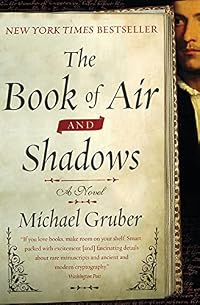
With the only other Michael Gruber novel I've read being The Book of Air and Shadows, I will definitely be checking out more of this author's backlist. show less
What follows is a finely crafted, intricately woven novel of psychological suspense that I found completely absorbing. While at certain stages I felt that I show more could have used an art history lesson to get full enjoyment out of the book -- and I'm sure that readers with more knowledge of art than I have will reap an extra dimension -- ultimately that was beside the point and I found myself thoroughly enjoying the ride I'd signed on for.
With the only other Michael Gruber novel I've read being The Book of Air and Shadows, I will definitely be checking out more of this author's backlist. show less
This review was written for LibraryThing Early Reviewers.Summary: Charles Wilmot Jr. is an artist, a painter. He makes his living producing magazine covers and other commercial pieces in the style of the Old Masters, but does not particularly have his own voice. Until he enters a medical study, in which the experimental drug seems to send him back in time - specifically, into the life of the 17th century painter Diego Velasquez. As he continues these vivid flashbacks, he becomes less certain about what is real in his life, although his talent, his ability to paint like the Old Masters, remains with him. Some restoration work that he's done on a fresco bring him to the attention of a Werner Krebs, a German art merchant, who makes him an unbelievable offer: he wants Wilmot to forge a Velasquez. show more But Wilmot is still losing time to his hallucinations of the past, and so when a lost Velasquez does in fact materialize, how is he to know whether it's real, or whether he painted it?
Review: My summary gives away more of the plot than I usually prefer to, but in this case, I think it's for the best. This book is a long, very slow build to the point where any noticeable action really starts. Its main "hook" doesn't come until relatively near the end - maybe 3/4 of the way through? - but once Gruber finally pulls the trigger and the pieces start falling into place, I was hooked, and good. But before that point, I found this book extremely slow going. If I were the sort that found it easier to abandon books unfinished, I doubt I would have made it past disc 2 or 3. (We'll get to my reasons why in a bit.) And I did in fact get stalled out, and didn't listen to any of it for over a week. But I persevered, and am definitely glad I did so.
My problems with the first half (at least) of the book were two-fold. First, I did not particularly like Wilmot as a person, nor as a protagonist. He's prickly and arrogant and self-involved, and it made it harder for me to care about the fact that he wasn't selling paintings or expressing himself as an artist or didn't have a good relationship with his ex-wife or whatever. That's probably related to my second problem with this book, namely, there is a lot of musing about art, and painting, and the modern state of painting, and what it means to be creative, and why we will pay millions of dollars to have a legitimate Old Master to hang on our walls but if someone is painting in that exact same style nowadays they're a derivative hack, and the importance of forgeries, etc., etc. Each of the times that Wilmot goes off on a rambling tangent about art (and he is a rambly and tangent-prone narrator), I thought that he brought up an interesting idea, but then he proceeded to harp on it past the point where my interest waned. Someone more versed in art, art history, and modern art might have more patience with these parts than I did, but I thought they made the first half of the book drag, without a corresponding amount of action to back them up.
But the good news is that even though the whole front part of the book is relatively action-free - sure, stuff happens, but there's no real sense of conflict other than Wilmot vs. the Monumental Task of Wilmot Getting His Shit Together - the way that everything falls together in the end makes up for a lot of slow going in the beginning. By the end of the book, the pieces really do all slot together in this terrifying and fascinating way. Gruber is not shy about messing with the minds of his characters nor his readers, and the questions about how one can prove anything about their past or themselves when they can't trust their own memories, or even their own perceptions, is a mind-trip of the highest order. There's a great level of tension and paranoia that's the result of the slow build in the beginning of the book, and once it's set, it doesn't let up until well after the last page. I was still thinking about this book, the ending of this book, well after I'd finished it... not a bad trick for a book I initially wasn't sure I wanted to finish at all. 3.5 out of 5 stars.
Recommendation: Tough one. I think fans of modern fiction, particularly those with an interest in art, a fondness for stories with unreliable narrators, or those who occasionally like to have their fiction mess with their minds, would be the best audience for this book. Just be prepared for a slow and prolonged first and second (and third... and fourth?) act. show less
Review: My summary gives away more of the plot than I usually prefer to, but in this case, I think it's for the best. This book is a long, very slow build to the point where any noticeable action really starts. Its main "hook" doesn't come until relatively near the end - maybe 3/4 of the way through? - but once Gruber finally pulls the trigger and the pieces start falling into place, I was hooked, and good. But before that point, I found this book extremely slow going. If I were the sort that found it easier to abandon books unfinished, I doubt I would have made it past disc 2 or 3. (We'll get to my reasons why in a bit.) And I did in fact get stalled out, and didn't listen to any of it for over a week. But I persevered, and am definitely glad I did so.
My problems with the first half (at least) of the book were two-fold. First, I did not particularly like Wilmot as a person, nor as a protagonist. He's prickly and arrogant and self-involved, and it made it harder for me to care about the fact that he wasn't selling paintings or expressing himself as an artist or didn't have a good relationship with his ex-wife or whatever. That's probably related to my second problem with this book, namely, there is a lot of musing about art, and painting, and the modern state of painting, and what it means to be creative, and why we will pay millions of dollars to have a legitimate Old Master to hang on our walls but if someone is painting in that exact same style nowadays they're a derivative hack, and the importance of forgeries, etc., etc. Each of the times that Wilmot goes off on a rambling tangent about art (and he is a rambly and tangent-prone narrator), I thought that he brought up an interesting idea, but then he proceeded to harp on it past the point where my interest waned. Someone more versed in art, art history, and modern art might have more patience with these parts than I did, but I thought they made the first half of the book drag, without a corresponding amount of action to back them up.
But the good news is that even though the whole front part of the book is relatively action-free - sure, stuff happens, but there's no real sense of conflict other than Wilmot vs. the Monumental Task of Wilmot Getting His Shit Together - the way that everything falls together in the end makes up for a lot of slow going in the beginning. By the end of the book, the pieces really do all slot together in this terrifying and fascinating way. Gruber is not shy about messing with the minds of his characters nor his readers, and the questions about how one can prove anything about their past or themselves when they can't trust their own memories, or even their own perceptions, is a mind-trip of the highest order. There's a great level of tension and paranoia that's the result of the slow build in the beginning of the book, and once it's set, it doesn't let up until well after the last page. I was still thinking about this book, the ending of this book, well after I'd finished it... not a bad trick for a book I initially wasn't sure I wanted to finish at all. 3.5 out of 5 stars.
Recommendation: Tough one. I think fans of modern fiction, particularly those with an interest in art, a fondness for stories with unreliable narrators, or those who occasionally like to have their fiction mess with their minds, would be the best audience for this book. Just be prepared for a slow and prolonged first and second (and third... and fourth?) act. show less
Members
- Recently Added By
Published Reviews
ThingScore 75
This is the kind of book that could easily become ludicrous and boring if it had been written by an author less talented than Gruber. His richly developed characters and engaging prose keep the story crisp and believable.
added by lampbane
"Art, culture, history and deception are the tantalizing plot elements at the center of Michael Gruber's exhilarating new novel, The Forgery of Venus."
added by bookfitz
Lists

Books Read in 2020
4,379 works; 123 members
Author Information

22+ Works 5,422 Members
Some Editions
Common Knowledge
- Canonical title
- The Forgery of Venus
- Original publication date
- 2008
- People/Characters
- Charles "Chaz" Wilmot; Werner Krebs; Mark Slotsky; Lotte Wilmot; Diego Velázquez; Leonora Fortunati
- Important places
- New York, New York, USA; Venice, Veneto, Italy
- Epigraph
- So with the faulty image as a start
We come at length to analyse and name
The Luminous darkness in the depths of art:
The timelessness that holds us is the same
As that of the transcendent sexual glance
And art... (show all) grows brilliant in the light it sheds,
Direct or not, on the inhabitants
Of our imagination and our beds.
--Robert Conquest, "The Rokeby Venus" - Dedication
- For E. W. N.
- First words
- "I'll lay a bet," said Sancho, "that before long there won't be a tavern, roadside inn, hostelry, or barber's shop where the story of our doings won't be painted up; but I'd like it painted by the had of a better painter than... (show all) painted these."
- Last words
- (Click to show. Warning: May contain spoilers.)And then I had to move on, and I circled around behind the crowd and stood for a moment in front of the greatest painting in the world, "The Maids of Honor" by Velázquez, and thought about what it would be like to be him, really be him, and I couldn't deal with it, and I left and reentered the long, gray sanity of my life.
Classifications
Statistics
- Members
- 698
- Popularity
- 40,647
- Reviews
- 46
- Rating
- (3.62)
- Languages
- English, French, Spanish
- Media
- Paper, Audiobook, Ebook
- ISBNs
- 16
- ASINs
- 9