
On This Page
Description
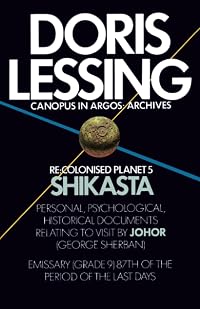
From the Publisher: This is the first volume in the series of novels Doris Lessing calls collectively Canopus in Argos: Archives. Presented as a compilation of documents, reports, letters, speeches and journal entries, this purports to be a general study of the planet Shikasta-clearly the planet Earth-to be used by history students of the higher planet Canopus and to be stored in the Canopian archives. For eons, galactic empires have struggled against one another, and Shikasta is one of the show more main battlegrounds. Johar, an emissary from Canopus and the primary contributor to the archives, visits Shikasta over the millennia from the time of the giants and the biblical great flood up to the present. With every visit he tries to distract Shikastans from the evil influences of the planet Shammat but notes with dismay the ever-growing chaos and destruction of Shikasta as its people hurl themselves towards World War III and annihilation. show lessTags
Recommendations




























Member Recommendations
Member Reviews
I'm not really partial to science fiction, but I am partial to Doris Lessing. This is the first book in a series of five, which sees our planet as a backwards and damaged part of a great cosmic empire. The history of the earth is told through that lens, with biblical resonances (from Methuselah to the tower of Babel and beyond) and a narrative of extra terrestrial intervention superimposed on what we think we know about our planet's past and evolution. We find that we are now in the last of our current days, with Lessing presenting a remarkably plausible picture of an apocalypse replacing our current capitalist and materialistic story, catalysed by members of a colonial overload race, incarnated repeatedly as human. As often with show more Lessing, I read this with a range of reactions and emotions - that this is a grandiose work of insanity; boredom at times and then swift engagement; recognition and also dissonance. I suspect I will need to read more before I really have any idea what this was abouot... show less
What a curious novel.It places the entire span of human existence in the context of a vast intergalactic war. This war is fought in the spiritual world as much as the temporal one. It sees humanity as we know it in the decades either side of the millennium as the final squabbling days of a much degraded species, a species alienated from its true purpose and true spiritual calling. It presents this history and the victory of the 'good' side as a series of documents from both Canopian and human observers of varying degrees of reliability. Some of these reports are highly allegorical and unrecognisable as anything other than mythological. It is strange and wonderful, sometimes hard work, and for the first half often confusing. The second show more half is easier reading, but isn't as original. It is, however, a great and exciting story. As speculative fiction it misses every target in that her predictions aren't accurate either literally or metaphorically. It is hard to argue in April 2026 that the final extinction event isn't close though, even if it's the mad greed of the boomer generation that is bringing us there rather than the anguished and untargetted violence of youth armies.
There are some great ideas in this book, and I will be reading on in the series because I think there are more great ideas to come! show less
There are some great ideas in this book, and I will be reading on in the series because I think there are more great ideas to come! show less
The first volume of Canopus in Argos: Archives is presented in the form of a series of documents about the planet Shikasta, which is the Canopean name for "Earth," chronicling its development and abandonment by the agents of Canopus. Canopus is one of several empires in the galaxy, though it operates on a benevolent basis, coming off an awful lot like the Ekumen in Ursula Le Guin's novels, pushing potential planets to be "ready" for entrance into its alliance. Most of the documents are from the perspective of Johor, a Canopean assigned to Shikasta many times over the millennia under a number of different guises, as he works to battle the influence of the planet Shammat in the Empire of Puttiora. Put simply, Canopus is the source of all show more that is good on Earth, while Shammat promotes disharmony and ill-feeling. Sometimes this is interesting, but the secret history does go on rather a while-- reading government documents gets rather dry when there's no clear narrative. I did like the bits where Johor plants some ideas on Shikasta before he departs in a last-ditch effort to secure the planet. The best part of the novel was the last third or so, when Johor is incarnated in the late 20th century as George Sherban, a British youth leader. Much of this section is told from the perspective of Rachel Sherban, George's unknowing younger sister, and her tale is what kept me interested, as she tries to make sense of the increasingly distressed modern world. But she fades out of the story, and I found the end kind of dull, even in the midst of nuclear apocalypse.
Looking for information on the various "Zones" that surround Earth (Johor enters into Zone Six to be incarnated, where he sees the souls of the recently departed waiting for their chance to return to Earth; I didn't see how this fit into how the Zones are depicted in the second book, and in fact I still don't), I found an on-line book club's discussion of the novel, which made a point that had not occurred to me: the (villainous) Chinese actually don't come across a whole lot differently than the Canopeans, claiming that they are working for the benefit of the people they are manipulating. But if we are supposed to see the Canopeans as somewhat villainous themselves, the text is very good about never quite giving you a solid piece of evidence to hang that argument on. The whole thing could be written with no self-consciousness, no realization that the Canopeans are no different from the Chinese or Shammat just because they are ostensibly "right." What sealed it for me, though, was the the title: the (gloriously long) title calls direct attention to the fact that this is a collection of documents collected by a particular group for a particular purpose. Why would Lessing do that if she didn't want her readers pondering that fact all the way through? Were the Canopeans really no different from everyone else? It was something for me to ponder as I moved forward with the series. (I keep on meaning to look up reviews and academic criticism to see if anyone has taken up this idea, but I've never remembered.) show less
Looking for information on the various "Zones" that surround Earth (Johor enters into Zone Six to be incarnated, where he sees the souls of the recently departed waiting for their chance to return to Earth; I didn't see how this fit into how the Zones are depicted in the second book, and in fact I still don't), I found an on-line book club's discussion of the novel, which made a point that had not occurred to me: the (villainous) Chinese actually don't come across a whole lot differently than the Canopeans, claiming that they are working for the benefit of the people they are manipulating. But if we are supposed to see the Canopeans as somewhat villainous themselves, the text is very good about never quite giving you a solid piece of evidence to hang that argument on. The whole thing could be written with no self-consciousness, no realization that the Canopeans are no different from the Chinese or Shammat just because they are ostensibly "right." What sealed it for me, though, was the the title: the (gloriously long) title calls direct attention to the fact that this is a collection of documents collected by a particular group for a particular purpose. Why would Lessing do that if she didn't want her readers pondering that fact all the way through? Were the Canopeans really no different from everyone else? It was something for me to ponder as I moved forward with the series. (I keep on meaning to look up reviews and academic criticism to see if anyone has taken up this idea, but I've never remembered.) show less
They say North America is full of troubles but I said I didn’t want to listen any longer.I have always admired Doris Lessing’s vision as a novelist and a humanist; The Golden Notebook was (as was The Diaries of Jane Somers, about which I wrote at length, and very personally, here) such an important book to me, and continues to be to this day, and I think its focus on our deep psychological and interpersonal rifts is still highly visionary, ominously prescient.
With that said, and perhaps because sci-fi and “space fiction” (as Lessing has termed the Canopus in Argos series) are not my cup of tea, I haven’t begun to touch these works of hers until now. And in the hands of a lesser novelist, without Lessing’s politics and her show more vision (here, too, is when her Sufism begins to be apparent in her fiction), this might have been a much, much weaker novel than it was. I’ve upgraded my rating to 4 stars from 3/3.5 on the simple grounds that this is, after all, Doris Lessing.
But I was riveted, especially by the early and later reportage sections. (It makes sense that these are archival, scattered sources, some reportage and some letters, some trial transcripts and some diaristic memoirs.) Lessing has in essence re-envisioned the entire history of the earth in Shikasta; the earliest, and most difficult, dense, laborious, sections deal with her space galaxy revision of the creationist tales from the Old Testament. These are ingenious and transcend both time and space—pun not intended. However, some of the later sections—with Shikasta, aka Earth, on the brink of World War 3—seem dated to us now in their historical, post-Soviet references, but they were highly visionary and even uncouth when she published this series. Many negative reviews seem to be misreading or not understanding this, and therefore taking this book out of context, which is unfair to a work that was truly groundbreaking for its time and still has relevance to our own.
Conceived as a single book which morphed into five volumes, I look forward to dipping into the other ones soon. Some of Lessing’s visions about our world and the inner workings of humanity—how we function, how we lack qualities that would otherwise see us excel as a human race, and how other planets might have experimented on us, and, ultimately, failed—are revolutionary for her time period (she was one of the first bestselling female authors to turn to sci-fi, and she was criticized for Shikasta upon its publication, for a variety of reasons, not least of which was genre).
My advice would be to not approach these books unless you are already well-versed in Lessing’s main humanist themes that much of her work broaches: some more successfully than others. And if you’re expecting sci-fi of the intergalactic spaceship and alien sort, well… this is also not for you. (Even though both do sort of exist in this novel.) But if you’re curious about an alternate history about how the world was created, and how we went wrong—especially in this day and age when we have gone so wrong—then this is a fun, uneven, and somewhat pactchworked read to consider.
Just don’t judge Lessing on this book, please: in her defense, I think working in a new genre caused her to take on more than she could chew in one dose, hence the subsequent books she didn’t at first foresee. And perhaps she gets better at writing “space fiction” in those; maybe she even gets closer to the pulse of the sexual political strain—that she touches on briefly here—of our Shikastan crisis as we launch into a geopolitical world that she could not have predicted, and yet, given the founding mythology she creates in Shikasta makes a little more sense, perhaps, to the disillusioned. show less
Shikasta was a logical step for Lessing taking up themes that she had explored in Memories of a Survivor. In that novel she had written about the breakdown of civilisation as seen by an elderly woman peering out of her ground floor city flat and who only ventured outside on local foraging expeditions. It provided a gritty reality to a dream world that she imagined behind her living room wall. In previous novels Lessing had used her experiences as a political activist in Southern Rhodesia, as a single woman in post war London and as a woman on the verge of a nervous breakdown to pin point ideas and themes that were shot through with a realism that was gripping and drenched in the life and times through which she lived. Shikasta opened show more out into something more ambitious, because Lessing sought to make her themes global: everything now was to be imagined and everything linked to the history of our civilisation.
She needed a medium in which to capture her ideas and she chose science fiction. Influenced no doubt by the novels of Olaf Stapledon particularly "Last and First Men” and "Star Maker" which attempted to put the broad sweep of our civilisation into the perspective of the universe: Lessing used these ideas to explore the human condition. There is very little science in her science fiction; this did not concern her, she wanted to create a scenario where she could put the human race under her microscope and expose the fault lines that she had observed through her own experiences and her knowledge of history. It should be no surprise that the outlook is pretty bleak.
The history of Shikasta (our Earth) is told by journals, reports and letters from representatives from Canopus; a higher civilisation that along with the Sirians work to keep the universe in harmony. Johor is the person who is tasked with protecting and nurturing Shikasta and it is a thankless task. Shikasta means the broken one but it did not start out like this. Johor first knew it as Rohanda a world blessed with a nature that supported a variety of life. It was one of the most hospitable worlds in the Universe and needed special attention. A race of giants in tune with the harmony of the spheres were bused in (by space ship) to support the emergent ape like humanoids who were the most intelligent of the earths inhabitants. With the support of the Giants the natives developed a harmonious civilisation that promised to be a cornerstone of the Canopus empire. Unfortunately within the Universe there was also Shammat a rapacious empire bent on destruction and they also had eyes on the Earth. They were able to introduce a degenerative disease into the native population which weakened their harmony with the Universe and with each other; they increasingly put themselves first, became greedy, and exploitative. Their protectors; the giant race had to leave.,
We pick up the story of Shikasta just as it emerges from its second world war. Johor receives a number of reports from his representatives detailing through individual cases the problems that are burgeoning on the planet. The most serious problem seems to be a generation gap, the youth of the world start to blame their parents for the state of the earth, which is steadily moving towards a third world war. Food production is not keeping pace with the population, the air is being poisoned by industry, there are water shortages and a small percentage of the population have become very rich to the detriment of the rest.
Johor realises that he must take more direct action and he chooses to be born on the planet to parents who will provide him with some support. He becomes George Sherban and we follow his growth into becoming a youth leader through the diary of his sister Rachel. He is powerless to stop the catastrophe that is developing but we follow his career second hand through his sisters diary. The final set piece of the novel is the Youth Conference hosted by Geoge Sherban which becomes a show trial for the white race colonisers who are blamed for the destruction of the planet. Shikasta is now ruled by the benevolent Chinese dynasty, but they are benevolent in name only and all the faults of previous rulers and colonisers are just as apparent. George Sherban can only work to save something from the wreckage.
Lessing has divided the novel into three parts, the first tells the story of Rohanda and it is here that her writing is at its lyrical best. She imagines a world where all is in harmony; the cities are built according to mathematical formulas that are in keeping with the landscape. There are round cities. crescent cities, star shaped cities and square cities all vibrating in harmony through the stones that have been placed by the giant race. Johor is stationed on the planet and notices the first dissonance in the vibrations and it is through him that we see the degenerative disease take hold.
The second part finds Johor in Zone 6. This is the place where the dead souls from various planets wait to enter a firmament to become reborn. It is here he receives reports from Shikasta and they tell of disaffected young people struggling in a world that has no future for them. These read like case histories and Lessing is able to pin point the ills of modern civilisation through these missives. The degenerative disease is having its effect in Zone 6 which is turning into a wasteland. Johor finds people(souls) who he has trusted in the past and persuades them to follow him down to be reborn on Shikasta
The third part describes the career of George Sherban and Lessing is able to paint a vivid picture of a world collapsing into a dystopia. George Sherban and his family move around the less fortunate countries where the parents work in hospitals for the common good and George gets on with the life of being a sort of prophet. It is Rachel’s diary that details this part of the story and Lessing once again takes her novel into the nitty gritty of the life of poor families trying to survive in ever worsening conditions. The final youth convention is described by a representative of the Chinese government.
The novel is not without its faults. I found the second section which details the issues faced by young people to be a sort of catch all for the ills of modern civilisation. Lessing uses them to hammer home her views on society and even if you sympathise with her left of centre opinions (and I do) they become a little repetitive and they add nothing to the overall flow of the novel. To enjoy the novel you must be able to swallow the science fiction elements; for example a benevolent higher civilisation that protects and guides fledgling civilisations and has representatives on earth. However Lessing uses them merely as a device for the working of her novel, we learn very little about Canopus, even less about the Sirians. It is a bleak view of the human race and ultimately one which is unable to help itself and the idea that higher powers control our destiny will not be welcome to some readers. (Lessing does however avoid any religious connotations). Despite all of this one cannot fail to be impressed by the scale of the novel or of passages of her most thoughtful prose. Brimful of ideas and it does have that sense of wonder that will appeal to some science fiction readers. 4.5 stars. show less
She needed a medium in which to capture her ideas and she chose science fiction. Influenced no doubt by the novels of Olaf Stapledon particularly "Last and First Men” and "Star Maker" which attempted to put the broad sweep of our civilisation into the perspective of the universe: Lessing used these ideas to explore the human condition. There is very little science in her science fiction; this did not concern her, she wanted to create a scenario where she could put the human race under her microscope and expose the fault lines that she had observed through her own experiences and her knowledge of history. It should be no surprise that the outlook is pretty bleak.
The history of Shikasta (our Earth) is told by journals, reports and letters from representatives from Canopus; a higher civilisation that along with the Sirians work to keep the universe in harmony. Johor is the person who is tasked with protecting and nurturing Shikasta and it is a thankless task. Shikasta means the broken one but it did not start out like this. Johor first knew it as Rohanda a world blessed with a nature that supported a variety of life. It was one of the most hospitable worlds in the Universe and needed special attention. A race of giants in tune with the harmony of the spheres were bused in (by space ship) to support the emergent ape like humanoids who were the most intelligent of the earths inhabitants. With the support of the Giants the natives developed a harmonious civilisation that promised to be a cornerstone of the Canopus empire. Unfortunately within the Universe there was also Shammat a rapacious empire bent on destruction and they also had eyes on the Earth. They were able to introduce a degenerative disease into the native population which weakened their harmony with the Universe and with each other; they increasingly put themselves first, became greedy, and exploitative. Their protectors; the giant race had to leave.,
We pick up the story of Shikasta just as it emerges from its second world war. Johor receives a number of reports from his representatives detailing through individual cases the problems that are burgeoning on the planet. The most serious problem seems to be a generation gap, the youth of the world start to blame their parents for the state of the earth, which is steadily moving towards a third world war. Food production is not keeping pace with the population, the air is being poisoned by industry, there are water shortages and a small percentage of the population have become very rich to the detriment of the rest.
Johor realises that he must take more direct action and he chooses to be born on the planet to parents who will provide him with some support. He becomes George Sherban and we follow his growth into becoming a youth leader through the diary of his sister Rachel. He is powerless to stop the catastrophe that is developing but we follow his career second hand through his sisters diary. The final set piece of the novel is the Youth Conference hosted by Geoge Sherban which becomes a show trial for the white race colonisers who are blamed for the destruction of the planet. Shikasta is now ruled by the benevolent Chinese dynasty, but they are benevolent in name only and all the faults of previous rulers and colonisers are just as apparent. George Sherban can only work to save something from the wreckage.
Lessing has divided the novel into three parts, the first tells the story of Rohanda and it is here that her writing is at its lyrical best. She imagines a world where all is in harmony; the cities are built according to mathematical formulas that are in keeping with the landscape. There are round cities. crescent cities, star shaped cities and square cities all vibrating in harmony through the stones that have been placed by the giant race. Johor is stationed on the planet and notices the first dissonance in the vibrations and it is through him that we see the degenerative disease take hold.
The second part finds Johor in Zone 6. This is the place where the dead souls from various planets wait to enter a firmament to become reborn. It is here he receives reports from Shikasta and they tell of disaffected young people struggling in a world that has no future for them. These read like case histories and Lessing is able to pin point the ills of modern civilisation through these missives. The degenerative disease is having its effect in Zone 6 which is turning into a wasteland. Johor finds people(souls) who he has trusted in the past and persuades them to follow him down to be reborn on Shikasta
The third part describes the career of George Sherban and Lessing is able to paint a vivid picture of a world collapsing into a dystopia. George Sherban and his family move around the less fortunate countries where the parents work in hospitals for the common good and George gets on with the life of being a sort of prophet. It is Rachel’s diary that details this part of the story and Lessing once again takes her novel into the nitty gritty of the life of poor families trying to survive in ever worsening conditions. The final youth convention is described by a representative of the Chinese government.
The novel is not without its faults. I found the second section which details the issues faced by young people to be a sort of catch all for the ills of modern civilisation. Lessing uses them to hammer home her views on society and even if you sympathise with her left of centre opinions (and I do) they become a little repetitive and they add nothing to the overall flow of the novel. To enjoy the novel you must be able to swallow the science fiction elements; for example a benevolent higher civilisation that protects and guides fledgling civilisations and has representatives on earth. However Lessing uses them merely as a device for the working of her novel, we learn very little about Canopus, even less about the Sirians. It is a bleak view of the human race and ultimately one which is unable to help itself and the idea that higher powers control our destiny will not be welcome to some readers. (Lessing does however avoid any religious connotations). Despite all of this one cannot fail to be impressed by the scale of the novel or of passages of her most thoughtful prose. Brimful of ideas and it does have that sense of wonder that will appeal to some science fiction readers. 4.5 stars. show less
This is about my fourth reading of this book. Shikasta remains one of my favourite science fictional tales, and the most powerful of Doris Lessing's 'space fiction' Canopus in Argos: Archives sequence. It is the history of the world from the point of view of benevolent, immortal but not all-powerful aliens (Canopus, as well as their rivals or opposites Sirius and Shammat), one of whom incarnates in order to help guide the world back to a saner path. The structure of the book is a collection of documents. The first half of the book contains reports and background about Shikasta, 'the wounded one' by Canopus, one of the alien empires which has observed the planet since time immemorial. The second half has document relating to agent Johor, show more who incarnates as George Sherban, a kind of quiet Messiah, in the last days -- our near future, compellingly and bleakly realised by letters, diaries and reports from Earth. Interestingly, none of the documents in the second part are authored by George Sherban -- but they nearly all concern him or his effect on the world. The subject of the book is the madness and unsustainability of the modern world; Shikasta rages against it. It remains a relevant and powerful work. show less
The full title is Canopus in Argos: Archives Re: Colonized Planet 5: Shikasta: Personal, Psychological, Historical Documents Relating to Visit by JOHOR (George Sherban): Emissary Grade 9: 87th of the Period of the Last Days.
To begin, we receive a Preface from the Nobel-winning author. It contains a brief defense of S-F as a literary form. Lessing’s contribution to S-F is rarely, if ever, mentioned. Totaling over 1100 pages, her 5 novel series constitutes an exhaustive study of a fictionalized galactic civilization.
The alien perspective is intriguing. We hear about negotiated agreements between Sirius and Canopus, after a ruinous war. Some large-scale backstory, non-traditional storytelling, a detached voice, disembodied, disorienting show more and disarming. I sank into the scientific narrative like I became immersed in Olaf Stapledon’s works. He was an acknowledged influence of Lessing’s and signs of his work are everywhere, down to the skeleton of the novel’s framework.
In what will become dense social commentary, the author introduces by degrees, an astoundingly complex level of world building, a dense architecture of philosophies, and then proceeds in the method established by Stapledon in Last and First Men and Star Maker. At first glance, this book could appear to be a similar masterpiece. The further you read, the more you will realize that is not so.
The subject veers dramatically as Lessing probes the furthest reaches of the human mind, but the message gets clogged with political agendas. The use of an inhuman narrator presents difficulties, easily surmounted by fascinating juxtapositions. Get ready for dry imagery, a large number of fictional facts and abstractions, and a sense of the dangerous scale of the universe. The mode of communication is uneven throughout. Dozens of reports are interpolated from extraterrestrials and humans. At once, a distinctly skewed and innately logical setting makes way for execrations to come. The language employed borrows more from its established backstory than from societal constructs, except for the implementation of pervasive allegory, until the story shifts to modern times.
The most interesting part was the exploration of the catastrophe, which left behind work for the custodians of Shikastan Truth. Through Johor’s contribution to his planet’s experiment, Lessing makes use of allegorical devices, infusing the narrative with the sense of higher powers orchestrating vast reaches of space-time. How much of it is alien technology, and how much faith-based relics is hard to quantify.
The novel takes the form of a note in a bottle, a time capsule, or a testament. This form is broken, irreparably, as the novel progresses.
It speaks of the end of civilizations and of the galactic development of empiricism, it covers the varieties and forms of extraterrestrial life all too briefly. Subtle allegories ensue: consumerism, the food chain, until we begin to see that Shikasta is Earth. With worthy lyricism, Lessing describes this world as an outsider, and her work is surreally fascinating. Her fiercely intelligent prose slides into abstract forms and sensations. The microscopic details are uncanny, but the sweeping, bitter statements undercut what might have been a thought-provoking, instead of a thought-suppressing, conclusion.
The narrator utilizes the sort of foreigners’ bizarre verbal patterns you might expect from a multi-national author. There is an incredible verisimilitude inherent in the sustained stylistic choices. The hallucinogenic descriptions of nature lend to the charm of reading Shikasta, before it betrays your every hope for consistency. I loved the lumbering, slow, aching prose, the giant, gaping palaces and eldritch ruins. I found the accumulation of atmosphere and detail profoundly unsettling. The stark narration, ripe with ordure, was strikingly vivid. Canopus institutes their regime on the vibrant planet of Shikasta, manufacturing giants and conducting sociological studies. Their enemy is Shammat. We know the Canopeans inherit genetic memory. Degeneration does not afflict them. They suffer no death. Their colonization is posited on designed evolution, and we can only assume their space-faring civilization is immense. The main concern of this “study” is the biological experiments on Shikasta and the aftermath, wherein selective breeding leads to unexpected consequences.
The development of sentience and intelligence in the controlled environment is interesting. It is speculative writing of the highest caliber, until it plummets into an abyss of antihumanism. The tension between galactic empires would have been a more stimulating subject, but I gather there will be further developments in that arena later in the series. She regales us with essays on the controlled distribution of wealth. Instead of plausible advanced technologies we get enigmatic magic. In fact, almost no explanation for the Canopeans’ powers intrudes. We must sit through 300 pages recounting the dry history of mankind, a saddening cultural survey, lacking any sign of sophistication. She exits the uncanny valley and only enters into the land of the canny, the trite and the wickedly accusatory.
She takes a scientific view of sex. But the traces of feminism are surprisingly light. Johor can change physical form. He understands acclimatization, but the more sacred knowledge he imparts, the more perverted the Shikastan experiment becomes. The clandestine alien subjugation of a civilization by a higher one is not original, but she started off in a convincing way. The planetary Petri dish, the control group, makes for a fine set-up. Recall that Johor refrains from corrupting society’s innocence with the introduction of advanced tech, but Taufiq becomes almost entirely human. Johor has an affinity with beasts, and uses this to his advantage as he seeks to modernize the brutes. His comrades practice micromanagement of a race already spiraling out of their control. Johor’s tasks and duties are at first vague, and his communication from Canopus is not enlightening, but it becomes clear he is meant to moderate the chaos.
Human symbiosis with the planet has always been tenuous, but Lessing drives home the fact that we have made a fine mess of things.
Luckily, we are given the emissary’s explanation along the way. He is a measurer of vibrations. These vibrations are the invisible forces at work, crafting the environment.
The Shikastan’s are told their function as lesser beings in service to Canopus, he bears the news of their loss of freedom, in one of the most stirring passages, and a fall results.
“A whole race will cease,” he says. This is the destruction of the self through hyper awareness. A competition for survival begins after the reliance of higher powers ceases. However, Johor’s prophetic powers and the development of the telepathic survival trait do little to prevent widespread degradation.
The fates of races are determined by the caprices of stars. Lessing distorts her religious allegory with many misappropriated Biblical references, only to castigate and belittle all organized religions later on.
Determinism and the possibility of anticipating the future follow attempts to placate the disintegration of their evolutionary project. The enemy emerges from their mishaps. Beginning with the Edenic people among which evil does not exist, she depicts society before sin, and Shammat, as sin, is labeled, and makes short work of any sign of Canopean progress. Johor’s immersion in another culture describes this scenario beautifully. He contemplates whether awareness of sin is a weakness. The garden falls through lack of adequate resources in the face of limitless wants. Shammat is syphoning off the life of planets. This is the enigmatic enemy, or the name he has given the force antagonistic to the aims of Canopus. Parasitism as an inevitable variation of progress from symbiots.
Loss of judgement en masse in the face of changing environmental constraints, sin as death, “disobedience to the master plan” causing the fall of Shikasta, and other parabolic constraints sheer away little by little, the fabulous invention Lessing spent 100 pages crafting.
The slow and assured death in the environment without divine intervention goes unchecked for 31 millenia. The plight of mutants and outsiders, those cast off and forsaken cry out from her pages. Possessed of no faith in a higher power, blessed were they in their ignorance, they fail to live up to the standards of the Canopean empire, which are divine in nature. Without religious beliefs they begin preternaturally innocent, but innocence soon falls by the wayside. Discovery that your planet is an artificial construct, would be enough to alter most peoples’ perception. Your society and development from beast hood was unnatural and programmed. The Natives and Giants are the 2 sentient species created by Canopus. The resultant diaspora dissolves the clever societal dichotomies she threatened to enumerate.
The signature is Johor’s distinguishing power. The loss of innocence is described as a descent into fear and dissolution. The rise of prophets as a result of chaos and the birth of religion, the rebellion of the spirit all come to the fore as Johor’s influence wanes. A multitude of afflictions intrude upon disorganized society, the tribes scatter, the disbalance physically manifests as a disease of the flesh. Their faith and awareness brings them torment and destruction. Disorder is measured by permeating vibrations in the environment which the natives misuse for their own pleasure. The destruction of the idealized past occurs repeatedly. They lose immortality and fall into perpetual cycles of death and sin, degenerate back into animals, devolution and reversion.
The intrusion of belief systems and humanity’s reliance on its environmental conditions, segregation and the survivalist mindset, and resistance to higher laws, all erupt from the misuse of Canopean stones. The patterns of stones create vibrations, in the sense that imposed order endows inhabitants with prosperity. The stones possess divine, or Canopean, power. Johor warns inhabitants with prohibitions and pointing out their in-progress destruction. He chooses disciples to spread the Truth from Canopus.
Shammat emanates, sows destruction. Johor tries to establish Laws. He communes with nature as a prophet seeking guidance. We learn of boosters, conductors and planet programming, Sirius, Effluon 3, Puttiora, pollution, abstract corruption, filtering and enhancing brain power, physical manifestations of conceptualizations, and a destructive force as supernatural as the stones. This allegory allows us to contemplate the destructive nature of our technology and our reliance on higher systems to function. Shammat uses Shikastans as transmitters. Out of darkness it came, sapping strength, beauty and intellect, which to Canopus, are measurable resources.
In his marvelous journey of discovery, Johor seeks to limit the spread of Shammat. The first murder occurs in an attempt to communicate divine Truth. Intimations of intoxication, idolatry and addiction are obvious consequences.
Love had been provided and engendered in the genetic make-up of their forebears. They must relearn progress, invention, adaption, intuition. They have to reinvent every basic device, the building blocks of civilization, SOWF (substance-of-we-feeling) = manna - the source of progress and human sentience. It is what separates Shikastans from animals.
Another disciple, Taufiq, is an agent, an instrument of the way toward life and immortal divinity. He espouses idealism. We recognize him amid our wars, government and culture.
An abrupt shift around page 100 brings us to modern Earth, still called Shikasta. The second section of the book is a direct castigation of privileged white society. Pettiness, avarice, socialist spoofs, small and frivolous revolutions, every expression of vanity. Supplemental reports give extraneous detached viewpoints, lassoing in cults and the minutiae of wasted lives, every category of sin is dissected in a discomfiting, clinical way. The writing degrades steadily from logical argument to execrable melodrama. It becomes a searing history text which cultivates a disgusted, ashamed tone of oppressive derogating, recounting all the missteps in human affairs, an endless series of disturbing protests against flawed individuals.
Perhaps Lessing was so ensconced in the omniscient extraterrestrial perspective, she let pessimism run rampant. She is excessive and obsessive in her portrayal of human folly. It seems to come from a place of anger, is spiteful and mean-spirited.
The repetitions, reinterpretations, and restating her theses statements becomes the modus operandi of the second half of the novel. There is a continual reinforcement of the depressing worthlessness of human beings. The shorter the lifespan, the worse the human maladjustments become, and a vestigial belief in former immunity to death remains as a carry-over to haunt them.
Rachel's journal presents a stilted human viewpoint, but after all the macrocosmic speculation, her foibles, whining and minuscule troubles appear petty, void and contrived, inserted for a dramatic shift in the scientific tone.
Lessing indulges in bald satire, on the changeable minds of men, makes light of the power struggles during and after the World Wars, progress, justice, vain ambitions, etc. Humans have an innate fear of Canopus, which is dimensionless, reinterpreted through religious agendas, Taufiq assumed human form and diverges from his mission, finds religion to be a tool for ruling castes, espouses pacifism and points out human flaws again.
The book is a survey of human corruption, the death of the spirit, a forecast of the bleak fate awaiting us. Post-human speculation comes singly, much like the new men in Stapledon. We see increased involvement by extraterrestrial agents, decreased population split into giants, little people, hybrids and natives, a mixed species majority, the persistence of evil in human nature (seems unjustly attributed to Shammat) mass extinction due to Shikasta's axis shift. Canopeans choose strategic, selective incarnations and visibility, and introduce experimental methods to combat the “revolt against the gods.”
The law of inevitable division and subdivision remains, operating through currents carried through stone patterns, Canopean vibrancies are simply eugenics, and even with their civilization-building experiments, they cannot prevent acts of God.
The Shikastans are victims of themselves, Canopeans deliberate and destroy some tribes, their insistence on their own morality becomes questionable. It reminds us in the most unpleasant way of the soulless behavior, cruelty, and small acts of terrorism that pervade our history. show less
To begin, we receive a Preface from the Nobel-winning author. It contains a brief defense of S-F as a literary form. Lessing’s contribution to S-F is rarely, if ever, mentioned. Totaling over 1100 pages, her 5 novel series constitutes an exhaustive study of a fictionalized galactic civilization.
The alien perspective is intriguing. We hear about negotiated agreements between Sirius and Canopus, after a ruinous war. Some large-scale backstory, non-traditional storytelling, a detached voice, disembodied, disorienting show more and disarming. I sank into the scientific narrative like I became immersed in Olaf Stapledon’s works. He was an acknowledged influence of Lessing’s and signs of his work are everywhere, down to the skeleton of the novel’s framework.
In what will become dense social commentary, the author introduces by degrees, an astoundingly complex level of world building, a dense architecture of philosophies, and then proceeds in the method established by Stapledon in Last and First Men and Star Maker. At first glance, this book could appear to be a similar masterpiece. The further you read, the more you will realize that is not so.
The subject veers dramatically as Lessing probes the furthest reaches of the human mind, but the message gets clogged with political agendas. The use of an inhuman narrator presents difficulties, easily surmounted by fascinating juxtapositions. Get ready for dry imagery, a large number of fictional facts and abstractions, and a sense of the dangerous scale of the universe. The mode of communication is uneven throughout. Dozens of reports are interpolated from extraterrestrials and humans. At once, a distinctly skewed and innately logical setting makes way for execrations to come. The language employed borrows more from its established backstory than from societal constructs, except for the implementation of pervasive allegory, until the story shifts to modern times.
The most interesting part was the exploration of the catastrophe, which left behind work for the custodians of Shikastan Truth. Through Johor’s contribution to his planet’s experiment, Lessing makes use of allegorical devices, infusing the narrative with the sense of higher powers orchestrating vast reaches of space-time. How much of it is alien technology, and how much faith-based relics is hard to quantify.
The novel takes the form of a note in a bottle, a time capsule, or a testament. This form is broken, irreparably, as the novel progresses.
It speaks of the end of civilizations and of the galactic development of empiricism, it covers the varieties and forms of extraterrestrial life all too briefly. Subtle allegories ensue: consumerism, the food chain, until we begin to see that Shikasta is Earth. With worthy lyricism, Lessing describes this world as an outsider, and her work is surreally fascinating. Her fiercely intelligent prose slides into abstract forms and sensations. The microscopic details are uncanny, but the sweeping, bitter statements undercut what might have been a thought-provoking, instead of a thought-suppressing, conclusion.
The narrator utilizes the sort of foreigners’ bizarre verbal patterns you might expect from a multi-national author. There is an incredible verisimilitude inherent in the sustained stylistic choices. The hallucinogenic descriptions of nature lend to the charm of reading Shikasta, before it betrays your every hope for consistency. I loved the lumbering, slow, aching prose, the giant, gaping palaces and eldritch ruins. I found the accumulation of atmosphere and detail profoundly unsettling. The stark narration, ripe with ordure, was strikingly vivid. Canopus institutes their regime on the vibrant planet of Shikasta, manufacturing giants and conducting sociological studies. Their enemy is Shammat. We know the Canopeans inherit genetic memory. Degeneration does not afflict them. They suffer no death. Their colonization is posited on designed evolution, and we can only assume their space-faring civilization is immense. The main concern of this “study” is the biological experiments on Shikasta and the aftermath, wherein selective breeding leads to unexpected consequences.
The development of sentience and intelligence in the controlled environment is interesting. It is speculative writing of the highest caliber, until it plummets into an abyss of antihumanism. The tension between galactic empires would have been a more stimulating subject, but I gather there will be further developments in that arena later in the series. She regales us with essays on the controlled distribution of wealth. Instead of plausible advanced technologies we get enigmatic magic. In fact, almost no explanation for the Canopeans’ powers intrudes. We must sit through 300 pages recounting the dry history of mankind, a saddening cultural survey, lacking any sign of sophistication. She exits the uncanny valley and only enters into the land of the canny, the trite and the wickedly accusatory.
She takes a scientific view of sex. But the traces of feminism are surprisingly light. Johor can change physical form. He understands acclimatization, but the more sacred knowledge he imparts, the more perverted the Shikastan experiment becomes. The clandestine alien subjugation of a civilization by a higher one is not original, but she started off in a convincing way. The planetary Petri dish, the control group, makes for a fine set-up. Recall that Johor refrains from corrupting society’s innocence with the introduction of advanced tech, but Taufiq becomes almost entirely human. Johor has an affinity with beasts, and uses this to his advantage as he seeks to modernize the brutes. His comrades practice micromanagement of a race already spiraling out of their control. Johor’s tasks and duties are at first vague, and his communication from Canopus is not enlightening, but it becomes clear he is meant to moderate the chaos.
Human symbiosis with the planet has always been tenuous, but Lessing drives home the fact that we have made a fine mess of things.
Luckily, we are given the emissary’s explanation along the way. He is a measurer of vibrations. These vibrations are the invisible forces at work, crafting the environment.
The Shikastan’s are told their function as lesser beings in service to Canopus, he bears the news of their loss of freedom, in one of the most stirring passages, and a fall results.
“A whole race will cease,” he says. This is the destruction of the self through hyper awareness. A competition for survival begins after the reliance of higher powers ceases. However, Johor’s prophetic powers and the development of the telepathic survival trait do little to prevent widespread degradation.
The fates of races are determined by the caprices of stars. Lessing distorts her religious allegory with many misappropriated Biblical references, only to castigate and belittle all organized religions later on.
Determinism and the possibility of anticipating the future follow attempts to placate the disintegration of their evolutionary project. The enemy emerges from their mishaps. Beginning with the Edenic people among which evil does not exist, she depicts society before sin, and Shammat, as sin, is labeled, and makes short work of any sign of Canopean progress. Johor’s immersion in another culture describes this scenario beautifully. He contemplates whether awareness of sin is a weakness. The garden falls through lack of adequate resources in the face of limitless wants. Shammat is syphoning off the life of planets. This is the enigmatic enemy, or the name he has given the force antagonistic to the aims of Canopus. Parasitism as an inevitable variation of progress from symbiots.
Loss of judgement en masse in the face of changing environmental constraints, sin as death, “disobedience to the master plan” causing the fall of Shikasta, and other parabolic constraints sheer away little by little, the fabulous invention Lessing spent 100 pages crafting.
The slow and assured death in the environment without divine intervention goes unchecked for 31 millenia. The plight of mutants and outsiders, those cast off and forsaken cry out from her pages. Possessed of no faith in a higher power, blessed were they in their ignorance, they fail to live up to the standards of the Canopean empire, which are divine in nature. Without religious beliefs they begin preternaturally innocent, but innocence soon falls by the wayside. Discovery that your planet is an artificial construct, would be enough to alter most peoples’ perception. Your society and development from beast hood was unnatural and programmed. The Natives and Giants are the 2 sentient species created by Canopus. The resultant diaspora dissolves the clever societal dichotomies she threatened to enumerate.
The signature is Johor’s distinguishing power. The loss of innocence is described as a descent into fear and dissolution. The rise of prophets as a result of chaos and the birth of religion, the rebellion of the spirit all come to the fore as Johor’s influence wanes. A multitude of afflictions intrude upon disorganized society, the tribes scatter, the disbalance physically manifests as a disease of the flesh. Their faith and awareness brings them torment and destruction. Disorder is measured by permeating vibrations in the environment which the natives misuse for their own pleasure. The destruction of the idealized past occurs repeatedly. They lose immortality and fall into perpetual cycles of death and sin, degenerate back into animals, devolution and reversion.
The intrusion of belief systems and humanity’s reliance on its environmental conditions, segregation and the survivalist mindset, and resistance to higher laws, all erupt from the misuse of Canopean stones. The patterns of stones create vibrations, in the sense that imposed order endows inhabitants with prosperity. The stones possess divine, or Canopean, power. Johor warns inhabitants with prohibitions and pointing out their in-progress destruction. He chooses disciples to spread the Truth from Canopus.
Shammat emanates, sows destruction. Johor tries to establish Laws. He communes with nature as a prophet seeking guidance. We learn of boosters, conductors and planet programming, Sirius, Effluon 3, Puttiora, pollution, abstract corruption, filtering and enhancing brain power, physical manifestations of conceptualizations, and a destructive force as supernatural as the stones. This allegory allows us to contemplate the destructive nature of our technology and our reliance on higher systems to function. Shammat uses Shikastans as transmitters. Out of darkness it came, sapping strength, beauty and intellect, which to Canopus, are measurable resources.
In his marvelous journey of discovery, Johor seeks to limit the spread of Shammat. The first murder occurs in an attempt to communicate divine Truth. Intimations of intoxication, idolatry and addiction are obvious consequences.
Love had been provided and engendered in the genetic make-up of their forebears. They must relearn progress, invention, adaption, intuition. They have to reinvent every basic device, the building blocks of civilization, SOWF (substance-of-we-feeling) = manna - the source of progress and human sentience. It is what separates Shikastans from animals.
Another disciple, Taufiq, is an agent, an instrument of the way toward life and immortal divinity. He espouses idealism. We recognize him amid our wars, government and culture.
An abrupt shift around page 100 brings us to modern Earth, still called Shikasta. The second section of the book is a direct castigation of privileged white society. Pettiness, avarice, socialist spoofs, small and frivolous revolutions, every expression of vanity. Supplemental reports give extraneous detached viewpoints, lassoing in cults and the minutiae of wasted lives, every category of sin is dissected in a discomfiting, clinical way. The writing degrades steadily from logical argument to execrable melodrama. It becomes a searing history text which cultivates a disgusted, ashamed tone of oppressive derogating, recounting all the missteps in human affairs, an endless series of disturbing protests against flawed individuals.
Perhaps Lessing was so ensconced in the omniscient extraterrestrial perspective, she let pessimism run rampant. She is excessive and obsessive in her portrayal of human folly. It seems to come from a place of anger, is spiteful and mean-spirited.
The repetitions, reinterpretations, and restating her theses statements becomes the modus operandi of the second half of the novel. There is a continual reinforcement of the depressing worthlessness of human beings. The shorter the lifespan, the worse the human maladjustments become, and a vestigial belief in former immunity to death remains as a carry-over to haunt them.
Rachel's journal presents a stilted human viewpoint, but after all the macrocosmic speculation, her foibles, whining and minuscule troubles appear petty, void and contrived, inserted for a dramatic shift in the scientific tone.
Lessing indulges in bald satire, on the changeable minds of men, makes light of the power struggles during and after the World Wars, progress, justice, vain ambitions, etc. Humans have an innate fear of Canopus, which is dimensionless, reinterpreted through religious agendas, Taufiq assumed human form and diverges from his mission, finds religion to be a tool for ruling castes, espouses pacifism and points out human flaws again.
The book is a survey of human corruption, the death of the spirit, a forecast of the bleak fate awaiting us. Post-human speculation comes singly, much like the new men in Stapledon. We see increased involvement by extraterrestrial agents, decreased population split into giants, little people, hybrids and natives, a mixed species majority, the persistence of evil in human nature (seems unjustly attributed to Shammat) mass extinction due to Shikasta's axis shift. Canopeans choose strategic, selective incarnations and visibility, and introduce experimental methods to combat the “revolt against the gods.”
The law of inevitable division and subdivision remains, operating through currents carried through stone patterns, Canopean vibrancies are simply eugenics, and even with their civilization-building experiments, they cannot prevent acts of God.
The Shikastans are victims of themselves, Canopeans deliberate and destroy some tribes, their insistence on their own morality becomes questionable. It reminds us in the most unpleasant way of the soulless behavior, cruelty, and small acts of terrorism that pervade our history. show less
Members
- Recently Added By
Lists

1001 Books You Must Read Before You Die
1,448 works; 1,132 members

Favorite Science Fiction by Women Authors
737 works; 202 members

Best Science Fiction Novels
816 works; 430 members
501 Must-Read Books
529 works; 72 members

Best Books About Plagues and Epidemics
99 works; 15 members

Bookriot's 100 Must-Read Sci-Fi Fantasy Novels By Female Authors
100 works; 9 members

Space Colonization
100 works; 26 members

Nonhuman Protagonists
235 works; 34 members

Unbound Worlds 100 Best SF Books
100 works; 8 members

Religious Science Fiction
70 works; 20 members
Recommended Speculative Fiction by Women and People of Color
298 works; 45 members

Books Read in 2013
1,630 works; 51 members

Mustich's 1000 Books to Read Before You Die: A Life Changing List
1,001 works; 19 members
Author Information

260+ Works 37,083 Members
Doris Lessing was born in Kermanshah, Persia (later Iran) on October 22, 1919 and grew up in Rhodesia (the present-day Zimbabwe). During her two marriages, she submitted short fiction and poetry for publication. After moving to London in 1949, she published her first novel, The Grass Is Singing, in 1950. She is best known for her 1954 Somerset show more Maugham Award-winning experimental novel The Golden Notebook. Her other works include This Was the Old Chief's Country, the Children of Violence series, the Canopus in Argos - Archives series, and Alfred and Emily. She has received numerous awards for her work including the 2001 Prince of Asturias Prize in Literature, the David Cohen British Literature Prize, and the 2007 Nobel Prize for Literature. She died on November 17, 2013 at the age of 94. (Bowker Author Biography) show less
Some Editions
Awards and Honors
Series

Belongs to Publisher Series
Work Relationships
Is contained in
Common Knowledge
- Canonical title
- Re: Colonised Planet 5, Shikasta
- Original title
- Re : Colonised planet 5, Shikasta : personal, psychological, historical documents relating to visit by Johor (George Sherban), Emissary (Grade 9), 87th of the Period of the Last Days (George Sherban | Grade 9)
- Alternate titles
- Shikasta : asia: kolonisoitu planeetta 5 : henkilökohtaisia, psykologisia, historiallisia dokumentteja : vierailijana planeetalla: JOHOR [George Sherban], lopun aikojen 87. lähettiläs [aste 9]; Shikasta
- Original publication date
- 1979-10
- People/Characters
- Johor (George Sherban); Taufiq; Jarsum; Ranee; Rilla; Ben (Benjamin Sherban)
- Important places
- Shikasta; Rohanda; Canopus; Round City; Atlantis
- Epigraph
- [None]
- Dedication
- For my father, who used to sit, hour after hour, night after night, outside our house in Africa, watching the stars. 'Well,' he would say, 'if we blow ourselves up, there's plenty more where we came from!'
- First words
- Shikasta was started in the belief that it would be a single self-contained book, and that when it was finished I would be done with the subject. (Some Remarks)
I have been sent on errands to our Colonies on many planets. - Last words
- (Click to show. Warning: May contain spoilers.)And here we all are together, here we are....
(Click to show. Warning: May contain spoilers.)There are even those who have come to believe that there has never been more than one Book in the Middle East. (Some Remarks) - Blurbers
- Gray, Paul
Classifications
Statistics
- Members
- 1,460
- Popularity
- 15,969
- Reviews
- 34
- Rating
- (3.64)
- Languages
- 16 — Danish, Dutch, English, Estonian, Finnish, French, German, Italian, Japanese, Norwegian (Bokmål), Norwegian, Portuguese, Russian, Spanish, Swedish, Turkish
- Media
- Paper, Ebook
- ISBNs
- 36
- ASINs
- 16