On This Page
Description
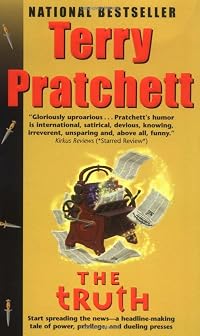
The denizens of Ankh-Morpork fancy they've seen just about everything. But then comes the Ankh-Morpork Times, struggling scribe William de Worde's upper-crust, newsletter turned Discworld's first paper of record. An ethical joulnalist, de Worde has a proclivity for investigating stories -- a nasty habit that soon creates powerful enemies eager to stop his presses. And what better way than to start the Inquirer, a titillating (well, what else would it be?) tabloid that conveniently show more interchanges what's real for what sells. But de Worde's got an inside line on the hot story concerning Ankh-Morpork's leading patrician Lord Vetinari. The facts say Vetinari is guilty. But as William de Worde learns, facts don't always tell the whole story. There's that pesky little thing called the truth ... show lessTags
Recommendations


Member Reviews
I have a favorable bias toward the story of someone stumbling into the business of printed news. This story isn't exactly analogous to my own. I decided to start a magazine when the concept of magazines already existed. William de Worde managed to invent the newspaper without even trying. Terry Pratchett does a wonderful job of showing the form evolve in fast-motion.
He also gives ample stage time here to two of my favorite Discworld characters: Lord Vetinari and Commander Vimes. And of course, as always, he manages to make every page humorous without making light of serious issues (which he grapples with on, well, pretty much every page).
This was also terrific read-aloud fare thanks to the character of Mr. Tulip, who swears a lot. show more Sort of. Specifically, he says, "--ing" all the time. Pratchett makes it clear that he isn't doing the old-fashioned removal of profanity with a dash left behind to show where the bad word was; his character's dialogue is self-cleaning, which leaves a lot of the other characters mystified. It's a lot of fun to read Tulip's dialogue aloud with a solid working-class British accent and lean on that dash before pronouncing the "ing" part. Seriously. Try it. It sounds fantastic.
In fact, I might just use this as a replacement habit to give up swearing, since my son's been begging me to. Kind of a nicotine patch for potty-mouths.
Anyway. Pratchett is such a skilled writer that you can jump into the Discworld books anywhere and enjoy them just fine, but I think this one is even better than usual in that regard. If you haven't read him before, this novel is a great place to start. If you have read him and haven't read The Truth yet, what on earth are you --ing waiting for? show less
He also gives ample stage time here to two of my favorite Discworld characters: Lord Vetinari and Commander Vimes. And of course, as always, he manages to make every page humorous without making light of serious issues (which he grapples with on, well, pretty much every page).
This was also terrific read-aloud fare thanks to the character of Mr. Tulip, who swears a lot. show more Sort of. Specifically, he says, "--ing" all the time. Pratchett makes it clear that he isn't doing the old-fashioned removal of profanity with a dash left behind to show where the bad word was; his character's dialogue is self-cleaning, which leaves a lot of the other characters mystified. It's a lot of fun to read Tulip's dialogue aloud with a solid working-class British accent and lean on that dash before pronouncing the "ing" part. Seriously. Try it. It sounds fantastic.
In fact, I might just use this as a replacement habit to give up swearing, since my son's been begging me to. Kind of a nicotine patch for potty-mouths.
Anyway. Pratchett is such a skilled writer that you can jump into the Discworld books anywhere and enjoy them just fine, but I think this one is even better than usual in that regard. If you haven't read him before, this novel is a great place to start. If you have read him and haven't read The Truth yet, what on earth are you --ing waiting for? show less
"The Truth" follows in the tradition of my experience with many other Terry Pratchett novels - that of feeling like there is some layer of hidden meaning that I'm just not quite getting at or able to understand in many of the characters' conversations. People say things in such oblique ways and I feel like I am supposed to be able to infer what is implied, except much of the time I am left baffled. It's possible that I am worrying too much and that Pratchett doesn't actually intend the reader to understand fully what is going on at that point. I am still trying to decide whether this opacity is a negative or positive aspect of his books. It can be frustrating but at the same time I like being made to 'work for it' and use my intellect show more as a reader.
I appreciated the fact that the protagonist William de Worde and his ideas about the Truth are not portrayed as unambiguously good or virtuous. Pratchett's heroes are never necessarily on the Right side or fighting for the Right cause, and in fact it is unclear which the Right one would be. Instead we are shown the different paradigms the characters operate under, and the way it makes them arrive at different perspectives.
While William acts as though he is doing a great public service by publishing his newspaper, his motivation for chasing after "the Truth" doesn't come from a history of oppression as a member of the lower classes and a desire to change things for the better. It's actually more of a way to rebel for someone who is a member of one of Ankh-Morpork's great noble families. William is simply following his own interests: he's good with words and the press needs feeding. To him the quote "The Truth shall set ye free" is just a pretty and useful slogan. He also has the incredibly privileged assumption that he has a right to decide what is best for others and what they should be interested in. As Lord Vetinari so brilliantly points out, what makes William's press a free press is that he himself is free to print whatever he likes in it. In the end, when it comes to sullying the good name of his own family, William turns out to care more about his own personal vendetta than about pursuing "the Truth" right to the end of the line. show less
I appreciated the fact that the protagonist William de Worde and his ideas about the Truth are not portrayed as unambiguously good or virtuous. Pratchett's heroes are never necessarily on the Right side or fighting for the Right cause, and in fact it is unclear which the Right one would be. Instead we are shown the different paradigms the characters operate under, and the way it makes them arrive at different perspectives.
While William acts as though he is doing a great public service by publishing his newspaper, his motivation for chasing after "the Truth" doesn't come from a history of oppression as a member of the lower classes and a desire to change things for the better. It's actually more of a way to rebel for someone who is a member of one of Ankh-Morpork's great noble families. William is simply following his own interests: he's good with words and the press needs feeding. To him the quote "The Truth shall set ye free" is just a pretty and useful slogan. He also has the incredibly privileged assumption that he has a right to decide what is best for others and what they should be interested in. As Lord Vetinari so brilliantly points out, what makes William's press a free press is that he himself is free to print whatever he likes in it. In the end, when it comes to sullying the good name of his own family, William turns out to care more about his own personal vendetta than about pursuing "the Truth" right to the end of the line. show less
I enjoyed this immensely. As a standalone Discworld novel, I wasn't sure what to expect from this, but this is what I received: an extremely funny, snarky, madcap cast of characters populating the town of Ankh-Morpork, with a solid storyline entwining them all together.
The story is part mystery, part conspiracy, subtle romance, morality lesson, and slapstick humor - a lot of slapstick humor, actually. The young son of a wealthy family, William de Worde, becomes drawn into the world of investigative journalism and becomes part of a rag-tag team of dwarfs who are using their newfangled printing press to turn literal lead into gold - though they keep their axes nearby in case of unwanted interruptions.
William enlists a vampire by the show more name of Otto to become the newspaper's photographer - which would be fine, if only the bright flash didn't cause him to regularly disintegrate. But Otto is no regular vampire - he is a black ribbon vampire, which means he has pledged to stay away from human blood, (though you mustn't say those words in his presence -"Ve prefer the 'B-vord!'") and joins in singsong and wholesome conversation with other black ribbon vampires to live (as best as is possible for a vampire) sound and hale lives.
The novel is like that, yes. Some of the novel's funniest exchanges come from Otto:
William: "Anyway, you're a vampire. What advice could a vampire give me about women?"
Otto: "Oh my vord, vake up and smell zer garlic!"
Despite the occasional frenetic pacing, I didn't race through this because it was so thoroughly entertaining, with a satisfying ending. The best part is the clear ring of truth behind all the satire.
I would recommend this to anyone looking for a funny, yet focused, story that happens to be laced with dwarfs and trolls, along with humans - pick this one up and enjoy the ride.
Brilliant! show less
The story is part mystery, part conspiracy, subtle romance, morality lesson, and slapstick humor - a lot of slapstick humor, actually. The young son of a wealthy family, William de Worde, becomes drawn into the world of investigative journalism and becomes part of a rag-tag team of dwarfs who are using their newfangled printing press to turn literal lead into gold - though they keep their axes nearby in case of unwanted interruptions.
William enlists a vampire by the show more name of Otto to become the newspaper's photographer - which would be fine, if only the bright flash didn't cause him to regularly disintegrate. But Otto is no regular vampire - he is a black ribbon vampire, which means he has pledged to stay away from human blood, (though you mustn't say those words in his presence -"Ve prefer the 'B-vord!'") and joins in singsong and wholesome conversation with other black ribbon vampires to live (as best as is possible for a vampire) sound and hale lives.
The novel is like that, yes. Some of the novel's funniest exchanges come from Otto:
William: "Anyway, you're a vampire. What advice could a vampire give me about women?"
Otto: "Oh my vord, vake up and smell zer garlic!"
Despite the occasional frenetic pacing, I didn't race through this because it was so thoroughly entertaining, with a satisfying ending. The best part is the clear ring of truth behind all the satire.
I would recommend this to anyone looking for a funny, yet focused, story that happens to be laced with dwarfs and trolls, along with humans - pick this one up and enjoy the ride.
Brilliant! show less
Pratchett's enduring style is his sense of fun, relying on wordplay, popular culture, myth and folklore, all of which skewered on the end of sharp metaphors. His descriptive writing, skilfully and humorously giving life to stories that have a firm basis in reality uses inventive and witty similes, produces a flawless and effortless humour.
The Truth is probably the 9th book I've read of the Discworld series, of a possible 39 (at time of writing) I really do have a long way to go. I was introduced to the author by a then mistress, who thought our involvement was becoming pointless (married women, I've noticed often think like this, after the initial sparkle of a relationship has tarnished) and gave me The Colour of Magic with the show more inscription “Serious it isn't” being a reflection on how she thought our relationship was developing. Happily, my relationship with her introduction, lasted longer than my relationship with her.
Actually, of all except The Colour of Magic, The Truth probably IS one of my favourite Pratchette stories and this, coincidentally given by my current amante who has an even greater collection of Terry Pratchett than the former. (I have been very blessed with the literacy inclinations of my paramours)
Despite having only read a few, I am knowledgeable in the mores of Discworld and know full well, amongst other things, that camels are ruminating over algebraical formulae, that Death SPEAKS INSIDE YOUR HEAD and that even rats have their own Grim Reaper, I found the torturous birth of the of the press and the concept of the birth of a newspaper so typically Pratchett I was laughing aloud on almost every other page.
The story builds up slowly but true to most of Pratchett's work, the conflicts of the book reach a certain boiling point and then the story gets really good. The conclusion of the book was appropriate and I got just about everything I wanted, although justice wasn't served, Lord de Worde was allowed escape.
The plot also satirized elements of the Watergate scandal. The dog "Deep Bone" played the role of "Deep Throat" the dog even meets William in a parking garage, except it was for horses in this story. "The Committee to Un-elect the Patrician" was also amusing, as it was a play on Nixon's "The Committee to Re-elect the President" during that same scandal
The villains of the piece Mr Pin and Mr Tulip, were suitably villainous and received their just desserts, despite the potato thing (that whole potato thing was classic) The on going ...ing joke, did pall after a while with it's constant repetition. And the antiques appreciation by Mr Tulip was really funny. One of my favourite Mr Tulip moments was when two bodyguards come in to defend the Mr. Slant, a cunning lawyer zombie, at which point, we are treated with a single, introductory line, in its own paragraph:
"It was horrible what Mr Tulip did to those men."
Some of the quotable's from the story are equally memorable, “A lie will be halfway round the world before truth has it's boots on” used often and by many characters in the story, is a slightly paraphrased Churchillism, which itself was first used by C. H. Spurgeon (1834 - 1892
"There are heroes, and there are those who take notes...and sometimes, they're the same person." Sacharissa Cripslock. Sacharissa was the love interest for William who, shy in the extreme barely manages to stop digging holes for himself when in her company. She was very sweet in a Lois Lane sort of way, but for reasons I can't think, I'm imagining her flat chested – or at least very small.
One of my favourite quotes and I've used paraphrases of it myself since, "There are, it has been said, two types of people in the world. There are those who, when presented with a glass that is exactly half full, say: “..this glass is half full.” And then there are those who say: “..this glass is half empty.” The world belongs, however, to those who can look at the glass and say: “What's up with this glass? Excuse me? Excuse me? This is my glass? I don't think so. My glass was full! And it was a bigger glass!” '
"It was a puzzle why things were always dragged kicking and screaming. No one ever seemed to want to, for example, lead them gently by the hand."
"He's going to go totally Librarian-poo" Gaspode about Vimes, had me in fits, but to get the joke you need to know that the Librarian is an Orang-outang.
A very enjoyable read, that endears she who lent it me even more so than she was before. show less
The Truth is probably the 9th book I've read of the Discworld series, of a possible 39 (at time of writing) I really do have a long way to go. I was introduced to the author by a then mistress, who thought our involvement was becoming pointless (married women, I've noticed often think like this, after the initial sparkle of a relationship has tarnished) and gave me The Colour of Magic with the show more inscription “Serious it isn't” being a reflection on how she thought our relationship was developing. Happily, my relationship with her introduction, lasted longer than my relationship with her.
Actually, of all except The Colour of Magic, The Truth probably IS one of my favourite Pratchette stories and this, coincidentally given by my current amante who has an even greater collection of Terry Pratchett than the former. (I have been very blessed with the literacy inclinations of my paramours)
Despite having only read a few, I am knowledgeable in the mores of Discworld and know full well, amongst other things, that camels are ruminating over algebraical formulae, that Death SPEAKS INSIDE YOUR HEAD and that even rats have their own Grim Reaper, I found the torturous birth of the of the press and the concept of the birth of a newspaper so typically Pratchett I was laughing aloud on almost every other page.
The story builds up slowly but true to most of Pratchett's work, the conflicts of the book reach a certain boiling point and then the story gets really good. The conclusion of the book was appropriate and I got just about everything I wanted, although justice wasn't served, Lord de Worde was allowed escape.
The plot also satirized elements of the Watergate scandal. The dog "Deep Bone" played the role of "Deep Throat" the dog even meets William in a parking garage, except it was for horses in this story. "The Committee to Un-elect the Patrician" was also amusing, as it was a play on Nixon's "The Committee to Re-elect the President" during that same scandal
The villains of the piece Mr Pin and Mr Tulip, were suitably villainous and received their just desserts, despite the potato thing (that whole potato thing was classic) The on going ...ing joke, did pall after a while with it's constant repetition. And the antiques appreciation by Mr Tulip was really funny. One of my favourite Mr Tulip moments was when two bodyguards come in to defend the Mr. Slant, a cunning lawyer zombie, at which point, we are treated with a single, introductory line, in its own paragraph:
"It was horrible what Mr Tulip did to those men."
Some of the quotable's from the story are equally memorable, “A lie will be halfway round the world before truth has it's boots on” used often and by many characters in the story, is a slightly paraphrased Churchillism, which itself was first used by C. H. Spurgeon (1834 - 1892
"There are heroes, and there are those who take notes...and sometimes, they're the same person." Sacharissa Cripslock. Sacharissa was the love interest for William who, shy in the extreme barely manages to stop digging holes for himself when in her company. She was very sweet in a Lois Lane sort of way, but for reasons I can't think, I'm imagining her flat chested – or at least very small.
One of my favourite quotes and I've used paraphrases of it myself since, "There are, it has been said, two types of people in the world. There are those who, when presented with a glass that is exactly half full, say: “..this glass is half full.” And then there are those who say: “..this glass is half empty.” The world belongs, however, to those who can look at the glass and say: “What's up with this glass? Excuse me? Excuse me? This is my glass? I don't think so. My glass was full! And it was a bigger glass!” '
"It was a puzzle why things were always dragged kicking and screaming. No one ever seemed to want to, for example, lead them gently by the hand."
"He's going to go totally Librarian-poo" Gaspode about Vimes, had me in fits, but to get the joke you need to know that the Librarian is an Orang-outang.
A very enjoyable read, that endears she who lent it me even more so than she was before. show less
My first Discworld read - the range of characters and short chapters felt a bit disorienting at first when listening as an audiobook while multitasking, but the performances, particularly Otto, were wonderful.
The book is very funny, weaving together the story of William setting up his newspaper with a plot to overthrow Vetinari. It has a flippant tone, yet showcases characters pulling together and growing over the course of the story. Alongside the humour, it touches on thought-provoking themes such as free speech and discrimination, leaving you both smiling and reflecting long after finishing.
The book is very funny, weaving together the story of William setting up his newspaper with a plot to overthrow Vetinari. It has a flippant tone, yet showcases characters pulling together and growing over the course of the story. Alongside the humour, it touches on thought-provoking themes such as free speech and discrimination, leaving you both smiling and reflecting long after finishing.
Pratchett takes on the media and its ability to reflect/influence the general public and course of political events. Expertly done as you would expect this is full of humour and the usual great characters such as Vetinari, Vimes, Gaspode etc mixed with a handful of new ones. Pratchett works best when his musings on the world hang around a plot of interest and here we have the possible framing of Vetinari as the central mystery. One of his best.
Pratchett, Terry. Truth. Discworld No. 25. Doubleday, 2000.
The Truth is one of Terry Pratchett’s very best novels. It is, if anything, more relevant in the post-Trump era than it was when it was written. News, we are told, is hard to define but a reporter knows it when he or she sees it. The public is less discerning and are easily drawn in by what we would now call fake news. Like the Moist von Lipwig stories from Going Postal to Raising Steam, The Truth is an industrial fantasy. Institutions like the Post Office and the railroad have a seductive power in Discworld. The Press wants to be fed, and it demands obsessive attention from its servants. A handwritten newsletter becomes a mass-market newspaper with a dwarf-produced printing show more press with moveable type and a light-sensitive vampire photographer who has trouble with a flash that regularly turns him into a pile of dust. Pratchett constructs an unusually complex mystery plot that conjures Watergate, even as its editor, William de Worde, conjures William Randolph Hearst. The villains, Mr. Pin and Mr. Tulip, are terrifyingly over the top, but we are reminded that they are in the service of shadowy Lords and lawyers who may be worse. Somehow, it all works out, and the press does reveal the truth and establish an uneasy détente with the forces of law and order represented by Vetinari and Vimes. 5 stars. show less
The Truth is one of Terry Pratchett’s very best novels. It is, if anything, more relevant in the post-Trump era than it was when it was written. News, we are told, is hard to define but a reporter knows it when he or she sees it. The public is less discerning and are easily drawn in by what we would now call fake news. Like the Moist von Lipwig stories from Going Postal to Raising Steam, The Truth is an industrial fantasy. Institutions like the Post Office and the railroad have a seductive power in Discworld. The Press wants to be fed, and it demands obsessive attention from its servants. A handwritten newsletter becomes a mass-market newspaper with a dwarf-produced printing show more press with moveable type and a light-sensitive vampire photographer who has trouble with a flash that regularly turns him into a pile of dust. Pratchett constructs an unusually complex mystery plot that conjures Watergate, even as its editor, William de Worde, conjures William Randolph Hearst. The villains, Mr. Pin and Mr. Tulip, are terrifyingly over the top, but we are reminded that they are in the service of shadowy Lords and lawyers who may be worse. Somehow, it all works out, and the press does reveal the truth and establish an uneasy détente with the forces of law and order represented by Vetinari and Vimes. 5 stars. show less
Members
- Recently Added By
Published Reviews
ThingScore 75
Much as I enjoyed The Truth, honesty nonetheless compels me to admit that the novel didn't seem quite as zippy or fresh as most of the Discworld books (though still offering more entertainment per page than anything this side of Wodehouse). But Pratchett doesn't just spew out jokes and puns (photographs as "prints of darkness"): He implicitly defends a liberal humanism, one that loathes show more bigotry, jingoism, easy answers and any kind of zealotry. show less
added by Shortride
Lists

BBC Big Read
191 works; 46 members

Best Satire
188 works; 29 members

Books I've Read More Than Once
602 works; 49 members

Genre Benders: Comic Fantasy
97 works; 16 members

Mind Expanding Books by hackerkid
581 works; 8 members

Speculative Fiction to Read
706 works; 32 members

Books Read in 2014
2,344 works; 86 members

Huxley's reading log 2016
84 works; 3 members

Books Read in 2016
4,666 works; 199 members
Books Read in 2015
3,299 works; 129 members

Saiyuki Reload Best Summer Reads
159 works; 2 members

Read in 2003
81 works; 1 member

Books Read in 2026
2,206 works; 71 members
Books We Want To Read Again For The First Time
384 works; 160 members

Vlogbrothers Book Recommendations
307 works; 4 members

Books Read in 2010
631 works; 11 members

Books Read in 2003
261 works; 7 members

Books Read in 2021
5,361 works; 114 members

Books Read in 2013
1,630 works; 51 members

KayStJ's to-read list
1,616 works; 11 members

Humorous Science Fiction and Fantasy
28 works; 6 members
Author Information

454+ Works 582,062 Members
Terry Pratchett was on born April 28, 1948 in Beaconsfield, United Kingdom. He left school at the age of 17 to work on his local paper, the Bucks Free Press. While with the Press, he took the National Council for the Training of Journalists proficiency class. He also worked for the Western Daily Press and the Bath Chronicle. He produced a series show more of cartoons for the monthly journal, Psychic Researcher, describing the goings-on at the government's fictional paranormal research establishment, Warlock Hall. In 1980, he was appointed publicity officer for the Central Electricity Generating Board with responsibility for three nuclear power stations. His first novel, The Carpet People, was published in 1971. His first Discworld novel, The Colour of Magic, was published in 1983. He became a full-time author in 1987. He wrote more than 70 books during his lifetime including The Dark Side of the Sun, Strata, The Light Fantastic, Equal Rites, Mort, Sourcery, Truckers, Diggers, Wings, Dodger, Raising Steam, Dragons at Crumbling Castle: And Other Tales, and The Shephard's Crown. He was diagnosis with early onset Alzheimer's disease in 2007. He was knighted for services to literature in 2009 and received the World Fantasy award for life achievement in 2010. He died on March 12, 2015 at the age of 66. (Bowker Author Biography) show less
Some Editions
Awards and Honors
Awards
Distinctions
Notable Lists
Series


Belongs to Publisher Series
Work Relationships
Is contained in
Has the adaptation
Is abridged in
Common Knowledge
- Canonical title
- The Truth
- Original title
- The Truth
- Alternate titles
- La Verdad (España) (España)
- Original publication date
- 2000-10-19
- People/Characters
- William de Worde; Otto von Chriek (vampire, iconographer); Sacharissa Cripslock (daughter of Cripslock the engraver); Death [Discworld]; Gunilla Goodmountain (dwarf, owner of the printing press); Lord de Worde (show all 33); Altogether Andrews; Rufus Drumknott (Patrician's secretary); The Duck Man; Foul Ole Ron; Igor [Discworld] (Constable, City Watch); Mr. Pin (the New Firm); Cut Me Own Throat 'C.M.O.T.' Dibbler (Ankh-Morpork businessman, usually selling food); Death of Rats; Coffin Henry; Sir Harry King (King of the Golden River, as Harry King); Cheery Littlebottom (Ankh-Morpork City Watch, dwarf); Mr. Slant (zombie lawyer); Mr. Tulip [Discworld]; Havelock Vetinari (Patrician of Ankh-Morpork); Sam Vimes (Commander); Angua von Überwald (Sergeant, Ankh-Morpork City Watch, werewolf); Wuffles (Vetinari's dog, 16 years old); Willie Hobson; Gaspode the Wonder Dog; The Bursar (Dr A. A. Dinwiddie, D.M. | 7th); Mustrum Ridcully (wizard, Archchancellor, Unseen University); Sergeant Colon (Ankh-Morpork City Watch); Nobby Nobbs (Ankh-Morpork City Watch corporal); Hughnon Ridcully (High Priest of Blind Io and brother of Ridcully); Caslong (a dwarf who works for Gunilla Goodmountain & Co.); Charlie (ran a clothes shop in Pseudopolis, looks like Veterinari); Thunderaxe (a dwarf who works for Goodmountain & Co., ate one of Dibbler's sausages)
- Important places
- Ankh-Morpork, Discworld; Discworld; Gunilla Goodmountain & Co., at the Sign of the Bucket, Geam Street, off Treacle Mine Road, Ankh Morpork (in one of the sheds behind Mr. Cheese's tavern, The Bucket, where the coppers drink); Patrician's Palace, Ankh-Morpork
- Epigraph
- Author's Note
Sometimes a fantasy author has to point out the strangeness of reality. The way Ankh-Morpork dealt with its flood problems (see p.232 and onwards) is curiously similar to that adopted by the ci... (show all)ty of Seattle, Washington, towards the end of the nineteenth century. Really. Go and see. Try the clam chowder while you're there. - First words
- The rumor spread through the city like wildfire (which had quite often spread through Ankh-Morpork since its citizens had learned the words "fire insurance").
- Quotations*
- Una mentira puede dar la vuelta al mundo antes de que la verdad tenga tiempo de ponerse las botas...
- Last words
- (Click to show. Warning: May contain spoilers.)Because nothing has to be true forever. Just for long enough, to tell you the truth.
- Original language
- English
- Canonical DDC/MDS
- 823.914
*Some information comes from Common Knowledge in other languages. Click "Edit" for more information.
Classifications
Statistics
- Members
- 9,408
- Popularity
- 1,124
- Reviews
- 97
- Rating
- (4.15)
- Languages
- 12 — Bulgarian, Czech, Dutch, English, Estonian, Finnish, French, German, Hungarian, Polish, Russian, Spanish
- Media
- Paper, Audiobook, Ebook
- ISBNs
- 54
- UPCs
- 1
- ASINs
- 35