On This Page
Description
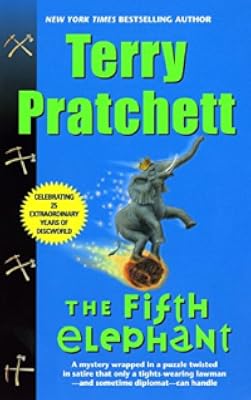
Everyone knows that the world is flat, and supported on the backs of four elephants. But weren't there supposed to be five? Indeed there were. So where is it?...When duty calls. Commander Vimes of the Ankh-Morpork constabulary answers. Even when he doesn't want to. He's been "invited" to attend a royal function as both detective and diplomat. The one role he relishes; the other requires, well, ruby tights. Of course where cops (even those clad in tights) go, alas, crime follows. An show more attempted assassination and a theft soon lead to a desperate chase from the low halls of Discworld royalty to the legendary fat mines of Uberwald, where lard is found in underground seams along with tusks and teeth and other precious ivory artifacts. It's up to the dauntless Vimes -- bothered as usual by a familiar cast of Discworld inhabitants (you know, trolls, dwarfs, werewolves, vampires and such) -- to solve the puzzle of the missing pachyderm. Which of course he does. After all, solving mysteries is his job.
. show less
Tags
Recommendations




Member Recommendations
Member Reviews
The Fifth Elephant continues the strong run of City Watch novels that came once Terry Pratchett perfected the concept. It's not as good as the novels on either side of it-- but given Jingo and Night Watch are my two favorites, that's nothing to sneer at. Like those two novels, Fifth Elephant takes Commander Vimes to his limits, as he's forced to play diplomat in the foreign land of Uberwald, but (of course) discovers a murderous conspiracy. He ends up on the run from a werewolf in the forest, forced to do anything he can to survive. The action scenes here are gripping and tense, as you know much this all means to Vimes as a person. Meanwhile, werewolf Sergeant Angua travels to Uberwald herself as part of a wolfpack, and her boyfriend show more Carrot follows here, and meanwhile meanwhile, "nature's sergeant" Colon goes mad with power when he becomes an officer.
Thematically, it's all quite tight: what is the difference between savagery and civilization? What separates the killing that Vimes and Angua must do from the killing that the werewolves of Uberwald carry out? Vimes marches right up to the line, but manages to not cross it by setting up circumstances that let him fairly kill someone. Like Jingo before it, it's at its best when it uses the genre of the police procedural to examine these issues of power and violence that suffuse the heroic fantasy-- and our own society. Vimes really is the best of us, and The Fifth Elephant shows why. Plus the stuff about Colon's going mad with power is hilarious. show less
Thematically, it's all quite tight: what is the difference between savagery and civilization? What separates the killing that Vimes and Angua must do from the killing that the werewolves of Uberwald carry out? Vimes marches right up to the line, but manages to not cross it by setting up circumstances that let him fairly kill someone. Like Jingo before it, it's at its best when it uses the genre of the police procedural to examine these issues of power and violence that suffuse the heroic fantasy-- and our own society. Vimes really is the best of us, and The Fifth Elephant shows why. Plus the stuff about Colon's going mad with power is hilarious. show less
https://fromtheheartofeurope.eu/the-fifth-elephant-by-terry-pratchett/
I have very happy memories of first reading this while bouncing around the hills and valleys of North Macedonia in 2001 during the conflict there, which actually made it rather appropriate reading; I wrote then:
"it is the story of a multiethnic diplomatic mission to a neighbouring, less developed country from the urban metropolis of Ankh-Morpork. As I met up with my Bulgarian, Romanian and American colleagues in Sofia, then proceeded to Skopje to rendezvous with our Greek, Turkish, Serb, Kosovar and Albanian comrades, before touring [North] Macedonia to find out what the hell was going on there, Pratchett’s satire took on a very hard edge for me. My Albanian show more colleague devoured the book on the day we travelled to Ohrid, though he confessed to some very understandable confusion about exactly who was a dwarf and who was not. Pratchett manages to give a gravely humorous treatment to some very serious themes."
I’m glad to say that I found it just as entertaining coming back to it a quarter-century later. Some of the puns are groan-worthy; some of the satire lands a bit better than other bits; but the core values of empathy and humanism (very much extending to the inhuman characters) are consistent, and there are some deep ideas about symbolism, community and identity. (Though there’s also a less successful sub-plot about the Watch falling to pieces in Ankh-Morpork while Vimes, Carrot and Angua are away in Uberwald.) Sure, these books are a formula; but it’s a good formula that can cope with varying the ingredients. show less
I have very happy memories of first reading this while bouncing around the hills and valleys of North Macedonia in 2001 during the conflict there, which actually made it rather appropriate reading; I wrote then:
"it is the story of a multiethnic diplomatic mission to a neighbouring, less developed country from the urban metropolis of Ankh-Morpork. As I met up with my Bulgarian, Romanian and American colleagues in Sofia, then proceeded to Skopje to rendezvous with our Greek, Turkish, Serb, Kosovar and Albanian comrades, before touring [North] Macedonia to find out what the hell was going on there, Pratchett’s satire took on a very hard edge for me. My Albanian show more colleague devoured the book on the day we travelled to Ohrid, though he confessed to some very understandable confusion about exactly who was a dwarf and who was not. Pratchett manages to give a gravely humorous treatment to some very serious themes."
I’m glad to say that I found it just as entertaining coming back to it a quarter-century later. Some of the puns are groan-worthy; some of the satire lands a bit better than other bits; but the core values of empathy and humanism (very much extending to the inhuman characters) are consistent, and there are some deep ideas about symbolism, community and identity. (Though there’s also a less successful sub-plot about the Watch falling to pieces in Ankh-Morpork while Vimes, Carrot and Angua are away in Uberwald.) Sure, these books are a formula; but it’s a good formula that can cope with varying the ingredients. show less
Newly promoted Duke of Ankh, Commander Vimes suddenly realises his responsabilities include diplomatic visits to Uberwald - to represent Ankh in the ceremonies for the crowning of the new Low King of the dwarves. And as he's going there anyway maybe he could try and negoiate some new lower prices from their famous fat deposits. In a move to show that AnhkMorpock is civilised place much like Uberwald and a place where you can do business, Vimes elects to take a Dwarf, a troll and a werewolf with him - Cherry a newly discovered female, Detritus and Angua. However angua can't be found as she's secretly left the city after discovering her family are causing troubles in Uberwald, and Captain Carrot flees after her - so all our key show more protagonists are on the scene when the wrong dwarf is elected to the throne.
Filled with Pratchett's trademark puns and bad jokes, it is humourous fantasy writing at it's best. Underneath the locked room mystery and general crime scene send-up it is also a barely concealed parody of international politics and racisim. Fat=Oil is one of the most obvious of Terry's analogies but whether it's fair to equate the plight of the mountain dwarfs with muslims is a harder question. What is the best approach to take to tradition?
There are certainly many parallels that can be drawn. As always very funny, and deeply thoughtful writing make this an appealing book for all readers at whatever level you read it at. show less
Filled with Pratchett's trademark puns and bad jokes, it is humourous fantasy writing at it's best. Underneath the locked room mystery and general crime scene send-up it is also a barely concealed parody of international politics and racisim. Fat=Oil is one of the most obvious of Terry's analogies but whether it's fair to equate the plight of the mountain dwarfs with muslims is a harder question. What is the best approach to take to tradition?
There are certainly many parallels that can be drawn. As always very funny, and deeply thoughtful writing make this an appealing book for all readers at whatever level you read it at. show less
The Discworld City Watch visits a country of dwarfs, werewolves and vampires.
3/4 (Good).
There's genuinely exciting action/adventure in here, if you ignore the fact that it's meant to be parody (It's rarely funny.). And there's some world-building, and memorable little character moments. (Although, there's also a B story focusing on Sgt. Colon that does not work at all.) I wonder with this one if Pratchett wouldn't have been a much better writer if he hadn't had the expectation to be silly all the time.
3/4 (Good).
There's genuinely exciting action/adventure in here, if you ignore the fact that it's meant to be parody (It's rarely funny.). And there's some world-building, and memorable little character moments. (Although, there's also a B story focusing on Sgt. Colon that does not work at all.) I wonder with this one if Pratchett wouldn't have been a much better writer if he hadn't had the expectation to be silly all the time.
Whenever Sybil has popped up in a book since Guards! Guards!, I've so wanted her to take on an active role and substantial presence: such a disappointment in Jingo. So I was delighted by the Lady Sybil action throughout The Fifth Elephant, and also the scenes involving Cheery Littlebottom (the subversively feminine dwarf who kind of started out as a joke about dwarf culture but turned into a full and compelling character through the magic of Pratchett). And the "nice little doggie" Gaspode is here, smelling terrible as always. I enjoyed this one a lot.
Oh boy. Here's another book that has twice now fallen through the cracks of my reading and blogging system. First and foremost, it sat pushed in the back of the bookshelf, unseen, and therefore, unread. Then, somehow beyond my ken, it either wasn't added to my list of books I wanted to blog about, or it was somehow deleted from the list before I had a chance to review it. In fact, even more distressing for my own list keeping (a hand written list I've kept since 1987), the book failed to make it into my book diary.
But in it's own special irony, it's the perfect introduction to The Fifth Element by Terry Pratchett. See it opens with a very important thing going missing — the Stone of Scone — the thing upon which the Low King sits show more during coronation. A replica of the Scone, kept in Ankh-Morpork, has also gone missing.
Vimes due to his marriage to Lady Sybil, has to don the tights and attend the upcoming coronation of the Low King. Vimes, ever the member of the Watch, sees things aren't as they seem.
Now I happened to read The Fifth Elephant on the heels of Raising Steam the 40th and final book of the adult Discworld books — and the sequel to this one. What that meant for me, is that I could see many of things Vimes could see (and a few he couldn't yet see).
Somewhere around the mid-point of the Discworld series, the books became more plot driven and more oriented towards social commentary. What is begun in The Fifth Elephant is finished in Raising Steam. show less
But in it's own special irony, it's the perfect introduction to The Fifth Element by Terry Pratchett. See it opens with a very important thing going missing — the Stone of Scone — the thing upon which the Low King sits show more during coronation. A replica of the Scone, kept in Ankh-Morpork, has also gone missing.
Vimes due to his marriage to Lady Sybil, has to don the tights and attend the upcoming coronation of the Low King. Vimes, ever the member of the Watch, sees things aren't as they seem.
Now I happened to read The Fifth Elephant on the heels of Raising Steam the 40th and final book of the adult Discworld books — and the sequel to this one. What that meant for me, is that I could see many of things Vimes could see (and a few he couldn't yet see).
Somewhere around the mid-point of the Discworld series, the books became more plot driven and more oriented towards social commentary. What is begun in The Fifth Elephant is finished in Raising Steam. show less
So this is diplomacy. It’s like lying, only to a better class of people.
More than most of the Guards series (or Discworld in general), [b:The Fifth Elephant|63720|The Fifth Elephant (Discworld, #24; City Watch, #5)|Terry Pratchett|https://images.gr-assets.com/books/1327961702s/63720.jpg|819126] is driven by a strong plot rather than leaning on characters and jokes. It's actually a nice change from many of the other books, although I do like both styles.
This time around, The Patrician is sending Vimes and his wife off as ambassadors to Uberwald--land of Dwarves, werewolves, and vampires. In an overall reading, this would be just after [b:Carpe Jugulum|34541|Carpe Jugulum (Discworld #23; Witches #6)|Terry show more Pratchett|https://images.gr-assets.com/books/1388895900s/34541.jpg|1494234], but since I'm reading series by series, it's been a while. Uberwald is still interesting though. And a nice contrast to the Ankh-Morpork of the last few books.
Mostly, it's a book about Vimes--who continues to be a wonderful combination of grumpy and overly straight forward; just the sort of 'ambassador' that makes the more traditional ambassadors nervous. We also get some interesting scenes with Angua going back to her werewolf family roots (in Uberwald) and Carrot dealing with the fallout of that.
There are a few interesting ideas in the book, mostly related to the nature of long lived things / traditions:
“You did something because it had always been done, and the explanation was, ‘But we’ve always done it this way.’ A million dead people can’t have been wrong, can they?”
And a more Discworld way of looking at the Ship of Theseus.
“This, milord, is my family's axe. We have owned it for almost nine hundred years, see. Of course, sometimes it needed a new blade. And sometimes it has required a new handle, new designs on the metalwork, a little refreshing of the ornamentation . . . but is this not the nine hundred-year-old axe of my family? And because it has changed gently over time, it is still a pretty good axe, y'know. Pretty good.”
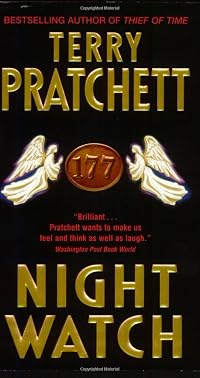
It's definitely a different sort of book than the early Discworld books--much more serious and darker--and we're drawing to the end of the subseries (3 left: [b:Night Watch|47989|Night Watch (Discworld, #29; City Watch, #6)|Terry Pratchett|https://images.gr-assets.com/books/1320518310s/47989.jpg|1712283], [b:Thud!|62530|Thud! (Discworld, #34; City Watch #7)|Terry Pratchett|https://images.gr-assets.com/books/1320495268s/62530.jpg|819104], and [b:Snuff|8785374|Snuff (Discworld, #39; City Watch #8)|Terry Pratchett|https://images.gr-assets.com/books/1302694636s/8785374.jpg|13659124]). I'm curious where it will go next. show less
Members
- Recently Added By
Published Reviews
ThingScore 100
Trying to summarize the plot of a Pratchett novel is like describing "Hamlet" as a play about a troubled guy with an Oedipus complex and a murderous uncle. Pratchett isn't Shakespeare -- for one thing, he's funnier -- but his books are richly textured, as the pundits say, and far more complex than they appear at first. You don't have to be familiar with folklore, Leonardo da Vinci and show more Capability Brown, the history of religion, "Macbeth" and Laurel and Hardy to appreciate them, but if you aren't, you will miss some of the in-jokes. Just consider yourself grabbed by the collar, with me shouting, "You've got to read this book!" show less
added by Shortride
Lists

BBC Big Read
191 works; 46 members

Best Satire
188 works; 29 members

Favorite Werewolf Novels
62 works; 30 members

1990s
309 works; 17 members

Books I've Read More Than Once
602 works; 49 members

Genre Benders: Comic Fantasy
97 works; 16 members

Mind Expanding Books by hackerkid
581 works; 8 members

Books Read in 2015
3,299 works; 126 members

Books Read in 2014
2,343 works; 86 members

Huxley's reading log 2016
84 works; 3 members

Books Read in 2023
5,547 works; 145 members

Speculative Fiction to Read
706 works; 32 members

Books Read in 2020
4,379 works; 124 members

al.vick-wishlist-scifi-fant
181 works; 2 members

Books With Numbers in the Title
308 works; 13 members
Books Read in 2016
4,666 works; 199 members

Books Read in 2026
1,930 works; 66 members

Books Read in 2025
4,091 works; 97 members

Best Vampire & Werewolf Fiction
221 works; 146 members

Genre Benders: Fantasy + Mystery
108 works; 16 members

Books Read in 2010
631 works; 11 members

Books Read in 2013
1,630 works; 51 members

Elephants in Books
55 works; 5 members

Books Read in 2021
5,361 works; 114 members
Author Information

423+ Works 580,236 Members
Terry Pratchett was on born April 28, 1948 in Beaconsfield, United Kingdom. He left school at the age of 17 to work on his local paper, the Bucks Free Press. While with the Press, he took the National Council for the Training of Journalists proficiency class. He also worked for the Western Daily Press and the Bath Chronicle. He produced a series show more of cartoons for the monthly journal, Psychic Researcher, describing the goings-on at the government's fictional paranormal research establishment, Warlock Hall. In 1980, he was appointed publicity officer for the Central Electricity Generating Board with responsibility for three nuclear power stations. His first novel, The Carpet People, was published in 1971. His first Discworld novel, The Colour of Magic, was published in 1983. He became a full-time author in 1987. He wrote more than 70 books during his lifetime including The Dark Side of the Sun, Strata, The Light Fantastic, Equal Rites, Mort, Sourcery, Truckers, Diggers, Wings, Dodger, Raising Steam, Dragons at Crumbling Castle: And Other Tales, and The Shephard's Crown. He was diagnosis with early onset Alzheimer's disease in 2007. He was knighted for services to literature in 2009 and received the World Fantasy award for life achievement in 2010. He died on March 12, 2015 at the age of 66. (Bowker Author Biography) show less
Some Editions
Awards and Honors
Notable Lists
BBC's Big Read (153)
Series


Belongs to Publisher Series
Work Relationships
Is contained in
Has the adaptation
Is abridged in
Common Knowledge
- Canonical title
- The Fifth Elephant
- Original title
- The Fifth Elephant
- Alternate titles
- El quinto elefante (España) (España)
- Original publication date
- 1999-11-04
- People/Characters
- Sam Vimes (Commander); Carrot Ironfoundersson (Captain); Fred Colon (Sergeant); Nobby Nobbs (Corporal); Lady Sybil Ramkin Vimes; Angua von Überwald (Constable) (show all 20); Ruston von Überwald; Serafine von Überwald; Wolfgang von Überwald; Detritus; Gaspode the Wonder Dog; Igor [Discworld]; Lady Margolotta; Gavin the wolf; Leonard da Quirm; Rhys Rhysson; Wallace Sonky; Inigo Skimmer; Havelock Vetinari; Visit-The-Infidel-With-Explanatory-Pamphlets (Constable)
- Important places
- Überwald, Discworld; Discworld; Ankh-Morpork, Discworld
- Epigraph
- [None]
- Dedication*
- Ich danke Peter Bleackley für seine Hilfe bei der Zwergenoper Blutaxt und Eisenhammer. In seiner Version war sie vermutlich viel besser (und enthielt viel mehr Lieder über Gold).
- First words
- They say the world is flat and supported on the back of four elephants who themselves stand on the back of a giant turtle.
- Quotations
- Sam Vimes could parallel process. Most husbands can. They learn to follow their own line of thought while at the same time listening to what their wives say. And the listening is important, because at any time they could be c... (show all)hallenged and must be ready to quote the last sentence in full. A vital additional skill is being able to scan the dialogue for telltale phrases such as "and they can deliver it tomorrow" or "so I've invited them for dinner?" or "they can do it in blue, really quite cheaply."
He wasn't strictly aware of it, but he treated even geography as if he was investigating a crime (did you see who carved out the valley? Would you recognize that glacier if you saw it again?)
A marriage is always made up of two people who are prepared to swear that only the other one snores. - Last words
- (Click to show. Warning: May contain spoilers.)"No one would ever have to make a clock again." Tick
- Blurbers
- Byatt, A. S.; Peters, Elizabeth; Mertz, Barbara
- Original language
- English
*Some information comes from Common Knowledge in other languages. Click "Edit" for more information.
Classifications
Statistics
- Members
- 10,945
- Popularity
- 848
- Reviews
- 117
- Rating
- (4.09)
- Languages
- 14 — Czech, Dutch, English, Estonian, Finnish, French, German, Hungarian, Japanese, Polish, Russian, Spanish, Swedish, Turkish
- Media
- Paper, Audiobook, Ebook
- ISBNs
- 55
- ASINs
- 38