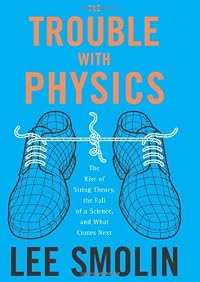
The Trouble with Physics: The Rise of String Theory, the Fall of a Science, and What Comes Next
by Lee Smolin
On This Page
Description
In this illuminating book, the renowned theoretical physicist Lee Smolin argues that fundamental physics -- the search for the laws of nature -- losing its way. Ambitious ideas about extra dimensions, exotic particles, multiple universes, and strings have captured the public s imagination -- and the imagination of experts. But these ideas have not been tested experimentally, and some, like string theory, seem to offer no possibility of being tested. Yet these speculations dominate the field, show more attracting the best talent and much of the funding and creating a climate in which emerging physicists are often penalized for pursuing other avenues. As Smolin points out, the situation threatens to impede the very progress of science. With clarity, passion, and authority, Smolin offers an unblinking assessment of the troubles that face modern physics -- and an encouraging view of where the search for the next big idea may lead." show lessTags
Recommendations










Member Reviews
From my perspective as an engineer with a PhD who never found a place in the "establishment" (R1 university, national lab), any critical take on academic science is sorely necessary. I know this isn't an ivory tower takedown as much as a critique on physics research in general, but I found it great, even though it's 16 years old.
While I'm not sure exactly how physics research has advanced in those 16 years (other than the experimental evidence of the Higgs Boson, which I feel like most people are aware of), my intuition leads me to believe that the beauty and elegance of string theory / theories have not advanced our understanding of the universe any more than it had when the book was first published. An updated edition with an show more additional chapter would be great for those of us not keeping up with scientific advances in the field.
Generally a great look into a theory I've always been deeply skeptical of, and a scientific system that is deeply flawed. You definitely do not need any physics background to read this book, although basic physics knowledge would likely make it much more approachable. I appreciated Smolin's ability to make the topic accessible.
Bonus: if you want to make this book into a drinking game, take a shot every time the author says something to the effect of "I have nothing but the utmost respect for my colleagues in string theory, but..." (At one point I laughed out loud when the version of this statement was along the lines of "but some of my best friends are string theorists!") show less
While I'm not sure exactly how physics research has advanced in those 16 years (other than the experimental evidence of the Higgs Boson, which I feel like most people are aware of), my intuition leads me to believe that the beauty and elegance of string theory / theories have not advanced our understanding of the universe any more than it had when the book was first published. An updated edition with an show more additional chapter would be great for those of us not keeping up with scientific advances in the field.
Generally a great look into a theory I've always been deeply skeptical of, and a scientific system that is deeply flawed. You definitely do not need any physics background to read this book, although basic physics knowledge would likely make it much more approachable. I appreciated Smolin's ability to make the topic accessible.
Bonus: if you want to make this book into a drinking game, take a shot every time the author says something to the effect of "I have nothing but the utmost respect for my colleagues in string theory, but..." (At one point I laughed out loud when the version of this statement was along the lines of "but some of my best friends are string theorists!") show less
The more I read of Lee Smolin, the more I appreciate him. This book was his warning cry that theoretical physics was entering a cul de sac, and risking having nothing meaningful to say about the nature of reality because of its infatuation with elegant mathematics over testable hypotheses.
I was struck by his using the term "postmodern physics" to describe this situation. Indeed, the faddish, fragmented, highly abstract world of contemporary physical theory has its parallel elsewhere in academics. We're all living in the enormous aftermath of some hope for a grand synthesis that never happened.
Why would anyone who's not a scientist care about these things? Because science, particularly theoretical physics and evolutionary biology when show more taken together, is attempting to give us our origin story and our place in the scheme of things without the kind of social coercion and enforced ignorance that political ideology or religion do. It's a tremendously worthwhile thing - if it doesn't become another unaccountable priesthood in its own right. And if it is honest about its limitations - its ability to create useful models of reality, but not to duplicate or replace it.
But if science is becoming its own Church, full of careerism, orthodoxy, and arrogance, then its helpfulness is reduced and its danger is increased. Physics has obtained too much power over the physical world not to be humble. Smolin's is a welcome voice of caution and hope from the inside. show less
I was struck by his using the term "postmodern physics" to describe this situation. Indeed, the faddish, fragmented, highly abstract world of contemporary physical theory has its parallel elsewhere in academics. We're all living in the enormous aftermath of some hope for a grand synthesis that never happened.
Why would anyone who's not a scientist care about these things? Because science, particularly theoretical physics and evolutionary biology when show more taken together, is attempting to give us our origin story and our place in the scheme of things without the kind of social coercion and enforced ignorance that political ideology or religion do. It's a tremendously worthwhile thing - if it doesn't become another unaccountable priesthood in its own right. And if it is honest about its limitations - its ability to create useful models of reality, but not to duplicate or replace it.
But if science is becoming its own Church, full of careerism, orthodoxy, and arrogance, then its helpfulness is reduced and its danger is increased. Physics has obtained too much power over the physical world not to be humble. Smolin's is a welcome voice of caution and hope from the inside. show less
This book changed my perception of the field of physics forever. Smolin excellently criticizes the most toxic elements of the academic physics community. He demonstrates how the power held by older physicists squashes the creativity of younger physicists, and how the consequence of that is heavy investment in the most likely dead-end of string theory. His unique personal experience brings invaluable insight. My only criticism is that Smolin repeats himself; this book would be stronger at 1/2 its length.
Smolin's The Trouble with Science is kind of a weird book. It was originally meant as a book about the sociology of the scientific community, but the string theory portion swelled to make the book more commercially viable. And to Smolin's credit, that part of the book was what originally pulled me in; he does an excellent job of detailing the history of science over the last few decades, including the developments that led to string theory as well as alternative programs. But about 3/4ths of the way through the book, the topic shifts to problems within the scientific community with a big clunk, and you sense that's his true passion.
One of the fundamental issues—one only semi-directly dealt with at the end of the book and never show more explicitly said—is that our social expectations of theory and the needs of science have come to be at odds. We want any new theories to agree with existing ones (for the standard model is possibly the most successful scientific theory ever), but need ones that disagree to actually give us testable predictions and cope with the unexpected results of experimentation. So we get theories, both string and otherwise, that only differ on the very large or very small scales. And whenever we do find unexpected effects at those scales, we are often left with nothing that had predicted them.
He does close, though, with a wonderful paen to the different "seers" in the field, those who have pursued inconsistencies and worries about the structure of theories for decades. They ran in the face of the field's traditional incentive structure, which prizes publishable work to earn tenure and looks for consistent output that precludes tackling the big fundamental issues of physics. It's hard to not tie this to Bret Victor's "Inventing on Principle" talk that's been circulating lately, and see the same lesson here. Pursuing a principle as a guiding light can lead you to much greater things than simply seeking to excel or solve a specific problem. It's a vision of the way the world should be, one that leads you to the skills and the means you need to make it a reality. show less
One of the fundamental issues—one only semi-directly dealt with at the end of the book and never show more explicitly said—is that our social expectations of theory and the needs of science have come to be at odds. We want any new theories to agree with existing ones (for the standard model is possibly the most successful scientific theory ever), but need ones that disagree to actually give us testable predictions and cope with the unexpected results of experimentation. So we get theories, both string and otherwise, that only differ on the very large or very small scales. And whenever we do find unexpected effects at those scales, we are often left with nothing that had predicted them.
He does close, though, with a wonderful paen to the different "seers" in the field, those who have pursued inconsistencies and worries about the structure of theories for decades. They ran in the face of the field's traditional incentive structure, which prizes publishable work to earn tenure and looks for consistent output that precludes tackling the big fundamental issues of physics. It's hard to not tie this to Bret Victor's "Inventing on Principle" talk that's been circulating lately, and see the same lesson here. Pursuing a principle as a guiding light can lead you to much greater things than simply seeking to excel or solve a specific problem. It's a vision of the way the world should be, one that leads you to the skills and the means you need to make it a reality. show less
This is not the easiest book to describe. I really enjoyed the author's criticisms of how modern physics is done, especially string theory and how it's become basically undisprovable because of how broad and multifaced they have made it rather than because of the theory behind it. While this book is probably understandable to those who don't have much of a physics education, it can be quite dense and dry at times which I don't think I was as in the mood for as I could have been
(posted on my blog: davenichols.net)
Lee Smolin is a well-respected physicist who isn't currently working on string theory (yes, there is such a person). The Trouble with Physics represents Smolin's well-developed and highly-engaging view of the current landscape of physics, the problems presented by string theory's dominance, alternative research underway in the field, and a call to academia to reform for the sake of science.
The first part of the book is largely an extension of the first half of his earlier book, Three Roads to Quantum Gravity. Here, Smolin expands the story and gives a more robust picture of some of the key players and key parts of various theories, beginning by defining five main problems which physics must attack show more directly.
In the second section, Smolin gives a broad and balanced view of string theory's history, successes, and failures. He does this in a very humane and reasonable way (unlike the bitter negative view in Peter Woit's book Not Even Wrong). Smolin himself worked on string theory for several years before coming to his senses and looking for new ways to attack the five problems of physics.
For me, the third section was the best in the book. Smolin gives us an overview of the world of physics after string theory, introducing unexplainable phenomenons and exploring several alternative areas of research currently underway, including cutting edge thoughts like double special relativity, the 'axis of evil', and twistor theory. Smolin advises us not to lose heart even if string theory is ultimately discredited (he argues politely but firmly that it already is so as the ultimate unification theory while conceding that it has opened up other areas of insight and advancement).
Finally, Smolin's last section is aimed primarily at his peers and those in positions of power in the academic world, though the non-academic reader should really take in his points here as they apply to our understanding of the academic world and the politics that often hinder the advancement of science. He challenges traditional notions of scientific method, peer review, and tenure, while arguing for more opportunities for alternative thinkers and researchers. His chief argument is that the Einsteins of the current physics world are unable to get jobs unless they give in to academic pressure to work on a very narrow range of accepted theories (most especially string theory), often leading them to abandon the independent thinking which may have lead to breakthroughs in the field. This, Smolin states, is a primary problem for physics to overcome in order to complete the revolution Einstein and other started decades ago.
I had just finished up Smolin's Three Roads prior to this one, so let me offer just a few thoughts. In Three Roads, Smolin was much more diplomatic about string theory's place in physics. While Trouble offers many reasons why string theory deserves attention, it also shows Smolin's hardened stance that alternative theories must be given much greater attention than they currently receive. Smolin also offered predictions in Three Roads which he has clearly backed away from, namely string theory's ultimate role in the unification of forces (he now shows considerable doubt that such a theory may even exist). To be fair, in Trouble, he also admits his disappointment of his own loop quantum gravity theory to provide results he thought showed great promise in Three Roads.
This is the book that needed to be written about Physics. It is well balanced, with loads of cutting edge science and personalities, but it is broader than most, less stary-eyed, more sober. It challenges traditionally held beliefs in how the physics world moves forward, and advocates strongly for a revolution in academia to preserve the vital nature of science itself.
What more can I say? Smolin is level-headed, presents an engaging and insightful book, and develops his thoughts with a hopeful but measured eye toward the future. Trouble with Physics is the book you should read if you like Brian Greene or Michio Kaku's books, but need to understand a more balanced, reality-based view of the world as physics really understands it (which is to say, not nearly as well as Greene, Kaku, and other string theorists would have us believe). Five stars, one of the best popular science books I have read in a long time. show less
Lee Smolin is a well-respected physicist who isn't currently working on string theory (yes, there is such a person). The Trouble with Physics represents Smolin's well-developed and highly-engaging view of the current landscape of physics, the problems presented by string theory's dominance, alternative research underway in the field, and a call to academia to reform for the sake of science.
The first part of the book is largely an extension of the first half of his earlier book, Three Roads to Quantum Gravity. Here, Smolin expands the story and gives a more robust picture of some of the key players and key parts of various theories, beginning by defining five main problems which physics must attack show more directly.
In the second section, Smolin gives a broad and balanced view of string theory's history, successes, and failures. He does this in a very humane and reasonable way (unlike the bitter negative view in Peter Woit's book Not Even Wrong). Smolin himself worked on string theory for several years before coming to his senses and looking for new ways to attack the five problems of physics.
For me, the third section was the best in the book. Smolin gives us an overview of the world of physics after string theory, introducing unexplainable phenomenons and exploring several alternative areas of research currently underway, including cutting edge thoughts like double special relativity, the 'axis of evil', and twistor theory. Smolin advises us not to lose heart even if string theory is ultimately discredited (he argues politely but firmly that it already is so as the ultimate unification theory while conceding that it has opened up other areas of insight and advancement).
Finally, Smolin's last section is aimed primarily at his peers and those in positions of power in the academic world, though the non-academic reader should really take in his points here as they apply to our understanding of the academic world and the politics that often hinder the advancement of science. He challenges traditional notions of scientific method, peer review, and tenure, while arguing for more opportunities for alternative thinkers and researchers. His chief argument is that the Einsteins of the current physics world are unable to get jobs unless they give in to academic pressure to work on a very narrow range of accepted theories (most especially string theory), often leading them to abandon the independent thinking which may have lead to breakthroughs in the field. This, Smolin states, is a primary problem for physics to overcome in order to complete the revolution Einstein and other started decades ago.
I had just finished up Smolin's Three Roads prior to this one, so let me offer just a few thoughts. In Three Roads, Smolin was much more diplomatic about string theory's place in physics. While Trouble offers many reasons why string theory deserves attention, it also shows Smolin's hardened stance that alternative theories must be given much greater attention than they currently receive. Smolin also offered predictions in Three Roads which he has clearly backed away from, namely string theory's ultimate role in the unification of forces (he now shows considerable doubt that such a theory may even exist). To be fair, in Trouble, he also admits his disappointment of his own loop quantum gravity theory to provide results he thought showed great promise in Three Roads.
This is the book that needed to be written about Physics. It is well balanced, with loads of cutting edge science and personalities, but it is broader than most, less stary-eyed, more sober. It challenges traditionally held beliefs in how the physics world moves forward, and advocates strongly for a revolution in academia to preserve the vital nature of science itself.
What more can I say? Smolin is level-headed, presents an engaging and insightful book, and develops his thoughts with a hopeful but measured eye toward the future. Trouble with Physics is the book you should read if you like Brian Greene or Michio Kaku's books, but need to understand a more balanced, reality-based view of the world as physics really understands it (which is to say, not nearly as well as Greene, Kaku, and other string theorists would have us believe). Five stars, one of the best popular science books I have read in a long time. show less
If only more scientists wrote for popular audiences with the humility Lee Smolin does. Whilst it occasionally gets bogged down in the detail of its own material - there are more minutiae on particle physics here than most people will care for in a bedtime read - Lee Smolin's major points are clearly made and they ring like a bell.
In some ways this is a work of popular philosophy of science, not popular science itself: Smolin approaches his subject through the prism of the failings of string theory to coagulate over the last thirty years, but only in the loosest sense is this an attempt to prove string theory wrong and his own favoured research programme, quantum loop gravity, right. For one thing, he accepts from the outset that there show more are significant issues with his own programme.
Smolin's concern is more around the practice of modern physics; how the gradual disappearance of anything resembling testable empirical evidence has given way to ever more theoretical modelling which in turn has led to hypotheses of increasingly incredible (literally, that is) implications. For any variety of string theory to work (it is more of a cluster of similar possible theories, rather than a discrete theory as such) the mathematics require something like *eleven* spatial dimensions, some of which, it is variously hypothesised, must be so small as to be conceptually unobservable (the image we are invited to consider is dimensions which curl up into little donuts smaller than an atomic particle across), or which appear to require an infinity of alternative universes - a "multiverse" if you will - into which these dimensions can be projected. (I may well have not understood or expressed this perfectly: the important point is that the theory must account for the absence of any physical evidence for the extra dimensions: solution - they're invisible, of course!)
Smolin's concern is not just that these are outlandish and faintly ridiculous consequences - though they surely seem to be - but precisely that they are systematically untestable. *By definition* there is no means to measure spatial dimensions smaller than the smallest subatomic particles. *by definition* we cannot see or measure physical effects occurring outside our own universe. These are not just difficult to say with a straight face, Smolin argues, but by any commonly understood sense of the term they're altogether unscientific: logically closed, untestable, unfalsifiable, unreliant on any kind of inductively gathered argument.
Precisely the sort of arguments, in other words, that give religious cosmologies a bad name: utterly verboten, you would think in the enlightened mead-hall of the physical sciences. (Yet, and without apparent irony, biologist Richard Dawkins makes favourable reference to the "multiverse" theory in his recent book The God Delusion!)
Smolin argues that this uneasy development collides head-on with some uncomfortable realities about the sociological aspects of the practice of science. Again, Smolin is persuasive here (though in my case preaching to the choir) in citing favourably the late, anarchic, philosopher of science Paul Feyerabend, whose general message is that for scientific methodology anything goes, and all theories have a role to play for the good of the "development of knowledge", and that determined insistence on an existing accepted theory for framing ongoing research hardens quickly and dangerously into dogma: you need the vistas that different theories offer, says Feyerabend, or they are "as useless as a medicine that heals a patient only if he is bacteria-free".
For his trouble, Smolin is duly criticised for exhibiting "postmodernist" or "relativist" tendencies, and while I don't think this *is* a criticism myself, it is in any case unfairly awarded, since Smolin avowedly retains a belief in the possibility of objective truth, and promises to (but in the end doesn't really) take issue with the work of the most celebrated "postmodernist" philosopher of science, Thomas Kuhn. (I'm a fan of Kuhn's so I was looking forward to the challenge, and was a bit disappointed to find it didn't materialise).
Practically, Smolin feels that String Theory is now a "paradigm in crisis". Certainly, the theoretical tail seems to be wagging the practical dog. It is difficult to see what practical utility a theory has which postulates invisible dimensions and which doesn't seem to point with any clarity to a possible solution at all, let alone one with the elegance of a f = ma or e = mc2.
I suspect this book will annoy the hard-core science-is-truth crowd, but anyone with a more open mind will find a valuable perspective here. show less
In some ways this is a work of popular philosophy of science, not popular science itself: Smolin approaches his subject through the prism of the failings of string theory to coagulate over the last thirty years, but only in the loosest sense is this an attempt to prove string theory wrong and his own favoured research programme, quantum loop gravity, right. For one thing, he accepts from the outset that there show more are significant issues with his own programme.
Smolin's concern is more around the practice of modern physics; how the gradual disappearance of anything resembling testable empirical evidence has given way to ever more theoretical modelling which in turn has led to hypotheses of increasingly incredible (literally, that is) implications. For any variety of string theory to work (it is more of a cluster of similar possible theories, rather than a discrete theory as such) the mathematics require something like *eleven* spatial dimensions, some of which, it is variously hypothesised, must be so small as to be conceptually unobservable (the image we are invited to consider is dimensions which curl up into little donuts smaller than an atomic particle across), or which appear to require an infinity of alternative universes - a "multiverse" if you will - into which these dimensions can be projected. (I may well have not understood or expressed this perfectly: the important point is that the theory must account for the absence of any physical evidence for the extra dimensions: solution - they're invisible, of course!)
Smolin's concern is not just that these are outlandish and faintly ridiculous consequences - though they surely seem to be - but precisely that they are systematically untestable. *By definition* there is no means to measure spatial dimensions smaller than the smallest subatomic particles. *by definition* we cannot see or measure physical effects occurring outside our own universe. These are not just difficult to say with a straight face, Smolin argues, but by any commonly understood sense of the term they're altogether unscientific: logically closed, untestable, unfalsifiable, unreliant on any kind of inductively gathered argument.
Precisely the sort of arguments, in other words, that give religious cosmologies a bad name: utterly verboten, you would think in the enlightened mead-hall of the physical sciences. (Yet, and without apparent irony, biologist Richard Dawkins makes favourable reference to the "multiverse" theory in his recent book The God Delusion!)
Smolin argues that this uneasy development collides head-on with some uncomfortable realities about the sociological aspects of the practice of science. Again, Smolin is persuasive here (though in my case preaching to the choir) in citing favourably the late, anarchic, philosopher of science Paul Feyerabend, whose general message is that for scientific methodology anything goes, and all theories have a role to play for the good of the "development of knowledge", and that determined insistence on an existing accepted theory for framing ongoing research hardens quickly and dangerously into dogma: you need the vistas that different theories offer, says Feyerabend, or they are "as useless as a medicine that heals a patient only if he is bacteria-free".
For his trouble, Smolin is duly criticised for exhibiting "postmodernist" or "relativist" tendencies, and while I don't think this *is* a criticism myself, it is in any case unfairly awarded, since Smolin avowedly retains a belief in the possibility of objective truth, and promises to (but in the end doesn't really) take issue with the work of the most celebrated "postmodernist" philosopher of science, Thomas Kuhn. (I'm a fan of Kuhn's so I was looking forward to the challenge, and was a bit disappointed to find it didn't materialise).
Practically, Smolin feels that String Theory is now a "paradigm in crisis". Certainly, the theoretical tail seems to be wagging the practical dog. It is difficult to see what practical utility a theory has which postulates invisible dimensions and which doesn't seem to point with any clarity to a possible solution at all, let alone one with the elegance of a f = ma or e = mc2.
I suspect this book will annoy the hard-core science-is-truth crowd, but anyone with a more open mind will find a valuable perspective here. show less
Members
- Recently Added By
Lists

Physics
29 works; 3 members

Houghton Mifflin Harcourt
45 works; 1 member
Author Information

11+ Works 3,671 Members
Lee Smolin is a theoretical physicist who is a founding and senior faculty member at the Perimeter Institute for Theoretical Physics. He is the author of five books, including The Trouble with Physics and Time Reborn.
Some Editions
Awards and Honors
Distinctions
Notable Lists
Series
Belongs to Publisher Series
BUR: Saggi [Rizzoli] (888)
Common Knowledge
- Canonical title
- The Trouble with Physics: The Rise of String Theory, the Fall of a Science, and What Comes Next
- Original publication date
- 2006
- People/Characters
- Giovanni Amelino-Camelia; Albert Einstein; Richard Feynman; Galileo Galilei; Stephen Hawking; Juan Maldacena (show all 13); James Clerk Maxwell; Roger Penrose; Joseph Polchinski; John Schwarz; Lee Smolin; Leonard Susskind; Edward Witten
- Dedication
- To Kai
- First words
- There may or may not be a God.--
Introduction
From the beginning of physics, there have been those who imagined they would be the last generation to face the unknown. - Last words
- (Click to show. Warning: May contain spoilers.)Then I'm going to turn off the phone and the Blackberry, put on some Bebel Gilberto, Esthero, and Ron Sexsmith, turn the volume way up, erase the blackboard, get out some good chalk, open a new notebook, take out my favorite pen, sit down, and start thinking.
- Publisher's editor
- Cook, Amanda; Lippincott, Sara
- Blurbers
- Lanier, Jaron; Ferris, Tim; Penrose, Roger; Levin, Janna; Stephenson, Neal; 't Hooft, Gerard (show all 8); Appleyard, Bryan; Easterbrook, Gregg
Classifications
Statistics
- Members
- 1,485
- Popularity
- 15,537
- Reviews
- 29
- Rating
- (3.89)
- Languages
- 11 — Czech, English, French, German, Greek, Hungarian, Italian, Japanese, Portuguese, Spanish, Turkish
- Media
- Paper, Audiobook, Ebook
- ISBNs
- 20
- UPCs
- 1
- ASINs
- 8