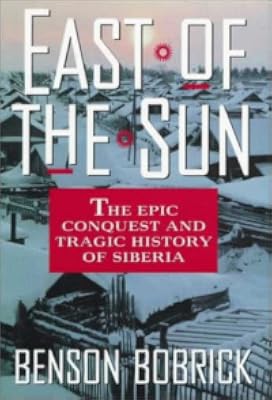
East of the Sun: The Epic Conquest and Tragic History of Siberia
by Benson Bobrick
On This Page
Description
In sweep, color, and grandeur, the conquest and settlement of Siberia compares with the winning of the American West. It is the greatest pioneering story in human history, uniquely combining the heroic colonization of an intractable virgin land, the ghastly dangers and high adventure of Arctic exploration, and the grimmest saga of penal servitude in the chronicles of man. Four hundred years of continual human striving chart its course, a drama of unremitting extremes and. Elemental show more confrontations, pitting man against nature, and man against man. East of the Sun, a work of panoramic scope and brilliance, is the first complete account of this strange and terrible story. To most Westerners, Siberia is a vast and mysterious place. The richest resource area on the face of the earth, its land mass covers 5 million square miles - 7 1/2 percent of the total land surface of the globe. From the first foray in 1581 across the Ural Mountains by a. Band of Cossack outlaws to the fall of Gorbachev, East of the Sun is history on a grand scale. With vivid immediacy, Bobrick describes the often brutal subjugation of Siberia's aboriginal tribes and the cultures that were destroyed; the great eighteenth-century explorations that defined Siberia's borders and Russia's attempt to "extend" Siberia further with settlements in Alaska, California, and Hawaii; and the transformation of Siberia into a penal colony for criminal. And political exiles, an experiment more terrible than Australia's Botany Bay. There is the building of the stupendous Trans-Siberian Railway across seven time zones; Siberia's key role in the bloody aftermath of the October Revolution in 1917; and Stalin's dreaded Gulag, which corrupted its very soil. Today, Siberia is the hope of Russia's future, now that all her appended republic have broken away. Its story has never been more timely. show lessTags
Recommendations




































Member Reviews
This is a solid enough account of Russian Imperial acquisition of the wastes and resources of Siberia albeit one marred by a decline (it was written in 1992) into anti-Soviet and very incomplete history once the brutal and chaotic Russian Civil War is over.
My cynical side notes that the British Edition simply refers in the sub-heading to the conquest and settlement of Siberia but the American edition suddenly makes this an 'epic conquest' and 'tragic'. One senses two chapters tagged on to give Americans what they want to hear - an evil empire.
Having said that, the previous fourteen chapters give us a pretty sound and interesting account of Russian Siberia from Yermak's first incursion until 1921. This is good old-fashioned narrative show more history and can be read as such.
Brobrick is mostly relying on English language sources throughout, sometimes over-relying. Certainly he over-relies on dissident accounts in the last two chapters so this is a best effort at bringing together what we knew about Siberian history in the West in 1992 into one volume.
Until things go a bit pearshaped towards the end - how on earth does he completely fail to mention the Nomonhan incident in 1939 when he is so adroit at explaining the complicated geo-politics of the Russian Far East before 1921? - he tells a good and readable story.
The detailed account of the Bering Expeditions is downright exciting and Bobrik is good at explaining the circumstances that led to particular decisions. The sale of Alaska now seems like a highly rational act where once it seemed a giveaway.
In that case, Russia solved a financial problem arising out of the Crimean War, and accepted the reality of an aggressive expanding US market economy coming up against what amounted to little more than a line of fairly primitive trading posts, in order to concentrate on the Amur valley.
Similarly, until it misjudged Japan in 1904, Russia was quite skilled at getting control of the bits of the Far East that it wanted. It even managed to get a surprisingly good deal out of its own defeat in 1905. Russian resilience is a remarkable phenomenon.
The Russia of the Tsars is the Russia of today. An under-capitalised country of immense scale with a population too small for its aspirations which yet made impressive imperial strides through something close to the exercise of pure political will by successive administrations.
Looking at it from outside, you can see modern sanctions as a deliberate strategy of containment by one dominant Western faction in an attempt to bend this nation to its will and perhaps avert what might happen if the country did get sufficient external capital for its needs.
The news from inside Russia today is of severe economic strains but if Neo-Cold Warriors think that this nation will fall apart again and become available for plunder, I suspect they will be wrong-footed. It may fall apart for a while but it will never be plundered.
Siberia is now an essential part of this story. Bobrick's weak last two chapters (you can tell I was irritated by them) fails to discuss adequately its role in supplying a Plan B to survive the destruction in 1941/42 of its industrial capacity in the West or as a reserve of trained troops.
So, I can recommend the book up to the end of Chapter 14 but that you go to other more measured and more inclusive sources (albeit that he is entirely right about the grim Stalinist horrors of the Gulag) for the full story of Siberia under the Soviets (and of course since 1991). show less
My cynical side notes that the British Edition simply refers in the sub-heading to the conquest and settlement of Siberia but the American edition suddenly makes this an 'epic conquest' and 'tragic'. One senses two chapters tagged on to give Americans what they want to hear - an evil empire.
Having said that, the previous fourteen chapters give us a pretty sound and interesting account of Russian Siberia from Yermak's first incursion until 1921. This is good old-fashioned narrative show more history and can be read as such.
Brobrick is mostly relying on English language sources throughout, sometimes over-relying. Certainly he over-relies on dissident accounts in the last two chapters so this is a best effort at bringing together what we knew about Siberian history in the West in 1992 into one volume.
Until things go a bit pearshaped towards the end - how on earth does he completely fail to mention the Nomonhan incident in 1939 when he is so adroit at explaining the complicated geo-politics of the Russian Far East before 1921? - he tells a good and readable story.
The detailed account of the Bering Expeditions is downright exciting and Bobrik is good at explaining the circumstances that led to particular decisions. The sale of Alaska now seems like a highly rational act where once it seemed a giveaway.
In that case, Russia solved a financial problem arising out of the Crimean War, and accepted the reality of an aggressive expanding US market economy coming up against what amounted to little more than a line of fairly primitive trading posts, in order to concentrate on the Amur valley.
Similarly, until it misjudged Japan in 1904, Russia was quite skilled at getting control of the bits of the Far East that it wanted. It even managed to get a surprisingly good deal out of its own defeat in 1905. Russian resilience is a remarkable phenomenon.
The Russia of the Tsars is the Russia of today. An under-capitalised country of immense scale with a population too small for its aspirations which yet made impressive imperial strides through something close to the exercise of pure political will by successive administrations.
Looking at it from outside, you can see modern sanctions as a deliberate strategy of containment by one dominant Western faction in an attempt to bend this nation to its will and perhaps avert what might happen if the country did get sufficient external capital for its needs.
The news from inside Russia today is of severe economic strains but if Neo-Cold Warriors think that this nation will fall apart again and become available for plunder, I suspect they will be wrong-footed. It may fall apart for a while but it will never be plundered.
Siberia is now an essential part of this story. Bobrick's weak last two chapters (you can tell I was irritated by them) fails to discuss adequately its role in supplying a Plan B to survive the destruction in 1941/42 of its industrial capacity in the West or as a reserve of trained troops.
So, I can recommend the book up to the end of Chapter 14 but that you go to other more measured and more inclusive sources (albeit that he is entirely right about the grim Stalinist horrors of the Gulag) for the full story of Siberia under the Soviets (and of course since 1991). show less
Great read - Highly recommended Could have used more maps.
Ratings
Members
- Recently Added By
Lists

All Things Russia
459 works; 11 members
Author Information

16 Works 2,768 Members
Benson Bobrick holds a doctorate in English & Comparative Literature from Columbia University & is the author of six previous books. He lives in Brattleboro, Vermont. (Bowker Author Biography)
Some Editions
Common Knowledge
- Original title
- East of the Sun
- Original publication date
- 1992
- Important places
- Siberia, Russia; Russian Empire
- Important events
- First Russian Expedition to Siberia (1581); Dissolution of the Soviet Union (1991)
- Epigraph
- This desert soil
Wants not her hidden lustre, gems and gold.
-John Milton. 'Paradise Lost'
If you would understand Russia, and interpret and forecast aright the march of great events, never forget that, for her, eastward the march of empire takes its way; that as the sap rises, as the sparks fly upward, as the tide... (show all)s follow the moon, so Russia goes to the sunrise.
-Henry Norman, 'All the Russias' - Dedication
- For Sherry & In Memory of My Mother, who bravely crossed Siberia alone in 1929
Für Sherry und im Gedenken an meine Mutter, die 1929 alleine Sibirien bereiste. - Blurbers
- Bullock, Alan; Goldstein, Steve; Rubenstein, Joshua
- Original language
- English
Classifications
- Genres
- History, Nonfiction, General Nonfiction
- DDC/MDS
- 957 — History & geography History of Asia Asiatic Russia: Siberia
- LCC
- DK761 .B6 — History of Europe, Asia, Africa and Oceania Russia. Soviet Union. Former Soviet Republics – Poland History of Russia. Soviet Union. Former Soviet Republics Local history and description Siberia
- BISAC
Statistics
- Members
- 201
- Popularity
- 163,177
- Reviews
- 2
- Rating
- (4.00)
- Languages
- Dutch, English, German, Italian
- Media
- Paper, Ebook
- ISBNs
- 10
- ASINs
- 2