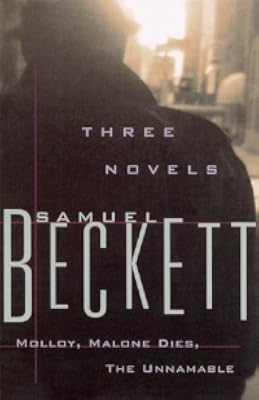
Three Novels: Molloy, Malone Dies, The Unnamable
by Samuel Beckett
Beckett's Trilogy (Collections and Selections — Omnibus)
On This Page
Description
Molloy is divided into two sections. In the first section, Molloy goes in search of his mother. In the second, he is pursued by Moran, an agent.Tags
Recommendations










Member Recommendations


Member Reviews
It's difficult for me to write about this one. When I was a young undergraduate, Beckett's work hit me like a sandbag between the eyes, and this trilogy was the ultimate blow. It was like suddenly understanding the *how* of how awful everything was, in my viscera. I never quite recovered from it: I'm not sure whether to thank Samuel Beckett, or curse his memory.
Of course you must also understand that, as he's showing you the architecture of wrong-ness, Beckett is also excruciatingly funny.
Far beyond 5 stars.
Of course you must also understand that, as he's showing you the architecture of wrong-ness, Beckett is also excruciatingly funny.
Far beyond 5 stars.
Beckett's three great novels like his plays, break new ground in their structure and narrative. A bleak emptiness hovers throughout the three novels that one may consider a sort of trilogy. I was mesmerized from the opening pages of Molloy and wondered what it was in this bleak indeterminacy that was so beguiling. Reading slowly and closely I slowly found a method in this seemingly chaotic world. Drawn inward by moments of humor that counterposed the strange events, if they can be called that, I was drawn forward by the narrator even as the narrative itself seemed to be collapsing. These are three novels with so much wonder and ideas to think about that the attentive reader cannot fail to be impressed. I found these novels to be moving show more in a unique way and important additions to the literature of modernism.
In Samuel Beckett's novel, Molloy, the first sentence states bluntly, “I am in my mother's room.” This is followed on the first page of the novel with the phrase “I don't know” repeated five times, and if you add “I don't understand” and “I've forgotten” you have eight assertions of lack of knowing. How can or should the reader interpret those comments as establishing anything but a high level of uncertainty both about what the narrator (I) is telling us and what the narrator, may or may not, believe about himself and the world around him? Of most interest to this reader is the comment that the narrator would like to “finish dying” and that his mother is dead, although he is not sure exactly when she died.
What is the reader's expectation for the succeeding 167 pages of the novel based on the first page filled with uncertainty and death? There is work mentioned, but the pages he works on are filled with “signs I don't understand”. Can we say the same for ourselves as readers? At best we are left with snippets of possible information about a handful of others (the man who comes every week, they who may or may not have buried his mother, the son that he may or may not have, and the chambermaid without true love, and yet another who was the true love-whose name he has forgotten, repeatedly). As I reread these lines I cannot help but note the humor of the situation. show less
In Samuel Beckett's novel, Molloy, the first sentence states bluntly, “I am in my mother's room.” This is followed on the first page of the novel with the phrase “I don't know” repeated five times, and if you add “I don't understand” and “I've forgotten” you have eight assertions of lack of knowing. How can or should the reader interpret those comments as establishing anything but a high level of uncertainty both about what the narrator (I) is telling us and what the narrator, may or may not, believe about himself and the world around him? Of most interest to this reader is the comment that the narrator would like to “finish dying” and that his mother is dead, although he is not sure exactly when she died.
What is the reader's expectation for the succeeding 167 pages of the novel based on the first page filled with uncertainty and death? There is work mentioned, but the pages he works on are filled with “signs I don't understand”. Can we say the same for ourselves as readers? At best we are left with snippets of possible information about a handful of others (the man who comes every week, they who may or may not have buried his mother, the son that he may or may not have, and the chambermaid without true love, and yet another who was the true love-whose name he has forgotten, repeatedly). As I reread these lines I cannot help but note the humor of the situation. show less
These novels are like the music video to Robbie Williams' 'Rock DJ'. Except if, after stripping off the clothes, muscle and flesh, you just whittled away at the bones until nothing but bare consciousness was left.
How sparse and stripped-down you can be before meaning dies? Molloy gives us the ponderings of a (very Beckettian) wandering leper - but no other discernible characters or purpose. Malone Dies strips away plot, motive and journey, confining us to the writings of a dying bedridden man. The Unnamable is another level altogether - just bare consciousness, floating in a void, trying desperately to abandon itself of all connection or relation.
Hard to read, but often rewarding.
How sparse and stripped-down you can be before meaning dies? Molloy gives us the ponderings of a (very Beckettian) wandering leper - but no other discernible characters or purpose. Malone Dies strips away plot, motive and journey, confining us to the writings of a dying bedridden man. The Unnamable is another level altogether - just bare consciousness, floating in a void, trying desperately to abandon itself of all connection or relation.
Hard to read, but often rewarding.
“To know you can do better next time, unrecognizably better, and that there is no next time, and that it is a blessing there is not, there is a thought to be going on with.”
—Malone Dies by Samuel Beckett
It’s probably been fifteen years since I’d read “Malloy”, the first part to Beckett’s non-self-acknowledged “Trilogy”, and I cannot deny the impact that the first part had on my own novel of OCD, body dysmorphic disorder, delusion and addiction: “Fluid Babies”. The impact that this second installment will have on my future writing will have to be intercepted by radar, sifting the raw dataflow for Beckettian echoes. I certainly won’t wait another fifteen years to complete this master’s experiment on the show more deconstructed novel. Fortunately, pioneers such as Beckett can only truly be appreciated by those brave readers, critics and writers who skirt the steady diet of comfort food and sugar buzzes by preferring to indulge in the exotic and bizarre fare from unfamiliar countries. Whole food. Ingested and digested. Over time to understand and then implement its uniqueness in personal, favorite dishes. I’d imagine chutneys developed this way. Over time. Restless experimentation. Punctuating the familiar with flamboyance from alien shores, alien planets, alien hands shaking over the distances and leaving an otherworldly scent.
This. This is how I feel about Samuel Beckett. He doesn’t just write. He shows you how easy it is to not give a fuck about the particulars while showing how important those particulars actually are. Knowing the difference makes all the difference in the world. And if you don’t get it, well, then you probably weren’t open to a new way of looking at the world anyway. Chutneys aren’t for everyone. show less
—Malone Dies by Samuel Beckett
It’s probably been fifteen years since I’d read “Malloy”, the first part to Beckett’s non-self-acknowledged “Trilogy”, and I cannot deny the impact that the first part had on my own novel of OCD, body dysmorphic disorder, delusion and addiction: “Fluid Babies”. The impact that this second installment will have on my future writing will have to be intercepted by radar, sifting the raw dataflow for Beckettian echoes. I certainly won’t wait another fifteen years to complete this master’s experiment on the show more deconstructed novel. Fortunately, pioneers such as Beckett can only truly be appreciated by those brave readers, critics and writers who skirt the steady diet of comfort food and sugar buzzes by preferring to indulge in the exotic and bizarre fare from unfamiliar countries. Whole food. Ingested and digested. Over time to understand and then implement its uniqueness in personal, favorite dishes. I’d imagine chutneys developed this way. Over time. Restless experimentation. Punctuating the familiar with flamboyance from alien shores, alien planets, alien hands shaking over the distances and leaving an otherworldly scent.
This. This is how I feel about Samuel Beckett. He doesn’t just write. He shows you how easy it is to not give a fuck about the particulars while showing how important those particulars actually are. Knowing the difference makes all the difference in the world. And if you don’t get it, well, then you probably weren’t open to a new way of looking at the world anyway. Chutneys aren’t for everyone. show less
What a trilogy of despair & hopelessness this is! Or, at least, that's the way I remember it. After I read this I'd pretty much had enuf of Beckett for awhile. If you've ever wanted to get inside the mind of a hopelessly trapped person.. & then do it again, these 3 novels are for you! I shd really re-read these but, the usual reason not to holds: there're too many things I haven't read yet that my reading time can be better spent on.
To try and review the Three Novels separately would require far too many words for here. These stories are masterpieces and Beckett was at the top of his game. Readers looking for any semblance of a plot, happy endings, strict narrative, or answers to any questions should probably opt for something in their local aeroports. Beckett has provided those who tag along an epistemological breakdown of life and its intricacies, failures, and rejections of desire and appeal. Each voice or creation (use of the term "character" is far too simplistic) strives for an end. The end can be viewed as death, a change of location, being given answers, or finding purpose. However, Beckett refuses to give readers an ending. Each novel leaves off with a show more consciousness in a position of continuing against its will. This decision by Beckett is either to further his usually humanist perspective of ending silence or wishing readers to come to terms with their own uncontrollable entropy. He was never clear, so it is up to readers to infer what these 'M' fellows wish to communicate.
When reading, one should not try to ascribe any conventional means of interpretation, however. By this, I mean labelling the novels as commentary on a particular historical event or somehow deciding Beckett is a Science Fiction writer. Beckett knew exactly what he was doing when he sought to sever the mind from its weak body and by the last sentence of The Unnameable, we might not be able to conclude what exactly has transpired over the past several hundred pages, but we know something -- what we just read has ever happened before in literature. Indeed, I highly doubt it will ever happen again. You're flipping through the pages of genius when reading these novels and if you don't walk away feeling a bit queasy or as if your world has been rattled a bit... you might want to try again. show less
When reading, one should not try to ascribe any conventional means of interpretation, however. By this, I mean labelling the novels as commentary on a particular historical event or somehow deciding Beckett is a Science Fiction writer. Beckett knew exactly what he was doing when he sought to sever the mind from its weak body and by the last sentence of The Unnameable, we might not be able to conclude what exactly has transpired over the past several hundred pages, but we know something -- what we just read has ever happened before in literature. Indeed, I highly doubt it will ever happen again. You're flipping through the pages of genius when reading these novels and if you don't walk away feeling a bit queasy or as if your world has been rattled a bit... you might want to try again. show less
[The Beckett Trilogy: Molloy, Malone Dies, The Unnamable] - Samuel Beckett
It was a long time ago. How long ago I can't really say. Perhaps I was bamboozled it would appear from the evidence, but what evidence from the book lying on my desk, the book that I am not going to read. Charity begins at home, but in this case it was a shop selling charity, who was selling this charity and was I in the mood for buying? I was gazing upwards and I couldn't quite see, somebody was in the way, my neck was hurting a fortiori. Movement was impossible, crammed in nowhere to go, if only I could reach up, it is tantalisingly close, rows and rows wherever I looked, but I could not see too much because my head had become stuck, stuck looking upwards, but I show more could see those dirty dusty jackets and if I could move my arm above my head then surely I would get some relief, I could enclose my fingers around a spine and a sharp tug might do the trick. There I did it, but horror of horrors a sound like cardboard fluttering on wood, I jerked forward trapping a paper object against my chest, still could not move my head, how long did I stay in this position, perhaps not very long, because a shove from the right unlocked my potential, just enough, just enough, the smell of damp overcoats cold winter dampness, chilling I got my right hand under the object, the thought of trying to bend down to pick something off the floor made me press tighter, tighter, but this prevented me moving my hand any further, a short cough, not my cough I don't think, but difficult to place, but now I was getting hot under my collar, pressure from behind, more movement a grunted apology an arm appearing above my head, but not my arm, my arm was trapped, but I could now move my head, fresh air, fresh cold air, a space had been made to my left. I was holding my breath, I could hold my breath underwater for 52 seconds, not moving, concentrating, trying not to panic, but thinking what it would feel like to drown, bubbles, choking, thrashing of arms, light disappearing. I escaped I was holding a book, I looked inside: Lindsey 1980 it said, was that a girl or a boy a woman or a man, evidence that somebody had possessed this object, which had certainly taken on the look of something unpleasant, or was that just the dust jacket with its mouldy mottled brown yellow design, it somehow looked forbidding, not welcoming. I dare you to open me with intent, intent to what, intent to get through the first paragraph. The first paragraph finished at page 84, but the count started at page 11. I could not hold my breath for that long, but I felt I might need to. I needed a distraction, something to stop my eyes slipping down the page, slipping into a temporary unconsciousness: a temporary death, from which waking up would be a guilt ridden experience. I know this. Molloy, Moran, Malone, Mahood would all slip by in an unnamable abyss. What did Lindsey think, that pretty college girl in glasses, I am quite sure that Lindsey is what I have said she was or is, but perhaps no longer; college girls grow up, but probably not growing up thinking of Molloy, Moran Malone or Mahood. She might have never forgiven the author for changing Sapos name to Macmann, but closer reading would have revealed that Sapo was just a shortening of his Mothers name; Mrs Saposcat. He became Macmann because he needed the lineage of Molloy, Moran, Malone. Mahood. Lindsey probably thought that a novel written in the genre of the Absurd and with the technique of a stream of consciousness becomes absurd stream of consciousness. How much of the absurd stream of consciousness could she take, she might not have had a choice because she had written her name on the flyleaf, part of a college curriculum. How long before her eyes glazed over how long before her mind wandered to the girl next door. The phone rings, she must get up to answer: it is 1980. Sapo is no more, forgotten never to be revisited, but the book has not read itself. Lindsey gets back into position and she ploughs on through the Unnamable: the head in the glass jar, the voices, the craving for silence, will it never end? It did end, but forty pages from the finishing line; Malone and Moran although going round in circles appeared to be getting somewhere, nowhere good, but somewhere. Malone got to be dead which was his ambition from the start, but the Unnamable, oh the unnamable just got stuck and her neck started to ache. I can't go on. I go on.
3.5 stars. show less
It was a long time ago. How long ago I can't really say. Perhaps I was bamboozled it would appear from the evidence, but what evidence from the book lying on my desk, the book that I am not going to read. Charity begins at home, but in this case it was a shop selling charity, who was selling this charity and was I in the mood for buying? I was gazing upwards and I couldn't quite see, somebody was in the way, my neck was hurting a fortiori. Movement was impossible, crammed in nowhere to go, if only I could reach up, it is tantalisingly close, rows and rows wherever I looked, but I could not see too much because my head had become stuck, stuck looking upwards, but I show more could see those dirty dusty jackets and if I could move my arm above my head then surely I would get some relief, I could enclose my fingers around a spine and a sharp tug might do the trick. There I did it, but horror of horrors a sound like cardboard fluttering on wood, I jerked forward trapping a paper object against my chest, still could not move my head, how long did I stay in this position, perhaps not very long, because a shove from the right unlocked my potential, just enough, just enough, the smell of damp overcoats cold winter dampness, chilling I got my right hand under the object, the thought of trying to bend down to pick something off the floor made me press tighter, tighter, but this prevented me moving my hand any further, a short cough, not my cough I don't think, but difficult to place, but now I was getting hot under my collar, pressure from behind, more movement a grunted apology an arm appearing above my head, but not my arm, my arm was trapped, but I could now move my head, fresh air, fresh cold air, a space had been made to my left. I was holding my breath, I could hold my breath underwater for 52 seconds, not moving, concentrating, trying not to panic, but thinking what it would feel like to drown, bubbles, choking, thrashing of arms, light disappearing. I escaped I was holding a book, I looked inside: Lindsey 1980 it said, was that a girl or a boy a woman or a man, evidence that somebody had possessed this object, which had certainly taken on the look of something unpleasant, or was that just the dust jacket with its mouldy mottled brown yellow design, it somehow looked forbidding, not welcoming. I dare you to open me with intent, intent to what, intent to get through the first paragraph. The first paragraph finished at page 84, but the count started at page 11. I could not hold my breath for that long, but I felt I might need to. I needed a distraction, something to stop my eyes slipping down the page, slipping into a temporary unconsciousness: a temporary death, from which waking up would be a guilt ridden experience. I know this. Molloy, Moran, Malone, Mahood would all slip by in an unnamable abyss. What did Lindsey think, that pretty college girl in glasses, I am quite sure that Lindsey is what I have said she was or is, but perhaps no longer; college girls grow up, but probably not growing up thinking of Molloy, Moran Malone or Mahood. She might have never forgiven the author for changing Sapos name to Macmann, but closer reading would have revealed that Sapo was just a shortening of his Mothers name; Mrs Saposcat. He became Macmann because he needed the lineage of Molloy, Moran, Malone. Mahood. Lindsey probably thought that a novel written in the genre of the Absurd and with the technique of a stream of consciousness becomes absurd stream of consciousness. How much of the absurd stream of consciousness could she take, she might not have had a choice because she had written her name on the flyleaf, part of a college curriculum. How long before her eyes glazed over how long before her mind wandered to the girl next door. The phone rings, she must get up to answer: it is 1980. Sapo is no more, forgotten never to be revisited, but the book has not read itself. Lindsey gets back into position and she ploughs on through the Unnamable: the head in the glass jar, the voices, the craving for silence, will it never end? It did end, but forty pages from the finishing line; Malone and Moran although going round in circles appeared to be getting somewhere, nowhere good, but somewhere. Malone got to be dead which was his ambition from the start, but the Unnamable, oh the unnamable just got stuck and her neck started to ache. I can't go on. I go on.
3.5 stars. show less
Members
- Recently Added By
Lists

1001 Books You Must Read Before You Die
1,448 works; 1,134 members

The 100 Best Books of All Time by Norwegian Book Club (World Library)
104 works; 21 members

Best of French Literature
138 works; 27 members

Philip Ward's Lifetime Reading Plan
592 works; 22 members

Larry McCaffery's 20th Century Greatest Hits: 100 English-Language Books
103 works; 12 members

1950s
340 works; 22 members

Significant works of postmodern fiction
86 works; 25 members

Stream of Consciousness
87 works; 8 members

Best of Irish Literature
37 works; 7 members

Experimental Literature
141 works; 18 members

TML 200 Best Books 1950-1999
202 works; 10 members

Existentialism
90 works; 11 members

Nifty Fifties
129 works; 13 members

Books worth rereading
21 works; 1 member
Harold Bloom - The Western Canon: D. The Chaotic Age
833 works; 24 members

The 150 Greatest Novels of All Time
150 works; 6 members

DigitalDreamDoor top 300
300 works; 4 members

The Modern Library (The Two Hundred Best Novels....
202 works; 1 member
Author Information

Nobel Prize winner (1969) Samuel Beckett was born on April 13, 1906 near Dublin, Ireland into a middle-class Protestant family. As a boy, he studied French and enjoyed cricket, tennis, and boxing. At Trinity College he continued his studies in French and Italian and became interested in theater and film, including American film. After graduation, show more Beckett taught English in Paris and traveled through France and Germany. While in Paris Beckett met Suzanne Deschevaus-Dusmesnil. During World War II when Paris was invaded, they joined the Resistance. They were later forced to flee Paris after being betrayed to the Gestapo, but returned in 1945. Beckett and Deschevaus-Dusmesnil married in 1961. Samuel Beckett's first novel was Dream of Fair to Middling Women. Among his many works are Murphy; Malone Dies; and The Unnameable. His plays include Endgame, Happy Days, Not I, That Time, and Krapp's Last Tape. In 1953, the production of Waiting For Godot in Paris by director and actor Roger Blin earned Beckett international fame. Beckett was awarded the Nobel Prize in Literature in 1969. His style was postmodern minimalist and some of his major themes were imprisonment in one's self, the failure of language, and moral conduct in a godless world. Despite his fame, Samuel Beckett led a secluded life. In his later years he suffered from cataracts and emphysema. His wife Suzanne died on July 17, 1989 and Beckett died on December 22nd of the same year. (Bowker Author Biography) show less
Some Editions
Awards and Honors
Notable Lists
Daniel S. Burt's Novel 100 (040 – 40)
Series

Belongs to Publisher Series
Work Relationships
Common Knowledge
- Canonical title*
- Malloy; Malone muore; L'innominabile
- Original title
- Molloy; Malone meurt; L'Innommable; Malone dies; The unnamable
- Original publication date
- 1951 (Molloy, Malone Dies) (Molloy, Malone Dies); 1953 (The Unnamable) (The Unnamable)
- First words
- I am in my mother's room.
- Last words
- (Click to show. Warning: May contain spoilers.)...I don't know, perhaps it's a dream, all a dream, that would surprise me, I'll wake, in the silence, and never sleep again, it will be I, or dream, dream again, dream of a silence, a dream silence, full of murmurs, I don't know, that's all words, never wake, all words, there's nothing else, you must go on, that's all I know, they're going to stop, I know that well, I can feel it, they're going to abandon me, it will be the silence, for a moment, a good few moments, or it will be mine, the lasting one, that didn't last, that still lasts, it will be I, you must go on, I can't go on, you must go on, I'll go on, you must say words, as long as there are any, until they find me, until they say me, strange pain, strange sin, you must go on, perhaps it's done already, perhaps they have said me already, perhaps they have carried me to the threshold of my story, before the door that opens on my story, that would surprise me, if it opens, it will be I, it will be the silence, where I am, I don't know, I'll never know, in the silence you don't know, you must go on, I can't go on, I'll go on.
- Disambiguation notice
- Molloy, Malone Dies, The Unnamable
*Some information comes from Common Knowledge in other languages. Click "Edit" for more information.
Classifications
Statistics
- Members
- 3,360
- Popularity
- 5,012
- Reviews
- 30
- Rating
- (4.17)
- Languages
- 13 — Danish, Dutch, English, Finnish, French, German, Hebrew, Italian, Norwegian (Bokmål), Norwegian, Russian, Spanish, Swedish
- Media
- Paper, Audiobook, Ebook
- ISBNs
- 29
- ASINs
- 31