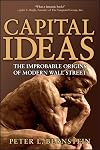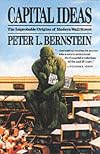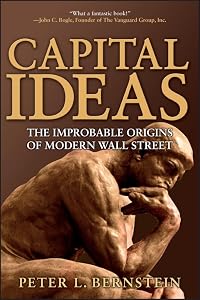
Capital Ideas: The Improbable Origins of Modern Wall Street
by Peter L. Bernstein
On This Page
Description
Capital Ideas traces the origins of modern Wall Street, from the pioneering work of early scholars and the development of new theories in risk, valuation, and investment returns, to the actual implementation of these theories in the real world of investment management. Bernstein brings to life a variety of brilliant academics who have contributed to modern investment theory over the years: Louis Bachelier, Harry Markowitz, William Sharpe, Fischer Black, Myron Scholes, Robert Merton, Franco show more Modigliani, and Merton Miller. Filled with in-depth insights and timeless advice, Capital Ideas reveals how the unique contributions of these talented individuals profoundly changed the practice of investment management as we know it today. show lessTags
Recommendations














Member Reviews
Your investment manager or stock broker probably believes he can beat the market-- ie: do a better job investing your money than simply putting your money in an index fund. And he is wrong. Anyone who says "I can beat the market" is a liar. "Buy and hold" is a better strategy for the investor than actively trading. As Nobel laureate Eugene Fama recently pointed out (again) using data from 1984-2006:
Even before expenses, the overall portfolio of active mutual funds shows no evidence that active managers can enhance returns. After costs, fund investors in aggregate simply lose the fees and expenses imposed on them.
As more players enter the capital markets, the markets become more strongly efficient. This is why I have a problem teaching show more finance-- I see too many students graduate who think they are somehow smarter than the market. Granted, one aspect of Efficient Markets Hypothesis may not hold to be true -- the underlying price may not always be right (and see my review of Taleb's Fooled by Randomness or Mandelbrot's The (Mis)Behavior of Markets) and risk may be grossly misassessed due to false assumptions of normality.
But people who are able to see mispriced assets or missassessed risk either don't exist or are too far and between. Bill Miller became a legend for managing a fund that beat the S&P 500 for 15 consecutive years (the only one to do so). Now his fund is the worst performing of its class and he's lost tens of billions of dollars.
This is also why I don't want to be an investment manager or try to sell someone the idea that I could pick the best mutual funds for them, because the data say that active management is ludicrous. All I could do is match their risk tolerance to the stated risk of the fund, like selling them the color car they want to drive.
Capital Ideas: The Improbable Origins of Modern Wall Street by Peter L. Bernstein is a classic history of modern finance. How academic economists and mathematicians revolutionized finance, and how the investment services industry fiercely resists their ideas. From determining the fair price of an option to designing the optimally diversified portfolio, Bernstein tells the story of how it all took place from Bachelier to Rubinstein.
Last summer, I read Bernstein's Against the Gods (my review here), which told the history of risk and is a good prelude to this book. What Taleb and Mandelbrot argue is that the tools used in Bernstein's book are folly for risk management because of the models' underlying assumptions--the world is not normally distributed. 1987 is an "aberration" Bernstein glosses over, and 2008 made Taleb and Mandelbrot rock stars (Taleb calls for every Nobel economics winner in Capital Ideas to be stripped of their awards).
As far as comprehensive history, this book is tough to beat. It has been required for our Jan term class for the last several years, which is why I needed to read it (although I'm not requiring it). After the dot-com crash of the 1990s, Bernstein wrote a sequel "defense" of his "heroes" which I would like to read.
4 stars out of 5. show less
Even before expenses, the overall portfolio of active mutual funds shows no evidence that active managers can enhance returns. After costs, fund investors in aggregate simply lose the fees and expenses imposed on them.
As more players enter the capital markets, the markets become more strongly efficient. This is why I have a problem teaching show more finance-- I see too many students graduate who think they are somehow smarter than the market. Granted, one aspect of Efficient Markets Hypothesis may not hold to be true -- the underlying price may not always be right (and see my review of Taleb's Fooled by Randomness or Mandelbrot's The (Mis)Behavior of Markets) and risk may be grossly misassessed due to false assumptions of normality.
But people who are able to see mispriced assets or missassessed risk either don't exist or are too far and between. Bill Miller became a legend for managing a fund that beat the S&P 500 for 15 consecutive years (the only one to do so). Now his fund is the worst performing of its class and he's lost tens of billions of dollars.
This is also why I don't want to be an investment manager or try to sell someone the idea that I could pick the best mutual funds for them, because the data say that active management is ludicrous. All I could do is match their risk tolerance to the stated risk of the fund, like selling them the color car they want to drive.
Capital Ideas: The Improbable Origins of Modern Wall Street by Peter L. Bernstein is a classic history of modern finance. How academic economists and mathematicians revolutionized finance, and how the investment services industry fiercely resists their ideas. From determining the fair price of an option to designing the optimally diversified portfolio, Bernstein tells the story of how it all took place from Bachelier to Rubinstein.
Last summer, I read Bernstein's Against the Gods (my review here), which told the history of risk and is a good prelude to this book. What Taleb and Mandelbrot argue is that the tools used in Bernstein's book are folly for risk management because of the models' underlying assumptions--the world is not normally distributed. 1987 is an "aberration" Bernstein glosses over, and 2008 made Taleb and Mandelbrot rock stars (Taleb calls for every Nobel economics winner in Capital Ideas to be stripped of their awards).
As far as comprehensive history, this book is tough to beat. It has been required for our Jan term class for the last several years, which is why I needed to read it (although I'm not requiring it). After the dot-com crash of the 1990s, Bernstein wrote a sequel "defense" of his "heroes" which I would like to read.
4 stars out of 5. show less
As the book's subtitle (The Improbable Origins of Modern Wall Street) suggests, Peter Bernstein has written a history of how academic theory shaped financial practice in the last half of the 20th century. It is at once an entertaining and enlightening treatment, particularly for those readers who have heard the names (like Fisher Black, Bill Sharpe, and Harry Markowitz) and want the “back fill” on their stories.
Bernstein, who was an insightful researcher in his own right as well as the founding editor of Journal of Portfolio Management, serves as the finance profession’s Boswell. While he is at his best regaling the reader with the small details behind the big ideas, the real payoff here is the good and relatively painless show more conceptual overview the book provides. show less
Bernstein, who was an insightful researcher in his own right as well as the founding editor of Journal of Portfolio Management, serves as the finance profession’s Boswell. While he is at his best regaling the reader with the small details behind the big ideas, the real payoff here is the good and relatively painless show more conceptual overview the book provides. show less
Bernstein is the man. Not only a fond summary of the leading innovators of capital market theory, but also a sound defense of the need for capital markets. Makes me want to find some numbers and write a paper. If only I were bright enough to do so.
Ratings
Members
- Recently Added By
Author Information

19+ Works 4,536 Members
Peter L. Bernstein graduated magna cum laude from Harvard College with a degree in economics. After serving as a member of the research staff at the Federal Reserve Bank of New York and at the Office of Strategic Services in Washington, Bernstein joined the the Air Force, attaining the rank of captain serving in World War II, and assigned to the show more Office of Strategic Services. After the war, Bernstein taught economics for many years as an adjunct professor on the Graduate Faculty of the New School for Social Research in New York. In 1951, after teaching economics at Williams College and spending five years in commercial banking, Bernstein became Chief Executive of a nationally known investment counsel firm He retired in 1973 to launch Peter L. Bernstein, Inc. Bernstein was the first Editor of The Journal of Portfolio Management in 1974,and is now Consulting Editor of the Journal. He served on the Visiting Committee to the Economics Department at Harvard University, as a Trustee and member of the Finance Committee of the College Retirement Equities Fund, and as a Trustee of the Investment Management Workshop sponsored by the Association for Investment Management & Research. Bernstein is the author of nine books in economics and finance and he has also written articles in professional journals such as The Harvard Business Review and the Financial Analysts Journal, and in the press, including The New York Times, The Wall Street Journal, Worth Magazine, and Bloomberg publications. He has contributed to collections of articles published by Perseus and FT Mastering. He is also a lecturer on risk management, asset allocation, portfolio strategy, and market history. Bernstein has received three major awards from the Association for Investment Management & Research, which include; The Award for Professional Excellence, The Graham & Dodd Award, given annually for the outstanding article in the Financial Analysts Journal for the previous year, and The James R. Vertin Award, recognizing individuals who have produced a body of research notable for its relevance and enduring value to investment professionals. (Bowker Author Biography) show less
Work Relationships
Classifications
Statistics
- Members
- 402
- Popularity
- 76,599
- Reviews
- 3
- Rating
- (3.92)
- Languages
- English, French, Swedish
- Media
- Paper, Ebook
- ISBNs
- 9
- ASINs
- 3