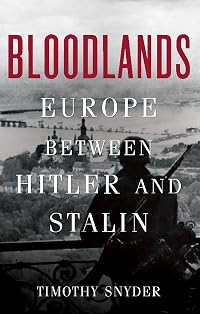
Bloodlands: Europe Between Hitler and Stalin
by Timothy Snyder
On This Page
Description
From the author of the international bestseller "On Tyranny", the definitive history of Hitler's and Stalin's politics of mass killing, explaining why Ukraine has been at the center of Western history for the last century. Americans call the Second World War "The Good War." But before it even began, America's wartime ally Josef Stalin had killed millions of his own citizens, and kept killing them during and after the war. Before Hitler was finally defeated, he had murdered six million Jews show more and nearly as many other Europeans. At war's end, both the German and the Soviet killing sites fell behind the iron curtain, leaving the history of mass killing in darkness. "Bloodlands" is a new kind of European history, presenting the mass murders committed by the Nazi and Stalinist regimes as two aspects of a single history, in the time and place where they occurred: between Germany and Russia, when Hitler and Stalin both held power. Assiduously researched, deeply humane, and utterly definitive, "Bloodlands" will be required reading for anyone seeking to understand the central tragedy of modern history. show lessTags
Recommendations




Member Recommendations

mercure What Bloodlands does for a much larger area does this book for the city of Lemberg. The different level of granularity of Lemberg enhances Bloodlands well.
11
More than a Grain of Truth: The official true story behind the film Mr. Jones, starring James Norton by Margaret Siriol Colley
M_Clark Bloodlands quotes from Gareth Jones a lot so it is worth reading more about this fascinating character.
Member Reviews
A reframing of the mass slaughter of WWII, from the popular image of nazi gas chambers, to vast killing fields and starvation camps employed by both the communist and nazi regimes concentrated in a swath of eastern Europe. Much in the same vein the popular image of the war needs to recalibrate to 3/4th of the dying happening on the much less covered eastern front, there's a blind spot and deliberate retelling of events that tries to tell a simple moralistic story about the war. This book presents the problem in a wider perspective and one that doesn't let mass murder and antisemitism be a unique property of the nazi regime. Aided and abetted by many others, and mirrored by the paranoid purges of the Soviet, the lessons of 'never again' show more need to have a wider scope - as modern day parallels in China and elsewhere also feature anonymous detention camps and mysteriously vanishing "problem" groups, the idea that it's not industralized genocide until gas chambers and ovens are involved miss the mark. By that time, as Snyder makes clear, the majority of the death toll was already accomplished. show less
Reviewing a book you love, can be as difficult as reviewing a book you hate. In the latter case, you want to be fair and not flaming. In the former, you want to be fair and not fawning. When it comes to this book, however, I can’t help but gush. I thought I knew a fair amount about the Holocaust: it’s history, it’s victims, and even the more subtle question of Why? But in [Bloodlands], Timothy Snyder takes everything I thought I knew and puts it in a new context that completely changes the way I view the entire period from 1933 to 1945.
The premise of the book is that in the area between the Molotov-Ribbentrop Line and the Urals lie territories that were under the control of both the Germans and the Russians at some point between show more 1933 and 1945, an area he calls the Bloodlands. It includes Latvia and Lithuania, eastern Poland, Ukraine, Belarus, and western Russia. In these lands, 14 million people were deliberately killed by a combination of Nazi and Soviet policies. This number does not include those who died of exertion, disease, or malnutrition in the camp or during deportment; forced laborers; civilians who died in bombings or wartime hunger; nor does it include the 12 million German and Soviet soldiers who died in WWII. It’s 14 million civilians who were murdered by deliberate policy in this strip of ground unfortunate enough to be occupied by the Germans and the Soviets (often undergoing three separate occupations: Soviet, German, then Soviet again).
So who were these 14 million people? To begin with, the 3 million Ukrainians that Stalin deliberately starved to death in pursuit of collectivization. Although I knew somewhat of the Ukrainian famine of 1932-33, I was shocked by some of the policy decisions that makes this a premeditated mass murder. For instance, that Stalin had the borders of the country closed so that the starving peasants couldn’t escape; that after requisitioning all the food that they had and imposing a meat tax in order to take the livestock, he then black listed the villages so that they could not even trade for food with other villages; that he closed the Ukrainian cities so that peasants could not beg for food. And perhaps most astonishing of all, goes from calling the famine a plot by saboteurs, to a deliberate attack on him, Stalin, and the progression of the Soviet Union to a communist ideal. Stalin becomes the victim, and starvation becomes an aggressive act tied to Ukrainian nationalism that turns the starving into traitors subject to the death penalty.
Hitler too had a “Hunger Plan” even more ambitious than Stalin’s. Hitler had imperialist dreams, but had to confine them to Eastern Europe because of the British Navy’s supremacy on the seas. He started to see the Soviet Union as less of an ally and more of a future colony. His plan? Conquer the Soviet Union in a blitzkrieg, starve roughly 30 million Slavs to death in the first winter (1940-41), raze the cities, and create German settlements all the way to the Urals. The Ukrainian breadbasket only produced enough food for Germany, he lectured the Wehrmacht, so every time you shoot a woman or child (something ordinary soldiers had a hard time doing), you are putting food into the mouths of your own wives and children. It’s us or them. The first step in the plan, conquer the Soviet Union, was not the quick work Hitler had expected, however, and only those Slavs who fell under his direct control were starved: 4 million civilians, mostly in Leningrad, Kiev, and Kharkiv, as well as 3 million Soviet POWs (not counted in the 14 million).
As the war in the East bogged down, Hitler needed both a scapegoat and a new Final Solution to the “Jewish problem”. The first four versions of the Final Solution had to be abandoned: the idea of a giant reservation for Jews in the area of Lublin; sending the Jews to Stalin who could put them into his already existing gulag (after all Stalin had all that land east of the Urals); sending all the Jews to Madagascar; and conquering the Soviet Union and then putting all the Jews into the gulag. Himmler and Heydrich realized that Hitler needed a new plan that would reaffirm his genius and give him a new focus for the war. The new ultimate objective was not the subjugation of the Soviet Union, which was looking less likely, but the elimination of the Jews. Instead of working the Jews to death in a reservation or gulag, they were now to be systematically shot in every area the Germans conquered.
For many Americans and Western Europeans, the Holocaust has come to be symbolized by the concentration camp, particularly by Auschwitz. But the fact is more Jews were shot in the second half of 1941 alone, than were gassed at Auschwitz during the entire war. Another million were shot in 1942. The Nazis were able to convince many Ukrainians and Belorussians that the Soviet atrocities that had so recently been committed against them were in fact caused by Jewish communists. The Germans trained and armed them to assist in the monumental task of shooting millions of people. The Nazis were less willing to arm the Poles as accomplices, and wanting to save ammunition, after two years of occupation, the Germans began gassing Jews at extermination facilities: Chelmno, Belzec, Sobibor, Triblinka, Majdanek, and one part of Auschwitz.
It began in 1941 at Belzec. Guards were recruited from the Soviet populace (mostly Ukrainians) and trained at Trawniki, while Nazi specialists from Germany who had overseen the “euthanasia” program that had gassed 70,000 Germans deemed “life unfit for life” were brought in to supervise. Only 2 or 3 Jews who arrived at Belzec survived. 434,508 did not. And it is precisely because so few people survived the extermination facilities (combined with the fact that American and British armies did not liberate them, the Soviets did) that the concentration camp continues to loom large in our minds and places like Belzec do not. Auschwitz was actually built in 1940 to intimidate the Poles, and then to house Soviet POWs. When I.G. Farben decided the camp would be an ideal place to make synthetic rubber, Slovakia sent its Jews to be used as slave labor (all of them died). In 1942 the extermination facility was added and then expanded with the addition of Birkenau in 1943.
Auschwitz was the climax of the Holocaust, reached at a moment when most Soviet and Polish Jews under German rule were already dead.
But Jews from France, Belgium, and the Netherlands (1942); Greece and now occupied Italy (1943); and Hungary (1944) could and were sent to Auschwitz to die. Although no one survived the gas chambers, 100,000 people did survive the Auschwitz labor camp. (As opposed to less than a 100 people who survived the six extermination facilities.)
If this sounds too familiar, it is because of my ineptitude at summarizing my 62 pages of notes that is at fault, because Snyder brings to light hundreds of details that have not been previously published. His research in newly opened archives guarantees surprises. In addition, he draws conclusions about the nature of the killing and the psychology of victimhood in the double-occupied territories that are entirely his own. Simply reading the introductory and concluding chapters would provide much to consider. Even more than [Gulag: A History] changed the way I think about the Soviet camps, [Bloodlands] has changed the way I think about this region and this time period. Highly recommended. show less
The premise of the book is that in the area between the Molotov-Ribbentrop Line and the Urals lie territories that were under the control of both the Germans and the Russians at some point between show more 1933 and 1945, an area he calls the Bloodlands. It includes Latvia and Lithuania, eastern Poland, Ukraine, Belarus, and western Russia. In these lands, 14 million people were deliberately killed by a combination of Nazi and Soviet policies. This number does not include those who died of exertion, disease, or malnutrition in the camp or during deportment; forced laborers; civilians who died in bombings or wartime hunger; nor does it include the 12 million German and Soviet soldiers who died in WWII. It’s 14 million civilians who were murdered by deliberate policy in this strip of ground unfortunate enough to be occupied by the Germans and the Soviets (often undergoing three separate occupations: Soviet, German, then Soviet again).
So who were these 14 million people? To begin with, the 3 million Ukrainians that Stalin deliberately starved to death in pursuit of collectivization. Although I knew somewhat of the Ukrainian famine of 1932-33, I was shocked by some of the policy decisions that makes this a premeditated mass murder. For instance, that Stalin had the borders of the country closed so that the starving peasants couldn’t escape; that after requisitioning all the food that they had and imposing a meat tax in order to take the livestock, he then black listed the villages so that they could not even trade for food with other villages; that he closed the Ukrainian cities so that peasants could not beg for food. And perhaps most astonishing of all, goes from calling the famine a plot by saboteurs, to a deliberate attack on him, Stalin, and the progression of the Soviet Union to a communist ideal. Stalin becomes the victim, and starvation becomes an aggressive act tied to Ukrainian nationalism that turns the starving into traitors subject to the death penalty.
Hitler too had a “Hunger Plan” even more ambitious than Stalin’s. Hitler had imperialist dreams, but had to confine them to Eastern Europe because of the British Navy’s supremacy on the seas. He started to see the Soviet Union as less of an ally and more of a future colony. His plan? Conquer the Soviet Union in a blitzkrieg, starve roughly 30 million Slavs to death in the first winter (1940-41), raze the cities, and create German settlements all the way to the Urals. The Ukrainian breadbasket only produced enough food for Germany, he lectured the Wehrmacht, so every time you shoot a woman or child (something ordinary soldiers had a hard time doing), you are putting food into the mouths of your own wives and children. It’s us or them. The first step in the plan, conquer the Soviet Union, was not the quick work Hitler had expected, however, and only those Slavs who fell under his direct control were starved: 4 million civilians, mostly in Leningrad, Kiev, and Kharkiv, as well as 3 million Soviet POWs (not counted in the 14 million).
As the war in the East bogged down, Hitler needed both a scapegoat and a new Final Solution to the “Jewish problem”. The first four versions of the Final Solution had to be abandoned: the idea of a giant reservation for Jews in the area of Lublin; sending the Jews to Stalin who could put them into his already existing gulag (after all Stalin had all that land east of the Urals); sending all the Jews to Madagascar; and conquering the Soviet Union and then putting all the Jews into the gulag. Himmler and Heydrich realized that Hitler needed a new plan that would reaffirm his genius and give him a new focus for the war. The new ultimate objective was not the subjugation of the Soviet Union, which was looking less likely, but the elimination of the Jews. Instead of working the Jews to death in a reservation or gulag, they were now to be systematically shot in every area the Germans conquered.
For many Americans and Western Europeans, the Holocaust has come to be symbolized by the concentration camp, particularly by Auschwitz. But the fact is more Jews were shot in the second half of 1941 alone, than were gassed at Auschwitz during the entire war. Another million were shot in 1942. The Nazis were able to convince many Ukrainians and Belorussians that the Soviet atrocities that had so recently been committed against them were in fact caused by Jewish communists. The Germans trained and armed them to assist in the monumental task of shooting millions of people. The Nazis were less willing to arm the Poles as accomplices, and wanting to save ammunition, after two years of occupation, the Germans began gassing Jews at extermination facilities: Chelmno, Belzec, Sobibor, Triblinka, Majdanek, and one part of Auschwitz.
It began in 1941 at Belzec. Guards were recruited from the Soviet populace (mostly Ukrainians) and trained at Trawniki, while Nazi specialists from Germany who had overseen the “euthanasia” program that had gassed 70,000 Germans deemed “life unfit for life” were brought in to supervise. Only 2 or 3 Jews who arrived at Belzec survived. 434,508 did not. And it is precisely because so few people survived the extermination facilities (combined with the fact that American and British armies did not liberate them, the Soviets did) that the concentration camp continues to loom large in our minds and places like Belzec do not. Auschwitz was actually built in 1940 to intimidate the Poles, and then to house Soviet POWs. When I.G. Farben decided the camp would be an ideal place to make synthetic rubber, Slovakia sent its Jews to be used as slave labor (all of them died). In 1942 the extermination facility was added and then expanded with the addition of Birkenau in 1943.
Auschwitz was the climax of the Holocaust, reached at a moment when most Soviet and Polish Jews under German rule were already dead.
But Jews from France, Belgium, and the Netherlands (1942); Greece and now occupied Italy (1943); and Hungary (1944) could and were sent to Auschwitz to die. Although no one survived the gas chambers, 100,000 people did survive the Auschwitz labor camp. (As opposed to less than a 100 people who survived the six extermination facilities.)
If this sounds too familiar, it is because of my ineptitude at summarizing my 62 pages of notes that is at fault, because Snyder brings to light hundreds of details that have not been previously published. His research in newly opened archives guarantees surprises. In addition, he draws conclusions about the nature of the killing and the psychology of victimhood in the double-occupied territories that are entirely his own. Simply reading the introductory and concluding chapters would provide much to consider. Even more than [Gulag: A History] changed the way I think about the Soviet camps, [Bloodlands] has changed the way I think about this region and this time period. Highly recommended. show less
In Bloodlands: Europe Between Hitler and Stalin Timothy Snyder looks at those lands that were occupied by both the Nazis and the Soviets, and how it impacted those places. He also, more importantly, seeks to both show how mass murder occurred and to make those horrifyingly large numbers represent real people. From the Baltic states, through eastern Poland, Belarus, the western edge of Russia and especially Ukraine, Snyder shows how these lands contained the vast majority of civilian deaths in the twelve years between 1933 to 1945.
Beginning with Stalin's Great Famine in the Ukraine, in which 3.3 people died, and continuing through final acts of ethnic cleansing that turned diverse and vibrant populations homogeneous, Snyder seeks to show more humanize the statistics, to explain the motivations of the perpetrators and to return to the dead the stories of their lives. He is too successful for this book to be easy reading.
People were perhaps alike in dying and in death, but each of them was different until that final moment, each had different preoccupations and presentiments until all was clear and all was black.
Snyder looks at why both Stalin and Hitler found it necessary to slaughter so many civilians, most who posed no political threat, many of whom were children. He's interested in the motivations of the guards, the policemen holding the guns, the soldiers obeying orders. He's also interested in the lives of those who died and the reasons for those deaths.
Only there in the ditch were these people reduced to nothing, or to their number, which was 33,761.
I took copious notes while reading this book, to absorb more of what I was learning, but also as a buffer against that relentless stream of information. Snyder writes well, has clearly done extensive research and has a passion for his subject. He wants the reader to be informed of the events of the past, the motivations and reasons, but most of all, he wants the reader to see each death as an individual story cut short. show less
Beginning with Stalin's Great Famine in the Ukraine, in which 3.3 people died, and continuing through final acts of ethnic cleansing that turned diverse and vibrant populations homogeneous, Snyder seeks to show more humanize the statistics, to explain the motivations of the perpetrators and to return to the dead the stories of their lives. He is too successful for this book to be easy reading.
People were perhaps alike in dying and in death, but each of them was different until that final moment, each had different preoccupations and presentiments until all was clear and all was black.
Snyder looks at why both Stalin and Hitler found it necessary to slaughter so many civilians, most who posed no political threat, many of whom were children. He's interested in the motivations of the guards, the policemen holding the guns, the soldiers obeying orders. He's also interested in the lives of those who died and the reasons for those deaths.
Only there in the ditch were these people reduced to nothing, or to their number, which was 33,761.
I took copious notes while reading this book, to absorb more of what I was learning, but also as a buffer against that relentless stream of information. Snyder writes well, has clearly done extensive research and has a passion for his subject. He wants the reader to be informed of the events of the past, the motivations and reasons, but most of all, he wants the reader to see each death as an individual story cut short. show less
Okolo "Bloodlands" (v češtině pod názvem "Krvavé země" vydala Paseka) byl před několika lety takový šrumec, jaký se u historických publikací moc často nevidí. Nutno podotknout, že šlo o zájem zasloužený. Za krvavé země označuje Snyder oblast mezi Německem a Ruskem, kde od konce první do konce druhé světové války zahynulo 14 milionů civilistů a válečných zajatců. Ve stejnojmenné publikaci se rozhodl vylíčit osud právě těchto lidí. Miliony jich zemřelo vinnou Stalinovy politiky, ještě než druhá světová válka vůbec započala, další umírali při Německo-sovětském spojenectví a smrt zbylých se postaraly Hitlerovy vyhlazovací plány.
Pohled zpět často skýtá poučení, zejména show more když jde o pohled do relativně blízké historie. Z "Krvavých zemí" jsem si odnesl pocit, že proti totalitě lze bojovat spíše, když nastoupí naráz a nestihne tak roztrhat existující struktury (odboje proti nacismu v Polsku či Bělorusku), než když se objevuje krok po kroku, lidé stále doufají a režim mezitím rozleptá všechny vazby mezi těmi, kteří by byli schopní odporu (sovětská Ukrajina). To je dobrá a zároveň špatná zpráva.
Historické knihy, zejména ty popisující dění v tak velkém měřítku (miliony mrtvých si lze jen těžko představit jinak než jako statistiku), mívají tendenci být nudné, ne však "Krvavé země". Snyder popisuje osudy jednotlivců a skupiny do mnohdy odporných podrobností, které následně zasazuje do širšího rámce. Činí tak nesmírně obratně a s jazykovou hravostí („An oprhan was a child who had not been eaten by his parents.“), díky které se "Krvavé země" čtou jako skvěle napsaná fikce. Tou však bohužel nejsou. show less
Pohled zpět často skýtá poučení, zejména show more když jde o pohled do relativně blízké historie. Z "Krvavých zemí" jsem si odnesl pocit, že proti totalitě lze bojovat spíše, když nastoupí naráz a nestihne tak roztrhat existující struktury (odboje proti nacismu v Polsku či Bělorusku), než když se objevuje krok po kroku, lidé stále doufají a režim mezitím rozleptá všechny vazby mezi těmi, kteří by byli schopní odporu (sovětská Ukrajina). To je dobrá a zároveň špatná zpráva.
Historické knihy, zejména ty popisující dění v tak velkém měřítku (miliony mrtvých si lze jen těžko představit jinak než jako statistiku), mívají tendenci být nudné, ne však "Krvavé země". Snyder popisuje osudy jednotlivců a skupiny do mnohdy odporných podrobností, které následně zasazuje do širšího rámce. Činí tak nesmírně obratně a s jazykovou hravostí („An oprhan was a child who had not been eaten by his parents.“), díky které se "Krvavé země" čtou jako skvěle napsaná fikce. Tou však bohužel nejsou. show less
In writing Bloodlands, Timothy Snyder has given us a new way to look at the tragedy of the years leading up to and including the Second World War. While it makes for a harrowing read, it is a necessary book for anyone interested in Eastern Europe and the Second World War.
Snyder rightly eschews simplistic comparisons between the deaths caused by both Hitler and Stalin but does not shy away from a brutal retelling of the stories of those many millions who were soon to be voiceless.
If anything, this book provides a brilliant polemic against bureaucracy and totalitarianism while being careful not to dismiss the violence to come out of both fascism and communism as madness or behavior beyond the pale. Snyder teases out the perspectives of show more victims and oppressors on all sides, allowing one to see causes and consequences not of individual inhumanity but the inhumanity of the systems in which human beings were helplessly entangled.
Finally, Snyder's book provides a useful corrective to the dearth of information which still exists due to decades of Soviet secrecy in the wake of the USSR's victory. One gets the sense that there are volumes of research yet to be undertaken before a complete picture of the tragedy emerges, particularly surrounding deaths in the Ukraine and Eastern Europe. Undoubtedly the task to uncover this information remains daunting, but Snyder has provided us with the first steps as well as an excellent framework for doing so. show less
Snyder rightly eschews simplistic comparisons between the deaths caused by both Hitler and Stalin but does not shy away from a brutal retelling of the stories of those many millions who were soon to be voiceless.
If anything, this book provides a brilliant polemic against bureaucracy and totalitarianism while being careful not to dismiss the violence to come out of both fascism and communism as madness or behavior beyond the pale. Snyder teases out the perspectives of show more victims and oppressors on all sides, allowing one to see causes and consequences not of individual inhumanity but the inhumanity of the systems in which human beings were helplessly entangled.
Finally, Snyder's book provides a useful corrective to the dearth of information which still exists due to decades of Soviet secrecy in the wake of the USSR's victory. One gets the sense that there are volumes of research yet to be undertaken before a complete picture of the tragedy emerges, particularly surrounding deaths in the Ukraine and Eastern Europe. Undoubtedly the task to uncover this information remains daunting, but Snyder has provided us with the first steps as well as an excellent framework for doing so. show less
Hræðileg saga sem er umfjöllunarefni Blóðlendna Timothy Snyders. Hann greinir af nærgætni en án þess að draga nokkuð undan frá skipulögðum og markvissum fjöldamorðum sem unnin voru að skipun Stalíns og Hitlers á 12 ára tímabili, 1933-45.
Blóðlendur vísa til svæðanna í A.-Evrópu þar sem flest morðin fóru fram óháð landamærum enda færðust þau til og frá bæði fyrir og eftir styrjöldina.
Snyder fjallar um morðin, ástæður þeirra, framkvæmd, óhugnað og afleiðingar út frá nýjustu heimildum og ber þær saman við eldri framsetningu út frá pólitísku og sögulegu samhengi. En hann gleymir þó ekki fórnarlömbunum sjálfum og við fáum að kynnast lítillega þolendum og show more eftirlifendum.
Djúpt snortinn eftir lesturinn. show less
Blóðlendur vísa til svæðanna í A.-Evrópu þar sem flest morðin fóru fram óháð landamærum enda færðust þau til og frá bæði fyrir og eftir styrjöldina.
Snyder fjallar um morðin, ástæður þeirra, framkvæmd, óhugnað og afleiðingar út frá nýjustu heimildum og ber þær saman við eldri framsetningu út frá pólitísku og sögulegu samhengi. En hann gleymir þó ekki fórnarlömbunum sjálfum og við fáum að kynnast lítillega þolendum og show more eftirlifendum.
Djúpt snortinn eftir lesturinn. show less
1-2024
Cuando se habla de los muertos en la segunda guerra mundial, siempre pensamos en los campos de concentración alemanes. Siempre pensé que era donde más seres humanos habían muerto. Pero no, he estado equivocada durante años.
Las "tierras de sangre" son todas aquellas zonas, países o parte de países, entre Alemania y la URSS, donde Stalin y Hitler decidieron que les sobraban gente. Regaron de sangre esas tierras, desde mucho antes de empezar la guerra y mucho después de terminar.
Mucho antes de empezar la 2° guerra mundial, por 1931 Stalin empezó sus "matanzas". Su idea de modernizar el país pasaba por hacer desaparecer a los trabajadores del campo y en especial a los ucranianos. Pero no únicamente a ellos, polacos y rusos show more también cayeron con el hambre que provocó. Recogió las cosechas y el grano que se usaba para la siembra siguiente. Dejo que murieran de hambre sin ningún cargo de conciencia. Todo con vistas, o la escusa, de una industrialización del país.
Y así empieza el libro, en ese año y contándote las políticas de ambos líderes políticos.
Cuando más leo sobre este periodo de la historia, más me doy cuenta de lo que desconozco.
Lo recomiendo a todo aquel que disfrute de este periodo de la historia y quiera conocer un poco más.
Lo que hicieron con Polonia y con Ucrania me parece demencial. Y ya no solo por Stalin y Hitler, me refiero al resto del mundo, miro hacia otro lado y los dejaron hacer. Tan criminal fue la acción de asesinar a tantos seres humanos, como la inacción por parte del resto.
Saber, más o menos, la cantidad de personas que murieron en esta zona, durante esos años (y después de 1945), que superan con mucho los asesinados en los campos de concentración, más los militares que murieron luchando de todos los países, indica que son cifras inimaginables.
Tanto Hitler, como Stalin ñ, tenían fijación con eliminar a los judíos. Pero no asesinaron judíos. Estás tierras regadas con tanta sangre, eran de civiles masacrados por ambos bandos y en muchas ocasiones, ayudados por vecinos de las víctimas.
Muy interesante, nada pesado. show less
Cuando se habla de los muertos en la segunda guerra mundial, siempre pensamos en los campos de concentración alemanes. Siempre pensé que era donde más seres humanos habían muerto. Pero no, he estado equivocada durante años.
Las "tierras de sangre" son todas aquellas zonas, países o parte de países, entre Alemania y la URSS, donde Stalin y Hitler decidieron que les sobraban gente. Regaron de sangre esas tierras, desde mucho antes de empezar la guerra y mucho después de terminar.
Mucho antes de empezar la 2° guerra mundial, por 1931 Stalin empezó sus "matanzas". Su idea de modernizar el país pasaba por hacer desaparecer a los trabajadores del campo y en especial a los ucranianos. Pero no únicamente a ellos, polacos y rusos show more también cayeron con el hambre que provocó. Recogió las cosechas y el grano que se usaba para la siembra siguiente. Dejo que murieran de hambre sin ningún cargo de conciencia. Todo con vistas, o la escusa, de una industrialización del país.
Y así empieza el libro, en ese año y contándote las políticas de ambos líderes políticos.
Cuando más leo sobre este periodo de la historia, más me doy cuenta de lo que desconozco.
Lo recomiendo a todo aquel que disfrute de este periodo de la historia y quiera conocer un poco más.
Lo que hicieron con Polonia y con Ucrania me parece demencial. Y ya no solo por Stalin y Hitler, me refiero al resto del mundo, miro hacia otro lado y los dejaron hacer. Tan criminal fue la acción de asesinar a tantos seres humanos, como la inacción por parte del resto.
Saber, más o menos, la cantidad de personas que murieron en esta zona, durante esos años (y después de 1945), que superan con mucho los asesinados en los campos de concentración, más los militares que murieron luchando de todos los países, indica que son cifras inimaginables.
Tanto Hitler, como Stalin ñ, tenían fijación con eliminar a los judíos. Pero no asesinaron judíos. Estás tierras regadas con tanta sangre, eran de civiles masacrados por ambos bandos y en muchas ocasiones, ayudados por vecinos de las víctimas.
Muy interesante, nada pesado. show less
Members
- Recently Added By
Published Reviews
ThingScore 58
Snyder’s ambition is to persuade the West—and the rest of the world—to see the war in a broader perspective. He does so by disputing popular assumptions about victims, death tolls, and killing methods—of which more in a moment—but above all about dates and geography. The title of this book, Bloodlands, is not a metaphor. Snyder’s “bloodlands,” which others have called show more “borderlands,” run from Poznan in the West to Smolensk in the East, encompassing modern Poland, the Baltic states, Ukraine, Belarus, and the edge of western Russia (see map on page 10). This is the region that experienced not one but two—and sometimes three—wartime occupations. This is also the region that suffered the most casualties and endured the worst physical destruction.
More to the point, this is the region that experienced the worst of both Stalin’s and Hitler’s ideological madness. show less
More to the point, this is the region that experienced the worst of both Stalin’s and Hitler’s ideological madness. show less
added by oregonobsessionz
Snyder claims that his purpose in describing 'all of the major killing policies in their common European historical setting' was 'to introduce to European history its central event'. But he has not described all the major killing policies and they did not all have a common setting. And to assert that they are the central event in the whole of European history is rhetorical overkill, to say the show more least. A number of other historians have written recently, and more perceptively, about this same topic, from Richard Overy in The Dictators to Robert Gellately in Lenin, Stalin and Hitler – some, like Norman Davies in Europe at War 1939-45, from a similar perspective to Snyder's own. Despite the widespread misapplication of Hitler's statement about the Armenians, few claims advanced in Snyder's book are less plausible nowadays than the assertion that 'beyond Poland, the extent of Polish suffering is underappreciated.' In fact, we know about the events Snyder describes already, despite his repeated assertions that we don't. What we need is not to be told yet again the facts about mass murder, but to understand why it took place and how people could carry it out, and in this task Snyder's book is of no use. show less
added by Cynfelyn
Mr Snyder’s book is revisionist history of the best kind: in spare, closely argued prose, with meticulous use of statistics, he makes the reader rethink some of the best-known episodes in Europe’s modern history.
added by ekorrhjulet
Lists

A Ukraine Reading List
121 works; 90 members

Top Five Books of 2015
811 works; 241 members

Non-Fiction Worth Reading
1,015 works; 261 members

Banned Books Week 2014
268 works; 63 members

Books about World War II
241 works; 22 members

r/AskHistorians' Recommended Books
1,068 works; 17 members

My wishlist
85 works; 1 member
Books That Changed Our Perspective
423 works; 168 members

Books recommended in the history category on FiveBooks.com
329 works; 4 members

Totalitarianism and Democratic Erosion: Essential Readings
45 works; 1 member
Author Information

34+ Works 12,224 Members
All Editions
Some Editions
Awards and Honors
Awards
Distinctions
Series
Belongs to Publisher Series
Work Relationships
Common Knowledge
- Canonical title*
- Terres de sang. L'Europe entre Hitler et Staline
- Original title
- Bloodlands: Europe between Hitler and Stalin
- Original publication date
- 2010
- People/Characters
- Adolf Hitler; Joseph Stalin
- Important places
- Baltic States; Belarus; Poland; Ukraine; Eastern Europe
- Important events
- Holodomor (1932 | 1933); Molotov-Ribbentrop Pact; Holocaust; World War II
- Epigraph
- your golden hair Margarete,
your ashen hair Shulamit
Paul Celan
"Death Fugue"
Everything flows, everything changes.
You can't board the same prison train twice.
Vasily Grossman
Everything flows
A stranger drowned on the Black Sea alone
With no to hear his prayers for forgiveness.
"Storm on the Black Sea"
Ukranian traditional song
Whole cities disappear. In nature's stead
Only a white stead to counter nonexistence.
Tomas Venclova
"The shield of Achilles" - First words
- (Preface) "Now we will live!" This is what the hungry boy liked to say, as he walked along the quiet roadside, or through the empty fields.
The origins of the Nazi and the Soviet regimes, and of their encounter in the bloodlands, lie in the First World War of 1914-118. - Last words
- (Click to show. Warning: May contain spoilers.)The Nazi and Soviet regimes turned people into numbers, some of which we can only estimate, some of which we can reconstruct with fair precision. It is for us as scholars to seek these numbers and to put them into perspective. It is for us as humanists to turn the numbers back into people. If we cannot do that, then Hitler and Stalin have shaped not only our world, but our humanity.
- Blurbers
- Denby, David; Deák, István; Applebaum, Anne; Hochschild, Adam
- Original language
- English
*Some information comes from Common Knowledge in other languages. Click "Edit" for more information.
Classifications
Statistics
- Members
- 2,505
- Popularity
- 7,660
- Reviews
- 71
- Rating
- (4.28)
- Languages
- 18 — Czech, Danish, Dutch, English, Estonian, Finnish, French, German, Greek, Italian, Norwegian (Bokmål), Polish, Portuguese, Romanian, Russian, Spanish, Swedish, Chinese, traditional
- Media
- Paper, Audiobook, Ebook
- ISBNs
- 68
- ASINs
- 24