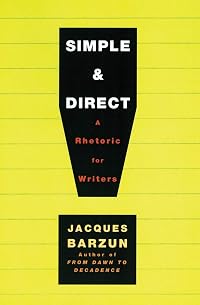
Simple & Direct
by Jacques Barzun
On This Page
Description
A fter a lifetime of writing and editing prose, Jacques Barzun has set down his view of the best ways to improve one's style. His discussions of diction, syntax, tone, meaning, composition, and revision guide the reader through the technique of making the written word clear and agreeable to read. Exercises, model passages both literary and casual, and hundreds of amusing examples of usage gone wrong show how to choose the right path to self-expression in forceful and distinctive words.Tags
Recommendations


























Member Reviews
This introduction to the 'simple and direct' writing style from the legendary scholar Jacques Barzun (Wait! According to Barzun, I've misused 'legendary' -- I should say 'the famous, highly-regarded scholar'!) is frequently delightful, and always helpful.
Barzun's own style isn't really simple and direct, at least not in the sense I understand the phrase, i.e. punchy and tight: he is elegant, if never ornate.
But his advice to writers is valuable. Its essence is expressed well late in the book:
"All thought, like all writing, is discrimination--separating ideas and, by means of a word, assigning to each the feature that matters in the present case."
A more accurate title for the book might have been 'The Right Word at the Right Time', since show more calling things by their right names is Barzun's passion.
Although he organizes the book conventionally -- e.g. with chapters on 'Diction', 'Linking', 'Tone and Tune', 'Meaning', 'Composition' and 'Revision', in his instructions and especially in his examples he returns nearly every time to 'getting the words right'. He simply cannot restrain himself, no matter the subject at hand, from listing out and denouncing solecisms and ambiguities in contemporary usage.
The book features little exercises in each chapter, but they are illustrative, not necessary.
Simple and Direct is not for everyone, but it is of much use to practicing writers and editors, and is highly recommended for them. show less
Barzun's own style isn't really simple and direct, at least not in the sense I understand the phrase, i.e. punchy and tight: he is elegant, if never ornate.
But his advice to writers is valuable. Its essence is expressed well late in the book:
"All thought, like all writing, is discrimination--separating ideas and, by means of a word, assigning to each the feature that matters in the present case."
A more accurate title for the book might have been 'The Right Word at the Right Time', since show more calling things by their right names is Barzun's passion.
Although he organizes the book conventionally -- e.g. with chapters on 'Diction', 'Linking', 'Tone and Tune', 'Meaning', 'Composition' and 'Revision', in his instructions and especially in his examples he returns nearly every time to 'getting the words right'. He simply cannot restrain himself, no matter the subject at hand, from listing out and denouncing solecisms and ambiguities in contemporary usage.
The book features little exercises in each chapter, but they are illustrative, not necessary.
Simple and Direct is not for everyone, but it is of much use to practicing writers and editors, and is highly recommended for them. show less
This book by Jacques Barzun must find a place in your library if you wish to improve as a writer. Not only must you read the book through once, but you must also open the book again, read through the material carefully, and do the exercises.
Also, read the passages from excellent writers he has inserted into each chapter.
A few reviewers believe he submerged the lessons in verbiage. While he may have been guilty of this ‘crime,’ I do not think the book’s style detracts from its merit. I will say, however, that you cannot skip through the pages with a song on your heart: his style demands concentrated reading.
Jacques Barzun’s book follows a logical flow. The author started with a chapter on simple diction and which words to use. show more Then, he added a chapter on linking: building logical connections between words. The third chapter focuses on style, and he emphasizes the importance of developing your style.
In the fourth chapter, he emphasizes the need for clarity: often, we use too many words, string them together carelessly, or adopt a pompous style, which makes writing incomprehensible.
The final two chapters focus on composition and revision. The last chapter, on revision, is too short. ‘All writing is rewriting,’ as many critics state. If he had given us detailed guidelines or illustrated the lessons with examples, this book would have become even better than it is today. show less
Also, read the passages from excellent writers he has inserted into each chapter.
A few reviewers believe he submerged the lessons in verbiage. While he may have been guilty of this ‘crime,’ I do not think the book’s style detracts from its merit. I will say, however, that you cannot skip through the pages with a song on your heart: his style demands concentrated reading.
Jacques Barzun’s book follows a logical flow. The author started with a chapter on simple diction and which words to use. show more Then, he added a chapter on linking: building logical connections between words. The third chapter focuses on style, and he emphasizes the importance of developing your style.
In the fourth chapter, he emphasizes the need for clarity: often, we use too many words, string them together carelessly, or adopt a pompous style, which makes writing incomprehensible.
The final two chapters focus on composition and revision. The last chapter, on revision, is too short. ‘All writing is rewriting,’ as many critics state. If he had given us detailed guidelines or illustrated the lessons with examples, this book would have become even better than it is today. show less
Pros: different perspective than most writing books; focus on logic thinking; practical and useful; thought-provoking; very good writing
Cons: none (the writing is a bit hard on criticism but I like it)
Cons: none (the writing is a bit hard on criticism but I like it)
SIMPLE AND DIRECT is anything but.
SIMPLE AND DIRECT is anything but.
"Mentioned in a blog. I enjoy books about writing, and as this is written by a nonfiction writer it will give a different perspective."
Ratings
Members
- Recently Added By
Author Information

74+ Works 9,666 Members
Jacques Barzun was born in Créteil, France on November 30, 1907. He came to the United States in 1920 and graduated magna cum laude from Columbia University in 1927. Following graduation, he joined Columbia's faculty as an instructor while continuing his studies in graduate school there, receiving a master's degree in 1928 and a doctorate in show more French history in 1932. He became a full professor in 1945, was dean of graduate faculties from 1955 to 1958, and dean of faculties from 1958 to 1967. He retired from Columbia University in 1975. He was a historian and cultural critic. The core of his work was the importance of studying history to understand the present and a fundamental respect for intellect. Although he wrote on subjects as diverse as detective fiction and baseball, he was especially known for his many books on music, nineteenth-century romanticism and education. His works include Darwin, Marx and Wagner: Critique of a Heritage; Romanticism and the Modern Ego; The House of Intellect; Race: A Study in Superstition; Simple and Direct: A Rhetoric for Writers; A Stroll with William James; The Culture We Deserve; and From Dawn to Decadence. He died on October 25, 2012 at the age of 104. (Bowker Author Biography) show less
Classifications
- Genre
- Fiction and Literature
- DDC/MDS
- 808.042 — Literature & rhetoric Literature, rhetoric & criticism Rhetoric and collections of literary texts from more than two literatures Rhetoric and anthologies Handbooks for writers English
- LCC
- PE1408 .B436 — Language and Literature English language English Modern English
- BISAC
Statistics
- Members
- 494
- Popularity
- 61,216
- Reviews
- 6
- Rating
- (3.93)
- Languages
- English
- Media
- Paper
- ISBNs
- 6
- ASINs
- 1