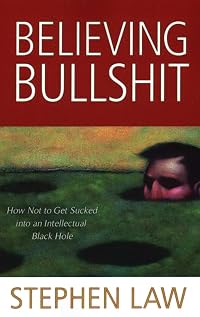
Believing Bullshit: How Not to Get Sucked into an Intellectual Black Hole
by Stephen Law
On This Page
Description
Wacky and ridiculous belief systems abound. Members of the Heaven's Gate suicide cult believed they were taking a ride to heaven on board a UFO. Muslim suicide bombers expect to be greeted after death by 72 heavenly virgins. And many fundamentalist Christians insist the entire universe is just 6,000 years old. Of course it's not only cults and religions that promote bizarre beliefs. Significant numbers of people believe that aliens built the pyramids, that the Holocaust never happened, and show more that the World Trade Center was brought down by the US government. How do such ridiculous views succeed in entrenching themselves in the minds of sane, intelligent, college-educated people and turn them into the willing slaves of claptrap? How, in particular, do the true believers manage to convince themselves that they are the rational, reasonable ones and that everyone else is deluded? Believing Bullshit identifies eight key mechanisms that can transform a set of ideas into a psychological flytrap. Philosopher Stephen Law suggests that, like the black holes of outer space, from which nothing, not even light, can escape, our contemporary cultural landscape contains numerous intellectual black-holes--belief systems constructed in such a way that unwary passers-by can similarly find themselves drawn in. While such self-sealing bubbles of belief will most easily trap the gullible or poorly educated, even the most intelligent and educated of us are potentially vulnerable.... show lessTags
Recommendations








Member Recommendations

Member Reviews
Well composed, excellent coverage of critical knowledge, this will go on the "to re-read" shelf. I'm also adding to to the Must read homeschool list. Law does a very good job illustrating the traps and describing how to avoid, dismantle and negate them. The composition is dense, and I set it aside several times in order to digest the text (do note that nothing here is new, but it is presented in a rich narrative that can be off-putting for those who don't play in the debate sandbox every day). Law does put his perspective on the subject and does a nice job collecting the entire theme in a bonus narrative in the form of C. S. Lewis's The Screwtape Letters. I wonder if fans of Lewis will see the irony...
Religion is the target of pretty show more much each of the trap examples, but Law is careful not to actually say something is BS (for example, he offers that while "psychic" anything is probably BS, someday, someone might actually be able to prove the "ability"). Still, the recipients of the analyses will likely take offense. show less
Religion is the target of pretty show more much each of the trap examples, but Law is careful not to actually say something is BS (for example, he offers that while "psychic" anything is probably BS, someday, someone might actually be able to prove the "ability"). Still, the recipients of the analyses will likely take offense. show less
A very lively introduction to the mistakes we make in our beliefs and thoughts. The author identifies eight intellectual "black holes" that a person can fall into when they have a cherished belief they are trying to defend, and demonstrates how to avoid getting sucked into those black holes. A couple of weak spots were in his definition of science (he seems to be one of those who defines science as what scientists do, requiring all sorts of special skills and equipment) and in his concept of evidence, which seemed very strange indeed, since he ruled out as evidence things that were, in fact, very much evidence. Other than that, a very strong defense of critical thinking. This should be read widely by the very people who are the least show more likely to read it. show less
Law's book isn't bullshit itself but it does smell a little. not because it's dishonest or trying to sell something cheap but because it's just a laundry list of logical fallacies that preaches to the skeptical choir. it's very title will put off those that might be the most "in need" of learning about these concepts and practices.
Law attempts to speak to an audience unversed in philosophy or critical thinking methods, he just comes across as pedestrian, pedantic, and authoritarian in its arguments. This also means that he almost waters things down too much for his would-be lay readers, sounding too colloquial and even poser-hipsterish at times. In addition to this, his refutations come out as statements of solid, immovable fact with show more little to no room for debate despite this ostensibly being a lesson in logic and critical thinking.
the only truly original and interesting piece of this book occurs at the very end with the section titled “The Tapescrew Letters.” based on CS Lewis Screwtape letters, Law attempts to parade the inner workings of an overtly, self-aware grifting cult before our eyes in a kind of satire of same. It seems poorly done, even so, as he trots out nearly every “black hole” he covered in the previous section of the book and uses a skeptic as a kind of savior. ugg.
so, if you have never been exposed to logical fallacies or would like to understand more about them, this is the book for you. otherwise, it's meh. show less
Law attempts to speak to an audience unversed in philosophy or critical thinking methods, he just comes across as pedestrian, pedantic, and authoritarian in its arguments. This also means that he almost waters things down too much for his would-be lay readers, sounding too colloquial and even poser-hipsterish at times. In addition to this, his refutations come out as statements of solid, immovable fact with show more little to no room for debate despite this ostensibly being a lesson in logic and critical thinking.
the only truly original and interesting piece of this book occurs at the very end with the section titled “The Tapescrew Letters.” based on CS Lewis Screwtape letters, Law attempts to parade the inner workings of an overtly, self-aware grifting cult before our eyes in a kind of satire of same. It seems poorly done, even so, as he trots out nearly every “black hole” he covered in the previous section of the book and uses a skeptic as a kind of savior. ugg.
so, if you have never been exposed to logical fallacies or would like to understand more about them, this is the book for you. otherwise, it's meh. show less
Ratings
Members
- Recently Added By
Lists

Amusing Book Titles
146 works; 39 members
Author Information

43+ Works 1,934 Members
Stephen Law is a senior lecturer in philosophy at Heythrop College, University of London; provost for the Centre for Inquiry; and editor of Think: Philosophy for Everyone. He is the author of numerous books for adults and for children, including The Greatest Philosophers, The Philosophy Gym, The War for Children's Minds, and Really. Really Big show more Questions, among others. show less
Common Knowledge
- Canonical title
- Believing Bullshit: How Not to Get Sucked into an Intellectual Black Hole
- People/Characters
- Thomas Aquinas (Saint, Confessor, Doctor of the Church, 1225 to 1274); Karen Armstrong; A. J. Ayer; Francis Bacon; Justin Barrett; Bob Barth (show all 57); Jean Baudrillard; Henry Beecher; Herbert Benson; Jean Bricmont; Andrew Bulhak; W. K. Clifford (William Kingdon); Erich von Däniken; Daniel Dennett; Michael Drosnin; Mary Baker Eddy; Edzard Ernst; Richard Feynman; Harry Frankfurt; Caroline Fraser; Christopher French; Galileo Galilei; Philip Henry Gosse; Félix Guattari; Steven D. Hales; Ken Ham; Betty Hill; Barney Hill; Bodie Hodge; Edward Hunter; Immanuel Kant (1724 to 1804); Nicholas Lash; Louis Pierre; Tom Lovett; Shirley MacLaine; Maimonides (Moses ben Maimon or Rambam, 1135 to 1204); James Clerk Maxwell; Alister McGrath; H. M. Morris; Geoffrey Monroe; Isaac Newton; Nostradamus; Hayley O'Donnell; George Orwell; Alvin Plantinga; Plato (428? to 347 BC/BCE); John Polkinghorne; Peter Popoff; Karl Popper; Benjamin Rush; Simon Singh; Quentin Smith; Alan Sokal; Kathleen Taylor; Denys Turner; Lyn Williams; Ludwig Wittgenstein
- First words
- Even among the world's most educated and scientifically literate populations, ridiculous belief systems abound.
- Last words
- (Click to show. Warning: May contain spoilers.)If we want to immunize the next generation against such bullshit, let's at least make sure they understand the warning signs.
Classifications
Statistics
- Members
- 206
- Popularity
- 159,349
- Reviews
- 3
- Rating
- (3.60)
- Languages
- English, Italian, Swedish
- Media
- Paper, Ebook
- ISBNs
- 4
- ASINs
- 2