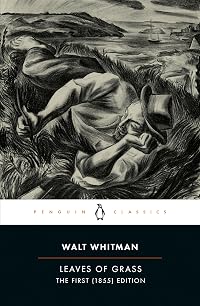
Leaves of Grass (1855 edition)
by Walt Whitman
On This Page
Description
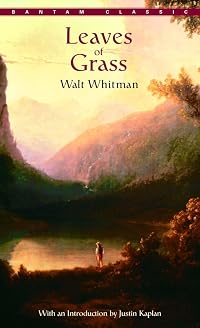
Abraham Lincoln read it with approval, but Emily Dickinson described its bold language and themes as "disgraceful." Ralph Waldo Emerson found it "the most extraordinary piece of wit and wisdom that America has yet produced." Published at the author's expense on July 4, 1855, Leaves of Grass inaugurated a new voice and style into American letters and gave expression to an optimistic, bombastic vision that took the nation as its subject. Unlike many other editions of Leaves of Grass, which show more reproduce various short, early versions, this Modern Library Paperback Classics "Death-bed" edition presents everything Whitman wrote in its final form, and includes newly commissioned notes. show lessTags
Recommendations








Member Reviews
This is a book that has been neglected on my bookshelves for WAY too long. I have been circling ever closer to it since starting the Less Stupid Civil War Reading Group years ago, and all the reading on the war and the Reconstruction period after, including a collection of some of Whitman’s poems and some of his Civil War writings.
I will not lie, there were sections I had to drag myself through here with a brain full of mush. But like I could give up on Walt “I contain multitudes” Whitman? Walt “This is What You Shall Do” Whitman? Clearly, no. Because when this poetry caught wind — the heights that it soared to!
This edition contained some reflections by Whitman at the end, on what he had attempted to do with this verse, on show more how it had been received, trying to place it in context of the poetry before. This is poetry that celebrates America, from Coast to Coast, from destitution to riches, man and woman, Black, white, and Native, and every kind of labor. From this point in history, parts of that celebration leave a bitter taste, but the celebration of humanity itself, and especially the humble, is remarkable.
What it captures of its time and place — the years of war, the explosion into the West, in so few pages is something only poetry can do.
I am glad to have finally gotten to this one! show less
I will not lie, there were sections I had to drag myself through here with a brain full of mush. But like I could give up on Walt “I contain multitudes” Whitman? Walt “This is What You Shall Do” Whitman? Clearly, no. Because when this poetry caught wind — the heights that it soared to!
This edition contained some reflections by Whitman at the end, on what he had attempted to do with this verse, on show more how it had been received, trying to place it in context of the poetry before. This is poetry that celebrates America, from Coast to Coast, from destitution to riches, man and woman, Black, white, and Native, and every kind of labor. From this point in history, parts of that celebration leave a bitter taste, but the celebration of humanity itself, and especially the humble, is remarkable.
What it captures of its time and place — the years of war, the explosion into the West, in so few pages is something only poetry can do.
I am glad to have finally gotten to this one! show less
I'm not sure what I expected when I started reading Leaves of Grass (1855 Edition) by Walt Whitman, but I found myself surprised as I read. His language was reflective of his time but felt a bit unrefined in places, which at times was refreshing and at others uncomfortable. His prejudices, in line with the times in which he lived, shined forth in some passages. His use of imagery and language to express the nature of life and living offers a sense of connection and contradiction that pushed me to think and to feel connected to the world he described even when I resisted. Whitman observed and recorded the world around him in a way that gives the reader a glimpse into that world as he saw it and moved through it in Leaves of Grass.
4 1/2 stars, really, but we can't do that. This is the original 1855 version. Whitman added to the collection throughout his life, ending up with an overstuffed and very uneven "deathbed" version, which is better known. There are some good poems in it which aren’t in the original, such as When Lilacs Last in the Door-yard Bloom’d, but there’s a lot of pretty weak stuff, too. The 1855 has a small number of pretty consistently excellent poems which are highly original and loosely but definitely connected. Reading it is a very different experience from wading through the bloated, inconsistent final version – there’s something Whitmanesque (i.e., at it’s best) about the original collection as a unit. I also recall Malcolm show more Cowley’s introduction being a bit wild and wooly (written in the late 60s or early 70s), but being interesting and enlightening. show less
Rambling Charter towards inner freedoms and a diary of sorts in prose. There is much that Whitman explores about sexuality and as a radical, his enduring take on the world, as much an outsider as an insider, it was a shame it took so long for his work to be recognised. "Song of the Open Road", a particular favourite section, and "By the Roadside", some incredibly rich sexually explicit desires thrust forward as I imagine Walt like D.H.Lawrence exuding all that natural naked strength in spirit and in mind.
'Walt in love with the world' would have been a better title.
The verses in this little book are certainly world affirming in a cosmopolitan sense. All people are connected by the same body and all are blessed by the same (divine) soul. Walt makes this clear by (sometimes annoyingly long lists) of people and their occupations. a bit like walking in a busy street and sucking everything in.
This broad empathy for, basically the whole universe, is addicitive. I felt my heart glowing while reading. However, when I layed the book down I was deeply unsatisfied. The reason being, that Walts main point is, 'all is perfect'. For me this felt like some escapism that causes a paradox in Walt's poetry. On the one hand he says 'yes!' to the world, but show more to do this he bagitalizes evil and pain by just saying 'it is ok, everything has it's place'.
I would definitely recommend this book, since it connects the body and the spiritual in exciting ways (it contains sex ;) and recognizes that what is equal in all man. To live, feel, have blood, to see beauty, to be mothers and fathers of fathers and mothers. show less
The verses in this little book are certainly world affirming in a cosmopolitan sense. All people are connected by the same body and all are blessed by the same (divine) soul. Walt makes this clear by (sometimes annoyingly long lists) of people and their occupations. a bit like walking in a busy street and sucking everything in.
This broad empathy for, basically the whole universe, is addicitive. I felt my heart glowing while reading. However, when I layed the book down I was deeply unsatisfied. The reason being, that Walts main point is, 'all is perfect'. For me this felt like some escapism that causes a paradox in Walt's poetry. On the one hand he says 'yes!' to the world, but show more to do this he bagitalizes evil and pain by just saying 'it is ok, everything has it's place'.
I would definitely recommend this book, since it connects the body and the spiritual in exciting ways (it contains sex ;) and recognizes that what is equal in all man. To live, feel, have blood, to see beauty, to be mothers and fathers of fathers and mothers. show less
If there was a single book I could have on a deserted island it would be "Leaves of Grass". It is beautiful, inspired writing. It's been analyzed by many so I'll spare you any grand statements or a lot of detail, but for a taste of the themes Whitman puts across:
- All men are brothers. The book celebrates the common man, and embraces the man that society has cast out or looked down upon.
- Delight and oneness with nature. Delight in the small things in nature.
- Spirituality achieved not by subjugating the senses or pleasures but by embracing them, and living life to the fullest.
- The belief in the innate power, spirituality, and goodness of man.
All of this is done in a very natural, unpretentious way ... I believe Whitman was truly show more inspired when he initially wrote this book, and was not regurgitating someone else's philosophy or metaphysics.
There are so many wonderful passages and quotes, maybe someday I'll include some here but for now I'll just say I highly, highly recommend this book.
Read it outside, under a tree. show less
- All men are brothers. The book celebrates the common man, and embraces the man that society has cast out or looked down upon.
- Delight and oneness with nature. Delight in the small things in nature.
- Spirituality achieved not by subjugating the senses or pleasures but by embracing them, and living life to the fullest.
- The belief in the innate power, spirituality, and goodness of man.
All of this is done in a very natural, unpretentious way ... I believe Whitman was truly show more inspired when he initially wrote this book, and was not regurgitating someone else's philosophy or metaphysics.
There are so many wonderful passages and quotes, maybe someday I'll include some here but for now I'll just say I highly, highly recommend this book.
Read it outside, under a tree. show less
This slim book was assigned to me in college and was my introduction to Walt William. This is the first 1855 edition of only 12 poems, later given titles: "Song of Myself," "A Song For Occupations," "To Think of Time," "The Sleepers," "I Sing the Body Electric," "Faces," "Song of the Answerer," "Europe: The 72d and 73d Years of These States," "A Boston Ballad," "There Was a Child Went Forth," "Who Learns My Lesson Complete?", and "Great Are the Myths." It would go through several editions until his death in 1892 where it reached 400 poems. But this is Whitman at his freshest, and most revolutionary. Especially coming from reading Romantic poets, such as Percy Bysse Shelley and John Keats, it's startling how sensual, personal and earthy show more these are, how modern they read. Unlike early works of romanticism, there are no elaborate allegories or classical or mythological allusions, this is the poetry of a democratic man, not an aristocrat: “I am large, I contain multitudes.” show less
Members
- Recently Added By
Lists

Harold Bloom - The Western Canon: C. The Democratic Age
336 works; 15 members

The College Board: 101 Great Books Recommended for College-Bound Readers
111 works; 7 members

American Lit for Eng 11 Research Project
368 works; 6 members
Author Information

Walt Whitman was born on Long Island and raised in Brooklyn, New York, the son of a carpenter. He left school when he was 11 years old to take a variety of jobs. By the time he was 15, Whitman was living on his own in New York City, working as a printer and writing short pieces for newspapers. He spent a few years teaching, but most of his work show more was either in journalism or politics. Gradually, Whitman became a regular contributor to a variety of Democratic Party newspapers and reviews, and early in his career established a rather eccentric way of life, spending a great deal of time walking the streets, absorbing life and talking with laborers. Extremely fond of the opera, he used his press pass to spend many evenings in the theater. In 1846, Whitman became editor of the Brooklyn Eagle, a leading Democratic newspaper. Two years later, he was fired for opposing the expansion of slavery into the west. Whitman's career as a poet began in 1885, with the publication of the first edition of his poetry collection, Leaves of Grass. The book was self-published (Whitman probably set some of the type himself), and despite his efforts to publicize it - including writing his own reviews - few people read it. One reader who did appreciate it was essayist Ralph Waldo Emerson, who wrote a letter greeting Whitman at "the beginning of a great career." Whitman's poetry was unlike any verse that had ever been seen. Written without rhyme, in long, loose lines, filled with poetic lists and exclamations taken from Whitman's reading of the Bible, Homer, and Asian poets, these poems were totally unlike conventional poetry. Their subject matter, too, was unusual - the celebration of a free-spirited individualist whose love for all things and people seemed at times disturbingly sensual. In 1860, with the publication of the third edition on Leaves of Grass, Whitman alienated conventional thinkers and writers even more. When he went to Boston to meet Emerson, poet Henry Wadsworth Longfellow, essayist Oliver Wendell Holmes, and poet James Russell Lowell, they all objected to the visit. With the outbreak of the Civil War, Whitman's attentions turned almost exclusively to that conflict. Some of the greatest poetry of his career, including Drum Taps (1865) and his magnificent elegy for President Abraham Lincoln, "When Last in the Dooryard Bloom'd" (1865), was written during this period. In 1862, his brother George was wounded in battle, and Whitman went to Washington to nurse him. He continued as a hospital volunteer throughout the war, nursing other wounded soldiers and acting as a benevolent father-figure and confidant. Parts of his memoir Specimen Days (1882) record this period. After the war, Whitman stayed on in Washington, working as a government clerk and continuing to write. In 1873 he suffered a stroke and retired to Camden, New Jersey, where he lived as an invalid for the rest of his life. Ironically, his reputation began to grow during this period, as the public became more receptive to his poetic and personal eccentricities. Whitman tried to capture the spirit of America in a new poetic form. His poetry is rough, colloquial, sweeping in its vistas - a poetic equivalent of the vast land and its varied peoples. Critic Louis Untermeyer has written, "In spite of Whitman's perplexing mannerisms, the poems justify their boundless contradictions. They shake themselves free from rant and bombastic audacities and rise into the clear air of major poetry. Such poetry is not large but self-assured; it knows, as Whitman asserted, the amplitude of time and laughs at dissolution. It contains continents; it unfolds the new heaven and new earth of the Western world." American poetry has never been the same since Whitman tore it away from its formal and thematic constraints, and he is considered by virtually all critics today to be one of the greatest poets the country has ever produced. (Bowker Author Biography) show less
All Editions
Awards and Honors
Notable Lists
Series
Belongs to Publisher Series
Work Relationships
Common Knowledge
- Canonical title
- Leaves of Grass (1855 edition) (1855 edition)
- Original publication date
- 1855
- First words
- I celebrate myself,
And what I assume you shall assume,
For every atom belonging to me as good belongs to you.
The original edition of Leaves of Grass had just 95 pages
of poetry, and a lengthy introduction. The only titles were “Leaves
of Grass” or a marker, indicating a new poem. The original book
listed no author, with... (show all) a small engraving of himself in a loose open
shirt and tipped hat, one hand on hip, the other in his pocket (to
“loafe” at that time meant to be seen idling stylishly about town).
The engraving by Samuel Hollyer was based on a photo by Gabriel
Harrison (a common printing conversion by skilled professionals
in the pre-digital age).
(from the America essay)
America does not repel the past or what it has produced
under its forms or amid other politics or the idea of castes or
the old religions … accepts the lesson with calmness … is not
so... (show all) impatient as has been supposed that the slough still sticks to
opinions and manners and literature while the life which served
its requirements has passed into the new life of the new forms
… perceives that the corpse is slowly borne from the eating and
sleeping rooms of the house … perceives that it waits a little while
in the door … that it was fittest for its days … that its action has
descended to the stalwart and wellshaped heir who approaches …
and that he shall be fittest for his days.
its forms or amid other politics or the idea of castes or the old
religions…accepts the lesson with calmness…is not so impatient
as has been supposed that the slough still sticks to opinions and
manners and liter... (show all)ature while the life which served its requirements
has passed into the new life of the new forms…perceives that the
corpse is slowly borne from the eating and sleeping rooms of the
house…perceives that it waits a little while in the door…that
it was fi ttest for its days…that its action has descended to the
stalwart and wellshaped heir who approaches…and that he shall
be fittest for his days. - Quotations
- You are also asking me questions, and I hear you;
I answer that I cannot answer … you must find out for yourself. - Last words
- (Click to show. Warning: May contain spoilers.)Great is life . . and real and mystical . . wherever and whoever,
Great is death . . . . Sure as life holds all parts together, death holds all parts together;
Sure as the stars return again after the merge in the light, death is as great as life.
(Click to show. Warning: May contain spoilers.)(from A Backward Glance)
In the free evening of the day I give to you, reader, the
foregoing garrulous talk, thoughts, reminiscences,
As idly drifting down the ebb,
Such ripples, half-caught voices, echo from the shore
Concluding with two items for the imaginative genius of
the West, when it worthily rises: fi rst, what Herder taught to the
young Goethe, that really great poetry is always (like the Homeric
or Biblical canticles) the result of a national spirit, and not the
privilege of a polished and select few; second, that the strongest
and sweetest songs yet remain to be sung. - Disambiguation notice
- Whitman significantly revised Leaves of Grass over his lifetime. This represents those works containing the first edition, originally published in 1855 and consisting of only 12 unnamed poems.
Please do not combine w... (show all)ith other editions, particularly the "Deathbed edition", which contains over 400 poems.
Classifications
Statistics
- Members
- 3,196
- Popularity
- 5,427
- Reviews
- 18
- Rating
- (4.15)
- Languages
- 5 — English, French, Italian, Portuguese, Serbian
- Media
- Paper, Audiobook, Ebook
- ISBNs
- 41
- UPCs
- 1
- ASINs
- 26