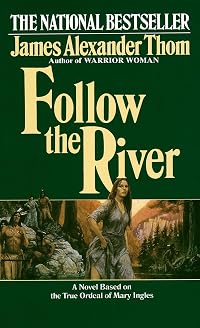
Follow the River
by James Alexander Thom
On This Page
Description
Mary Ingles was twenty-three, happily married, and pregnant with her third child when Shawnee Indians invaded her peaceful Virginia settlement in 1755 and kidnapped her, leaving behind a bloody massacre. For months they held her captive. But nothing could imprison her spirit. With the rushing Ohio River as her guide, Mary Ingles walked one thousand miles through an untamed wilderness no white woman had ever seen. Her story lives on--extraordinary testimony to the indomitable strength of one show more pioneer woman who risked her life to return to her own people. show lessTags
Recommendations



















Member Reviews
Follow the River by James Alexander Thom
Audio read by David Drummond
Illustration of Mary Draper Ingles and fellow captives of the Shawnee, July 1755
Excellent fictionalized account of the true-life story of 23yo Mary Draper Ingles, who survived a Shawnee attack on her Virginia settlement on July 3, 1755. After witnessing the murders of the majority of her people in Draper's Meadow (including her mother and her brother's infant son), she was captured along with a few others, including her two young sons. She gave birth to her daughter on the trail of the nearly 1000-mile journey to present-day Ohio. She earned the respect of the chieftan leading their party and was eventually offered his protection for herself and her children if she show more agreed to become his wife. She refused and was shocked when she was then sold into slavery, while the chieftan, Wild Cat, kept her sons to raise as his own. Her sister in law was given to another warrior. She was then separated from them when the French trappers who bought her took her away from Lower Shawneetown at the Ohio and Scioto Rivers.
She quickly took the chance of escaping when an opportunity presented itself, and an older Dutch woman agreed to go with her. They were desperate and unprepared for their journey and left with only a small ax and a knife (both were eventually lost), two blankets, and the clothes on their backs. Mary had to rely on her memory of landmarks in order to get back to her husband (whom she wasn't even sure had survived the massacre).
The two women walked over 800 miles from an area in Northern Kentucky where they were making salt for the Frenchmen (the area now known as Big Bone Lick State Historic Site, home to a lot of prehistoric bones of ice age mammals), back to Draper's Meadow (present-day Blacksburg), Virginia, crossing rivers multiple times as well as the Appalachian Mountains. Some accounts say that during their journey, they crossed at least 145 creeks and rivers—remarkable as neither woman could swim. By the end of their 42-day return trek, their clothes and shoes were worn to nothing. They were walking naked and barefoot through the forests and wading through rivers in December!
Their journey is incredible, their stamina was epic, as they were literally starving (their return saw them as skeletal, teeth falling out, and 23yo Mary's hair had turned white) while walking around 20 miles a day. The older Dutch woman (called Gretel in this account) started losing her mind, was obsessed with her hunger, and eventually attempted to kill Mary so she could eat her. With only a week or so to go, Mary crossed a river to escape her and they finished off their journey separately, although Mary sent a search party out to locate her after she herself found safety.Gretel was found alive but it is assumed she was eventually sent back to Holland as she had no family left in America and news of her attempted cannibalism tainted opinions against her.
Years later, William and Mary Ingles were reunited with one of their sons, who was raised as a Shawnee for over 13 years. Ironically, he faced a similar fate as his parents when his own settlement was raided and his family was captured.
There was an interesting afterword by the author which explained that there were nearly 2000 similar captures during the French Indian War (Seven Years' War). The tribes would often capture white men/women/children in order to take the place of people who were killed and taken from their people. Even though this account does not favor the Shawnee tribe or native peoples in general as their accounts of brutality are described freely (murder of infants, taking scalps, making captives run the gauntlet and/or eventually being burned alive) without an equal accounting of the atrocities also performed by white settlers to them, there is mention of the reason some Indians took the side of the French colonialists instead of the British colonialists during the Seven Years' War. They felt they could live in harmony with the French trappers/traders because they lived in a similar way as the indians. It was the encroachment of the white settlers (and government regulations) which forced them to move from lands where they previously had a good life. (White people. *sigh* Why can't we all just get along??)
Example of a captive being forced to run the gauntlet, where they ran from one spot to another, getting jeered and beaten by their captors. This was a way for captives to earn respect. If they failed, they could be killed. show less
Audio read by David Drummond
Illustration of Mary Draper Ingles and fellow captives of the Shawnee, July 1755
Excellent fictionalized account of the true-life story of 23yo Mary Draper Ingles, who survived a Shawnee attack on her Virginia settlement on July 3, 1755. After witnessing the murders of the majority of her people in Draper's Meadow (including her mother and her brother's infant son), she was captured along with a few others, including her two young sons. She gave birth to her daughter on the trail of the nearly 1000-mile journey to present-day Ohio. She earned the respect of the chieftan leading their party and was eventually offered his protection for herself and her children if she show more agreed to become his wife. She refused and was shocked when she was then sold into slavery, while the chieftan, Wild Cat, kept her sons to raise as his own. Her sister in law was given to another warrior. She was then separated from them when the French trappers who bought her took her away from Lower Shawneetown at the Ohio and Scioto Rivers.
She quickly took the chance of escaping when an opportunity presented itself, and an older Dutch woman agreed to go with her. They were desperate and unprepared for their journey and left with only a small ax and a knife (both were eventually lost), two blankets, and the clothes on their backs. Mary had to rely on her memory of landmarks in order to get back to her husband (whom she wasn't even sure had survived the massacre).
The two women walked over 800 miles from an area in Northern Kentucky where they were making salt for the Frenchmen (the area now known as Big Bone Lick State Historic Site, home to a lot of prehistoric bones of ice age mammals), back to Draper's Meadow (present-day Blacksburg), Virginia, crossing rivers multiple times as well as the Appalachian Mountains. Some accounts say that during their journey, they crossed at least 145 creeks and rivers—remarkable as neither woman could swim. By the end of their 42-day return trek, their clothes and shoes were worn to nothing. They were walking naked and barefoot through the forests and wading through rivers in December!
Their journey is incredible, their stamina was epic, as they were literally starving (their return saw them as skeletal, teeth falling out, and 23yo Mary's hair had turned white) while walking around 20 miles a day. The older Dutch woman (called Gretel in this account) started losing her mind, was obsessed with her hunger, and eventually attempted to kill Mary so she could eat her. With only a week or so to go, Mary crossed a river to escape her and they finished off their journey separately, although Mary sent a search party out to locate her after she herself found safety.
Years later, William and Mary Ingles were reunited with one of their sons, who was raised as a Shawnee for over 13 years. Ironically, he faced a similar fate as his parents when his own settlement was raided and his family was captured.
There was an interesting afterword by the author which explained that there were nearly 2000 similar captures during the French Indian War (Seven Years' War). The tribes would often capture white men/women/children in order to take the place of people who were killed and taken from their people. Even though this account does not favor the Shawnee tribe or native peoples in general as their accounts of brutality are described freely (murder of infants, taking scalps, making captives run the gauntlet and/or eventually being burned alive) without an equal accounting of the atrocities also performed by white settlers to them, there is mention of the reason some Indians took the side of the French colonialists instead of the British colonialists during the Seven Years' War. They felt they could live in harmony with the French trappers/traders because they lived in a similar way as the indians. It was the encroachment of the white settlers (and government regulations) which forced them to move from lands where they previously had a good life. (White people. *sigh* Why can't we all just get along??)
Example of a captive being forced to run the gauntlet, where they ran from one spot to another, getting jeered and beaten by their captors. This was a way for captives to earn respect. If they failed, they could be killed. show less
picked up Follow the River by James Alexander Thom, a fictional account of the life of Mary Draper Ingles who was kidnapped by and escaped from Shawnee Indians in the 1700s when Virginia was the edge of the wilderness. The book was well-researched and based on contemporary and family accounts. It was written in the style of a thriller with an edge of sensationalism reminiscent of the way the story might have been reported at the time. I have the Ingles monument and farm, which is near Radford, Virginia, marked on my state map but have yet to visit. It looks like there was some effort to create an official trail following her path with bits and pieces referenced in localities. I will add it to the list of places to explore in my home show more state.
The book was good if, as I said, a bit overdone and I learned about a piece of local history. The paperback came from Book No Further, the independent bookstore in downtown Roanoke, Virginia. They feature local authors and themes. show less
The book was good if, as I said, a bit overdone and I learned about a piece of local history. The paperback came from Book No Further, the independent bookstore in downtown Roanoke, Virginia. They feature local authors and themes. show less
I've often seen book jacket blurb-writers claim "This novel was so exciting I literally couldn't put it down," but I've only had that experience once myself -- with Follow the River.
This is not high literature, but a good "old-fashioned" novel that grabs you by the throat and doesn't let go. Based on a true story of a young woman captured by Indians in Virginia in the 1700s, Follow the River vividly conjures up Mary Ingles's world. The Indians who kidnap her are neither ruthless savages, nor idealized people living in simple harmony with the natural world. And Mary's incredible 1000-mile journey home when she escapes is beyond harrowing. The perfect escapist read, pun intended.
This is not high literature, but a good "old-fashioned" novel that grabs you by the throat and doesn't let go. Based on a true story of a young woman captured by Indians in Virginia in the 1700s, Follow the River vividly conjures up Mary Ingles's world. The Indians who kidnap her are neither ruthless savages, nor idealized people living in simple harmony with the natural world. And Mary's incredible 1000-mile journey home when she escapes is beyond harrowing. The perfect escapist read, pun intended.
This is a really good book about the capture of a white pioneer woman by a Shawnee war party and then her subsequent escape.
If this book had just been loosely based on historical fact for the purposes of entertainment, I probably would have given it four stars. One star is definitely for the author's effort to base both the story and the characters on reality to the point that is humanly possible when writing about someone who live in the mid 1700s while still making the story flow well. The note from the author at the end was as fascinating as the book itself.
James Alexander Thom did an amazing job of recreating the life and journey of Mary Ingles. He researched the facts that were available to a great extend and then made much of show more Mary's journey himself in order to describe it accurately. This really shows in the book. So does his knowledge of Shawnee culture of the time. He is a very believable writer. This makes for great historical fiction. You can tell that Thom really feels his characters. and he brings them to life. The story is faced paced when it should be and drags just enough during the tedium of Mary's journey to represent how it must have drug on for her and her companion.
I read one critical review of this book that suggested it would have been better if more had been said of the conflict (The French and Indian War) that spurred the Native American hostility of the time. I have to disagree with this. Though the time period and it's events are obviously important to the story, Thom presents it from Mary's perspective as a white captive. That perspective is at times one of respect for her captors, but mostly one of anger and hate at the people who killed members of her family, took her prisoner and stole her children. It is a realistic depiction of how she must have felt, and any effort to show the other side of the story would have felt false. show less
If this book had just been loosely based on historical fact for the purposes of entertainment, I probably would have given it four stars. One star is definitely for the author's effort to base both the story and the characters on reality to the point that is humanly possible when writing about someone who live in the mid 1700s while still making the story flow well. The note from the author at the end was as fascinating as the book itself.
James Alexander Thom did an amazing job of recreating the life and journey of Mary Ingles. He researched the facts that were available to a great extend and then made much of show more Mary's journey himself in order to describe it accurately. This really shows in the book. So does his knowledge of Shawnee culture of the time. He is a very believable writer. This makes for great historical fiction. You can tell that Thom really feels his characters. and he brings them to life. The story is faced paced when it should be and drags just enough during the tedium of Mary's journey to represent how it must have drug on for her and her companion.
I read one critical review of this book that suggested it would have been better if more had been said of the conflict (The French and Indian War) that spurred the Native American hostility of the time. I have to disagree with this. Though the time period and it's events are obviously important to the story, Thom presents it from Mary's perspective as a white captive. That perspective is at times one of respect for her captors, but mostly one of anger and hate at the people who killed members of her family, took her prisoner and stole her children. It is a realistic depiction of how she must have felt, and any effort to show the other side of the story would have felt false. show less
This is a true adventure book, full of moment after moment of trials and tribulations, yet also of joy and tenderness. Somewhat amazingly, the story is based on real people and real personal history. Set in French and Indian War early America, the narrative does a good job of revealing frontier life and characters. The bulk of the book is about an almost super human struggle. I was most appreciative of the author's ability to avoid superficiality in accessing the complexities of specific situations, both physical and personal. This is no B-movie special-effects shoot-em-up. The detail is there, and in a natural way, not like a professor stopping periodically to explain some interesting nuance. I would have loved to have read this book show more as a teenager, but I thoroughly enjoyed it as an old geezer. I certainly see myself reading more of this author's books. show less
This is an enjoyable but often repetitive, and strangely homoerotic, frontier novel in the same genre as The Frontiersmen by Allan W. Eckert, which Thom intentionally mirrored. The scope is small, detailing a single historical incident involving one main character. Nevertheless, the nature writing is superb, I really felt like I was there. Thom lived in a historical log cabin, ate grubs and grass to know what it's like, went backcountry bushwacking through the same terrain as Mary. Still it gets repetitive, how often can one be on the verge of death, at the utter end of ones reserves, chapter after chapter, it strains credibility. He ran out of ways to describe the hardship. The relationship between Mary and her Dutch companion has show more homoerotic tensions - this is not my overactive imagination, I could quote many lines that are hilariously over the top - maybe this was intentional to contrast her desire for her husband - but it is not historical and cheapened the book. This is a minor classic and still widely read, I will remember it. show less
I chose to read "Follow the River" by James Alexander Thom not so much to be entertained and inspired by the story of Mary Ingles’s escape in 1755 from Indian captivity and her torturous return from the Ohio River to her family’s frontier settlement west of the Blue Ridge Mountains. I had read about her ordeal, it being a true story, years ago. I wanted to see how Thom dealt with what I anticipated would be two major difficulties: description of her surroundings and portrayal of her thoughts and emotions. Being that Mary was isolated so much and that she was forced to trek through wild, diverse terrain, I recognized that surmounting these difficulties would be a substantial achievement.
Thom explains at the end of the book that he show more traveled Mary Ingles’s route home as part of his research. Not surprisingly, his description of her surroundings is genuine, readily believable. Included in much of his description is sharp sensory imagery, derived, I am certain, from close personal observation.
"Thunder grumbled, lightning flickered on the horizon, and as the clouds climbed, a blast of damp air shivered the surface of the river and turned the leaves of the forest white side up. Soon the thunderheads dominated the whole sky above the river; they came gliding across, their undersides lowering and dragging gray veils of rain under them. Birds and insects fell silent."
Equally impressive is Thom’s ability to describe Mary’s physical suffering, so necessary to evoke reader identification and empathy. In this passage near the end of the novel Mary is scaling a steep incline between two immense, vertical pillars of rock.
"She hung there for a moment, saw a leafless dogwood sapling two feet above her head. She got her numb left hand up to it and around it, forced the fingers to close, and pulled herself, panting and squinting, a little further up, her naked abdomen and thighs scraping over snow and rock and frozen soil, her cold-petrified toes trying awkwardly to gain traction."
Thom’s ability to narrate Mary’s thoughts and emotions is equally vital to the success of the novel. One aspect of her thought processes is her wavering allegiance to God. How could a benevolent, omnipresent Lord countenance the horrors she had witnessed and the miseries she daily endured? I appreciated especially these thoughts, which follow her successful ascent of the steep incline partially described above.
"She lay with her face against the frozen dirt and had her say with God.
Lord, I’ll thank’ee never to give me another day like this if I grow to be eighty.
No one deserves a day like this.
This is the most terrible day I’ve had in a hell of terrible days and I’m no’ grateful for it.
Now give me the strength to make my way across and down this devil’s scarp. Do that and then maybe I can make peace with’ee."
The detail of Mary’s ordeal makes the novel fascinating. Adding considerably to the tension of Mary’s situation is the presence of her companion, an unstable, middle-aged Dutch woman who becomes homicidal. Each chapter presents a specific conflict that is a component of Mary’s overall battle to survive and reach her destination. The story never loses momentum.
At appropriate places Thom’s narration touches the reader’s emotions. I was especially moved by Mary’s leaving-taking of her infant child, born during Mary’s early captivity.
"Her hot tears were dropping on the baby’s forehead and would awaken it; little frowns were disturbing its face and its little beak of an upper lip sucked in the soft red lower lip. Mary couldn’t stop herself. She kissed the little mouth and then, with anguish that would surely kill her, she rose to her feet and stumbled, tearblinded, to the edge of the camp, her lungs quaking for release, her throat clamped to hold down the awful wail of despair that was trying to erupt."
"Follow the River" deserves high praise. show less
Thom explains at the end of the book that he show more traveled Mary Ingles’s route home as part of his research. Not surprisingly, his description of her surroundings is genuine, readily believable. Included in much of his description is sharp sensory imagery, derived, I am certain, from close personal observation.
"Thunder grumbled, lightning flickered on the horizon, and as the clouds climbed, a blast of damp air shivered the surface of the river and turned the leaves of the forest white side up. Soon the thunderheads dominated the whole sky above the river; they came gliding across, their undersides lowering and dragging gray veils of rain under them. Birds and insects fell silent."
Equally impressive is Thom’s ability to describe Mary’s physical suffering, so necessary to evoke reader identification and empathy. In this passage near the end of the novel Mary is scaling a steep incline between two immense, vertical pillars of rock.
"She hung there for a moment, saw a leafless dogwood sapling two feet above her head. She got her numb left hand up to it and around it, forced the fingers to close, and pulled herself, panting and squinting, a little further up, her naked abdomen and thighs scraping over snow and rock and frozen soil, her cold-petrified toes trying awkwardly to gain traction."
Thom’s ability to narrate Mary’s thoughts and emotions is equally vital to the success of the novel. One aspect of her thought processes is her wavering allegiance to God. How could a benevolent, omnipresent Lord countenance the horrors she had witnessed and the miseries she daily endured? I appreciated especially these thoughts, which follow her successful ascent of the steep incline partially described above.
"She lay with her face against the frozen dirt and had her say with God.
Lord, I’ll thank’ee never to give me another day like this if I grow to be eighty.
No one deserves a day like this.
This is the most terrible day I’ve had in a hell of terrible days and I’m no’ grateful for it.
Now give me the strength to make my way across and down this devil’s scarp. Do that and then maybe I can make peace with’ee."
The detail of Mary’s ordeal makes the novel fascinating. Adding considerably to the tension of Mary’s situation is the presence of her companion, an unstable, middle-aged Dutch woman who becomes homicidal. Each chapter presents a specific conflict that is a component of Mary’s overall battle to survive and reach her destination. The story never loses momentum.
At appropriate places Thom’s narration touches the reader’s emotions. I was especially moved by Mary’s leaving-taking of her infant child, born during Mary’s early captivity.
"Her hot tears were dropping on the baby’s forehead and would awaken it; little frowns were disturbing its face and its little beak of an upper lip sucked in the soft red lower lip. Mary couldn’t stop herself. She kissed the little mouth and then, with anguish that would surely kill her, she rose to her feet and stumbled, tearblinded, to the edge of the camp, her lungs quaking for release, her throat clamped to hold down the awful wail of despair that was trying to erupt."
"Follow the River" deserves high praise. show less
Members
- Recently Added By
Lists

Top Five Books of 2013
1,562 works; 715 members

Daniel S. Burt's recommended historical novels
8 works; 1 member

Indigenous Peoples: Nonfiction & Fiction
50 works; 1 member

1980 great books
63 works; 1 member
Author Information

16+ Works 3,038 Members
Some Editions
Awards and Honors
Common Knowledge
- Canonical title*
- Het dal der beproeving
- Original title
- Follow the River
- Original publication date
- 1981
- People/Characters
- Mary Draper Ingles
- Important places
- Colonial America
- Important events
- Draper's Meadow massacre (1755)
- First words*
- Ze huiverde, ondanks de hitte van de haard, en keek weer naar de zonnige rechthoek van de deuropening.
- Last words*
- (Click to show. Warning: May contain spoilers.)'O, welkom thuis, mijn zoon.'
*Some information comes from Common Knowledge in other languages. Click "Edit" for more information.
Classifications
Statistics
- Members
- 1,147
- Popularity
- 21,953
- Reviews
- 37
- Rating
- (4.25)
- Languages
- Dutch, English, German, Norwegian (Bokmål)
- Media
- Paper, Audiobook, Ebook
- ISBNs
- 17
- ASINs
- 7