The Canterbury Tales
by Seymour Chwast (Adaptor), Geoffrey Chaucer (Original work)
On This Page
Description
"Accompany a band of merry medieval pilgrims as they make their way-on motorcycles, of course-to Canterbury. Meeting at the Tabard Inn, the travelers, including a battle-worn knight, a sweetly pretentious prioress, the bawdy Wife of Bath, and an emaciated scholar-clerk, come up with a plan to pass time on the journey to Thomas à Becket's shrine by telling stories. The twenty-four tales, which range from high romance set in ancient Greece to low comedy in contemporary England, are adapted show more into graphic novel form by Seymour Chwast-a pitch-perfect transposition of Chaucer's pointed satire. Chwast's illustrations relate tales of trust and treachery, of piety and bawdiness, in an engaging style that will appeal to those who have enjoyed The Canterbury Tales for years, and those for whom this is a first, delectable introduction"--Provided by publisher. show lessTags
Recommendations







Member Recommendations
Member Reviews
Seymour Chwast is at it again with the Canterbury Tales, adapting another classic to his signature graphic novel style. He also did Dante’s Divine Comedy a couple of years ago and this one continues the “tradition”. While maybe not enough to help you pass a college level test on Chaucer, this might be enough for you to squeak by in high school English if you were lucky enough to have to read a little Chaucer. In any event, you’ll be much more entertained than you would be reading Cliff Notes.
Of course, I am not encouraging anyone out there to skip the real deal. You should definitely read your Chaucer people! But Seymour gives you the gist of some of the tales in his trademark fashion here, skipping over some of the long show more rambling descriptions and getting to the meat of the narrative. I love how he has some of the characters popping up in the page margins (aka “the peanut gallery”) heckling the narrator to get a move on. In the knight’s tale, where Chaucer spends a good six pages of verse describing the amphitheatre that Theseus builds for the tournament for Emelye’s hand, Chwast has a character lean over the frame with the illustration of the amphitheatre and temple to tell the knight:
“Hey, all this is slowing down the story. Get on with it!”
For the Miller’s Prologue and tale, we have Chaucer himself stepping into the margin to warn us that “Readers should be eighteen or older.” Then, as we are winding down and getting into the Doctor’s tale involving the beautiful maid Virginia, we have the Friar heckling the author for “any tales about an ugly woman?”
And we have Chwast breaking down Chaucer’s notes to wives at the end of the Clerk’s tale. Where Chaucer says:
Superwives, stand up in your own defence!
Each is as huge and strong as a camel.
Then why permit a man to give offence?
You smaller wives, though feeble in battle,
Be fiercer than a tiger or a fiend,
Clack on and on like windmills, I counsel.
Chwast summarizes it and tells wives to:
Show off your figure, make your husband jealous, and confront him even if he’s in full armor!
All in all, this is an entertaining and quick graphic jaunt through the tales. For me, it was good that I had read them in their entirety but I suppose if you just want a quick study this could be it. Or maybe if you are thoroughly entertained by Chwast’s irreverent take, it will put you on the path to reading the real Chaucer. I’m looking forward to whatever classic he decides to tackle next! show less
Of course, I am not encouraging anyone out there to skip the real deal. You should definitely read your Chaucer people! But Seymour gives you the gist of some of the tales in his trademark fashion here, skipping over some of the long show more rambling descriptions and getting to the meat of the narrative. I love how he has some of the characters popping up in the page margins (aka “the peanut gallery”) heckling the narrator to get a move on. In the knight’s tale, where Chaucer spends a good six pages of verse describing the amphitheatre that Theseus builds for the tournament for Emelye’s hand, Chwast has a character lean over the frame with the illustration of the amphitheatre and temple to tell the knight:
“Hey, all this is slowing down the story. Get on with it!”
For the Miller’s Prologue and tale, we have Chaucer himself stepping into the margin to warn us that “Readers should be eighteen or older.” Then, as we are winding down and getting into the Doctor’s tale involving the beautiful maid Virginia, we have the Friar heckling the author for “any tales about an ugly woman?”
And we have Chwast breaking down Chaucer’s notes to wives at the end of the Clerk’s tale. Where Chaucer says:
Superwives, stand up in your own defence!
Each is as huge and strong as a camel.
Then why permit a man to give offence?
You smaller wives, though feeble in battle,
Be fiercer than a tiger or a fiend,
Clack on and on like windmills, I counsel.
Chwast summarizes it and tells wives to:
Show off your figure, make your husband jealous, and confront him even if he’s in full armor!
All in all, this is an entertaining and quick graphic jaunt through the tales. For me, it was good that I had read them in their entirety but I suppose if you just want a quick study this could be it. Or maybe if you are thoroughly entertained by Chwast’s irreverent take, it will put you on the path to reading the real Chaucer. I’m looking forward to whatever classic he decides to tackle next! show less
 This review was written for LibraryThing Early Reviewers.
As much as I enjoyed Seymour Chwast's treatment of Dante's Divine Comedy, his Canterbury Tales never comes to life. Perhaps the success of Chwast's Divine Comedy was due to the inherently graphic nature of much of the Commedia and the sparseness of the comic's text—Chwast's Divine Comedy is something like a collection of single page posters of the most memorable scenes with little need for narrative. Chaucer's second masterpiece is an entirely different matter. The brilliance of Chaucer is both in the melody of his verse and in his varied, but often lively narratives, and this is something Chwast's comics cannot possibly deliver. Chaucer gives us a ribald Miller's Tale full of dirty slapstick. The infamous kiss in the dark and the show more vengeful poker to the bum are brimming with vulgar hilarity. Chwast gives us a stilted narrative with a zephyric pen and ink fart followed by what might as well be a scrub-brush to the bum. It isn't funny to see it. If the verses bring back giggling memories of raunchy middle school body humor, the comic embarrasses, reminding us of just how juvenile we once were. Much of the book seems to focus on Chaucer's ribaldry, and without any of the puckish charm of the English verses. These comic tales just fall flat amidst a swamp of limp prose narrative and boringly salacious imagery. show less
This review was written for LibraryThing Early Reviewers.After thoroughly enjoying Chwast’s take on Dante, I was excited to snag a review copy of his Cantebury Tales. Unfortunately, expectations exceeded reality.
Chwast’s simple graphic style seemed too simplistic here. That leaves you with the story to carry the book. While The Divine Comedy seemed suited to such drastic reduction, Chaucer’s legendary poetry didn’t fare as well. The 24 tales, each reduced to only a few pages, were not compelling enough to stand on their own.
On the positive side, this is an easy introduction to the structure and substance of Chaucer. When I finally get around to tackling the original, I’ll use Chwast’s book as a map.
Disclaimer: A review copy of this book was provided at no cost through show more LibraryThing’s Early Reviewer’s program. show less
Chwast’s simple graphic style seemed too simplistic here. That leaves you with the story to carry the book. While The Divine Comedy seemed suited to such drastic reduction, Chaucer’s legendary poetry didn’t fare as well. The 24 tales, each reduced to only a few pages, were not compelling enough to stand on their own.
On the positive side, this is an easy introduction to the structure and substance of Chaucer. When I finally get around to tackling the original, I’ll use Chwast’s book as a map.
Disclaimer: A review copy of this book was provided at no cost through show more LibraryThing’s Early Reviewer’s program. show less
This review was written for LibraryThing Early Reviewers.I read portions of the original in college 15 years ago and enjoyed returning to the stories with this graphic novel edition. No, Chwast can't capture the humor, nuance, and playfulness in Chaucer's writing, but most 21st century readers can't either. This edition would make a good companion for the original, helping one decipher Chaucer's English. It also stands alone as a fun read for someone who wants to become familiar with the Tales without getting bogged down in what is practically a foreign language.
This review was written for LibraryThing Early Reviewers.Let's break it down: Chaucer's Olde English poetry is pretty hard to understand. Even modern English translations are difficult for the average person/student to fully grok, which I frustratingly discovered during a university Chaucer course several years ago. The CliffsNotes study guide, with concentration, helped. But I wish I'd had Chwast's graphic novel to start me off!
At 143 pages of sequential black and white illustrations interspersed with handwritten dialogue, it's pretty easy to read and digest in an hour or two. Some reviewers have complained that it is over-simplified, and I don't disagree–but then again, I wasn't expecting a full-scale graphic novel interpretation. That would be really, really long!
This book is great for show more students (and especially visual learners) who are just trying to "get" what the The Canterbury Tales are all about before they dive into deeper analysis or understanding. I would also recommend it to Chaucer fans who have a sense of humor about the sanctity of the work.
Chwast took many liberties to adapt and shorten the stories while also adding some fun elements of his own, like the image of the pilgrims riding motorcycles. I was a little skeptical at first, but I came to enjoy the anachronistic details like that because it just made it fun. Though I did occasionally find the all-caps handwritten parts hard to read, some of the tales really came to life for me in a new way thanks to the artwork (I particularly enjoyed the diagram of who ended up in whose bed in the Reeve's Tale). Overall it was a fun read for me and I am happy to have this book on my shelf next to my big (and admittedly dusty) Chaucer textbook. show less
At 143 pages of sequential black and white illustrations interspersed with handwritten dialogue, it's pretty easy to read and digest in an hour or two. Some reviewers have complained that it is over-simplified, and I don't disagree–but then again, I wasn't expecting a full-scale graphic novel interpretation. That would be really, really long!
This book is great for show more students (and especially visual learners) who are just trying to "get" what the The Canterbury Tales are all about before they dive into deeper analysis or understanding. I would also recommend it to Chaucer fans who have a sense of humor about the sanctity of the work.
Chwast took many liberties to adapt and shorten the stories while also adding some fun elements of his own, like the image of the pilgrims riding motorcycles. I was a little skeptical at first, but I came to enjoy the anachronistic details like that because it just made it fun. Though I did occasionally find the all-caps handwritten parts hard to read, some of the tales really came to life for me in a new way thanks to the artwork (I particularly enjoyed the diagram of who ended up in whose bed in the Reeve's Tale). Overall it was a fun read for me and I am happy to have this book on my shelf next to my big (and admittedly dusty) Chaucer textbook. show less
This review was written for LibraryThing Early Reviewers.I wanted to like this book/graphic novel, I really did. The Canterbury Tales is full of rich description and funny stories, so it seemed natural that illustrating them would bring out the best. Instead, I was sad to see that a lot of the humor of the works was left out of their adaptation. The most stark example is perhaps the Wife of Bath. She's arguably Chaucer's most memorable tale-teller - funny, blunt, and oddly motherly - but Chwast reduces her to an old woman somewhat creepy. And while the Miller's Tale is done best of all, it still does not manage to capture the hilarity of a man kissing an ass and then poking the same with a red hot poker. The Prioress was handled so badly I wondered if Chwast overlooked Chaucer's satire show more completely - no little dog, no crusts of bread- what's left? Not much to satirize.
I tend to like Chwast's drawing style, but here it just didn't work for me. He oversimplified the best of the Tales and his art failed to bring the stores to life. I would not recommend this anyone with an existing appreciation of Chaucer - they will be disappointed - nor to any who are new to him - they will fail to see Chaucer's gift of comedy. show less
I tend to like Chwast's drawing style, but here it just didn't work for me. He oversimplified the best of the Tales and his art failed to bring the stores to life. I would not recommend this anyone with an existing appreciation of Chaucer - they will be disappointed - nor to any who are new to him - they will fail to see Chaucer's gift of comedy. show less
This review was written for LibraryThing Early Reviewers.Seymour Chwast is a cartoonist who apparently made a splash with a graphic novel version of Dante's Divine Comedy; he's followed it up with this, an adaptation of Geoffrey Chaucer's The Canterbury Tales. The whole poem is here: every tale and every prologue, condensed down into 143 pages. It's a bit of an odd project: not innately so, but I'm not sure what Chwast's mission is in adapting The Canterbury Tales, and as a result, I'm not so sure how I think about his adaptation.
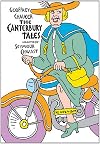
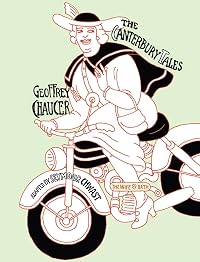
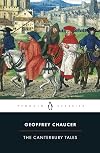
As you can see on the cover, the pilgrims are all on motorcycles. That's the Wife of Bath there; the back cover and the front/endpapers of the book show the rest of the pilgrims on their own bikes. (On the back, we see the Host driving his cycle, with Chaucer in his show more sidecar!) It's a delightful bit of imagery, and it's maintained throughout the rest of the book; the pilgrims always scoot around on their motorcycles as they tell their tales. But other than that, these stories are clearly set during medieval times, as everyone's dress and attitude is medieval. The tales themselves are told pretty straight visually; there's no attempt to transpose them to time or places other than the ones within which they are set. Why then the motorcycles? I don't know, but I like them.
The stories themselves are pretty condensed; they're also transposed into modern English, so you're certainly not reading this book for Chaucer's language. (Which is disappointing sometimes; "The Franklin's Tale" loses almost all of its punch without Dorigen's beautiful ruminations.) The condensing makes a lot of funny moments, since neither the narrators nor the characters have time to explain things in detail. Everything is communicated very matter-of-factly, such as when Lady Constance is delivered to the Syrian sultan in "The Man of Law's Tale":
The Sultan's mother was not happy with this marriage. "When we are Christians we will be slaves of the Church and we will have to renounce the Koran."
The truth was that she was an evil reptile.
I feel like I shouldn't like the condensing, but I don't mind it in general (once you get past the language, most of the tales don't feel like they lose a whole lot), and the matter-of-factness often serves to reveal the inherent absurdity of the situations, as above. It really doesn't work where the original humor of The Canterbury Tales gets undermined (I didn't laugh at this rendition of "The Miller's Tale," for example), but there were a couple other tales that felt flimsy.
The sense of this work primarily functioning as a commentary on the original is enhanced by Chwast's main innovation (since the stories remain unchanged and the art is played straight): what I came to consider the pop-up Chaucer commentary. Some of the tales would have Chaucer (or occasionally the Host) appear in borderless panels with comments about what was happening. Chaucer tells us that "The Knight's Tale" is "complete with swash and buckling" while before the Reeve speaks, he begs, "Gentlemen, I don't want my book banned in Birmingham." When Constance is about to murdered by another lover's mother, the Host asks, "What about all these terrible mothers?" These were my favorite moments in the book-- though The Canterbury Tales is a classic of English literature, there's no denying that it's a strange and unusual set of tales, often absurd to a modern audience, and playing this up is fun.
I haven't talked about the art much-- it's good. Chwast has a simply, sketchy style, which works well for the broad stories being told here. It emphasizes the coarseness of the sexual happenings, which is appropriate: this is The Canterbury Tales, after all. The lettering, on the other hand, is just a pain to read.
But like I said, I don't know what it's all for. I liked the commentary moments best, but there's not a lot of it. The art doesn't put too much of a spin on the story, and though it does its job, it's not particularly nice to look at. The motorcycles are nice, but they don't go anywhere. The compression means you lose the language of Chaucer. On the whole, it's nice to read, but I want it to be more for some reason. show less
As you can see on the cover, the pilgrims are all on motorcycles. That's the Wife of Bath there; the back cover and the front/endpapers of the book show the rest of the pilgrims on their own bikes. (On the back, we see the Host driving his cycle, with Chaucer in his show more sidecar!) It's a delightful bit of imagery, and it's maintained throughout the rest of the book; the pilgrims always scoot around on their motorcycles as they tell their tales. But other than that, these stories are clearly set during medieval times, as everyone's dress and attitude is medieval. The tales themselves are told pretty straight visually; there's no attempt to transpose them to time or places other than the ones within which they are set. Why then the motorcycles? I don't know, but I like them.
The stories themselves are pretty condensed; they're also transposed into modern English, so you're certainly not reading this book for Chaucer's language. (Which is disappointing sometimes; "The Franklin's Tale" loses almost all of its punch without Dorigen's beautiful ruminations.) The condensing makes a lot of funny moments, since neither the narrators nor the characters have time to explain things in detail. Everything is communicated very matter-of-factly, such as when Lady Constance is delivered to the Syrian sultan in "The Man of Law's Tale":
The Sultan's mother was not happy with this marriage. "When we are Christians we will be slaves of the Church and we will have to renounce the Koran."
The truth was that she was an evil reptile.
I feel like I shouldn't like the condensing, but I don't mind it in general (once you get past the language, most of the tales don't feel like they lose a whole lot), and the matter-of-factness often serves to reveal the inherent absurdity of the situations, as above. It really doesn't work where the original humor of The Canterbury Tales gets undermined (I didn't laugh at this rendition of "The Miller's Tale," for example), but there were a couple other tales that felt flimsy.
The sense of this work primarily functioning as a commentary on the original is enhanced by Chwast's main innovation (since the stories remain unchanged and the art is played straight): what I came to consider the pop-up Chaucer commentary. Some of the tales would have Chaucer (or occasionally the Host) appear in borderless panels with comments about what was happening. Chaucer tells us that "The Knight's Tale" is "complete with swash and buckling" while before the Reeve speaks, he begs, "Gentlemen, I don't want my book banned in Birmingham." When Constance is about to murdered by another lover's mother, the Host asks, "What about all these terrible mothers?" These were my favorite moments in the book-- though The Canterbury Tales is a classic of English literature, there's no denying that it's a strange and unusual set of tales, often absurd to a modern audience, and playing this up is fun.
I haven't talked about the art much-- it's good. Chwast has a simply, sketchy style, which works well for the broad stories being told here. It emphasizes the coarseness of the sexual happenings, which is appropriate: this is The Canterbury Tales, after all. The lettering, on the other hand, is just a pain to read.
But like I said, I don't know what it's all for. I liked the commentary moments best, but there's not a lot of it. The art doesn't put too much of a spin on the story, and though it does its job, it's not particularly nice to look at. The motorcycles are nice, but they don't go anywhere. The compression means you lose the language of Chaucer. On the whole, it's nice to read, but I want it to be more for some reason. show less
This review was written for LibraryThing Early Reviewers.Members
- Recently Added By
Author Information


Geoffrey Chaucer, one of England's greatest poets, was born in London about 1340, the son of a wine merchant and deputy to the king's butler and his wife Agnes. Not much is known of Chaucer's early life and education, other than he learned to read French, Latin, and Italian. His experiences as a civil servant and diplomat are said to have show more developed his fascination with people and his knowledge of English life. In 1359-1360 Chaucer traveled with King Edward III's army to France during the Hundred Years' War and was captured in Ardennes. He returned to England after the Treaty of Bretigny when the King paid his ransom. In 1366 he married Philippa Roet, one of Queen Philippa's ladies, who gave him two sons and two daughters. Chaucer remained in royal service traveling to Flanders, Italy, and Spain. These travels would all have a great influence on his work. His early writing was influenced by the French tradition of courtly love poetry, and his later work by the Italians, especially Dante, Boccaccio, and Petrarch. Chaucer wrote in Middle English, the form of English used from 1100 to about 1485. He is given the designation of the first English poet to use rhymed couplets in iambic pentameter and to compose successfully in the vernacular. Chaucer's Canterbury Tales is a collection of humorous, bawdy, and poignant stories told by a group of fictional pilgrims traveling to the shrine of St. Thomas a Becket. It is considered to be among the masterpieces of literature. His works also include The Book of the Duchess, inspired by the death of John Gaunt's first wife; House of Fame, The Parliament of Fowls, and The Legend of Good Women. Troilus and Criseyde, adapted from a love story by Boccaccio, is one of his greatest poems apart from The Canterbury Tales. Chaucer died in London on October 25, 1400. He was buried in Westminster Abbey, in what is now called Poet's Corner. (Bowker Author Biography) show less
Work Relationships
Is an adaptation of
Common Knowledge
- Original publication date
- 2011
- People/Characters
- The Knight; The Miller; The Reeve; The Cook; The Man of Law; The Wife of Bath/Alisoun/Alyson/Alys (show all 23); The Friar; The Summoner; The Clerk; The Merchant; The Squire; The Franklin; The Doctor; The Pardoner; The Shipman; The Prioress; Sir Thopas; Melibee; The Monk; The Nun's Priest; The Second Nun; The Parson; Geoffrey Chaucer
- Important places
- The Tabard
- Dedication
- To the memory of my mother, Esther Newman
- First words
- In the Tabard Inn in Southwark, Near London, the owner, Harry Bailey approached twenty-nine pilgrims.
- Last words
- (Click to show. Warning: May contain spoilers.)I trust the saints will pray for me and forgive my trespasses.
Classifications
- Genre
- Graphic Novels & Comics
- DDC/MDS
- 741.5 — Arts & recreation Drawing & decorative arts Drawing Comic books, graphic novels, fotonovelas, cartoons, caricatures, comic strips
- LCC
- PN6727 .C499 .C36 — Language and Literature Literature (General) Literature (General) Collections of general literature Comic books, strips, etc.
- BISAC
Statistics
- Members
- 114
- Popularity
- 286,072
- Reviews
- 31
- Rating
- (3.00)
- Languages
- English
- Media
- Paper, Ebook
- ISBNs
- 3
- ASINs
- 2