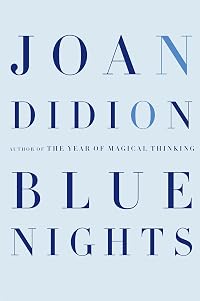
Blue Nights
by Joan Didion
On This Page
Description
NATIONAL BESTSELLER • A work of stunning frankness about losing a daughter, from the bestselling, award-winning author of The Year of Magical Thinking and Let Me Tell You What I MeanRichly textured with memories from her own childhood and married life with her husband, John Gregory Dunne, and daughter, Quintana Roo, this new book by Joan Didion is an intensely personal and moving account of her thoughts, fears, and doubts regarding having children, illness and growing old.
As she show more reflects on her daughter’s life and on her role as a parent, Didion grapples with the candid questions that all parents face, and contemplates her age, something she finds hard to acknowledge, much less accept. Blue Nights—the long, light evening hours that signal the summer solstice, “the opposite of the dying of the brightness, but also its warning”—like The Year of Magical Thinking before it, is an...
. show less
Tags
Recommendations
































Member Reviews
Joan Didion’s Blue Nights, written after the death of Didion’s daughter, is a reflection on aging, death, and having children. The book is written in snapshots that appear to be loosely organized. It reminds me of an interview she once gave, discussing Play It As It Lays, in which she said that she wrote the book chapters out of order, tacked them on a wall, and reorganized them in a way that made sense to her. (Or maybe it wasn't Play It As It Lays, but Run River, or A Book of Common Prayer.) If this book was written in the same way it wouldn’t surprise me. The chapters are short and episodic, and they work wonderfully.
Yet Didion tells us herself in this book that her style of writing has changed. She has been forced to become show more more direct. She worries that this is a side-effect of aging, a sign that she is losing her mental capabilities. She worries that she won’t be able to remember the right words. Not only that, she worries that her memories, which as she points out, are not at all a blessing like people say, are fading. These memories are something that she hates, yet cannot live without.
I used to think that aging was nothing to worry about, that perhaps as a natural process of living it is even beautiful. But what did I know? I have yet to lose anything to the process of aging. Nothing has made me fear aging more than this book. As Didion says in the closing chapter, “The fear is not for what is lost. . . The fear is for what is still to be lost” (188). She has made me realize that there is so much to lose in life and that it is all unavoidable. It is because this book is so personal that it is so heartbreaking. Didion has not lost her touch like she worries.
I’ve heard people complain that Didion name-drops too much in this book. I don’t think it’s a way to show off. I think it’s an act of remembrance. To say, I knew these people, spectacular or not, even well-liked or not, is almost an act of happiness. (Or maybe it isn’t, as she points out, “Memories are what you no longer want to remember” (64).) It’s saying, I lived through all that. And in the case where it’s people who made her happy and people she loved, remembering is a beautiful act. Yes, it’s luxurious, but it also shows a time of happiness she took for granted. And she took so much for granted, had so many misconceptions about life and motherhood. This makes it all the more tragic that she lost those people. She is saying, we all lose a lot. It hurts to find out the Blue Nights don’t last forever. show less
Yet Didion tells us herself in this book that her style of writing has changed. She has been forced to become show more more direct. She worries that this is a side-effect of aging, a sign that she is losing her mental capabilities. She worries that she won’t be able to remember the right words. Not only that, she worries that her memories, which as she points out, are not at all a blessing like people say, are fading. These memories are something that she hates, yet cannot live without.
I used to think that aging was nothing to worry about, that perhaps as a natural process of living it is even beautiful. But what did I know? I have yet to lose anything to the process of aging. Nothing has made me fear aging more than this book. As Didion says in the closing chapter, “The fear is not for what is lost. . . The fear is for what is still to be lost” (188). She has made me realize that there is so much to lose in life and that it is all unavoidable. It is because this book is so personal that it is so heartbreaking. Didion has not lost her touch like she worries.
I’ve heard people complain that Didion name-drops too much in this book. I don’t think it’s a way to show off. I think it’s an act of remembrance. To say, I knew these people, spectacular or not, even well-liked or not, is almost an act of happiness. (Or maybe it isn’t, as she points out, “Memories are what you no longer want to remember” (64).) It’s saying, I lived through all that. And in the case where it’s people who made her happy and people she loved, remembering is a beautiful act. Yes, it’s luxurious, but it also shows a time of happiness she took for granted. And she took so much for granted, had so many misconceptions about life and motherhood. This makes it all the more tragic that she lost those people. She is saying, we all lose a lot. It hurts to find out the Blue Nights don’t last forever. show less
I read this book in two hours. Large print, many short sentences and paragraphs, much repetition. Deliberate, not careless repetition, that is emotionally powerful. Blue Nights is more about Didion's own aging and her response to that and to the death of her daughter, than it is about her daughter. Whatever is the opposite of sentimental, this book is that. Didion identifies what she sees at writing as lack of attention to aspects of her daughter. She doesn't want mementoes, she wants real, strong memories.
I liked Blue Nights. I have had an adult daughter die, and I am dealing with the decripitudes of aging. This does not mean I think Didion and I are in any way similar, but it does mean that I appreciate her front-on approach to both.
I liked Blue Nights. I have had an adult daughter die, and I am dealing with the decripitudes of aging. This does not mean I think Didion and I are in any way similar, but it does mean that I appreciate her front-on approach to both.
Se avete adorato la freddezza e la razionalità con cui Didion elabora il lutto in l’anno del pensiero magico, DOVETE LEGGERE BLUE NIGHTS.
Qui Joan Didion racconta il lutto per la morte di Quintana partendo dalle basi del rapporto con la figlia e con la maternità. E lo fa in maniera razionale, analizzando il suo essere madre e madre adottiva, mettendo sul tavolo tutto: tutta se stessa e tutti i suoi errori e le sue debolezze. Capolavoro assoluto.
Qui Joan Didion racconta il lutto per la morte di Quintana partendo dalle basi del rapporto con la figlia e con la maternità. E lo fa in maniera razionale, analizzando il suo essere madre e madre adottiva, mettendo sul tavolo tutto: tutta se stessa e tutti i suoi errori e le sue debolezze. Capolavoro assoluto.
It's hard to imagine what it took to write this. I see this both for its therapeutic value and for its Art. Her style has a stream of consciousness flow-you can feel her feeling her way through and processing her life experiences. I feel this is really what a memoir should be: a way of processing your life not just writing something that will become polished and done. She writes not just about death but life; not just about life but death. I have heard Didion described as holding back when what I actually feel about her is that she is the most vulnerable writer I've encountered. And this is what healing needs: to process the whole relationship. This was a more difficult read than The Year of Magical Thinking but possibly a greater show more achievement. show less
Blue nights are those magical evenings at the peak of summer when the intensity of light makes it seem as if they could go on forever. As summer wanes, the blue nights fade and in no time summer is gone. The notion that blue nights cannot last forever is one we tend to ignore until events force us into the realization that our own blue nights have passed forever.
Photographs, ephemera, memorabilia, all the back drop of our lives show us what happened, but the explanations of how and why are left to us. Joan Didion confronts these totems and explanations on the seventh anniversary of her daughter Quintana's wedding, almost five years after that daughter's death. When Didion's husband died five months after Quintana's wedding, Didion show more promised herself she would "maintain momentum". Now, on this July night, she realizes she has all but missed this year's blue nights in that effort; that blue nights are over for her and momentum is all but lost.
Didion has always had a rapier like mind and pen, so her confrontation with the end of life is brutally honest; an examination of what has been and what might have been, and most devastatingly of all, of the time yet to come. A doctor suggests she is not adjusting properly to ageing. Friends suggest it may be time to move from her apartment. Out on the street she has become invisible to a world attuned to youth and action. She herself realizes she will no longer "continue to wear the red suede sandals with the four inch heels that I always preferred".
Reading this book was a long good bye to a favourite author and a melancholy realization that there will likely be no more new encounters. At least there was the opportunity for farewell. show less
Photographs, ephemera, memorabilia, all the back drop of our lives show us what happened, but the explanations of how and why are left to us. Joan Didion confronts these totems and explanations on the seventh anniversary of her daughter Quintana's wedding, almost five years after that daughter's death. When Didion's husband died five months after Quintana's wedding, Didion show more promised herself she would "maintain momentum". Now, on this July night, she realizes she has all but missed this year's blue nights in that effort; that blue nights are over for her and momentum is all but lost.
Didion has always had a rapier like mind and pen, so her confrontation with the end of life is brutally honest; an examination of what has been and what might have been, and most devastatingly of all, of the time yet to come. A doctor suggests she is not adjusting properly to ageing. Friends suggest it may be time to move from her apartment. Out on the street she has become invisible to a world attuned to youth and action. She herself realizes she will no longer "continue to wear the red suede sandals with the four inch heels that I always preferred".
Reading this book was a long good bye to a favourite author and a melancholy realization that there will likely be no more new encounters. At least there was the opportunity for farewell. show less
Bad timing. I began reading this book on December 23. The next day, I learned that Joan Didion had died. That added poignancy to this, since it is a book saturated with death and dying. One could even say the book is haunted by the memory of her husband, their daughter, and a friend of the family. By the end of the book, the author reluctantly confronts her own mortality.
Perhaps I should also mention that I chose this as something light to read while sitting in a hospital waiting room? So not only was my timing off.
Given the timing, it feels uncharitable to say so, but from the beginning, this book felt like a slim addendum to her Year of Magical Thinking, a powerful book. The writing is beautiful, although her repetition of sentences show more that act as leitmotifs, which was evocative, even mesmerizing for a while, began to wear on me. Even more irritating to me was Didion’s penchant for name-dropping. In a way, fair enough: she and her husband were bright stars in the literary firmament of both Hollywood and New York, so these people were a part of their social life, even their circle of friends (not always the same thing). But brand-name dropping? Christian Louboutin, Chanel, David Webb. Perhaps I feel left out because these evoke no pictures in me, as if I’m not the person Didion wrote this for. I nearly gave up on the book when she listed the hotels she, her husband, and her daughter stayed in. Then adds, when they were on expenses; then she named a hotel they stayed in when they had to pay the bill.
I decided to give her the benefit of the doubt and reckoned with the possibility that she was aware of how this sounded.
And perhaps that this is part of the message of the book. No matter how well-padded your expense account, or even if you land in Columbia Presbyterian rather than Lenox Hill hospital, the time comes when you realize that medicine is, as Didion writes, “an imperfect art.” And even when that art is practiced flawlessly, we remain mortal. show less
Perhaps I should also mention that I chose this as something light to read while sitting in a hospital waiting room? So not only was my timing off.
Given the timing, it feels uncharitable to say so, but from the beginning, this book felt like a slim addendum to her Year of Magical Thinking, a powerful book. The writing is beautiful, although her repetition of sentences show more that act as leitmotifs, which was evocative, even mesmerizing for a while, began to wear on me. Even more irritating to me was Didion’s penchant for name-dropping. In a way, fair enough: she and her husband were bright stars in the literary firmament of both Hollywood and New York, so these people were a part of their social life, even their circle of friends (not always the same thing). But brand-name dropping? Christian Louboutin, Chanel, David Webb. Perhaps I feel left out because these evoke no pictures in me, as if I’m not the person Didion wrote this for. I nearly gave up on the book when she listed the hotels she, her husband, and her daughter stayed in. Then adds, when they were on expenses; then she named a hotel they stayed in when they had to pay the bill.
I decided to give her the benefit of the doubt and reckoned with the possibility that she was aware of how this sounded.
And perhaps that this is part of the message of the book. No matter how well-padded your expense account, or even if you land in Columbia Presbyterian rather than Lenox Hill hospital, the time comes when you realize that medicine is, as Didion writes, “an imperfect art.” And even when that art is practiced flawlessly, we remain mortal. show less
Blue Nights is very much a piece with Didion's The Year of Magical Thinking, continuing her account of the remains of her life in the aftermath of the deaths of her husband and daughter. Blue Nights is not the book that the other was, partly because Didion cannot address her daughter's life and death in the same head-on manner that she did with her husband's, but mostly because in between the two books she has, she seems to be saying, grown old, she has become what she appears to be: small, frail, and diminished in possibility and power. This dwindling is pretty much her focus in Blue Nights.
While the portions devoted to her daughter Quintana are moving, Didion acknowledges in the book that she cannot come at this directly, instead show more Quintana's story comes in bits and pieces: an episode here, a quote there. Hugely important elements of her daughter's life are dealt with in a sentence or a paragraph, or at most a page or two, then off Didion strays to other memories or immediacies. Even getting a sense of Quintana's final illness and death is elusive, it was all dealt with in such fleeting glimpses.
Implicit in her meditations about her daughter is a search for agency and attribution - why did things happen the way they did, could it have been different? Not only are there no answers that can help, but even worse, the time for the magical thinking that could have kept those questions at bay, is irrevocably past. show less
While the portions devoted to her daughter Quintana are moving, Didion acknowledges in the book that she cannot come at this directly, instead show more Quintana's story comes in bits and pieces: an episode here, a quote there. Hugely important elements of her daughter's life are dealt with in a sentence or a paragraph, or at most a page or two, then off Didion strays to other memories or immediacies. Even getting a sense of Quintana's final illness and death is elusive, it was all dealt with in such fleeting glimpses.
Implicit in her meditations about her daughter is a search for agency and attribution - why did things happen the way they did, could it have been different? Not only are there no answers that can help, but even worse, the time for the magical thinking that could have kept those questions at bay, is irrevocably past. show less
Members
- Recently Added By
Published Reviews
ThingScore 100
added by melmore
Lists

Books I Want to Read in 2012
6 works; 3 members

Books Read in 2017
4,249 works; 129 members

The Luca Guadagnino Universe
62 works; 1 member
Author Information

56+ Works 36,340 Members
Born in Sacramento, California, on December 5, 1934, Joan Didion received a B.A. from the University of California, Berkeley in 1956. She wrote for Vogue from 1956 to 1963, and was visiting regent's lecturer in English at the University of California, Berkeley in 1976. Didion also published novels, short stories, social commentary, and essays. Her show more work often comments on social disorder. Didion wrote for years on her native California; from there her perspective broadened and turned to the countries of Central America and Southeast Asia. Her novels include Democracy (1984) and The Last Thing He Wanted (1996). Well known nonfiction titles include Slouching Towards Bethlehem (1968), The White Album (1979), The Year of Magical Thinking (2005) and Blue Nights (2011). In 1971 Joan Didion was nominated for the National Book Award in fiction for Play It As It Lays. In 1981 she received the American Book Award in nonfiction, and was nominated for a National Book Critics Circle Prize in nonfiction for The White Album. Didion has received a great deal of recognition for The Year of Magical Thinking, which was awarded the National Book Award for Nonfiction in 2005. In 2007, Didion received the National Book Foundation's annual Medal for Distinguished Contribution to American Letters. In 2009, Didion was awarded an honorary Doctor of Letters degree by Harvard University. On July 3, 2013 the White House announced Didion was one of the recipients of the National Medals of Arts and Humanities presented by President Barack Obama. (Bowker Author Biography) show less
Some Editions
Awards and Honors
Distinctions
Common Knowledge
- Canonical title
- Blue Nights
- Original title
- Blue Nights
- Dedication
- This book is for Quintana
- First words
- In certain latitudes there comes a span of time approaching and following the summer solstice, some weeks in all, when the twilights turn long and blue.
- Canonical DDC/MDS
- 813.54
- Canonical LCC
- PS3554.I33 Z46
Classifications
Statistics
- Members
- 1,925
- Popularity
- 11,059
- Reviews
- 70
- Rating
- (3.71)
- Languages
- 11 — Dutch, English, Finnish, French, German, Italian, Polish, Russian, Spanish, Swedish, Portuguese (Portugal)
- Media
- Paper, Audiobook, Ebook
- ISBNs
- 44
- ASINs
- 14