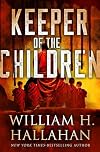
Keeper of the Children
by William H. Hallahan
On This Page
Description
The New York Times-bestselling author of The Search for Joseph Tully delivers "a mixture of horror and occultism told with driving force" (The New York Times). Eddie Benson is a typical middle-class father with a secure job, a home in suburban Philadelphia, and a seemingly happy family. For Benson life holds no fear or terror. Then something unusual happens. One day his daughter, Renni, a normal, fun-loving fourteen-year-old, disappears. Soon after, Eddie finds her wandering the show more streets of Philadelphia with a band of children. Dressed in orange robes, they bear drums and tambourines and cymbals. Moving through the crowds, they dance and sing and proffer metal bowls for coins. The children refuse to return to their homes. The youngsters, their parents have learned, are living with a mysterious Tibetan monk with strange, otherworldly powers. What follows is a series of bone-chilling incidents, each more violent than the last, all inexplicable. Only Eddie Benson will not abandon hope. And to rescue his child, Eddie must run a terrible risk, one that could cost him his life and his soul. "Hallahan improbably makes it work. . . . A careful and serious writer, making the absurd plausible and wringing satisfying suspense out of it." --Too Much Horror Fiction show lessTags
Recommendations

















Member Reviews
Hallahan's second occult novel (1978) which got a passing mention in 'Paperbacks from Hell' almost lost a star on the basis of its first half which is weakly structured and written. Hallahan only proved he could write effectively in the last third in what would otherwise be a potboiler.
A horror novel relates to its time and place. This one is carefully positioned in mid-1970s Philadelphia with the hint of Vietnam coming home to roost and family fears of dislocation from some of the new religions of the East. An East Coast fear of the occult is grounded in contemporary cultural change.
There is plenty of evidence that American middle class families, especially in the big depressed cities of the 1970s, were worried about losing their show more children as runaways to malevolent forces. You see this appear in Hollywood films without occult trappings as much as in popular literature.
A good horror novel - which will always be implausible at its core - must be embedded in a reality that is plausible, one that is more than tracking people through the streets of a city in a way that you can follow on a map. It has to hang together 'sociologically' which Stephen King does so well.
Hallahan's Philadelphia is real enough but the dystopian vision of the city as a place of isolated families without any support goes too far. The occult element becomes murderous too obviously and too quickly - the police would surely have become involved and enquiries made.
Of course, child protection was much less developed then than it is now but the lack of support for parents losing their kids to a malevolent force operating in the full light of day and with easily connected deaths over a short period really does not ring true.
Hallahan also seems to be lazy with human relationships. These are expressed in ways that barely seem credible given what is happening around the characters as if he just wants to get them out of the way in order to get to his more dramatic set pieces.
These set pieces involve possessed scarecrows and puppets, Buddhist tulpa (although the word is never used), astral travel and occult struggle with the hero (Benson) trying to rescue his child by packing decades of 'spiritual' training into a few weeks.
Suspension of disbelief is fully stretched. However, Hallahan's set pieces get better as the story proceeds. They become more coherent. Although nonsense in itself, Benson's astral training shifts the tale from the mundane and from that point on it becomes enjoyable rather than dull.
There is one section later which explores the predatory behaviour of urban cats and rats which is very fine writing indeed. It captures something of the existential horror that is nature red in tooth and claw. To move forward from this with more information would be to be accused of spoilers.
Overall, not a story that I would recommend going out of your way to read. I suspect the average reader might not be impressed and risk abandoning their investment two thirds of the way through but the whole is partially redeemed not so much by the peremptory ending as by that last third. show less
A horror novel relates to its time and place. This one is carefully positioned in mid-1970s Philadelphia with the hint of Vietnam coming home to roost and family fears of dislocation from some of the new religions of the East. An East Coast fear of the occult is grounded in contemporary cultural change.
There is plenty of evidence that American middle class families, especially in the big depressed cities of the 1970s, were worried about losing their show more children as runaways to malevolent forces. You see this appear in Hollywood films without occult trappings as much as in popular literature.
A good horror novel - which will always be implausible at its core - must be embedded in a reality that is plausible, one that is more than tracking people through the streets of a city in a way that you can follow on a map. It has to hang together 'sociologically' which Stephen King does so well.
Hallahan's Philadelphia is real enough but the dystopian vision of the city as a place of isolated families without any support goes too far. The occult element becomes murderous too obviously and too quickly - the police would surely have become involved and enquiries made.
Of course, child protection was much less developed then than it is now but the lack of support for parents losing their kids to a malevolent force operating in the full light of day and with easily connected deaths over a short period really does not ring true.
Hallahan also seems to be lazy with human relationships. These are expressed in ways that barely seem credible given what is happening around the characters as if he just wants to get them out of the way in order to get to his more dramatic set pieces.
These set pieces involve possessed scarecrows and puppets, Buddhist tulpa (although the word is never used), astral travel and occult struggle with the hero (Benson) trying to rescue his child by packing decades of 'spiritual' training into a few weeks.
Suspension of disbelief is fully stretched. However, Hallahan's set pieces get better as the story proceeds. They become more coherent. Although nonsense in itself, Benson's astral training shifts the tale from the mundane and from that point on it becomes enjoyable rather than dull.
There is one section later which explores the predatory behaviour of urban cats and rats which is very fine writing indeed. It captures something of the existential horror that is nature red in tooth and claw. To move forward from this with more information would be to be accused of spoilers.
Overall, not a story that I would recommend going out of your way to read. I suspect the average reader might not be impressed and risk abandoning their investment two thirds of the way through but the whole is partially redeemed not so much by the peremptory ending as by that last third. show less
Meh. A fast read but not as cool as the cover.
Ratings
Members
- Recently Added By
Lists

1970s
657 works; 23 members

Stephen King's 'Danse Macabre' reading list
111 works; 25 members

Paperbacks from Hell
382 works; 9 members
BlackDog's Complete Paperbacks From Hell List
639 works; 3 members
Stephen King's Danse Macabre Full Appendix List
110 works; 2 members
Author Information

14+ Works 722 Members
William H. Hallahan, an award-winning novelist as well as a historian
Work Relationships
Is contained in
Classifications
Statistics
- Members
- 71
- Popularity
- 443,251
- Reviews
- 2
- Rating
- (3.12)
- Languages
- English
- Media
- Paper, Ebook
- ISBNs
- 7
- ASINs
- 1