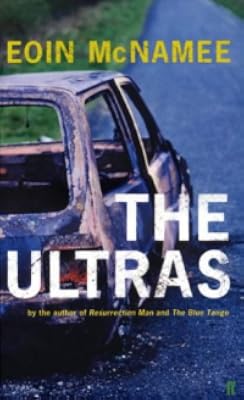
The Ultras
by Eoin McNamee
On This Page
Description
In 1970s Ireland the British establishment conducted its struggle with the IRA in the dirty war. This novel, set around the real-life figure of Captain Nairac, recreates the intrigue, loyalism and violence of a time when friend could turn foe overnight and nothing was ever quite as it seemed.Tags
Recommendations













Member Reviews
This is an excellent novel by a fine writer. The story is based, loosely, on the life and death of a Special Forces Captain, Robert Nairac, who left a bar in 1977, in the company of three men, and was never seen again, nor was his body ever found. Nairac, at least in the novel, is a larger-than-life, shadowy figure who works hard at perfecting a mysterious persona, a mythic personality. Twenty-five years later, ex-Sergeant Blair Agnew, who knew Nairac, dedicates his wasted life to trying to figure out what happened to Nairac; an obsession that is probably the only thing that keeps him going. Agnew himself was a peripheral player in the shadowy world of special forces and competing intelligence agencies, a man with a failed marriage, no show more career prospects, no core beliefs, a man described by his anorexic daughter as having real expertise only in the “field of weak promises and shallow commitments”.
McNamee conveys very well the indistinct world of the counter intelligence war, a war characterized by many competing agencies and individuals with ill-defined objectives and constantly shifting alliances that can, at times, even cross the lines between friend and foe, a war of clandestine military actions, a world of vaporous lines of communication and responsibility, a world of rituals and talismans and of roles played and imposed but with no moral core, a world of metaphor and enigma and riddles, a world where events and directions seem, in their own mad logic, to have their own life forces, their own ineluctable movements and outcomes beyond the ken and control of the men who think they are masters of the moment. In this, I was struck by parallels to the writing of Dennis Johnson in Tree of Smoke, describing the confusion of purposes and actions of the war in Vietnam.
As one of the protagonists says, “There were complaints from GCHQ that there were too many organizations on the ground and that they were interfering with each other’s work. Knox didn’t agree. He encouraged the entry of other branches into the field. It was important to have inter-agency rivalry, people working in layers, laying false trails for each other. Groups of highly trained men stumbling across each other at night. Knox knew that confusion was important. A sense of unstable government was vital to good intelligence work. You wanted there to be shifting patterns, shadowy alliances, overtones of corruption and sexual scandal.” Or, as Agnew himself realizes at one point, “That was what Robert and the others did. They created secrets and forced everyone to live in them. That was what scared him. The knowledge of clandestine governance, the dark polity.”
This is the third book I’ve read by McNamee (in addition to Resurrection Man and The Blue Tango) and I see repeating characteristics and themes. One is McNamee’s psychological acuity in exploring the weaknesses, guilt, and destinies of individuals and how they interact with others at various levels and in various circumstances. Another is the psychology of confession that does not stop people from doing dark deeds, but drives them towards the absolution, not necessarily of repentance, but of being known, of playing a role consonant with self-images that impose certain requirements. Another is the idea that events have a force and direction and meaning in and of themselves, beyond or apart from the motives of the people that initiate and think they control the interactions.
And then there is the beauty of McNamee’s writing, in particular his use of metaphor in the best manner of unexpected juxtapositions that illuminate. Some examples:
“…he was willing to sit back and watch nurses leaving the hospital, the white of their uniforms stark in the gathering dusk. You had the sensation of signals coming through, systemic in darkness, of semaphore.”
“The bird [a buzzard] moved sideways along the perch and stepped on to his arm with an odd delicacy, something Robert would come to notice in the birds, the way they displayed what seemed like a murderous fastidiousness.”
“The words had a bitter outline, but there was an absence in the way she spoke them that robbed them of malice. She ran her fingers over the seam of the T-shirt and turned it over again as if she could enfold apprehension within it. “
There is more to this book: metaphors of sight and blindness, of the wasting of Agnew’s anorexic daughter. McNamee’s world is stark and there is no redemption, but he does a masterful job of exploring it. Recommended reading. show less
McNamee conveys very well the indistinct world of the counter intelligence war, a war characterized by many competing agencies and individuals with ill-defined objectives and constantly shifting alliances that can, at times, even cross the lines between friend and foe, a war of clandestine military actions, a world of vaporous lines of communication and responsibility, a world of rituals and talismans and of roles played and imposed but with no moral core, a world of metaphor and enigma and riddles, a world where events and directions seem, in their own mad logic, to have their own life forces, their own ineluctable movements and outcomes beyond the ken and control of the men who think they are masters of the moment. In this, I was struck by parallels to the writing of Dennis Johnson in Tree of Smoke, describing the confusion of purposes and actions of the war in Vietnam.
As one of the protagonists says, “There were complaints from GCHQ that there were too many organizations on the ground and that they were interfering with each other’s work. Knox didn’t agree. He encouraged the entry of other branches into the field. It was important to have inter-agency rivalry, people working in layers, laying false trails for each other. Groups of highly trained men stumbling across each other at night. Knox knew that confusion was important. A sense of unstable government was vital to good intelligence work. You wanted there to be shifting patterns, shadowy alliances, overtones of corruption and sexual scandal.” Or, as Agnew himself realizes at one point, “That was what Robert and the others did. They created secrets and forced everyone to live in them. That was what scared him. The knowledge of clandestine governance, the dark polity.”
This is the third book I’ve read by McNamee (in addition to Resurrection Man and The Blue Tango) and I see repeating characteristics and themes. One is McNamee’s psychological acuity in exploring the weaknesses, guilt, and destinies of individuals and how they interact with others at various levels and in various circumstances. Another is the psychology of confession that does not stop people from doing dark deeds, but drives them towards the absolution, not necessarily of repentance, but of being known, of playing a role consonant with self-images that impose certain requirements. Another is the idea that events have a force and direction and meaning in and of themselves, beyond or apart from the motives of the people that initiate and think they control the interactions.
And then there is the beauty of McNamee’s writing, in particular his use of metaphor in the best manner of unexpected juxtapositions that illuminate. Some examples:
“…he was willing to sit back and watch nurses leaving the hospital, the white of their uniforms stark in the gathering dusk. You had the sensation of signals coming through, systemic in darkness, of semaphore.”
“The bird [a buzzard] moved sideways along the perch and stepped on to his arm with an odd delicacy, something Robert would come to notice in the birds, the way they displayed what seemed like a murderous fastidiousness.”
“The words had a bitter outline, but there was an absence in the way she spoke them that robbed them of malice. She ran her fingers over the seam of the T-shirt and turned it over again as if she could enfold apprehension within it. “
There is more to this book: metaphors of sight and blindness, of the wasting of Agnew’s anorexic daughter. McNamee’s world is stark and there is no redemption, but he does a masterful job of exploring it. Recommended reading. show less
This book is disappointing the novel is about the mysterious disappearance of Robert Noriac he was an undercover M15 agent in Northern Ireland he went missing presumed dead in 1977
Blair Agnew an ex policeman wants to write a book about this event.
Book is complicated and keeps jumping a shame because it could have been a really good read.
Blair Agnew an ex policeman wants to write a book about this event.
Book is complicated and keeps jumping a shame because it could have been a really good read.
Ratings
Members
- Recently Added By
Author Information

25+ Works 1,142 Members
Classifications
Statistics
- Members
- 46
- Popularity
- 651,259
- Reviews
- 2
- Rating
- (3.95)
- Languages
- Dutch, English
- Media
- Paper
- ISBNs
- 3