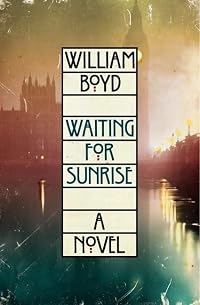
Waiting for Sunrise
by William Boyd
On This Page
Description
From one of our most celebrated and imaginative writers comes a spellbinding novel about deception, betrayal, psychoanalysis, and the mysteries of the human heart. William Boyd follows his critically acclaimed novels A Good Man in Africa, Brazzaville Beach, and Ordinary Thunderstorms with a razor-sharp, incandescent thriller in Waiting for Sunrise. Vienna, 1913. Lysander Rief, a young English actor in town seeking psychotherapy for a troubling ailment, becomes caught up in a feverish affair show more with a beautiful, enigmatic woman. When she goes to the police to press charges of rape, however, he is mystified, and his few months of passion come to an abrupt end. Only a carefully plotted escape-with the help of two mysterious British diplomats-saves him from trial. But the frenzied getaway sets off a chain of events that steadily dismantles Lysander's life as he knows it. He returns to London hoping to win back his one-time fiancée and banish from memory his traumatic ordeals abroad, but Vienna haunts him at every turn. The men who helped coordinate his escape recruit him to carry out the brutal murder of a complete stranger. His lover from Vienna shows up nonchalantly at a party, ready to resume their liaison. And before he knows where his new life has taken him, Lysander soon finds himself on the trail of a traitor-a man whose bizarre connection to his own family proves a cruel twist of fate A provocative exploration of the line between consciousness and reality is nested within a tense, rollercoaster plotline following as a young English actor ensnared in a bewildering scandal with an enigmatic woman in early twentieth-century Vienna. Sophisticated, page-turning, and unforgettable, Boyd's Waiting for Sunrise is a triumph of literary fiction from one of the most powerful, thought-provoking writers working today. show lessTags
Recommendations



























Member Reviews
This was a feverish read, very cleverly done. The ending is wonderfully enigmatic, raising the possibility that everything else in the novel is a lie or a reimagining of the facts to make them sit more comfortably with the protagonist. At face value, it's a WW1 espionage thriller, and a ripping yarn at that. Simultaneously, it's an exploration of the psyche and whether it's ever possible to really locate the truth, because we all have our own version of what the truth is. Wonderful stuff as usual from William Boyd.
A lot of similarities between this and AHH - the diary, the sexual focus/hangups, the lone young man caught in a war. It had a bit more of a linear plot since there was an espionage angle to things, but the beginning was very slow and I wondered how Lysander, who couldn’t seem to make one good decision, would survive as a spy or spy hunter, which is what he ends up being. I didn’t care about Lysander like I did Logan Mountstuart and that’s kind of a let-down. Lysander leaves a light impression and gets some sympathy at times, but he isn’t an attractive person in the way that LMS was. I think when he admitted he falsely accused another boy of molesting him, and other than possibly giving him a temporary sexual dysfunction, he show more didn’t suffer any consequences for his lie or betrayal. So I decided he was basically a craven liar with poor judgement who got what he deserved a lot of the time. After a while the descriptions and musings of his sexual encounters got pretty irritating. But I guess musing on what every woman looks like naked is the norm for most men.
The belated spy story while it started out interesting and explosive, ends in a whimper with not much in the way of consequences or explanation. Why did the traitor betray his country? How much did catching him improve the situation? Eh, I still don’t really know. There was a lot of build-up with very little pay off and a lot of dangling people and situations. As good as Boyd is, he’s no le Carre.
And speaking of no pay-off - what’s with Hettie? I really wanted her to pay for what she did to Lysander in Vienna and her whole general attitude with him. Granted, he walked into it again and again (musta been them amazing tits that get so much press), but damn if she wasn’t a conniving jerk. I was hoping she’d be part of the set-up (which again, wasn’t explained all that well...lots of innuendo and suspicion and no resolution) and she’d have to take her lumps, but no, she slides off to “New Mexico, wherever that is”. Bah.
Tons of atmosphere and characterization though, which is really his strength. I felt what it was like to be in Vienna and London during the early part of the 20th century. The excitement and confusion and huge social upheavals that left everyone feeling afloat; as if they didn’t belong to their world anymore. The first major modern war with all its nasty armaments and brutality. Effectively and evocatively done. I’ve said it before about other writers like Michael Chabon and T.C. Boyle, I think Boyd is one of those writers who shouldn’t try to work to a specific plot. He should write books with a character that connects a series of events that don’t have bearing on one another, but shape his life or outlook. A see-what-happens-next kind of thing. A character sketch of a whole life. A looking back, like in Restless, or a moving through time as in Any Human Heart. The two books with definitive outcomes and plots of the four that I’ve read now, have been the weakest. I like Boyd though and will keep reading his books, even when one is weak, there’s still merit and I always enjoy them. show less
The belated spy story while it started out interesting and explosive, ends in a whimper with not much in the way of consequences or explanation. Why did the traitor betray his country? How much did catching him improve the situation? Eh, I still don’t really know. There was a lot of build-up with very little pay off and a lot of dangling people and situations. As good as Boyd is, he’s no le Carre.
And speaking of no pay-off - what’s with Hettie? I really wanted her to pay for what she did to Lysander in Vienna and her whole general attitude with him. Granted, he walked into it again and again (musta been them amazing tits that get so much press), but damn if she wasn’t a conniving jerk. I was hoping she’d be part of the set-up (which again, wasn’t explained all that well...lots of innuendo and suspicion and no resolution) and she’d have to take her lumps, but no, she slides off to “New Mexico, wherever that is”. Bah.
Tons of atmosphere and characterization though, which is really his strength. I felt what it was like to be in Vienna and London during the early part of the 20th century. The excitement and confusion and huge social upheavals that left everyone feeling afloat; as if they didn’t belong to their world anymore. The first major modern war with all its nasty armaments and brutality. Effectively and evocatively done. I’ve said it before about other writers like Michael Chabon and T.C. Boyle, I think Boyd is one of those writers who shouldn’t try to work to a specific plot. He should write books with a character that connects a series of events that don’t have bearing on one another, but shape his life or outlook. A see-what-happens-next kind of thing. A character sketch of a whole life. A looking back, like in Restless, or a moving through time as in Any Human Heart. The two books with definitive outcomes and plots of the four that I’ve read now, have been the weakest. I like Boyd though and will keep reading his books, even when one is weak, there’s still merit and I always enjoy them. show less
Luck is a recurring theme in Boyd’s work (if what I’ve read of his to date is any indication – viz., Any Human Heart; Nat Tate – An American Artist; Fascination; Ordinary Thunderstorms; and now, Waiting for Sunrise. As unadorned as that sentiment may be, I’m more and more inclined to agree with it. Good genes and a generous trust fund certainly help. But at the end of the day, luck seems to be what it’s all about.
Boyd, however, supplies a downside corollary to this suggestion on p. 285: “(b)ut all history is the history of unintended consequences, he said to himself – there’s nothing you can do about it.”
Even if Waiting for Sunrise is not quite the magnum opus Any Human Heart is, I find that what I most like about show more William Boyd is that I feel, at each and every instant, that I’m reading an adult writer – and not some over-aged kid failing miserably to sound like an adult either because the writing is so sophomoric, not to say moronic, or because the subject-matter is just plain silly.
Boyd can wax lyrical with the best of ‘em – don’t get me wrong – but there’s nothing artsy-fartsy in his prose. It’s simply mature, ripe, and polished to perfection. And while a given situation in his narrative might be downright dangerous, there’s also nothing overtly macho about his writing (pace Hemingway). At the same time, and although Lysander Rief (the protagonist of this novel) has an unusually close relationship with his mother, there’s nothing even remotely or uncomfortably oedipal about it (pace D. H. Lawrence).
A few examples of Boyd’s authorial skills? Take, already on p. 22, this description of a Viennese widow – and please also take my word, as someone who once spent a couple of years in that fair city, that he obviously knows what he’s talking about: “Frau K., as her three lodgers referred to her, was a woman of rigid piety and decorum. Widowed in her forties, she wore traditional Austrian clothes – moss-green dirndl dresses, in the main, with embroidered blouses and aprons, and broad buckled pumps – and projected a demeanour of excruciating politesse that was really only endurable for the length of a meal, Lysander had quickly realized. Her world admitted and contained only people, events and opinions that were either ‘nice’ or ‘pleasant’ (net or angenehm). These were her favourite adjectives, deployed at every opportunity. The cheese was nice; the weather pleasant. The Crown Prince’s young wife seemed a nice person; the new post office had a pleasant aspect. And so on.”
On p. 48, we have a marvelous little exchange between Lysander and Dr. Bensimon, his therapist.
“‘Love at second sight, my father used to say.
‘Why second sight?’
‘Because he said that at first sight his thoughts were hardly “amorous.” If you see what I mean.’”
If Boyd invented this – and I suspect he did – I have to say (as Brits would) that it’s nothing short of BRILL!
Perhaps not since I last read P. G. Wodehouse have I read another writer – albeit in tidbit rather than compendium form – whose humor is quite so punctiliously apt. For evidence, I give you the following on p. 299: “(a)s I write this, a man sitting opposite me is reading a novel and, from time to time, picking his nose, examining what he has mined from his nasal cavities and popping the sweetmeat into his mouth. Amazing the secrets we reveal about ourselves when we think we’re not being observed. Amazing the secrets we can reveal when we know we are.”
I dare you, ever again, to pop a bonbon or other candied fruit into your mouth and not flash back to this paragraph! At the same time, kindly note how Boyd has singlehandedly resuscitated the word “amazing” from the mealy mouths of American Millennials. Would that he could as much with the word “awesome” (although he does a quite credible job with its lexical cousin, “awestruck,” on p. 309).
Can Boyd paint a picture? I’ll let you be the judge. “He remembered how, on very cold days in winter, when you lit a bonfire the smoke sometimes refused to rise. The slightest breeze would move it flatly across the land, a low enlarging horizontal plume of smoke that hugged the ground and never dispersed into the air as it did with a normal fire on a warmer day. He saw all the monstrous, gargantuan effort of the war as a winter bonfire – yes, but in reverse. As if the drifting, ground-hugging pall of smoke were converging – arrowing in – on one point, to feed the small, angry conflagration of the fire. All those miles of broad, dense, drifting smoke narrowing, focussing on the little crackling flickering flames burning vivid orange amongst the fallen leaves and the dead branches” (p. 256).
As always with a good work of fiction, one can also learn a bit of fact. In the case of Waiting for Sunrise, it’s the question of who first used gas in that most ghastly of all wars, WWI. Until now, I’d always been under the mistaken impression that it was the Germans. On p. 266, Boyd suggests otherwise: “…(o)ur cloud of poison gas…”. A quick investigation outside of this work suggests that the French were in fact the first to violate the 1899 Hague Declaration Concerning Asphyxiating Gases – as well as the 1907 Hague Convention on Land Warfare. (Ironic – is it not? – that the Allied Powers should’ve been the first to violate a fundamental human rights declaration/convention, even if it’s somewhat less ironic that the Germans should’ve ultimately done it more thoroughly and more efficiently. Of course, the ultimate irony (history is such a bitch!) is that the Russians should’ve suffered the majority of casualties and fatalities resulting from the introduction of this nifty little war “accessory.”)
While a leap from a discussion of poison gas to one of free verse might seem, to the casual reader, either to reek of non sequitur (at best) or to flout decency (at worst), I’ll risk it – as Boyd has done – by quoting him on p. 267: “(f)ree verse is both seductive and dangerous, I can see – it can be a licence to be pretentious and obscure.” I, personally, couldn’t agree more – and Boyd’s few demonstrations of his skilled use of metrical verse in this novel are testament not only to his belief, but also to his talent as a formalist.
And yet, mirabile dictum – even William Boyd can be guilty of an occasional Oops!,! however modest that Oops! might be. On p. 200, we find “…until he remembered that was exactly whom (sic!) he wasn’t meant to be.” One could possibly debate the who/whom question here for a good hour over tea and crumpets. But we’re talking about the object of the infinitive form of an intransitive verb, make no mistake about it.
This same confusion of case occurs on p. 353 in the very last sentence of the book with “…and who is whom…”. Why would a nominative (“who”) require an objective (“whom”) as compliment after a simple verb like “to be” (third-person singular, present tense)? Beats me!
Then, there’s that old problem of “in” versus “into,” which any copy editor worth his or her salt at either Bloomsbury or HarperCollins should be able and willing to correct. On p. 204, we find “(h)e folded them [the letters] up and slipped them in (sic!) his pocket...”. And again on p. 209, “Lysander slipped the box in (sic!) his jacket pocket…”. And yet again on p. 338, “…and tucked them in (sic!) his coat.” Tut, tut, Monsieur Boyd!
And what of this “then” on p. 345 in “…I felt that the more I seemed to know, then the more clarity and certainty dimmed and faded away.” Is it not superfluous – as the following identical construction in the same paragraph makes clear? – viz., “(t)he more we know(,) the less we know.”
And lastly, has God lost his upper-case status in Anglican Great Britain – (and no, not the Greek or Roman gods – who never had it – but the one true God of Moses and Abraham)? Chez the Venerable Boyd, at least, He apparently has.
I must confess that a Whodunit has never really been my literary cup of tea. And while I would never suggest that William Boyd’s novel is simply that, elements of both the “spy versus spy” and the cops ‘n’ robbers genres are a prevalent part of this story. I, personally, would be at a loss to categorize this novel, which is perhaps why I’ve never managed to find gainful employment in a bookstore. Maybe it’s time to invent a new category and call it “Boydeurism” – a marvelous and mysterious form of voyeurism for “a man happier with the dubious comfort of the shadows” (p. 353).
As Lysander Rief/William Boyd ruminates on p. 345, “…for all the privileged insight and precious knowledge (that) I gleaned, I felt that the more I seemed to know, (then) the more clarity and certainty dimmed and faded away. As we advance into the future(,) the paradox will become clearer – clear and black, blackly clear. The more we know(,) the less we know. Funnily enough, I can live with that idea quite happily. If this is our modern world(,) I feel a very modern man.”
RRB
10/21/14
Brooklyn, NY show less
Boyd, however, supplies a downside corollary to this suggestion on p. 285: “(b)ut all history is the history of unintended consequences, he said to himself – there’s nothing you can do about it.”
Even if Waiting for Sunrise is not quite the magnum opus Any Human Heart is, I find that what I most like about show more William Boyd is that I feel, at each and every instant, that I’m reading an adult writer – and not some over-aged kid failing miserably to sound like an adult either because the writing is so sophomoric, not to say moronic, or because the subject-matter is just plain silly.
Boyd can wax lyrical with the best of ‘em – don’t get me wrong – but there’s nothing artsy-fartsy in his prose. It’s simply mature, ripe, and polished to perfection. And while a given situation in his narrative might be downright dangerous, there’s also nothing overtly macho about his writing (pace Hemingway). At the same time, and although Lysander Rief (the protagonist of this novel) has an unusually close relationship with his mother, there’s nothing even remotely or uncomfortably oedipal about it (pace D. H. Lawrence).
A few examples of Boyd’s authorial skills? Take, already on p. 22, this description of a Viennese widow – and please also take my word, as someone who once spent a couple of years in that fair city, that he obviously knows what he’s talking about: “Frau K., as her three lodgers referred to her, was a woman of rigid piety and decorum. Widowed in her forties, she wore traditional Austrian clothes – moss-green dirndl dresses, in the main, with embroidered blouses and aprons, and broad buckled pumps – and projected a demeanour of excruciating politesse that was really only endurable for the length of a meal, Lysander had quickly realized. Her world admitted and contained only people, events and opinions that were either ‘nice’ or ‘pleasant’ (net or angenehm). These were her favourite adjectives, deployed at every opportunity. The cheese was nice; the weather pleasant. The Crown Prince’s young wife seemed a nice person; the new post office had a pleasant aspect. And so on.”
On p. 48, we have a marvelous little exchange between Lysander and Dr. Bensimon, his therapist.
“‘Love at second sight, my father used to say.
‘Why second sight?’
‘Because he said that at first sight his thoughts were hardly “amorous.” If you see what I mean.’”
If Boyd invented this – and I suspect he did – I have to say (as Brits would) that it’s nothing short of BRILL!
Perhaps not since I last read P. G. Wodehouse have I read another writer – albeit in tidbit rather than compendium form – whose humor is quite so punctiliously apt. For evidence, I give you the following on p. 299: “(a)s I write this, a man sitting opposite me is reading a novel and, from time to time, picking his nose, examining what he has mined from his nasal cavities and popping the sweetmeat into his mouth. Amazing the secrets we reveal about ourselves when we think we’re not being observed. Amazing the secrets we can reveal when we know we are.”
I dare you, ever again, to pop a bonbon or other candied fruit into your mouth and not flash back to this paragraph! At the same time, kindly note how Boyd has singlehandedly resuscitated the word “amazing” from the mealy mouths of American Millennials. Would that he could as much with the word “awesome” (although he does a quite credible job with its lexical cousin, “awestruck,” on p. 309).
Can Boyd paint a picture? I’ll let you be the judge. “He remembered how, on very cold days in winter, when you lit a bonfire the smoke sometimes refused to rise. The slightest breeze would move it flatly across the land, a low enlarging horizontal plume of smoke that hugged the ground and never dispersed into the air as it did with a normal fire on a warmer day. He saw all the monstrous, gargantuan effort of the war as a winter bonfire – yes, but in reverse. As if the drifting, ground-hugging pall of smoke were converging – arrowing in – on one point, to feed the small, angry conflagration of the fire. All those miles of broad, dense, drifting smoke narrowing, focussing on the little crackling flickering flames burning vivid orange amongst the fallen leaves and the dead branches” (p. 256).
As always with a good work of fiction, one can also learn a bit of fact. In the case of Waiting for Sunrise, it’s the question of who first used gas in that most ghastly of all wars, WWI. Until now, I’d always been under the mistaken impression that it was the Germans. On p. 266, Boyd suggests otherwise: “…(o)ur cloud of poison gas…”. A quick investigation outside of this work suggests that the French were in fact the first to violate the 1899 Hague Declaration Concerning Asphyxiating Gases – as well as the 1907 Hague Convention on Land Warfare. (Ironic – is it not? – that the Allied Powers should’ve been the first to violate a fundamental human rights declaration/convention, even if it’s somewhat less ironic that the Germans should’ve ultimately done it more thoroughly and more efficiently. Of course, the ultimate irony (history is such a bitch!) is that the Russians should’ve suffered the majority of casualties and fatalities resulting from the introduction of this nifty little war “accessory.”)
While a leap from a discussion of poison gas to one of free verse might seem, to the casual reader, either to reek of non sequitur (at best) or to flout decency (at worst), I’ll risk it – as Boyd has done – by quoting him on p. 267: “(f)ree verse is both seductive and dangerous, I can see – it can be a licence to be pretentious and obscure.” I, personally, couldn’t agree more – and Boyd’s few demonstrations of his skilled use of metrical verse in this novel are testament not only to his belief, but also to his talent as a formalist.
And yet, mirabile dictum – even William Boyd can be guilty of an occasional Oops!,! however modest that Oops! might be. On p. 200, we find “…until he remembered that was exactly whom (sic!) he wasn’t meant to be.” One could possibly debate the who/whom question here for a good hour over tea and crumpets. But we’re talking about the object of the infinitive form of an intransitive verb, make no mistake about it.
This same confusion of case occurs on p. 353 in the very last sentence of the book with “…and who is whom…”. Why would a nominative (“who”) require an objective (“whom”) as compliment after a simple verb like “to be” (third-person singular, present tense)? Beats me!
Then, there’s that old problem of “in” versus “into,” which any copy editor worth his or her salt at either Bloomsbury or HarperCollins should be able and willing to correct. On p. 204, we find “(h)e folded them [the letters] up and slipped them in (sic!) his pocket...”. And again on p. 209, “Lysander slipped the box in (sic!) his jacket pocket…”. And yet again on p. 338, “…and tucked them in (sic!) his coat.” Tut, tut, Monsieur Boyd!
And what of this “then” on p. 345 in “…I felt that the more I seemed to know, then the more clarity and certainty dimmed and faded away.” Is it not superfluous – as the following identical construction in the same paragraph makes clear? – viz., “(t)he more we know(,) the less we know.”
And lastly, has God lost his upper-case status in Anglican Great Britain – (and no, not the Greek or Roman gods – who never had it – but the one true God of Moses and Abraham)? Chez the Venerable Boyd, at least, He apparently has.
I must confess that a Whodunit has never really been my literary cup of tea. And while I would never suggest that William Boyd’s novel is simply that, elements of both the “spy versus spy” and the cops ‘n’ robbers genres are a prevalent part of this story. I, personally, would be at a loss to categorize this novel, which is perhaps why I’ve never managed to find gainful employment in a bookstore. Maybe it’s time to invent a new category and call it “Boydeurism” – a marvelous and mysterious form of voyeurism for “a man happier with the dubious comfort of the shadows” (p. 353).
As Lysander Rief/William Boyd ruminates on p. 345, “…for all the privileged insight and precious knowledge (that) I gleaned, I felt that the more I seemed to know, (then) the more clarity and certainty dimmed and faded away. As we advance into the future(,) the paradox will become clearer – clear and black, blackly clear. The more we know(,) the less we know. Funnily enough, I can live with that idea quite happily. If this is our modern world(,) I feel a very modern man.”
RRB
10/21/14
Brooklyn, NY show less
Readers of William Boyd’s new novel Waiting for Sunrise had best be prepared to play amateur detective because this one is filled with enough twists, turns, false leads, hints, and clues to make anyone’s head spin. Best of all, it is both an admirable piece of historical fiction and a whole lot of fun.
We first meet British actor Lysander Rief in 1913 Vienna, to which he has temporarily relocated in order to be treated by a Sigmund Freud disciple with an office only a short distance from the master himself. Although Lysander’s psychoanalyst has modified some of Freud’s methods, he proves to be particularly adept at “curing” the sex-related problem that Lysander brings him – so successful, in fact, that Lysander, while still show more in treatment, initiates a torrid affair with a married woman he first meets in the doctor’s waiting room.
The affair will end badly, forever changing the lives of Lysander and Hetty Bull, his lover. One will flee Vienna barely a step ahead of the law; the other will still be in Vienna as the ugliness of World War I begins. One will be forced by British intelligence to take on the role of soldier/spy, a spy in search of a traitor who is costing thousands of British lives by leaking intelligence to the enemy. The other continues the tortured and destructive life that made analysis necessary in the first place. Unfortunately for both, their paths will cross again in London.
Waiting for Sunrise is long on atmosphere and character development. Boyd builds his main characters (in particular Lysander, Bull, and Lysander’s mother) gradually, layer by layer, until the reader comes to know them as well from their innermost thoughts as from their actions. If, as is often said, literary fiction tends to focus more on style and the emotional depth of characters than on plot, Waiting for Sunrise handily qualifies as such. This is not to say, however, that the book has no plot, because Boyd’s intricately rewarding plot, if it is to be followed, demands the reader’s full attention from first page to last.
Lysander’s pursuit of the mole inside British intelligence will leave him second-guessing everything he thinks he knows about himself and his own background. When he becomes suspicious of those closest to him, he begins to wonder if he is just a player in someone else’s spy game. But this game could end up having more disastrous consequences for Lysander than for the man he pursues.
Rated at: 4.0 show less
We first meet British actor Lysander Rief in 1913 Vienna, to which he has temporarily relocated in order to be treated by a Sigmund Freud disciple with an office only a short distance from the master himself. Although Lysander’s psychoanalyst has modified some of Freud’s methods, he proves to be particularly adept at “curing” the sex-related problem that Lysander brings him – so successful, in fact, that Lysander, while still show more in treatment, initiates a torrid affair with a married woman he first meets in the doctor’s waiting room.
The affair will end badly, forever changing the lives of Lysander and Hetty Bull, his lover. One will flee Vienna barely a step ahead of the law; the other will still be in Vienna as the ugliness of World War I begins. One will be forced by British intelligence to take on the role of soldier/spy, a spy in search of a traitor who is costing thousands of British lives by leaking intelligence to the enemy. The other continues the tortured and destructive life that made analysis necessary in the first place. Unfortunately for both, their paths will cross again in London.
Waiting for Sunrise is long on atmosphere and character development. Boyd builds his main characters (in particular Lysander, Bull, and Lysander’s mother) gradually, layer by layer, until the reader comes to know them as well from their innermost thoughts as from their actions. If, as is often said, literary fiction tends to focus more on style and the emotional depth of characters than on plot, Waiting for Sunrise handily qualifies as such. This is not to say, however, that the book has no plot, because Boyd’s intricately rewarding plot, if it is to be followed, demands the reader’s full attention from first page to last.
Lysander’s pursuit of the mole inside British intelligence will leave him second-guessing everything he thinks he knows about himself and his own background. When he becomes suspicious of those closest to him, he begins to wonder if he is just a player in someone else’s spy game. But this game could end up having more disastrous consequences for Lysander than for the man he pursues.
Rated at: 4.0 show less
Boyd mixes genre in this book about psychology and espionage set in the years around WW1. Our reluctant hero gets psychoanalyzed in Vienna and is then forced to hastily flee. Having been talked into becoming a spy catcher, he finds himself at odds with his handlers. At times reminiscent of Burgess _Tremor of Intent_, though less zany, it’s a story filled with humor and sexy diversions. Though parts of the book are told using first person, I think I prefer Boyd’s books where this is the case throughout. I also agree with several of the other reviewers that suggest that Boyd's most recent forays (_Restless_, _Ordinary Thunderstorms_ and _Waiting for Sunrise_) have lacked the depth we are used to in his writing.
A reviewer in a local paper complained the other day that too many writers were not writing because they had to, rather because they had a good story idea they wanted to utilize. William Boyd may belong to the latter group for all I know, but he is one of the leading contemporary story tellers in the company of John Irving and Ian McEwan. and he gives me immense reading pleasure. Waiting for Sunrise is no exception, this is a great yarn, a true page turner with characters I believe in and want to know more about. Rarely do I read a book these days where I dread reaching the end, because I want it to go on indefinitely. Lysander Rief is a budding actor who goes to Vienna in 1914 to seek psychoanalysis for a sexual problem. In Vienna he show more gets entangled in a spy story that gets him involved in the first world war. There are some easy solutions here and there that weakens the plot, and a few characters that could have been developed further, but overall Waiting for Sunrise is pure pleasure. show less
William Boyd’s latest novel, Waiting for Sunrise, effortlessly mixes genres to create an outstanding, gripping, and highly pleasurable reading experience. This novel will certainly not disappoint Boyd’s legions of international fans who expect the best from this master literary craftsman.
Waiting for Sunrise is primarily an atmospheric thriller set in Vienna, London, and Geneva from 1913 to 1915; there are also brief scenes in the front line trenches of World War I. But this is a thriller wrapped within a complex espionage tale, and all that enveloped inside a sophisticated and intellectually stimulating psychological character study with serious universal themes about the human condition. I should also mention that there’s a lots show more of steamy sex scenes and themes that are integral to the plot. Indeed, it all adds up to a saucy and riveting page-turner. As usual, and as an added bonus to his highly educated and well-read literary audience, this latest book contains a goodly number of literary and academic references that challenge the mind, delight the intellect, and provide irony and humor.
Like two of his previous recent novels (Any Human Heart and Restless), this one deals with an inexperienced everyday sort of person who is forced by unusual circumstances to become a spy.
In this new book, the central character is Lysander Rief, a second-rate actor from a famous acting family who travels to Vienna in 1913 to seek a cure for an embarrassing sexual problem. There he undergoes a treatment with one of Freud’s disciples and stumbles into a passionate affair with a femme fatale sculptor who he meets in the psychiatrist’s office. The affair takes some unusual turns, and he is eventually unjustly accused of rape and seriously looking at the prospect of ten years in prison. Fortunately, the British Government helps to disentangle Lysander from his legal predicament by assisting in his covert flight from Vienna. In return, Lysander is forced to put his acting talents to use as a spy to pay back his debt to the War Office. His job is to help find a traitor, code-named Andromeda, who is sending valuable military information to the enemy from deep within the British high command.
At the beginning of the book, Lysander is introduced as a not-very-good actor, recently seen on the London stage as the "second leading man" in a third-rate play. But, once he is forced to use his acting talents as a spy, we find that he has a natural gift for disguises, deceit, and deception. When circumstances require, he also manages the psychological mettle to torture another human being in order to get information vital to guarantee his own life and further the well-being of his Government’s interests. As a matter of fact, he finds his calling on the stage of life, and we are all left to ponder if we, too, might succeed if history came calling.
What is best about this book is the author’s close attention to atmospheric detail. Boyd’s craft is at its finest when he is recreating the sights, sounds, smells and feel of life in Vienna, London, and Geneva at the beginning of World War I. Since the book is a thriller, it is easy to want to read quickly through these details in order to get on with the action. My recommendation is to hold back and savor the details. In fact, this is the type of novel that is so full of atmospheric, psychological, and intellectual detail that, upon finishing it, some readers may immediately want to turn around and reread it again. That’s the beauty of Boyd! Savor him.
Any new book by William Boyd is an event. This one is pure pleasure. Don’t miss it!
[Caveat: if you are looking merely for another action-packed thriller espionage novel, you might be thrown off by how carefully Boyd creates a vivid sense of place and takes great pains to give his characters depth and life. Although this novel will, no doubt, hold your interest, you may be thrown off by how slow the action moves at times when Boyd is attending to details.] show less
Waiting for Sunrise is primarily an atmospheric thriller set in Vienna, London, and Geneva from 1913 to 1915; there are also brief scenes in the front line trenches of World War I. But this is a thriller wrapped within a complex espionage tale, and all that enveloped inside a sophisticated and intellectually stimulating psychological character study with serious universal themes about the human condition. I should also mention that there’s a lots show more of steamy sex scenes and themes that are integral to the plot. Indeed, it all adds up to a saucy and riveting page-turner. As usual, and as an added bonus to his highly educated and well-read literary audience, this latest book contains a goodly number of literary and academic references that challenge the mind, delight the intellect, and provide irony and humor.
Like two of his previous recent novels (Any Human Heart and Restless), this one deals with an inexperienced everyday sort of person who is forced by unusual circumstances to become a spy.
In this new book, the central character is Lysander Rief, a second-rate actor from a famous acting family who travels to Vienna in 1913 to seek a cure for an embarrassing sexual problem. There he undergoes a treatment with one of Freud’s disciples and stumbles into a passionate affair with a femme fatale sculptor who he meets in the psychiatrist’s office. The affair takes some unusual turns, and he is eventually unjustly accused of rape and seriously looking at the prospect of ten years in prison. Fortunately, the British Government helps to disentangle Lysander from his legal predicament by assisting in his covert flight from Vienna. In return, Lysander is forced to put his acting talents to use as a spy to pay back his debt to the War Office. His job is to help find a traitor, code-named Andromeda, who is sending valuable military information to the enemy from deep within the British high command.
At the beginning of the book, Lysander is introduced as a not-very-good actor, recently seen on the London stage as the "second leading man" in a third-rate play. But, once he is forced to use his acting talents as a spy, we find that he has a natural gift for disguises, deceit, and deception. When circumstances require, he also manages the psychological mettle to torture another human being in order to get information vital to guarantee his own life and further the well-being of his Government’s interests. As a matter of fact, he finds his calling on the stage of life, and we are all left to ponder if we, too, might succeed if history came calling.
What is best about this book is the author’s close attention to atmospheric detail. Boyd’s craft is at its finest when he is recreating the sights, sounds, smells and feel of life in Vienna, London, and Geneva at the beginning of World War I. Since the book is a thriller, it is easy to want to read quickly through these details in order to get on with the action. My recommendation is to hold back and savor the details. In fact, this is the type of novel that is so full of atmospheric, psychological, and intellectual detail that, upon finishing it, some readers may immediately want to turn around and reread it again. That’s the beauty of Boyd! Savor him.
Any new book by William Boyd is an event. This one is pure pleasure. Don’t miss it!
[Caveat: if you are looking merely for another action-packed thriller espionage novel, you might be thrown off by how carefully Boyd creates a vivid sense of place and takes great pains to give his characters depth and life. Although this novel will, no doubt, hold your interest, you may be thrown off by how slow the action moves at times when Boyd is attending to details.] show less
Members
- Recently Added By
Lists

Epistolary Books
105 works; 25 members

World War I Fiction
94 works; 15 members

Books Read in 2017
4,249 works; 130 members

IMPAC Dublin Literary Award 2014 longlist
150 works; 3 members
Author Information

78+ Works 20,468 Members
William Boyd is a writer who was born in Ghana on March 7, 1952. He was educated at Gordonstoun school; and then the University of Nice, France, the University of Glasgow, and finally Jesus College, Oxford. Between 1980 and 1983 he was a lecturer in English at St Hilda's College, Oxford, and it was while he was there that his first novel, A Good show more Man in Africa (1981), was published. He was appointed Commander of the Order of the British Empire in 2005. Boyd was selected in 1983 as one of the 20 "Best of Young British Novelists" in a promotion run by Granta magazine and the Book Marketing Council. His novels include: A Good Man in Africa, for which he won the Whitbread Book award and Somerset Maugham Award in 1981; An Ice-Cream War, which won the John Llewellyn Rhys Prize and was nominated for the Booker Prize for Fiction in 1982; Brazzaville Beach, published in 1991, and Any Human Heart, which was long-listed for the Booker Prize in 2002. Restless, the tale of a young woman who discovers that her mother had been recruited as a spy during World War II, was published in 2006 and won the Novel Award in the 2006 Costa Book Awards. Boyd published Waiting for Sunrise: A Novel in early 2012. In 2015 his title, Sweet Caress: The Many Lives of Clay, Amory made the new Zealand Best Seller List. (Bowker Author Biography) show less
Some Editions
Awards and Honors
Awards
Distinctions
Common Knowledge
- Canonical title*
- Aspettando l'alba
- Original title
- Waiting for Sunrise
- Original publication date
- 2012
- People/Characters
- Lysander Rief; Hettie Bull; Alwyn Munro; Blanche Blondel; Florence Duchesne; Christian Vandenbrook (show all 15); John Bensimon; Udo Hoff; Sigmund Freud; Nikolas Barth; Wolfram Rozman; Jack Fyfe-Miller; Annaliese Faulkner; Hamo Rief; Crickmay Faulkner
- Important places
- Vienna, Austria; London, England, UK; Geneva, Geneva, Switzerland
- Important events
- World War I (1914 | 1918)
- Epigraph
- A thing is true by first light and alive by noon. (Ernest Hemingway)
- First words
- It is a clear and dazzling summer's day in Vienna.
- Quotations
- Maybe this is what life is like -- we try to see clearly but what we see is never clear and is never going to be. The more we strive the murkier it becomes. All we are left with are approximations, nuances, multitudes of ... (show all)plausible explanations. Take your pick. (p. 345)
- Last words*
- (Click to show. Warning: May contain spoilers.)Good luck to him - he's evidently a man who prefers the fringes and the edges of the city streets, its blurry peripheries - where it's hard to make things out clearly, hard to tell exactly what is what, and who is whom - Mr Lysander Rief looks like someone who is far more at ease occupying the cold security of the dark; a man happier with the dubious comfort of the shaows.
- Original language*
- Englisch
*Some information comes from Common Knowledge in other languages. Click "Edit" for more information.
Classifications
Statistics
- Members
- 1,164
- Popularity
- 21,443
- Reviews
- 56
- Rating
- (3.61)
- Languages
- 8 — Danish, Dutch, English, French, German, Italian, Portuguese, Spanish
- Media
- Paper, Audiobook, Ebook
- ISBNs
- 42
- ASINs
- 18