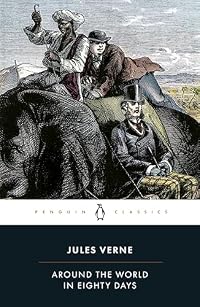
On This Page
Description
An unmarried by mathematically precise Englishman dismisses his valet for heating his shaving water two degrees cooler than usual. He hires a French valet to replace him and the two of them set off to travel around the world in eighty days - a supposedly possible feat, now that the Indian railways have been built. If they succeed they will win a fortune off the other members of the Reform Club..
Tags
Recommendations

















Member Recommendations



Member Reviews
"A true Englishman doesn't joke when he is talking about so serious a thing as a wager," replied Phileas Fogg, solemnly.
With this we're off to the one of the best adventure stories... And no matter how often I read this book, I still get excited about whether they will make it back to the Reform Club in time.
Anyway, while Phileas Fogg is of course the originator of the bet and the driving force behind the trip. Having meticulously planned the route and conveyances that would allow him to circumnavigate the world, of course nothing goes to plan...
Verne's writing is fantastic in this one, because it is both funny, sensitive, and informative, and you just want to be on that trip.
But the absolute best part of the book is Fogg's man show more Passepartout.
Passepartout was by no means one of those pert dunces depicted by Moliere with a bold gaze and a nose held high in the air; he was an honest fellow, with a pleasant face, lips a trifle protruding, soft-mannered and serviceable, with a good round head, such as one likes to see on the shoulders of a friend.
He is the absolute hero of the story even though the original meeting between Fogg and Passepartou indicates that he had other plans for his time in Fogg's employment:
"You are a Frenchman, I believe," asked Phileas Fogg, "and your name is John?" "Jean, if monsieur pleases," replied the newcomer, "Jean Passepartout, a surname which has clung to me because I have a natural aptness for going out of one business into another. I believe I'm honest, monsieur, but, to be outspoken, I've had several trades. I've been an itinerant singer, a circus-rider, when I used to vault like Leotard, and dance on a rope like Blondin. Then I got to be a professor of gymnastics, so as to make better use of my talents; and then I was a sergeant fireman at Paris, and assisted at many a big fire. But I quitted France five years ago, and, wishing to taste the sweets of domestic life, took service as a valet here in England. Finding myself out of place, and hearing that Monsieur Phileas Fogg was the most exact and settled gentleman in the United Kingdom, I have come to monsieur in the hope of living with him a tranquil life, and forgetting even the name of Passepartout."
Such a great read. show less
With this we're off to the one of the best adventure stories... And no matter how often I read this book, I still get excited about whether they will make it back to the Reform Club in time.
Anyway, while Phileas Fogg is of course the originator of the bet and the driving force behind the trip. Having meticulously planned the route and conveyances that would allow him to circumnavigate the world, of course nothing goes to plan...
Verne's writing is fantastic in this one, because it is both funny, sensitive, and informative, and you just want to be on that trip.
But the absolute best part of the book is Fogg's man show more Passepartout.
Passepartout was by no means one of those pert dunces depicted by Moliere with a bold gaze and a nose held high in the air; he was an honest fellow, with a pleasant face, lips a trifle protruding, soft-mannered and serviceable, with a good round head, such as one likes to see on the shoulders of a friend.
He is the absolute hero of the story even though the original meeting between Fogg and Passepartou indicates that he had other plans for his time in Fogg's employment:
"You are a Frenchman, I believe," asked Phileas Fogg, "and your name is John?" "Jean, if monsieur pleases," replied the newcomer, "Jean Passepartout, a surname which has clung to me because I have a natural aptness for going out of one business into another. I believe I'm honest, monsieur, but, to be outspoken, I've had several trades. I've been an itinerant singer, a circus-rider, when I used to vault like Leotard, and dance on a rope like Blondin. Then I got to be a professor of gymnastics, so as to make better use of my talents; and then I was a sergeant fireman at Paris, and assisted at many a big fire. But I quitted France five years ago, and, wishing to taste the sweets of domestic life, took service as a valet here in England. Finding myself out of place, and hearing that Monsieur Phileas Fogg was the most exact and settled gentleman in the United Kingdom, I have come to monsieur in the hope of living with him a tranquil life, and forgetting even the name of Passepartout."
Such a great read. show less
Having watched the miniseries with David Tennant for the third time, I thought I ought really to read the original in order to better understand how many liberties the adaptation took.
The answer is "All of them - and good on it for that."
I had known about the whole sati episode, so I was prepared for some racism. I wasn't however prepared for so much racism. Aouda is an acceptable heroine only because as a Parsee she is of the "highest of the native races of India", and "received a thoroughly English education [...], and, from her manners and intelligence, would be thought an European", and "spoke English with great purity", and her relative had made enough money to be made a baronet somehow. Meanwhile "the savage Papuans [...] are in show more the lowest scale of humanity, but are not, as has been asserted, cannibals," um. Um. I guess you're trying to be even-handed, Jules, but no, please just stop talking about people. Sadly there's more of this, so much more, and it's deeply embedded in the plot - so the miniseries had the best idea to just burn it down and start from scratch as a "vaguely inspired by distant recollections of".
Aouda does get to make a pretty fantastic marriage proposal. It's a pity: she could do a lot better than some rich dude who proves that it's possible to travel around the world in 80 days if you have (in 2022 money) millions of pounds to throw at every obstacle in your path and don't mind occasionally skipping bail and fomenting mutiny. show less
The answer is "All of them - and good on it for that."
I had known about the whole sati episode, so I was prepared for some racism. I wasn't however prepared for so much racism. Aouda is an acceptable heroine only because as a Parsee she is of the "highest of the native races of India", and "received a thoroughly English education [...], and, from her manners and intelligence, would be thought an European", and "spoke English with great purity", and her relative had made enough money to be made a baronet somehow. Meanwhile "the savage Papuans [...] are in show more the lowest scale of humanity, but are not, as has been asserted, cannibals," um. Um. I guess you're trying to be even-handed, Jules, but no, please just stop talking about people. Sadly there's more of this, so much more, and it's deeply embedded in the plot - so the miniseries had the best idea to just burn it down and start from scratch as a "vaguely inspired by distant recollections of".
Aouda does get to make a pretty fantastic marriage proposal. It's a pity: she could do a lot better than some rich dude who proves that it's possible to travel around the world in 80 days if you have (in 2022 money) millions of pounds to throw at every obstacle in your path and don't mind occasionally skipping bail and fomenting mutiny. show less
You know the story and so forth, but what you might not know (unless you are psychic or I already told you) is that this book had a life-changing effect on me.
One has to read the right books at the right time, especially in childhood. Frankly, one has to read in childhood - this point is critical. I read this beautiful little novel, and for a time the world lay stretched out before me, a perfect little world full of adventure just waiting to be explored.
The more I think about it, the more I'm sure that it was this book that caused me to become so obsessed with travel. I've always dreamt of far-away places, and having read this book during my formative years, and having loved every page, there's a strong possibility that I owe Verne my show more very ambitions. Thank you, sir. show less
One has to read the right books at the right time, especially in childhood. Frankly, one has to read in childhood - this point is critical. I read this beautiful little novel, and for a time the world lay stretched out before me, a perfect little world full of adventure just waiting to be explored.
The more I think about it, the more I'm sure that it was this book that caused me to become so obsessed with travel. I've always dreamt of far-away places, and having read this book during my formative years, and having loved every page, there's a strong possibility that I owe Verne my show more very ambitions. Thank you, sir. show less
My most recent installment book was Around the World in Eighty Days by Jules Verne which was originally published in 1873 and I think it has definitely aged well. The story is told in a simple straightforward style, and the various global adventures move the story along at a rapid pace. The plot is a little silly yet the book comes together nicely and before too long the reader finds himself involved in the story and rooting for the participants.
The characters are distinct and well developed from the routine-obsessed, uptight yet cool main character who travels around the world based on a bet from some of the gentlemen at his club, to the sympathetic French manservant who is loyal, smart and a very good gymnast. Even the lesser show more developed characters of Aouda, the Indian lady, to Fix, the stalking policeman, are colourful and add to the story.
Around the World in Eighty Days is light, fun and makes for great escape reading. A little dated, to be sure, but overall a very good read. show less
The characters are distinct and well developed from the routine-obsessed, uptight yet cool main character who travels around the world based on a bet from some of the gentlemen at his club, to the sympathetic French manservant who is loyal, smart and a very good gymnast. Even the lesser show more developed characters of Aouda, the Indian lady, to Fix, the stalking policeman, are colourful and add to the story.
Around the World in Eighty Days is light, fun and makes for great escape reading. A little dated, to be sure, but overall a very good read. show less
Jules Verne’s Around the World in Eighty Days is an absolute joy. This gleeful romp, wherein Phileas Fogg places a bet with some associates at the Reform Club that he can indeed perform the titular feat in that prescribed timeframe. Verne is at his wittiest, with a wonderful cast of characters: Fogg, one of literature’s great eccentrics; his loyal and resourceful servant Passepartout; and the comically inept Detective Fix, in hot pursuit of Fogg who has become a suspect in a recent bank robbery. Along the way Verne provides panoramic travelogue summaries for each new locale, which colorfully set the scenes. The story flows like a giddy Wes Anderson screenplay - and, in my view, that’s a compliment to both Anderson and Verne.
It's not a criticism to say this is very much a novel where you have to invest in the perspective of its original audience. The wider world is no longer a vast and unknown sphere to anyone who would be reading this book, where once any kind of travel was full of wondrous terrors and terrible wonders. There's a real sense of awe in Verne's writing about far-off countries that are being conquered - in both a positive and negative sense - by the rapid onset of technology. And he has even more awe for that technology - the trains, the ships, and so on. It's like a fever dream for a small child who loves to make things go.
The plot comes dangerously close to being a comedy of escalation, with a central figure (Phileas Fogg) whom Verne quite show more clearly finds slightly risible in his stiff-upper-lippedness. Fogg buckles to nothing and never breaks his calm, even during a storm at sea or an attack by the Sioux. The real hero is, of course, stout-hearted Frenchman Passpartout, who - as Fogg's servant - is the only character with real, human emotions and reactions, receiving the bulk of the (very limited) dialogue as well as the reader's affections.
It's a thin story, barreling along like the adventure movie of its day, with lots of exotic scenery and no real time to stop. Taken as such it's quite charming, and an example of a time when it really was the travel that was important, and not the people we met along the way. show less
The plot comes dangerously close to being a comedy of escalation, with a central figure (Phileas Fogg) whom Verne quite show more clearly finds slightly risible in his stiff-upper-lippedness. Fogg buckles to nothing and never breaks his calm, even during a storm at sea or an attack by the Sioux. The real hero is, of course, stout-hearted Frenchman Passpartout, who - as Fogg's servant - is the only character with real, human emotions and reactions, receiving the bulk of the (very limited) dialogue as well as the reader's affections.
It's a thin story, barreling along like the adventure movie of its day, with lots of exotic scenery and no real time to stop. Taken as such it's quite charming, and an example of a time when it really was the travel that was important, and not the people we met along the way. show less
This might just be one of the most fast-paced classics I have read so far.
Considering how much happens during such a comparatively short book length of about 250 pages, it's no surprise that Jules Verne's Around the World in Eighty Days was a huge success upon its release in the form of serial installments. The plot faces considerable progress during every chapter, often culminating on a cliffhanger, so it is easy to imagine that readerships during the 1870s were thrilled to learn how this story was going to continue.
Obviously, almost 150 years afterwards, some of the initial thrill of Jules Verne's adventure story has been lost simply due to the timeframe we live in. It isn't quite as extraordinary and seemingly difficult anymore to show more travel around the globe, and some of the cultural depictions feel strangely inappropriate from our modern point of view (although it should be said that the exhausting 1956 film adaptation of the story, which for some obscure reason managed to win Best Picture, was even more guilty of delivering culturally insensitive representations).
So, Verne's story really works best once you try to emphasize with the mindset of the people who must have been reading this in 1872. A sense of adventure and thrill drives the story along, something that hasn't ever quite been done before and that would have sounded so inachievable if not for some logistical changes in the world throughout the most recent years - to follow these adventures, to capture the novel's spirit of achieving something that might be deemed impossible or ridiculous by those more averse to risking something now and then to achieve your dreams. Verne's story also has some worthy messages, including the depiciton of Phileas Fogg's ambitions - the value of the entire voyage does not lie in the financial compensation that awaited him, but rather in the thrill and excitement of actually having conquered this seemingly inachievable bet, of having done something to be proud of for the rest of his life.
It's a fun and entertaining read that has deservedly turned into a classic of the adventure genre. show less
Considering how much happens during such a comparatively short book length of about 250 pages, it's no surprise that Jules Verne's Around the World in Eighty Days was a huge success upon its release in the form of serial installments. The plot faces considerable progress during every chapter, often culminating on a cliffhanger, so it is easy to imagine that readerships during the 1870s were thrilled to learn how this story was going to continue.
Obviously, almost 150 years afterwards, some of the initial thrill of Jules Verne's adventure story has been lost simply due to the timeframe we live in. It isn't quite as extraordinary and seemingly difficult anymore to show more travel around the globe, and some of the cultural depictions feel strangely inappropriate from our modern point of view (although it should be said that the exhausting 1956 film adaptation of the story, which for some obscure reason managed to win Best Picture, was even more guilty of delivering culturally insensitive representations).
So, Verne's story really works best once you try to emphasize with the mindset of the people who must have been reading this in 1872. A sense of adventure and thrill drives the story along, something that hasn't ever quite been done before and that would have sounded so inachievable if not for some logistical changes in the world throughout the most recent years - to follow these adventures, to capture the novel's spirit of achieving something that might be deemed impossible or ridiculous by those more averse to risking something now and then to achieve your dreams. Verne's story also has some worthy messages, including the depiciton of Phileas Fogg's ambitions - the value of the entire voyage does not lie in the financial compensation that awaited him, but rather in the thrill and excitement of actually having conquered this seemingly inachievable bet, of having done something to be proud of for the rest of his life.
It's a fun and entertaining read that has deservedly turned into a classic of the adventure genre. show less
Members
- Recently Added By
Lists

The Guardian's 1000 Novels Everyone Must Read
1,005 works; 549 members

1001 Books You Must Read Before You Die
1,448 works; 1,132 members

Read the book and saw the movie
1,170 works; 192 members

Favourite Books
1,817 works; 316 members

Best of French Literature
138 works; 27 members

Favourite 19th century fiction
257 works; 62 members

Unread books
1,063 works; 82 members

Top Five Books of 2013
1,564 works; 722 members

Best Adventure Stories
66 works; 13 members

Best Books About Journeys and Quests
117 works; 30 members

19th Century
190 works; 16 members

1001 Children's Books You Must Read Before You Grow Up
774 works; 101 members
Out of Copyright
244 works; 14 members

150 Best Novels Selected by Brander Matthews (1883)
150 works; 7 members

Western World's Greatest Books - Project Gutenberg
295 works; 15 members

Best Science Fiction Novels
816 works; 426 members

Blue Pyramid 1,276 Best Books of All Time
1,248 works; 32 members
One Book, Many Authors
441 works; 40 members

1,001 BYMRBYD Concensus
723 works; 27 members

Epic Fiction
42 works; 12 members

Asia
178 works; 7 members

Newark Public Library's 1904 List of a Thousand of the Best Novels
95 works; 5 members

Books Read in 2014
2,341 works; 89 members

Watched the Movie, Probably Won't Read the Book
185 works; 34 members

Books With Numbers in the Title
308 works; 13 members
Works That Inspired Disney Movies
119 works; 13 members

Best Science Fiction Originally Published in a Language Other Than English
449 works; 31 members
United Kingdom
82 works; 5 members

Literature in Translation
113 works; 5 members
Overdue Podcast
803 works; 9 members

Books Read in 2023
5,547 works; 145 members

Books Read in 2016
4,666 works; 199 members
Books Read in 2015
3,298 works; 126 members

Evan's Reading List 2020
12 works; 1 member

Generation Joshua
115 works; 3 members

Books Read in 2017
4,249 works; 129 members

Recommended Reading List
219 works; 1 member

Read in 1999
62 works; 1 member

Favorite Books in Translation
320 works; 133 members

Recommended Reading : 600 Classics Reviewed, Editors of Salem Press, 2015
634 works; 6 members
Reading LIst
648 works; 1 member

Favorite Kids Books (chapter, middle grade)
168 works; 4 members
Folio Society
831 works; 53 members

Works Cited in The Life and Death of Democracy by John Keane
278 works; 1 member

Books Read in 2025
4,090 works; 97 members

Books Read in 2026
1,711 works; 62 members

el
1,139 works; 1 member

Before Austen Comes Aesop
318 works; 9 members
Favorite Childhood Books
1,602 works; 514 members

Elevenses
316 works; 88 members

Books Read in 2021
5,361 works; 114 members
Books With Time Words in the Title
160 works; 4 members
Books available on Open Library
171 works; 4 members

French Fiction of the 18th and 19th Centuries in English Translation
169 works; 3 members

Books Read in 2012
815 works; 34 members

Books Read in 2012 (Numbered)
168 works; 6 members
Works Referenced in The League of Extraordinary Gentlemen
122 works; 6 members
Puffin Books 70th anniversary handbook recommendations
537 works; 10 members

Books Read in 2013
1,629 works; 51 members

Unshelved Book Clubs
579 works; 5 members
Honey For a Child's Heart
1,152 works; 25 members

Sonlight Books
1,487 works; 25 members

Books referenced in the Astral Library
60 works; 1 member
Author Information

2,778+ Works 111,978 Members
Jules Verne was born on February 8, 1828 in Nantes, France. He wrote for the theater and worked briefly as a stockbroker. He is considered by many to be the father of science fiction. His most popular novels included Journey to the Center of the Earth, Twenty Thousand Leagues Under the Sea, and Around the World in Eighty Days. Several of his works show more have been adapted into movies and TV mini-series. In 1892, he was made a Chevalier of the Legion of Honor in France. He died on March 24, 1905 at the age of 77. (Bowker Author Biography) Jules Verne (1828-1905) is the author of numerous adventure stories grounded in popularizations of science. (Publisher Provided) show less
Some Editions
Awards and Honors
Awards
Distinctions
Notable Lists
Series

Belongs to Publisher Series
Roman für alle (64)
Geração Público (1)
Die grosse Jules Verne Ausgabe (Band 6)
Dean's Classics (13)
Airmont Classics (24)
Grandes Novelas de Aventuras (XXXIV)
Corticelli [Mursia] (26)
Tus libros (37)
Elsevier pockets (JVW11)
Penguin Clothbound Classics (2021*)
Work Relationships
Is contained in
Journey to the Center of the Earth / Twenty Thousand Leagues Under the Sea / Round the World in Eighty Days by Jules Verne
Twenty Thousand Leagues Under the Sea / The Mysterious Island / Journey to the Center of the Earth / Around the World in Eighty Days by Jules Verne
Zwanzigtausend Meilen unter dem Meer / Reise um die Erde in achtzig Tagen / Fünf Wochen im Ballon. 3 Welterfolge in 1 Band by Jules Verne
The Works of Jules Verne: Twenty Thousand Leagues Under the Sea, A Journey to the Center of the Earth, From the Earth to the Moon, Round the Moon, Around the World in Eighty Days, Short Stories by Jules Verne
Around the World in 80 Days / A Journey to the Centre of the Earth / Twenty Thousand Leagues Under the Sea by Jules Verne
Around the World in Eighty Days / From the Earth to the Moon / 20,000 Leagues Under the Sea by Jules Verne
Amazing Journeys: Journey to the Center of the Earth, From the Earth to the Moon, Circling the Moon, 20,000 Leagues Under the Seas, and Around the World in 80 Days by Jules Verne
Omnibus of Jules Verne: Around the World in Eighty Days/ From the Earth to the Moon / Twenty Thousand Leagues Under the Sea / The Blockade Runners by Jules Verne
Twenty Thousand Leagues Under the Sea / Around the World in Eighty Days / The Blockade Runners / From the Earth to the Moon and a Trip Around It by Jules Verne
Collected Novels: Around the World in 80 Days / The Clipper of the Clouds / Journey to the Centre of the Earth / From the Earth to the Moon / Twenty Thousand Leagues Under the Sea by Jules Verne
Jules Verne - Romane (Vier Bände im Schuber): 20.000 Meilen unter den Meeren - In 80 Tagen um die Welt - Reise zum Mittelpunkt der Erde - Von der Erde zum Mond by Jules Verne
International Collector's Library Classics 19 volumes: Crime & Punishment; Twenty Thousand Leagues Under the Sea; Mysterious Island; Magic Mountain; Around the World in 80 Days; Count of Monte Cristo; Camille; Quo Vadis; Hunchback of Notre Dame; Nana; Scaramouche; Pinocchio; Fernande; War and Peace; The Egyptian; From the Earth to the Moon; Candide; Treasure of Sierra Madre; Siddhartha/Steppenwolf by Jules Verne
Voyages extraordinaires : Michel Strogoff et autres romans: Michel Strogoff et autres romans by Jules Verne
The Ultimate Science Fiction Mega Collection: 24 of the Best Sci-Fi Books of All Time: A Journey to the Center of the Earth, 20,000 Leagues Under the Sea, Around the World in 80 Days, John Carter of Mars Trilogy, The War of the Worlds, The Time Machine, Frankenstein, Dr. Jekyll and Mr. Hyde, 3 Ray Bradbury Stories, Flatland, & More by Jules Verne
Is retold in
Has the (non-series) sequel
Has the adaptation
Classics Illustrated Deluxe #7: Around the World in 80 Days (Classics Illustrated Deluxe Graphic Nove) by Jules Verne
Reading & Training : Jules Verne : Around the world in eighty days [book + sound recording] by CIDEB
Is abridged in
Is parodied in
Inspired
Has as a commentary on the text
Has as a student's study guide
Has as a teacher's guide
Common Knowledge
- Canonical title
- Around the World in Eighty Days
- Original title
- Le Tour du monde en quatre-vingts jours
- Alternate titles
- Around the World in 80 Days
- Original publication date
- 1872 (serial) (serial); 1873 (book) (book)
- People/Characters
- Phileas Fogg; Jean Passepartout; Fix; Francis Cromarty; Aouda; John Bunsby (show all 15); William Batulcar; Stamp Proctor; William Hitch; John Sullivan; Samuel Fallentin; Gauthier Ralph; Thomas Flanagan; Andrew Stuart; Samuel Wilson
- Important places
- London, England, UK; Paris, France; Brindisi, Apulia, Italy; Suez, Egypt; Mumbai, Maharashtra, India (as Bombay, India); Kholby, India (fictional?) (show all 23); Bundelkhand, India (region); Allahabad, Uttar Pradesh, India (officially known as Prayagraj); Kolkata, West Bengal, India (as Calcutta, India); Singapore; Hong Kong, China; Shanghai, China; Yokohama, Kanagawa Prefecture, Japan; San Francisco, California, USA; Ogden, Utah, USA; Medicine Bow, Wyoming, USA; Fort Kearny, Nebraska, USA; Omaha, Nebraska, USA; Chicago, Illinois, USA; New York, New York, USA; Cobh, County Cork, Ireland (as Queenstown, Ireland); Dublin, Ireland; Liverpool, England, UK
- Important events
- 19th century; 1870s; 1872
- Related movies
- Around the World in Eighty Days (1956 | IMDb); Around the World with Willy Fog (1983 | IMDb); Around the World in 80 Days (1989 | IMDb); Around the World in 80 Days (1999 | IMDb); Around the World in 80 Days (2004 | IMDb); Around the World in 80 Days (2021 | IMDb)
- First words
- Mr. Phileas Fogg lived, in 1872, at No. 7, Saville Row, Burlington Gardens, the house in which Sheridan died in 1814.
In the year 1872, No. 7 Savile Row, Burlington Gardens -- the house where Sheridan died in 1814 -- was occupied by Phileas Fogg, Esq.
(William Butcher's translation).
In the year 1872, the house at number 7 Savile Row, Burlington Gardens - the house in which Sheridan died in 1814 - was lived in by Phileas Fogg, Esq., one of the oddest and most striking members of the Reform Club, even thou... (show all)gh he seemed determined to avoid doing anything that might draw attention to himself.
(Penguin 2004 edition translation) - Last words
- (Click to show. Warning: May contain spoilers.)Truly, would you not for less than that make the tour around the world?
(Click to show. Warning: May contain spoilers.)In truth, wouldn't anyone go around the world for less?
(William Butcher's translation) - Publisher's editor*
- Pierre-Jules Hetzel
- Original language
- French
- Disambiguation notice
- This LT work should be the complete text of Jules Verne's 1873 novel, Around the World in Eighty Days. Please do not combine it with any abridgements, adaptations, young readers' versions, pop-up books, graphic novels,... (show all) annotated editions, multi-title compendiums, single volumes of a multi-volume edition, or other, similar works based on the original. Thank you.
*Some information comes from Common Knowledge in other languages. Click "Edit" for more information.
Classifications
- Genres
- Fiction and Literature, General Fiction
- DDC/MDS
- 843.8 — Literature & rhetoric French & related literatures French fiction Later 19th century 1848–1900
- LCC
- PQ2469 .T7 .E5 — Language and Literature French, Italian, Spanish and Portuguese literatures French literature Modern literature 19th century
- BISAC
Statistics
- Members
- 20,145
- Popularity
- 289
- Reviews
- 298
- Rating
- (3.83)
- Languages
- 40 — Arabic, Catalan, Chinese, Czech, Danish, Dutch, English, Estonian, Finnish, French, German, Galician, Greek, Hebrew, Hungarian, Icelandic, Italian, Japanese, Kannada, Korean, Latvian, Lithuanian, Malayalam, Malay, Norwegian (Bokmål), Norwegian, Polish, Romanian, Russian, Slovak, Slovenian, Spanish, Swahili, Swedish, Thai, Turkish, Urdu, Welsh, Portuguese (Portugal), Portuguese (Brazil)
- Media
- Paper, Audiobook, Ebook
- ISBNs
- 1,528
- UPCs
- 14
- ASINs
- 520