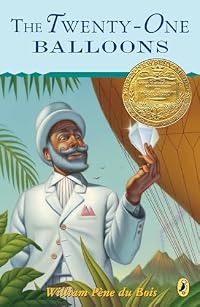
The Twenty-One Balloons
by William Pène du Bois
On This Page
Description
Relates the incredible adventures of Professor William Waterman Sherman who in 1883 sets off in a balloon across the Pacific, survives the volcanic eruption of Krakatoa, and is eventually picked up in the Atlantic.Tags
Recommendations














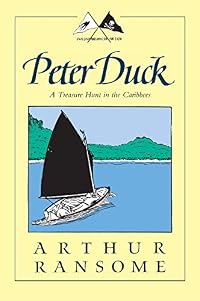
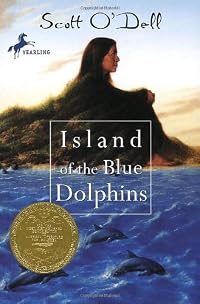

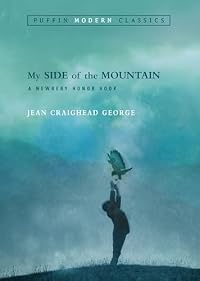
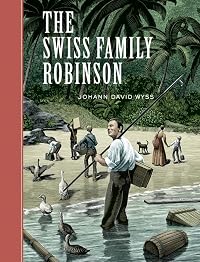


Member Recommendations
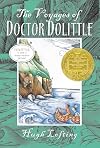
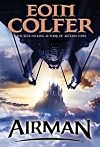
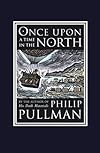
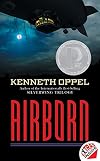
by Othemts
Member Reviews
‘There are two kinds of travel’….. So begins this 1948 Newbery award winner, a brilliant book ranging from scientific truths to absolute fantasy. At first I thought the mingling of fact and fiction would disappoint me. To the contrary I was completely enthralled and really involved in the adventure. Black and white illustrations complemented the text and explained further some of the inventions. Underneath all the fantasy was a depth and a number of truths regarding ‘teamship’ and questions regarding riches. Excellent writing and highly recommended.
A footnote – at first I was captivated as I too have flown in hot air balloons. This has been with a friend, an amateur in the Pyrennees along with my husband, not to mention my show more then 87 year old mum and friend! It is the most magical and wonderful form of transport. I have already recommended this to Dave and his family, especially Chloe whose childhood took her round the Pyrenean countryside as her mum followed their beautiful balloon named One World Dreaming. show less
A footnote – at first I was captivated as I too have flown in hot air balloons. This has been with a friend, an amateur in the Pyrennees along with my husband, not to mention my show more then 87 year old mum and friend! It is the most magical and wonderful form of transport. I have already recommended this to Dave and his family, especially Chloe whose childhood took her round the Pyrenean countryside as her mum followed their beautiful balloon named One World Dreaming. show less
I'm going to be the renegade who disagrees with everyone else.
The first chapter or two were promising. A well written, somewhat humorous tale of a man discovered lost at sea in an inexplicable manner, who then refuses to say a word about how he came to be there until he was before his explorers club in San Francisco.
But once Professon Sherman actually begins telling of his adventure, the story plummets downhill at break-neck speed. Every single aspect of his adventure on Krakatoa is preposterous to the degree that my eye-balls hurt from rolling them so far back in their sockets. The idea that 20 families with children would just up and move to an uninhabited volcanic island... the restaurant based government... the endless, tediously show more explained, absurd inventions... the idiocy of all inhabitants renaming themselves to be letters of the alphabet (the children with numbers added)... the ground that moves about like ocean waves... on and on.
Once the professor begins explaining his adventure, the entire book is a non-stop stream of nonsense.
I have no issue with magic, or silliness, or wacky inventions... but they need to make sense within the rules of the world in which they are set. The Harry Potter universe allows for endless magic (but always with rules), the Chitty-Chitty Bang-Bang or Willy Wonka universes allow for crazy inventions. But The Twenty-One Balloons seems to establish itself firmly in the real world, or very close to it, of it's time period, which meant nothing on the island of Krakatoa, socially or technologically, made any sense whatsoever.
That this book won a Newbery award is mind-boggling to me. show less
The first chapter or two were promising. A well written, somewhat humorous tale of a man discovered lost at sea in an inexplicable manner, who then refuses to say a word about how he came to be there until he was before his explorers club in San Francisco.
But once Professon Sherman actually begins telling of his adventure, the story plummets downhill at break-neck speed. Every single aspect of his adventure on Krakatoa is preposterous to the degree that my eye-balls hurt from rolling them so far back in their sockets. The idea that 20 families with children would just up and move to an uninhabited volcanic island... the restaurant based government... the endless, tediously show more explained, absurd inventions... the idiocy of all inhabitants renaming themselves to be letters of the alphabet (the children with numbers added)... the ground that moves about like ocean waves... on and on.
Once the professor begins explaining his adventure, the entire book is a non-stop stream of nonsense.
I have no issue with magic, or silliness, or wacky inventions... but they need to make sense within the rules of the world in which they are set. The Harry Potter universe allows for endless magic (but always with rules), the Chitty-Chitty Bang-Bang or Willy Wonka universes allow for crazy inventions. But The Twenty-One Balloons seems to establish itself firmly in the real world, or very close to it, of it's time period, which meant nothing on the island of Krakatoa, socially or technologically, made any sense whatsoever.
That this book won a Newbery award is mind-boggling to me. show less
Audiobook performed by John McDonough
This is a classic of children’s literature, for which du Bois was awarded the Newbery Medal. It’s a fantastical adventure story featuring Professor William Waterman Sherman, who leaves San Francisco on Aug 15, 1883, in a balloon, with the intention of going across the Pacific Ocean and enjoying some solitude. Three weeks later he’s picked up in the Atlantic Ocean clinging to wreckage. Once rescued he insists on being transported to San Francisco where he will tell his tale – once and only once – to the Western American Explorer’s Club.
What a fun story! Professor Sherman, despite his apparent forethought and preparation for any eventuality, still manages to run afoul of several show more unanticipated problems … from seagulls to sharks to volcanoes. His time spent on Krakatoa is extraordinary and hard to believe; even in his telling of it, Professor Sherman seems amazed and incredulous.
The illustrations (also by du Bois) help by providing a visual representation to go along with some of the detailed descriptions of the various inventions. I think parents and teachers would have a great time allowing children to explore their imaginations, while explaining the realities of science. But I WOULD like that bed with endless clean sheets! (And having already cut and polished diamonds handily about would be pretty nice as well…)
John McDonough does a marvelous job of reading the audio version. His dramatic performance lends a sense of awe, amazement, excitement and danger as the scenes require. show less
This is a classic of children’s literature, for which du Bois was awarded the Newbery Medal. It’s a fantastical adventure story featuring Professor William Waterman Sherman, who leaves San Francisco on Aug 15, 1883, in a balloon, with the intention of going across the Pacific Ocean and enjoying some solitude. Three weeks later he’s picked up in the Atlantic Ocean clinging to wreckage. Once rescued he insists on being transported to San Francisco where he will tell his tale – once and only once – to the Western American Explorer’s Club.
What a fun story! Professor Sherman, despite his apparent forethought and preparation for any eventuality, still manages to run afoul of several show more unanticipated problems … from seagulls to sharks to volcanoes. His time spent on Krakatoa is extraordinary and hard to believe; even in his telling of it, Professor Sherman seems amazed and incredulous.
The illustrations (also by du Bois) help by providing a visual representation to go along with some of the detailed descriptions of the various inventions. I think parents and teachers would have a great time allowing children to explore their imaginations, while explaining the realities of science. But I WOULD like that bed with endless clean sheets! (And having already cut and polished diamonds handily about would be pretty nice as well…)
John McDonough does a marvelous job of reading the audio version. His dramatic performance lends a sense of awe, amazement, excitement and danger as the scenes require. show less
This is probably one of my new favorites in the Newberry Award winners! From the moment the story opens, you just fall in love with Professor Sherman. He's such a down to earth little man, and to hear his tale is extraordinary. I really enjoyed the illustrations that went along in describing the inventions and houses in Krakatoa. The best description of all was the terrifying flight over the volcano when the kids took a ride on the Balloon Merry go round--such vivid detail. I honestly could feel myself hovering over that hole!
In my edition, there is a preface from the author. He says that his publishers originally thought he had copied this story from one by F. Scott Fitzgerald. After reading it, Du Bois says that the 2 stories are show more eerily similar, but he had never even heard of Fitzgerald's story "The Diamond as Big as the Ritz" until it was pointed out to him. I plan on reading this short story in the near future, and I'm anxious to see the similarities between the two stories. show less
In my edition, there is a preface from the author. He says that his publishers originally thought he had copied this story from one by F. Scott Fitzgerald. After reading it, Du Bois says that the 2 stories are show more eerily similar, but he had never even heard of Fitzgerald's story "The Diamond as Big as the Ritz" until it was pointed out to him. I plan on reading this short story in the near future, and I'm anxious to see the similarities between the two stories. show less
At the end of a forty year career teaching math at a San Francisco boys' school, professor William Waterman Sherman looks forward to a year of solitude traveling the world in a hot air balloon that he's built for the purpose. He sets out over the Pacific Ocean on August 15, 1883, only to be found weeks later barely alive and floating in the Atlantic Ocean. How did he get there? Professor Sherman will tell his story...but only after San Francisco's Western American Explorers' Club members have heard it. The nation waits with great anticipation as the professor convalesces and then makes his way across the continent to San Francisco, where he is greeted by a great crowd. He has an amazing story to tell the Explorers' Club of an unusual show more society on an island believed to have been uninhabited. Professor Sherman arrived there just in time to experience one of the world's greatest disasters.
This imaginative story of a Victorian society living on top of a volcano was a delightful diversion at a time when I lacked the concentration for anything but lighthearted and/or comfort reads. I loved the creative details and the author's illustrations, but the delivery lacks sparkle. Most of the book is supposed to be a speech delivered in the style of a Victorian orator. I'm not sure how many of today's young people in the book's target age group would have enough patience with the style to finish the book, but it's one that I could see my brother and his friends enjoying in their upper elementary and middle school years. (My brother and his best friends all went on to earn engineering degrees.) Potential readers should be aware that the book includes a few racial terms and stereotypes that are often found in older works but are generally considered offensive by today's standards. show less
This imaginative story of a Victorian society living on top of a volcano was a delightful diversion at a time when I lacked the concentration for anything but lighthearted and/or comfort reads. I loved the creative details and the author's illustrations, but the delivery lacks sparkle. Most of the book is supposed to be a speech delivered in the style of a Victorian orator. I'm not sure how many of today's young people in the book's target age group would have enough patience with the style to finish the book, but it's one that I could see my brother and his friends enjoying in their upper elementary and middle school years. (My brother and his best friends all went on to earn engineering degrees.) Potential readers should be aware that the book includes a few racial terms and stereotypes that are often found in older works but are generally considered offensive by today's standards. show less
I felt like a Newberry, so I chose The Twenty-One Balloons. The book is cute and I enjoyed Professor Sherman's detailed description of his Balloon designed wicker house and his plan for a lengthy trip floating over the Pacific. Not everything went according to plan (but I did learn a bit about ballooning). The whole Walden Pond kind of theme on the island of Krakatoa was a bit over the top for me but I can see how this book might appeal to Middle Grades; there is a great deal to spark the imagination.
I read this aloud with my son for the Level 4 Building Your Library curriculum. It's a quirky, somewhat bizarre story about a group of people who settled on Krakatoa in the years before it exploded. The book has kind of a Babar/Curious George feel to me, not in the language so much as in the somewhat cartoonish atmosphere. The beginning was slow, and we almost gave up, but before long we were both engaged in the story and looking forward to seeing what happened. Well, we knew what would happen to Krakatoa, but we were curious about what happened to the characters living there.
The biggest complaint my son has with the book is that the drawings of people are a little terrifying.
Overall, it's not what I'd consider great literature, but show more it's an enjoyable read. show less
The biggest complaint my son has with the book is that the drawings of people are a little terrifying.
Overall, it's not what I'd consider great literature, but show more it's an enjoyable read. show less
Members
- Recently Added By
Lists

Best Newbery Medal Winners
94 works; 53 members

1001 Children's Books You Must Read Before You Grow Up
774 works; 101 members

School Library Journal - 2012 Top 100 Children's Novels
68 works; 8 members
Mensa for Kids Excellence in Reading Award Program (Grades 4-6)
64 works; 9 members
NPRs Ultimate Backseat Bookshelf: 100 Must-Reads for kids 9-14
222 works; 30 members
Honey For a Child's Heart
1,152 works; 25 members

Sonlight Books
1,487 works; 25 members

Children's Chapter Books from 1940s, ...
77 works; 4 members

Satori Smiles Children's Book List
262 works; 7 members

Newbery Medal Winners - By Year
105 works; 7 members

A Child's Book Tour of Indonesia
20 works; 1 member

4th Grade Books
312 works; 5 members

CCE 1000 Good Books List
1,033 works; 12 members

Romalda Spalding's Writing Road To Reading
213 works; 3 members

The Story of the World: Activity Book Four: The Modern Age
333 works; 2 members

Books Read in 2016
4,666 works; 199 members

Recommended Reading List
219 works; 1 member

My Mad Men Reading List
47 works; 1 member

al.vick-wishlist-YA
156 works; 3 members
Before Austen Comes Aesop
318 works; 9 members
Mad Men Reading List
25 works; 5 members
Ambleside Books
459 works; 18 members
Talk Discussions
Past Discussions
Found: Children's book: hot air balloon stranded on island with gold in Name that Book (April 2021)
Author Information

46+ Works 7,187 Members
Some Editions
Awards and Honors
Series
Belongs to Publisher Series
Work Relationships
Is contained in
Has as a teacher's guide
Common Knowledge
- Original publication date
- 1947-09-14
- People/Characters
- William Waterman Sherman (professor)
- Important places
- Krakatoa, Indonesia
- Important events
- Krakatoa Eruption (1883)
- Dedication
- To my wife with love
- First words
- There are two kinds of travel.
- Last words
- (Click to show. Warning: May contain spoilers.)"Using food for ballast I plan to spend one full year in the air, one year of truly delightful living, a year in a balloon!"
- Original language
- English
- Disambiguation notice
- The ISBN 0140303588 belongs to Ruth Sawyer's Roller Skates, not The Twenty-One Balloons.
Classifications
Statistics
- Members
- 5,849
- Popularity
- 2,209
- Reviews
- 74
- Rating
- (4.01)
- Languages
- English, Korean, Spanish, Swedish
- Media
- Paper, Audiobook, Ebook
- ISBNs
- 44
- ASINs
- 52