There is 1 current discussion about this work.
On This Page
Description
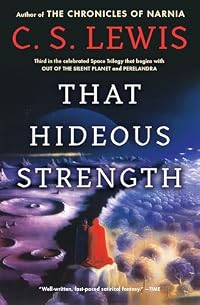
This is the final book of C. S. Lewis's acclaimed Cosmic (or Ransom) Trilogy, which includes Out of the Silent Planet and Perelandra. A classic work of fantasy as much for the wonder of its storytelling as for its insights into the human condition, the trilogy stages an epic battle between forces of light and darkness across a canvas of other worlds.In That Hideous Strength, the brave philologist Dr. Ransom (modeled after Lewis's friend J. R. R. Tolkien) finds himself in a world of superior show more alien beings and scientific experiments run amok. There is a rumor that the powerful wizard Merlin has returned to the world of the living, and a sinister technocratic organization plans to use his power in their plot to "recondition" society. Ransom's fight for moral wisdom in a brave new universe dominated by science is a quest filled with intrigue and suspense.
. show less
Tags
Recommendations








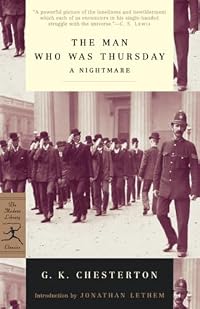






Member Recommendations

Member Reviews
I think this may be a new favorite. It felt like a deeper, more thoughtful, longer version of [b:The Man Who Was Thursday: A Nightmare|184419|The Man Who Was Thursday A Nightmare|G.K. Chesterton|https://images.gr-assets.com/books/1403181403s/184419.jpg|195447].
I read a review by a favorite writer, Connie Willis, that deemed this novel anti-feminist. I actually think it is one of C. S. Lewis's most feminist books.After all it is Jane who has the special gift, Jane who doesn't succumb to N.I.C.E., and Jane is writing a thesis. His goal isn't for her to be barefoot in the kitchen. And, for all the Director's talk about marriage, he really doesn't stick to his guns after the big event anyway. Most of his other books seem to ignore women show more altogether, or it is a woman vs. woman thing like [b:Till We Have Faces|17343|Till We Have Faces|C.S. Lewis|https://images.gr-assets.com/books/1381692105s/17343.jpg|2072983].
Along with my enjoyment of Lewis's exploration of Jane's character, I loved his accurate portrayal of University PhD's at the beginning. My professors would talk similarly about their colleagues (never mentioning names, of course).
I also loved the old, but relevant, comments on "Fake News." Very timely. :)
Finally, it was absolutely brilliant. I will be digesting this book for years and will probably need another couple of reads to really get it. There's so much to think and talk about and write about. Definitely one of his best in my opinion. Read it and tell me what you think.
[Exit pursued by bear] show less
I read a review by a favorite writer, Connie Willis, that deemed this novel anti-feminist. I actually think it is one of C. S. Lewis's most feminist books.
Along with my enjoyment of Lewis's exploration of Jane's character, I loved his accurate portrayal of University PhD's at the beginning. My professors would talk similarly about their colleagues (never mentioning names, of course).
I also loved the old, but relevant, comments on "Fake News." Very timely. :)
Finally, it was absolutely brilliant. I will be digesting this book for years and will probably need another couple of reads to really get it. There's so much to think and talk about and write about. Definitely one of his best in my opinion. Read it and tell me what you think.
[Exit pursued by bear] show less
What a gruesome story this is. Unlike Out of the Silent Planet and Perelandra, it takes place entirely on Planet Earth, which diminishes the reader’s ability to experience the same level of detached novelty and makes the reading that much more grim. I do recommend that the three books be read in order.
Most of the story is told from the points of view of Mark and Jane Studdock, who are in a stale marriage. Although neither of them is thinking actively of divorce, their fragile bond is no defence against the evil insinuating itself into their lives. (Readers will recognize at least one of the faces of that evil from the first two books.)
The couple is soon physically serparated thanks to the entrapment of one of them; as the point of show more view switches from one Studdock to the other, we get a close look at evil – and at the unlikely group that ultimately fights for good.
I first read the print version of That Hideous Strength at least fifteen years ago; I listened to the audio version, narrated by Geoffrey Howard (pseudonym of the late Ralph Cosham), several months ago. I was struck, this time, by how long Lewis takes to just get to the point. This isn’t necessarily a bad thing; I just hadn’t remembered it from the first reading. Once we get there though, the Big Ending is quite the production.
The one real pain point is Lewis’ depiction of the only gay character as grossly sadistic. I would give a pass on this to just about any other author, considering the times, but not Lewis; he was a man of self-awareness and itrospection who should have been capable of looking past conventional opinion.
Fifteen years ago I would have given That Hideous Strength an unqualified 5 stars. Today, I’m giving 4 stars to the audio version – 3.5 stars for the story and another bonus half star as a nod to Ralph Cosham’s unparalleled narration. show less
Most of the story is told from the points of view of Mark and Jane Studdock, who are in a stale marriage. Although neither of them is thinking actively of divorce, their fragile bond is no defence against the evil insinuating itself into their lives. (Readers will recognize at least one of the faces of that evil from the first two books.)
The couple is soon physically serparated thanks to the entrapment of one of them; as the point of show more view switches from one Studdock to the other, we get a close look at evil – and at the unlikely group that ultimately fights for good.
I first read the print version of That Hideous Strength at least fifteen years ago; I listened to the audio version, narrated by Geoffrey Howard (pseudonym of the late Ralph Cosham), several months ago. I was struck, this time, by how long Lewis takes to just get to the point. This isn’t necessarily a bad thing; I just hadn’t remembered it from the first reading. Once we get there though, the Big Ending is quite the production.
The one real pain point is Lewis’ depiction of the only gay character as grossly sadistic. I would give a pass on this to just about any other author, considering the times, but not Lewis; he was a man of self-awareness and itrospection who should have been capable of looking past conventional opinion.
Fifteen years ago I would have given That Hideous Strength an unqualified 5 stars. Today, I’m giving 4 stars to the audio version – 3.5 stars for the story and another bonus half star as a nod to Ralph Cosham’s unparalleled narration. show less
"...and great words like castles came out of his mouth."
There were several times i came near deducting marks here. The main characters didn't really do anything in the story. There's a big exposition dump in the epilogue which feels like it should have been in the prologue. Half of it is hilarious and i don't think its meant to be and then there's the female question which we'll get to.
Nevertheless, this is some of the best writing i've seen from Lewis. Filled with memorable characters and great descriptions.
Its quite hard to describe because it feels like a clash of many different genres. Most of this comes down to the bad guys.
At first i found them very scary, some seemed Kafka-esque others Orwellian, then you find that the group show more consists of every type of evil trope. The corporate evil, politically evil, religious evil, police state, mad scientists etc. Etc.
This is where any sense of horror collapses. There’s just too many genres of bad guy all in one place so that it becomes absurd rather than scary.
Each bad guy is also convinced that their plan is the real master plan and they’re just using the others to get to their particular goal. After the third or fourth time you run into yet another new evil scheme, it loses its punch :lol .
Any sense of suspense isn’t helped by the evil plans their hatching not even getting off the drawing board. By about half-way it had become a complete farce but a highly entertaining one :) .
But i can’t avoid the female elephant in the room. So what seems at first like the main character is a woman and a very well drawn one. In a loveless marriage, intelligent, independent and certainly with ambitions beyond being a housewife or mother.
However Lewis only spends so much time crafting this character so that what he says next cannot be dismissed as mere ignorance, he then goes on to state his religious beliefs.
Which boil down to, god is a big phallus in the sky and he only gave women legs so they could walk from the bedroom to the kitchen.
Lewis expresses this very politely and almost apologetically, after all it isn’t his fault god is like this, it just is... pardon me a moment while i vomit.
Anyway, obviously i have not rated this book on its morality.
Far more in everyway than the previous two oddities in this very odd trilogy.
"Your husband is waiting for you... You will have no more dreams. Have children instead."
The above quote in context does not mean what it sounds like, but on a subtext level it means exactly what it sounds like :| . show less
There were several times i came near deducting marks here. The main characters didn't really do anything in the story. There's a big exposition dump in the epilogue which feels like it should have been in the prologue. Half of it is hilarious and i don't think its meant to be and then there's the female question which we'll get to.
Nevertheless, this is some of the best writing i've seen from Lewis. Filled with memorable characters and great descriptions.
Its quite hard to describe because it feels like a clash of many different genres. Most of this comes down to the bad guys.
At first i found them very scary, some seemed Kafka-esque others Orwellian, then you find that the group show more consists of every type of evil trope. The corporate evil, politically evil, religious evil, police state, mad scientists etc. Etc.
This is where any sense of horror collapses. There’s just too many genres of bad guy all in one place so that it becomes absurd rather than scary.
Each bad guy is also convinced that their plan is the real master plan and they’re just using the others to get to their particular goal. After the third or fourth time you run into yet another new evil scheme, it loses its punch :lol .
Any sense of suspense isn’t helped by the evil plans their hatching not even getting off the drawing board. By about half-way it had become a complete farce but a highly entertaining one :) .
But i can’t avoid the female elephant in the room. So what seems at first like the main character is a woman and a very well drawn one. In a loveless marriage, intelligent, independent and certainly with ambitions beyond being a housewife or mother.
However Lewis only spends so much time crafting this character so that what he says next cannot be dismissed as mere ignorance, he then goes on to state his religious beliefs.
Which boil down to, god is a big phallus in the sky and he only gave women legs so they could walk from the bedroom to the kitchen.
Lewis expresses this very politely and almost apologetically, after all it isn’t his fault god is like this, it just is... pardon me a moment while i vomit.
Anyway, obviously i have not rated this book on its morality.
Far more in everyway than the previous two oddities in this very odd trilogy.
"Your husband is waiting for you... You will have no more dreams. Have children instead."
The above quote in context does not mean what it sounds like, but on a subtext level it means exactly what it sounds like :| . show less
That Hideous Strength is the third and final book in C.S. Lewis’ “Space Trilogy” and is also the best book in the series. This assessment is, however, damning with faint praise. As with the rest of the series, the book is mostly weak religious polemics coupled with a generous amount of misogyny. What places this book above the previous two installments in the series is that there is actually something of a story contained in its pages, and although the story is somewhat weak, it is still better than either the rambling travelogue of Out of the Silent Planet or the unadulterated tedium of Perelandra. As has become the pattern for Lewis thus far, his apologia in favor of his Christian faith are weakened by his apparent lack of show more understanding of the arguments of his ideological adversaries and his own inability to formulate a coherent reasoned argument on behalf of his chosen creed.
The central characters of the book are Mark and Jane Studdock, a young married couple living in the fictitious university town of Edgestow where Mark is a sociologist and a fellow at the fictitious college of Bracton. One oddity about the book is that despite the fact that Lewis attempts to make the Studdock's marriage a central element of the story, the reader never gets to see the Studdock's interact with one another. They open the book going their separate ways, and soon Mark is whisked away by Lord Feverstone, who happens to also be Devine from Out of the Silent Planet, to the headquarters of the National Institute of Coordinated Experiments, or N.I.C.E., at Belbury which is the villainous organization that the heroes of the book have to save the world from. The N.I.C.E. is a confusing place for Mark, as the deputy director says he is to be hired, but the head of the sociology section has no knowledge of Mark's appointment and has no need for another sociologist. Mark bounces about the confusing place trying to figure out if he has in fact been hired and if so for what position and at what salary but is given a run-around every time he tries to figure out his status, and is eventually sternly warned that he is annoying important people at N.I.C.E. It seems that this sort of confusion about organizational structure is intended as a commentary on the disordered nature of modern thinking, but all it really does is make the N.I.C.E. seem like a fairly ineffectual villain. If the N.I.C.E. is this disorganized one has to wonder how they would be able to execute their purportedly nefarious plans.
Jane, on the other hand, putters around Edgestow for a while before going to St. Anne's and joining up with the somewhat ineffective assembly that the "Director", in the form of a wounded Elwin Ransom, has gathered around himself to oppose this supposedly existential threat to humanity. Much of the machinations of the villains rely upon attempting to manipulate Mark in order to secure Jane's services as a prophetic dreamer, the various bits of advice that Ransom, a confirmed bachelor, gives to Jane on how to repair her marriage, and Mark coming to realize that he really does love his wife, but by giving so very little attention to developing the relationship between the two characters, the reader ends up not caring very much whether they do actually reconcile or not. This problem does not seem to be confined to the Studdock's. Although there are only a handful of married couples in the book, they are either separated throughout the entire story or interact with one another only very briefly.
Although one might be able to make the argument that Lewis keeps Mark and Jane apart through the narrative in order to build up tension that is to be resolved by their dramatic reunion, the fact that none of the married couples seem to have a shared relationship that is presented with any kind of depth in the story makes one think that perhaps Lewis's experiences with women were so lacking that he simply didn't know how to write scenes involving a healthy relationship. Not only that, when the time comes for the emotional payoff at the end, Lewis has it take place entirely off stage, meaning that two people with a poorly developed relationship have a dramatic reunion out of sight, leaving the reader to simply not care about what is clearly, in Lewis' mind, one of the critical developments of his book. As I have noted elsewhere, it seems that the misogynistic sentiments that seem to ripple throughout Lewis' books were driven not by an active dislike for women, but instead by Lewis' limited contact with them, and a resulting lack of familiarity with actual women and lack of understanding of how men and women actually interact. All of the women who appear in the book are portrayed as petulant children, dutiful wives, matronly mothers, or awful harridans. Apparently, there are no other choices for women.
Women, it seems, were strange beasts in Lewis’ mind, and while he might have conceded that they were human, it seems that he was inclined to regard them as never being fully adult. Nowhere is this more apparent in That Hideous Strength than in the character of Jane Studdock, who Lewis treats as some odd combination of a wayward child and a recalcitrant brood mare. When the story opens we are told that Jane is pursuing graduate studies of her own, presumably intent on following her husband into academia. But almost immediately the narrative (and Jane herself) dismisses her aspirations as being both dissatisfying and childish. Jane wanders through the opening chapters more or less bewildered and confused until she encounters Ransom, whereupon she is informed that her mental anguish would be ameliorated if she simply submitted herself to the authority of her husband. In other words, a fully grown woman capable enough to graduate from college and pursue an advanced degree is advised by an unmarried male character in a book written by an unmarried man that her best course of action is to be obedient to her husband. To reinforce this point, when Jane states that she would like to take the Director’s side and join his motley crew at St. Anne’s Ransom instructs her that he is not inclined to accept her unless she first gets permission from her husband even though Mark has already gone to Belbury and more or less joined the enemy. In effect, all of the other characters treat Jane as more or less an extension of Mark – even the forces of evil that represent the modernity that Jane has supposedly been misled by only recruit her husband Mark because they presume that if he is on their side then Jane will surely follow.
And Jane is critically important to both sides of the conflict in the book because she has prophetic dreams, the disturbing nature of which are the source of her disquietude at the start of the book. Apparently it would be a disastrous turn of events for N.I.C.E. to get hold of Jane and use her dream visions to their advantage. Since Jane’s dreams seem mostly to convey information that N.I.C.E. already knows, this seems to be a dubious proposition, but even so, it makes Ransom’s refusal to allow Jane to join with St. Anne’s until after she is captured and tortured by the N.I.C.E. security chief “Fairy” Hardcastle (revealing Hardcastle's sadistic and apparently Sapphic tendencies) seem shortsighted and foolish. Eventually Jane does join with Ransom’s merry little band despite not obtaining Mark’s permission first and proceeds have incredibly cryptic dreams that tell Ransom that the N.I.C.E. is doing exactly what he thought they were doing: buying property from Bracton College so they can dig up an ancient grove of trees and try to locate the buried but not dead body of Merlin.
But this reveals the weakest element of the book, which is the idiotic resolution to the plot. All of the misogynistic and anti-reason messages contained in the story would possibly be excusable if Lewis had provided a moderately interesting story. But the ostensible heroes are more or less superfluous to the plot: Ransom has gathered about him a collection of faithful followers, but they don't actually do anything at all except wait around until Merlin shows up. Ransom does send a cadre of his followers out to try to find Merlin, but they prove to be wholly incapable of completing this task and Merlin arrives on Ransom's doorstep on his own and identifies the philologist as the "Pendragon", heir to the authority of King Arthur and rightful ruler of Logres, which is more or less "magical" Britain. Once Merlin has submitted himself to Ransom's authority, the two of them sit around waiting until the eldils of the heavens arrive to endow Merlin with their powers and send him out to do battle with the supposedly terrible forces of the N.I.C.E. Once Merlin has gone off to fulfill his destiny, the women of Ransom's merry band play dress up (because women always want to play dress up) and then everyone has a nice dinner. In short, despite everyone being told that they have a critical role to play in saving the world, what really happens is that Lewis pulls out a literal deus ex machina ending by having a magic man from the past show up and destroy the evildoers with the powers of angels. In the end, N.I.C.E. isn't defeated by reason, or courage, or any kind of human response, but instead because God decided to arrange things so he could smite them into oblivion. Instead of a call to action or an argument for faith, Lewis basically says that one should sit around doing not much of anything until divine intervention saves the day.
But what makes the story even weaker is that the N.I.C.E. doesn't seem to be all that effective or evil of a villain. Despite repeated admonishments about the horrible nature of the N.I.C.E., the only large scale "evils" that the organization seems to actually do are manipulating the news, buying and then tearing down a copse of trees, and arranging for a riot to break out in Edgestow. On a smaller scale, the N.I.C.E. more nefariously murders a scientist who wants to leave the organization and imprisons Mark. Even though there are clearly nasty acts, they aren't any more villainous than those performed by a run of the mill organized crime gang. As a result, it is difficult to see the N.I.C.E. as some sort of looming threat to humanity itself. There are a myriad of hints and dire warnings that the N.I.C.E. is up to far worse activities, but even the one thing that is supposedly truly evil – reanimating the head of their dead leader Alsacan – seems fairly trivial, especially when it is revealed that Alsacan as not actually been reanimated. This act seems to be little more than misusing a cadaver, and certainly not as horrific as Mark makes it out to be when he is confronted by the sight. Later, Lewis reveals that the real evil in the action results from the fact that the animating force is actually "macrobes" or evil eldil. But this removes the evil from being the work of men to being the result of supernatural influence. Despite Lewis' repeated railings against any field of academic study of more recent vintage than the 13th century, by making all of it the influence of otherworldly macrobes, Lewis effectively removes human agency from the equation. The plot of That Hideous Strength ends up being benign supernatural forces lining up to destroy malicious supernatural forces with the various human characters taking the part of pawns or bystanders. It is clear that Lewis desperately wants to convince the reader that the N.I.C.E. is a looming threat that will transform England into a dystopian nightmare, but the Keystone Kops nature of the organization coupled with the relatively bland nature of the evil deeds attributed to them makes this attempted characterization simply fall flat.
As the book winds its way through its poorly thought out plot to its unsatisfying conclusion, Lewis has to throw in a number of jabs at his ideological opponents and an additional helping of misogyny to go with them. Lewis tries to include criticism of various non-Christian philosophical positions, but ends up revealing that he simply doesn't understand the arguments advanced by their proponents. For example, the character of Frost adheres to the nondualistic view of the mind, an argument that holds that the human mind is entirely a product of the brain. But Lewis mutates this into a denial of the existence of the mind and writes frost as merely wandering about as his body does things. In the book, Frost is well-aware that he has a mind, but he has his mind merely observe as his body "instinctively" wanders about doing things on its own. But this sort of characterization of the philosophical position doesn't even rise to the level of being a straw-man and just makes Lewis look ill-informed and makes his counterarguments look ridiculous. Alongside this sort of ham-fisted attempts to make ideological points, Lewis adds some ham-fisted misogyny, most notably in the form of N.I.C.E. security chief "Fairy" Hardcastle who is portrayed as a heavyset, crude, and overtly sexual (and possibly bisexual) woman, and therefore she is sadistic and evil. The clear message sent by Lewis' characterization of women in the book is that unless a woman fits into the category of subservient baby-maker, she has gone astray and must be herded back into the fold or condemned to damnation.
Even the emotional payoff at the end of the story is poorly executed. When Mark does get free of the clutches of the N.I.C.E. having learned his lesson about foolish ambition and rekindled his love for his spouse, one would expect him to head straight for Jane. Instead he stops off at an inn near Jane and has himself a nice breakfast, spends the day reading the entirety of Curdie, and then tucks in for a nap. For a man who has been separated from his wife for some weeks and who is desperate to reconnect with her, this seems like an odd course of action. At the other end of the equation, Jane is instructed by Ransom to go to her husband and in the future "have babies instead of dreams". The overt message here is for Jane to cease having prophetic dreams, but the underlying message appears to be that Jane should give up her ambitions of academic accomplishment and take up the proper role of a woman as a dutiful wife and brood mare. At the very end, it is Jane who has to do the work and walk into the inn room where her husband has gone to sleep, at which point the book ends just before the emotional scene in which the couple are reunited. And at this point, both this book and the entire Space Trilogy mercifully come to an end. Unless one is interested in a deus ex machina plot laden with terribly weak theological arguments, spiced up with a screed against learning and reason, and topped off with a generous coating of misogyny, then That Hideous Strength is a book to be avoided.
This review has also been posted to my blog Dreaming About Other Worlds. show less
The central characters of the book are Mark and Jane Studdock, a young married couple living in the fictitious university town of Edgestow where Mark is a sociologist and a fellow at the fictitious college of Bracton. One oddity about the book is that despite the fact that Lewis attempts to make the Studdock's marriage a central element of the story, the reader never gets to see the Studdock's interact with one another. They open the book going their separate ways, and soon Mark is whisked away by Lord Feverstone, who happens to also be Devine from Out of the Silent Planet, to the headquarters of the National Institute of Coordinated Experiments, or N.I.C.E., at Belbury which is the villainous organization that the heroes of the book have to save the world from. The N.I.C.E. is a confusing place for Mark, as the deputy director says he is to be hired, but the head of the sociology section has no knowledge of Mark's appointment and has no need for another sociologist. Mark bounces about the confusing place trying to figure out if he has in fact been hired and if so for what position and at what salary but is given a run-around every time he tries to figure out his status, and is eventually sternly warned that he is annoying important people at N.I.C.E. It seems that this sort of confusion about organizational structure is intended as a commentary on the disordered nature of modern thinking, but all it really does is make the N.I.C.E. seem like a fairly ineffectual villain. If the N.I.C.E. is this disorganized one has to wonder how they would be able to execute their purportedly nefarious plans.
Jane, on the other hand, putters around Edgestow for a while before going to St. Anne's and joining up with the somewhat ineffective assembly that the "Director", in the form of a wounded Elwin Ransom, has gathered around himself to oppose this supposedly existential threat to humanity. Much of the machinations of the villains rely upon attempting to manipulate Mark in order to secure Jane's services as a prophetic dreamer, the various bits of advice that Ransom, a confirmed bachelor, gives to Jane on how to repair her marriage, and Mark coming to realize that he really does love his wife, but by giving so very little attention to developing the relationship between the two characters, the reader ends up not caring very much whether they do actually reconcile or not. This problem does not seem to be confined to the Studdock's. Although there are only a handful of married couples in the book, they are either separated throughout the entire story or interact with one another only very briefly.
Although one might be able to make the argument that Lewis keeps Mark and Jane apart through the narrative in order to build up tension that is to be resolved by their dramatic reunion, the fact that none of the married couples seem to have a shared relationship that is presented with any kind of depth in the story makes one think that perhaps Lewis's experiences with women were so lacking that he simply didn't know how to write scenes involving a healthy relationship. Not only that, when the time comes for the emotional payoff at the end, Lewis has it take place entirely off stage, meaning that two people with a poorly developed relationship have a dramatic reunion out of sight, leaving the reader to simply not care about what is clearly, in Lewis' mind, one of the critical developments of his book. As I have noted elsewhere, it seems that the misogynistic sentiments that seem to ripple throughout Lewis' books were driven not by an active dislike for women, but instead by Lewis' limited contact with them, and a resulting lack of familiarity with actual women and lack of understanding of how men and women actually interact. All of the women who appear in the book are portrayed as petulant children, dutiful wives, matronly mothers, or awful harridans. Apparently, there are no other choices for women.
Women, it seems, were strange beasts in Lewis’ mind, and while he might have conceded that they were human, it seems that he was inclined to regard them as never being fully adult. Nowhere is this more apparent in That Hideous Strength than in the character of Jane Studdock, who Lewis treats as some odd combination of a wayward child and a recalcitrant brood mare. When the story opens we are told that Jane is pursuing graduate studies of her own, presumably intent on following her husband into academia. But almost immediately the narrative (and Jane herself) dismisses her aspirations as being both dissatisfying and childish. Jane wanders through the opening chapters more or less bewildered and confused until she encounters Ransom, whereupon she is informed that her mental anguish would be ameliorated if she simply submitted herself to the authority of her husband. In other words, a fully grown woman capable enough to graduate from college and pursue an advanced degree is advised by an unmarried male character in a book written by an unmarried man that her best course of action is to be obedient to her husband. To reinforce this point, when Jane states that she would like to take the Director’s side and join his motley crew at St. Anne’s Ransom instructs her that he is not inclined to accept her unless she first gets permission from her husband even though Mark has already gone to Belbury and more or less joined the enemy. In effect, all of the other characters treat Jane as more or less an extension of Mark – even the forces of evil that represent the modernity that Jane has supposedly been misled by only recruit her husband Mark because they presume that if he is on their side then Jane will surely follow.
And Jane is critically important to both sides of the conflict in the book because she has prophetic dreams, the disturbing nature of which are the source of her disquietude at the start of the book. Apparently it would be a disastrous turn of events for N.I.C.E. to get hold of Jane and use her dream visions to their advantage. Since Jane’s dreams seem mostly to convey information that N.I.C.E. already knows, this seems to be a dubious proposition, but even so, it makes Ransom’s refusal to allow Jane to join with St. Anne’s until after she is captured and tortured by the N.I.C.E. security chief “Fairy” Hardcastle (revealing Hardcastle's sadistic and apparently Sapphic tendencies) seem shortsighted and foolish. Eventually Jane does join with Ransom’s merry little band despite not obtaining Mark’s permission first and proceeds have incredibly cryptic dreams that tell Ransom that the N.I.C.E. is doing exactly what he thought they were doing: buying property from Bracton College so they can dig up an ancient grove of trees and try to locate the buried but not dead body of Merlin.
But this reveals the weakest element of the book, which is the idiotic resolution to the plot. All of the misogynistic and anti-reason messages contained in the story would possibly be excusable if Lewis had provided a moderately interesting story. But the ostensible heroes are more or less superfluous to the plot: Ransom has gathered about him a collection of faithful followers, but they don't actually do anything at all except wait around until Merlin shows up. Ransom does send a cadre of his followers out to try to find Merlin, but they prove to be wholly incapable of completing this task and Merlin arrives on Ransom's doorstep on his own and identifies the philologist as the "Pendragon", heir to the authority of King Arthur and rightful ruler of Logres, which is more or less "magical" Britain. Once Merlin has submitted himself to Ransom's authority, the two of them sit around waiting until the eldils of the heavens arrive to endow Merlin with their powers and send him out to do battle with the supposedly terrible forces of the N.I.C.E. Once Merlin has gone off to fulfill his destiny, the women of Ransom's merry band play dress up (because women always want to play dress up) and then everyone has a nice dinner. In short, despite everyone being told that they have a critical role to play in saving the world, what really happens is that Lewis pulls out a literal deus ex machina ending by having a magic man from the past show up and destroy the evildoers with the powers of angels. In the end, N.I.C.E. isn't defeated by reason, or courage, or any kind of human response, but instead because God decided to arrange things so he could smite them into oblivion. Instead of a call to action or an argument for faith, Lewis basically says that one should sit around doing not much of anything until divine intervention saves the day.
But what makes the story even weaker is that the N.I.C.E. doesn't seem to be all that effective or evil of a villain. Despite repeated admonishments about the horrible nature of the N.I.C.E., the only large scale "evils" that the organization seems to actually do are manipulating the news, buying and then tearing down a copse of trees, and arranging for a riot to break out in Edgestow. On a smaller scale, the N.I.C.E. more nefariously murders a scientist who wants to leave the organization and imprisons Mark. Even though there are clearly nasty acts, they aren't any more villainous than those performed by a run of the mill organized crime gang. As a result, it is difficult to see the N.I.C.E. as some sort of looming threat to humanity itself. There are a myriad of hints and dire warnings that the N.I.C.E. is up to far worse activities, but even the one thing that is supposedly truly evil – reanimating the head of their dead leader Alsacan – seems fairly trivial, especially when it is revealed that Alsacan as not actually been reanimated. This act seems to be little more than misusing a cadaver, and certainly not as horrific as Mark makes it out to be when he is confronted by the sight. Later, Lewis reveals that the real evil in the action results from the fact that the animating force is actually "macrobes" or evil eldil. But this removes the evil from being the work of men to being the result of supernatural influence. Despite Lewis' repeated railings against any field of academic study of more recent vintage than the 13th century, by making all of it the influence of otherworldly macrobes, Lewis effectively removes human agency from the equation. The plot of That Hideous Strength ends up being benign supernatural forces lining up to destroy malicious supernatural forces with the various human characters taking the part of pawns or bystanders. It is clear that Lewis desperately wants to convince the reader that the N.I.C.E. is a looming threat that will transform England into a dystopian nightmare, but the Keystone Kops nature of the organization coupled with the relatively bland nature of the evil deeds attributed to them makes this attempted characterization simply fall flat.
As the book winds its way through its poorly thought out plot to its unsatisfying conclusion, Lewis has to throw in a number of jabs at his ideological opponents and an additional helping of misogyny to go with them. Lewis tries to include criticism of various non-Christian philosophical positions, but ends up revealing that he simply doesn't understand the arguments advanced by their proponents. For example, the character of Frost adheres to the nondualistic view of the mind, an argument that holds that the human mind is entirely a product of the brain. But Lewis mutates this into a denial of the existence of the mind and writes frost as merely wandering about as his body does things. In the book, Frost is well-aware that he has a mind, but he has his mind merely observe as his body "instinctively" wanders about doing things on its own. But this sort of characterization of the philosophical position doesn't even rise to the level of being a straw-man and just makes Lewis look ill-informed and makes his counterarguments look ridiculous. Alongside this sort of ham-fisted attempts to make ideological points, Lewis adds some ham-fisted misogyny, most notably in the form of N.I.C.E. security chief "Fairy" Hardcastle who is portrayed as a heavyset, crude, and overtly sexual (and possibly bisexual) woman, and therefore she is sadistic and evil. The clear message sent by Lewis' characterization of women in the book is that unless a woman fits into the category of subservient baby-maker, she has gone astray and must be herded back into the fold or condemned to damnation.
Even the emotional payoff at the end of the story is poorly executed. When Mark does get free of the clutches of the N.I.C.E. having learned his lesson about foolish ambition and rekindled his love for his spouse, one would expect him to head straight for Jane. Instead he stops off at an inn near Jane and has himself a nice breakfast, spends the day reading the entirety of Curdie, and then tucks in for a nap. For a man who has been separated from his wife for some weeks and who is desperate to reconnect with her, this seems like an odd course of action. At the other end of the equation, Jane is instructed by Ransom to go to her husband and in the future "have babies instead of dreams". The overt message here is for Jane to cease having prophetic dreams, but the underlying message appears to be that Jane should give up her ambitions of academic accomplishment and take up the proper role of a woman as a dutiful wife and brood mare. At the very end, it is Jane who has to do the work and walk into the inn room where her husband has gone to sleep, at which point the book ends just before the emotional scene in which the couple are reunited. And at this point, both this book and the entire Space Trilogy mercifully come to an end. Unless one is interested in a deus ex machina plot laden with terribly weak theological arguments, spiced up with a screed against learning and reason, and topped off with a generous coating of misogyny, then That Hideous Strength is a book to be avoided.
This review has also been posted to my blog Dreaming About Other Worlds. show less
I have a love/hate relationship with C.S. Lewis. There's a lot I admire in his writing but enough I deplore in his worldview that even though I keep being drawn to his works, I can't call him a favorite. I mostly loved The Screwtape Letters and Narnia, which I read as an adult, adored Till We Have Faces (my favorite Lewis work), was moved by his book A Grief Observed and found Mere Christianity and the first two books in the Space Trilogy interesting. There was only one book by him until this one that I had dropped mid-read because I found it just too exasperating--and that was The Abolition of Man. Significantly, he cites that book in the Preface saying he delineated in that essay the point he was making through fiction in this book. I show more noted in the first two books of the Space Trilogy that for all they might seem to fall into the science fiction genre, both books are actually anti-science fiction. In the first book Out of the Silent Planet, the hero, Ransom spoke of the purpose of the book as "a change-over from the conception of Space to the conception of Heaven." (And I prefer Space--greatly.) The thrust of the first two books is against the humanistic message of science fiction itself and the books decry the very idea of space exploration and colonization.
That's very much a line that is continued in That Hideous Strength, but that isn't what caused me to put the book down deciding not to torture myself further. Yes, the anti-science, anti-technology line irked me. As did the evident contempt for all those who aren't believers in Christian orthodoxy--let alone atheists. And as an American and (small "r" and "d") republican and democrat I bristle at Lewis' evident fondness for the whole class system from how you address servants to the belief in the curtsy as an essential social skill to the love of monarchy--and what may seem quaint in that respect in Narnia just seemed at its most noisome here. But no, what really got to me was the attitude towards women. I've defended Lewis in reviews against those who have called him sexist based on Narnia. Truly, Narnia has wonderful heroines. Even compared in terms of current science fiction and fantasy what struck me was how important and strong were his female characters and how gender balanced were his cast of characters in a very testosterone-laden genre. But it really was just really too much in The Hideous Strength. The contempt heaped on "emancipated women," characters like Hardcastle that seem to signal that just being in an nontraditional profession for a woman means you're perverted and a fascist. And Jane. Oh, Jane. You know where I couldn't take it anymore? It was the "Pendragon" chapter. Here's two quotes:
She said at last, "I suppose our marriage was just a mistake."
The Director said nothing.
"What would you - what would the people you are talking of - say about a case like that?"
"I will tell you if you really want to know," said the Director.
"Please," said Jane reluctantly.
"They would say," he answered, "that you do not fail in obedience through lack of love, but have lost love because you never attempted obedience."
And...
Jane said, "I always thought it was in their souls that people were equal."
"You were mistaken," he said gravely. "That is the last place where they are equal. Equality before the law, equality of incomes - that is very well. Equality guards life; it doesn't make it. It is medicine, not food. You might as well try warming yourself with a blue-book."
"But surely in marriage . . . ?"
"Worse and worse," said the Director. "Courtship knows nothing of it; nor does fruition. What has free companionship to do with that? Those who are enjoying something, or suffering something together, are companions. Those who enjoy or suffer one another, are not. Do you not know how bashful friendship is? Friends - comrades - do not look at each other. Friendship would be ashamed . . ."
"I thought," said Jane and stopped.
"I see," said the Director. "It is not your fault. They never warned you. No one has ever told you that obedience - humility - is an erotic necessity. You are putting equality just where it ought not to be.
No, just no.
And yes, there were things I liked that make me wish I could tolerate this novel better. There's a reason after all I keep coming back to Lewis. He's a great writer with truly striking, shapely prose and at his best has a prodigious imagination and a winning sense of humor and a great way of infusing fiction with ideas--sometimes all too blatantly--but often brilliantly. Even here there were things I relished. His depiction of the process for instance by which Mark Studdock was corrupted was terrifically done. And I had to smile at the way he named his characters--very Dickensian. Some of those on the villain's roll included Lord Feverstone, Miss Hardcastle, Mr Frost, Withers, Steele, Curry. And you can't get better than the acronym for the sinister organization of baddies--N.I.C.E. And it's not as if I disagree with all of Lewis' message--the whole scenario of controlling humanity in the name of "Order" and scientific principle was chilling and resonated with me. I loved how Lewis was working in the Arthurian theme into a story set in mid-twentieth century England. And as I love the Arthurian genre, that was very much a highlight and it took a lot to finally break me away from that. But after that encounter between Jane and Fisher-King I thought it was time to part company before the urge to tear my book in half and start shredding the pages took hold of me--especially since this was about twice the length of the two earlier books. I couldn't imagine being able to get through the rest with my sanity intact. show less
That's very much a line that is continued in That Hideous Strength, but that isn't what caused me to put the book down deciding not to torture myself further. Yes, the anti-science, anti-technology line irked me. As did the evident contempt for all those who aren't believers in Christian orthodoxy--let alone atheists. And as an American and (small "r" and "d") republican and democrat I bristle at Lewis' evident fondness for the whole class system from how you address servants to the belief in the curtsy as an essential social skill to the love of monarchy--and what may seem quaint in that respect in Narnia just seemed at its most noisome here. But no, what really got to me was the attitude towards women. I've defended Lewis in reviews against those who have called him sexist based on Narnia. Truly, Narnia has wonderful heroines. Even compared in terms of current science fiction and fantasy what struck me was how important and strong were his female characters and how gender balanced were his cast of characters in a very testosterone-laden genre. But it really was just really too much in The Hideous Strength. The contempt heaped on "emancipated women," characters like Hardcastle that seem to signal that just being in an nontraditional profession for a woman means you're perverted and a fascist. And Jane. Oh, Jane. You know where I couldn't take it anymore? It was the "Pendragon" chapter. Here's two quotes:
She said at last, "I suppose our marriage was just a mistake."
The Director said nothing.
"What would you - what would the people you are talking of - say about a case like that?"
"I will tell you if you really want to know," said the Director.
"Please," said Jane reluctantly.
"They would say," he answered, "that you do not fail in obedience through lack of love, but have lost love because you never attempted obedience."
And...
Jane said, "I always thought it was in their souls that people were equal."
"You were mistaken," he said gravely. "That is the last place where they are equal. Equality before the law, equality of incomes - that is very well. Equality guards life; it doesn't make it. It is medicine, not food. You might as well try warming yourself with a blue-book."
"But surely in marriage . . . ?"
"Worse and worse," said the Director. "Courtship knows nothing of it; nor does fruition. What has free companionship to do with that? Those who are enjoying something, or suffering something together, are companions. Those who enjoy or suffer one another, are not. Do you not know how bashful friendship is? Friends - comrades - do not look at each other. Friendship would be ashamed . . ."
"I thought," said Jane and stopped.
"I see," said the Director. "It is not your fault. They never warned you. No one has ever told you that obedience - humility - is an erotic necessity. You are putting equality just where it ought not to be.
No, just no.
And yes, there were things I liked that make me wish I could tolerate this novel better. There's a reason after all I keep coming back to Lewis. He's a great writer with truly striking, shapely prose and at his best has a prodigious imagination and a winning sense of humor and a great way of infusing fiction with ideas--sometimes all too blatantly--but often brilliantly. Even here there were things I relished. His depiction of the process for instance by which Mark Studdock was corrupted was terrifically done. And I had to smile at the way he named his characters--very Dickensian. Some of those on the villain's roll included Lord Feverstone, Miss Hardcastle, Mr Frost, Withers, Steele, Curry. And you can't get better than the acronym for the sinister organization of baddies--N.I.C.E. And it's not as if I disagree with all of Lewis' message--the whole scenario of controlling humanity in the name of "Order" and scientific principle was chilling and resonated with me. I loved how Lewis was working in the Arthurian theme into a story set in mid-twentieth century England. And as I love the Arthurian genre, that was very much a highlight and it took a lot to finally break me away from that. But after that encounter between Jane and Fisher-King I thought it was time to part company before the urge to tear my book in half and start shredding the pages took hold of me--especially since this was about twice the length of the two earlier books. I couldn't imagine being able to get through the rest with my sanity intact. show less
C. S. Lewis doesn't just write to tell a story. He has a whole philosophy to communicate--one which he would call "Christian." I'm not a Christian but am often a sympathizer and enjoy a nice philosophy sometimes, though I prefer it when it doesn't take over the story. I forgive a morality tale from a certain level of concern with morality.
This is book 3 of Lewis's "space trilogy" and is the most interestingly written of the three. The main characters are often well drawn and not merely stand-ins for political or philosophical/religious positions (though minor characters fail in this way).
I enjoyed it despite serious disagreements with Lewis's point of view. I have a fantasy that I could convince him of my position were it possible to show more sit down with him and talk it out.
He takes a position that objectivity and thus science implies a lack of values and is taking the world, or at least the England of the mid 20th century, on a disastrous course. Objectivity is achieved (according to N.I.C.E. training procedures) by learning to block out and ignore one's feelings. One needs to learn to act without, for example, friendship, fear, or religious awe, which are merely the product of brain chemicals. (This idea in some ways resembles the Buddhist concept of non-attachment but the similarity is actually superficial.) Objectivity out of control leads to overvaluing Earthly Life and forgetting about the hereafter and God. Morality, objectively, is just chemicals and must be overcome.
The story is about the struggle to keep the N.I.C.E from destroying humanity with science and their lack of values (though they are actually manipulated by Satan's evil values.)
It's disturbing to google a quote from the book and have it show up on right-wing websites, but it's also interesting to see Lewis's sophisticated thought being appreciated by a political wing associated with anti-intellectualism.
As an important plot point, the "liberal media" manipulates the public to accept the unacceptable. This is beautifully written though I am politically closer to Orwell, who also writes how language is used to coerce thought.
Lewis's good guys share housework across gender lines but believe a wife must obey her husband. Lewis's bad guys include a Lesbian who can only carry out her role because the objective people have learned to suppress their "natural feelings" against this sexual abomination.
Lewis's bad guys want to substitute treatment of criminals for punishment because, like the Soviet Union, they understand this gives them more power over them--they can be locked up forever in hospitals. I suppose his brand of Christianity sees forgiveness including the sinner paying his debt to society (i.e. being punished.)
Lewis is on record (elsewhere) as saying it is scientism, not science he sees as a problem but as someone who recently enjoyed reading The Martian, I'm not sure Lewis is clear on the difference. It is notable that the downfall of the bad guys is only possible because, through space travel, they have rendered inoperable the seventh law which says that Maleldil will not send down the Powers until the end times. In other words, they started it and He has not forbidden the Powers to hit back (this is the defense of a big brother when the little brother complains to Mom).
Wither (deputy director of the NICE) is so objective that he speaks in non-committal corporate speak. His dialogue, a mixture of vagueness, generalization, innuendo, unfinished sentences, and formal politeness is a joy to read. Similarly, I loved the gibberish spoken by those under Merlin's spell. Lewis and I agree that language is important. (Ransom is, after all, a philologist)
In the end, the bad guys appear to kill each other so it looks like it's not really anyone's fault (none of the good guys breaks the commandment "Thou shalt not kill") though, in fact it is all happening under orchestration of "the Powers." Perhaps, not being human, the Powers are not bound by the ten commandments. Still, you'd think a Christian would be more forgiving than requiring them to die. show less
This is book 3 of Lewis's "space trilogy" and is the most interestingly written of the three. The main characters are often well drawn and not merely stand-ins for political or philosophical/religious positions (though minor characters fail in this way).
I enjoyed it despite serious disagreements with Lewis's point of view. I have a fantasy that I could convince him of my position were it possible to show more sit down with him and talk it out.
He takes a position that objectivity and thus science implies a lack of values and is taking the world, or at least the England of the mid 20th century, on a disastrous course. Objectivity is achieved (according to N.I.C.E. training procedures) by learning to block out and ignore one's feelings. One needs to learn to act without, for example, friendship, fear, or religious awe, which are merely the product of brain chemicals. (This idea in some ways resembles the Buddhist concept of non-attachment but the similarity is actually superficial.) Objectivity out of control leads to overvaluing Earthly Life and forgetting about the hereafter and God. Morality, objectively, is just chemicals and must be overcome.
The story is about the struggle to keep the N.I.C.E from destroying humanity with science and their lack of values (though they are actually manipulated by Satan's evil values.)
It's disturbing to google a quote from the book and have it show up on right-wing websites, but it's also interesting to see Lewis's sophisticated thought being appreciated by a political wing associated with anti-intellectualism.
As an important plot point, the "liberal media" manipulates the public to accept the unacceptable. This is beautifully written though I am politically closer to Orwell, who also writes how language is used to coerce thought.
Lewis's good guys share housework across gender lines but believe a wife must obey her husband. Lewis's bad guys include a Lesbian who can only carry out her role because the objective people have learned to suppress their "natural feelings" against this sexual abomination.
Lewis's bad guys want to substitute treatment of criminals for punishment because, like the Soviet Union, they understand this gives them more power over them--they can be locked up forever in hospitals. I suppose his brand of Christianity sees forgiveness including the sinner paying his debt to society (i.e. being punished.)
Lewis is on record (elsewhere) as saying it is scientism, not science he sees as a problem but as someone who recently enjoyed reading The Martian, I'm not sure Lewis is clear on the difference. It is notable that the downfall of the bad guys is only possible because, through space travel, they have rendered inoperable the seventh law which says that Maleldil will not send down the Powers until the end times. In other words, they started it and He has not forbidden the Powers to hit back (this is the defense of a big brother when the little brother complains to Mom).
Wither (deputy director of the NICE) is so objective that he speaks in non-committal corporate speak. His dialogue, a mixture of vagueness, generalization, innuendo, unfinished sentences, and formal politeness is a joy to read. Similarly, I loved the gibberish spoken by those under Merlin's spell. Lewis and I agree that language is important. (Ransom is, after all, a philologist)
In the end, the bad guys appear to kill each other so it looks like it's not really anyone's fault (none of the good guys breaks the commandment "Thou shalt not kill") though, in fact it is all happening under orchestration of "the Powers." Perhaps, not being human, the Powers are not bound by the ten commandments. Still, you'd think a Christian would be more forgiving than requiring them to die. show less
Jane Studdock's nightmares turn out to be true dreams and she may be a key player in a struggle between Earth's evil planetary angel and the heavens.
Although there are places where I winced a bit at Lewis's ideas of the proper relations between the sexes and the portrayal of the big, bad, lesbian Miss Hardcastle, Lewis's writing does give the story a mythic grandeur without being written in faux-medieval style, which is odd considering the medieval world view of Earth and the Heavens it comes from.
Although there are places where I winced a bit at Lewis's ideas of the proper relations between the sexes and the portrayal of the big, bad, lesbian Miss Hardcastle, Lewis's writing does give the story a mythic grandeur without being written in faux-medieval style, which is odd considering the medieval world view of Earth and the Heavens it comes from.
Members
- Recently Added By
Lists

NPRs your picks: top 100 Sci-Fi/Fantasy books
297 works; 78 members

Best Science Fiction Novels
816 works; 430 members

1001 Books You Must Read Before You Die
1,448 works; 1,131 members

Novels featuring language professionals
98 works; 12 members
Best of British Literature
226 works; 41 members

Christianity Books You've Read
179 works; 19 members

Dystopian and Apocalyptic Literature
350 works; 74 members

Religious Science Fiction
70 works; 20 members
Generation Joshua
115 works; 3 members

Speculative Fiction to Read
706 works; 31 members

Unread books
1,063 works; 83 members

Our Favorite Banned Books
138 works; 122 members

Books Read in 2023
5,547 works; 145 members

Books Read in 2019
4,052 works; 110 members

Modern Arthurian Fiction
237 works; 16 members

Best School Stories
219 works; 22 members
Books That Go Bump in the Night
42 works; 6 members
Good, Smart, Clean Fiction
46 works; 4 members

Christianity
19 works; 3 members

Literature of Honor for Boys
91 works; 3 members

Honey For a Child's Heart
1,152 works; 25 members
Ambleside Books
459 works; 18 members

Tour of Ireland
40 works; 11 members

Philosophical Fiction
97 works; 27 members

Books You Read During High School (For School)
301 works; 53 members

Books talked about in Pamela Dean's Tam Lin
74 works; 1 member
Talk Discussions
Current Discussions
That hideous hideous strength! in Good Show Sir! — bad science fiction and fantasy covers (November 2025)
Past Discussions
Reading That Hideous Strength in July in The Green Dragon (July 2020)
Author Information

C. S. (Clive Staples) Lewis, "Jack" to his intimates, was born on November 29, 1898 in Belfast, Ireland. His mother died when he was 10 years old and his lawyer father allowed Lewis and his brother Warren extensive freedom. The pair were extremely close and they took full advantage of this freedom, learning on their own and frequently enjoying show more games of make-believe. These early activities led to Lewis's lifelong attraction to fantasy and mythology, often reflected in his writing. He enjoyed writing about, and reading, literature of the past, publishing such works as the award-winning The Allegory of Love (1936), about the period of history known as the Middle Ages. Although at one time Lewis considered himself an atheist, he soon became fascinated with religion. He is probably best known for his books for young adults, such as his Chronicles of Narnia series. This fantasy series, as well as such works as The Screwtape Letters (a collection of letters written by the devil), is typical of the author's interest in mixing religion and mythology, evident in both his fictional works and nonfiction articles. Lewis served with the Somerset Light Infantry in World War I; for nearly 30 years he served as Fellow and tutor of Magdalen College at Oxford University. Later, he became Professor of Medieval and Renaissance English at Cambridge University. C.S. Lewis married late in life, in 1957, and his wife, writer Joy Davidman, died of cancer in 1960. He remained at Cambridge until his death on November 22, 1963. (Bowker Author Biography) show less
Some Editions
Awards and Honors
Awards
Notable Lists
Series

Belongs to Publisher Series
Claren-Taschenbuch (10002)
Delta Pocket (15)
Work Relationships
Is contained in
Is abridged in
Is a reply to
Was inspired by
Common Knowledge
- Canonical title*
- Die böse Macht
- Original title
- That hideous strength
- Original publication date
- 1945
- People/Characters
- Mark Studdock; Elwin Ransom (Doctor, Pendragon); Jane Studdock; Merlin (Merlinus Ambrosius); François Alcasan; John Wither (Deputy Director) (show all 28); Professor Frost; Miss Hardcastle (Major, a.k.a "The Fairy"); Dr. Filostrato; Richard Devine (Lord Feverstone); Reverend Straik; Horace Jules; Grace Ironwood; Cecil Dimble (Doctor); Margaret Dimble ("Mother" Dimble); Ivy Maggs; Andrew MacPhee (Mister); Mr. Bultitude; Lurga / Saturn; Saturn / Lurga; Viritrilbia / Mercury; Mercury / Viritrilbia; Venus / Perelandra; Perelandra / Venus; Mars / Malacandra; Malacandra / Mars; Jupiter / Glund; Glund / Jupiter
- Important places
- N.I.C.E. (the National Institute of Coordinated Experiments); St. Anne's; Home of Dr Elwin Ransom; Atlantis; Bracton College, University of Edgestow; Bragdon Wood; Edgestow
- Epigraph
- THE SHADOW OF THAT HYDDEOUS STRENGTH
SAX MYLE AND MORE IT IS OF LENGTH.
(Sir David Lyndsay: from Ane Dialog, describing the Tower of Babel) - Dedication
- To J. McNeill
- First words
- "Matrimony was ordained, thirdly," said Jane Studdock to herself, "for the mutual society, help, and comfort that the one ought to have of the other."
- Last words
- (Click to show. Warning: May contain spoilers.)Obviously it was high time she went in.
- Original language*
- Englisch
- Disambiguation notice
- The Tortured Planet is an abridged version of That Hideous Strength. Please do not combine them.
*Some information comes from Common Knowledge in other languages. Click "Edit" for more information.
Classifications
Statistics
- Members
- 9,370
- Popularity
- 1,118
- Reviews
- 102
- Rating
- (3.78)
- Languages
- 17 — Czech, Danish, Dutch, English, Finnish, French, German, Hungarian, Italian, Japanese, Lithuanian, Croatian, Spanish, Swedish, Turkish, Ukrainian, Portuguese (Portugal)
- Media
- Paper, Audiobook, Ebook
- ISBNs
- 82
- UPCs
- 2
- ASINs
- 87