On This Page
Description
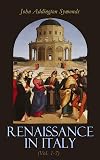
This book does not pretend to retrace the history of the Italian arts, but rather to define their relation to the main movement of Renaissance culture. Keeping this object in mind, Symonds explains the dependence of the arts on medieval Christianity at their commencement, their gradual emancipation from ecclesiastical control, and their final attainment of freedom at the moment when the classical revival culminated. Poet, essayist, and literary historian, John Addington Symonds (1840-1893) show more delved into every field of the humanities, writing the celebrated Renaissance in Italy and publishing translations of the Autobiography of Benvenuto Cellini and the Sonnets of Michelangelo and Campanella; he wrote biographies of Shelley, Sidney, and Jonson, and collaborated with Havelock Ellis on a number of projects in sexology. He is remembered for his untiring efforts to loosen the restraints on homosexuals in England, and his Memoirs are the only diary of a Victorian homosexual of his stature. show lessTags
Recommendations
















Member Reviews
“The intellectual medium formed in Italy upon the dissolution of the middle ages was irreligious and indifferent: highly refined and highly cultivated; instinctively aesthetic and superbly gifted, but devoid of moral earnestness or patriotic enthusiasms, of spiritual passions or political energy.”…….The men who made this literature and those with whom they lived, for whom they wrote, were well bred, satisfied with inactivity, open at all pores to pleasure, delighting in the refinements of tact and taste, but at the same time addicted to gross sensuality of word and deed”
John Addington Symonds writing in the 1880’s grits his teeth and plunges into the realms of these dissolute Italians. Symonds was a poet and literary critic show more who died in Rome in 1893. He produced a 7 volume history of Renaissance Italy; two volumes of which are devoted to literature. His passion for the Italian Renaissance shines through as he takes his readers on a guided tour of all that is worth reading from the period. This is much more than just biographical details of the famous as he uses his critical faculties to the full and along the way delves into much of the social history. He succeeds in producing a well rounded portrait of the literature and the life and times.
His two volumes start with providing an introduction to the romances of the middle ages and the struggle to find an acceptable national language with Latin rapidly becoming a dead language. He moves on to what he calls the Triumvirate of Italian literature; Dante, Petrarch and Boccaccio and the influence they had on all those that followed them. There are chapters on popular secular and religious poetry before the excellent chapter on Lorenzo De Medici and the cult of the carnival and the pageant in Florence. The lesser known writers of epic romances are then covered before an excellent critique of Ariosto’s Orlando Furioso. There are good chapters on the Novellieri and the bawdy short stories that they produced, followed by the even more bawdy secular dramas. Another good chapter on Burlesque poetry, before a chapter on Pietro Aretino the ultimate perhaps in satire and bad taste. Politics and Philosophy are covered with reference to Machiavelli and Pomponazzi and there are chapters on Pastoral and Didactic poetry and a critique on the Purists.
There were many new names to me to explore further; Matteo Bandello, Giovanni Pontano, Salernitano Massucio, Teofilo Polengo, Francesco Berni and Niccolo Franco. It all got a bit dangerous for my bank balance leading to the purchase of seven more books with many other extracts downloaded from google books. John Addington Symonds writes clearly and well and in spite of what he says I get the impression he enjoyed the obscenity of the burlesque writers as much as he did the Pastoral and Religious poetry; he saves his most damming criticism for work that he finds dull. Of course he was writing from a Victorian perspective but I did not find this got in the way of my enjoyment of his book.
The full set of Symonds Renaissance Italy is available for free download at the Gutenburg Project. His critique of literature is contained in volumes four and five. Some of his examples and extracts remain in the original language and many of the translated pieces I found to be incomplete, however this was not a serious problem as the flow of his writing is not seriously disrupted. This is really a very good introduction to the literature of the period with enough context provided to enable the reader to make his own judgements on what to follow up.
Edit | More show less
John Addington Symonds writing in the 1880’s grits his teeth and plunges into the realms of these dissolute Italians. Symonds was a poet and literary critic show more who died in Rome in 1893. He produced a 7 volume history of Renaissance Italy; two volumes of which are devoted to literature. His passion for the Italian Renaissance shines through as he takes his readers on a guided tour of all that is worth reading from the period. This is much more than just biographical details of the famous as he uses his critical faculties to the full and along the way delves into much of the social history. He succeeds in producing a well rounded portrait of the literature and the life and times.
His two volumes start with providing an introduction to the romances of the middle ages and the struggle to find an acceptable national language with Latin rapidly becoming a dead language. He moves on to what he calls the Triumvirate of Italian literature; Dante, Petrarch and Boccaccio and the influence they had on all those that followed them. There are chapters on popular secular and religious poetry before the excellent chapter on Lorenzo De Medici and the cult of the carnival and the pageant in Florence. The lesser known writers of epic romances are then covered before an excellent critique of Ariosto’s Orlando Furioso. There are good chapters on the Novellieri and the bawdy short stories that they produced, followed by the even more bawdy secular dramas. Another good chapter on Burlesque poetry, before a chapter on Pietro Aretino the ultimate perhaps in satire and bad taste. Politics and Philosophy are covered with reference to Machiavelli and Pomponazzi and there are chapters on Pastoral and Didactic poetry and a critique on the Purists.
There were many new names to me to explore further; Matteo Bandello, Giovanni Pontano, Salernitano Massucio, Teofilo Polengo, Francesco Berni and Niccolo Franco. It all got a bit dangerous for my bank balance leading to the purchase of seven more books with many other extracts downloaded from google books. John Addington Symonds writes clearly and well and in spite of what he says I get the impression he enjoyed the obscenity of the burlesque writers as much as he did the Pastoral and Religious poetry; he saves his most damming criticism for work that he finds dull. Of course he was writing from a Victorian perspective but I did not find this got in the way of my enjoyment of his book.
The full set of Symonds Renaissance Italy is available for free download at the Gutenburg Project. His critique of literature is contained in volumes four and five. Some of his examples and extracts remain in the original language and many of the translated pieces I found to be incomplete, however this was not a serious problem as the flow of his writing is not seriously disrupted. This is really a very good introduction to the literature of the period with enough context provided to enable the reader to make his own judgements on what to follow up.
Edit | More show less
Ratings
Members
- Recently Added By
Lists

The Road to Freedom (Will Durant's 100 Best Books for an Education)
100 works; 8 members

Trinity College Booklist (1951): Class Four, History
120 works; 2 members
Author Information

85+ Works 912 Members
John Addington Symonds was born in Bristol on 5 October 1840. Symonds attended first a private tutor's in Clifton, then to Harrow, then to Balliol and later to Magdalen. In 1860 he took a first in " Mods," and won the Newdigate with a poem on The Escorial; in 1862 he was placed in the first class in Literae Humaniores, and in the following year show more was winner of the Chancellor's English Essay. In 1862 he had been elected to an open fellowship at Magdalen. The strain of study unfortunately proved too great for him, and, immediately after his election to a fellowship, his health broke down, and he was obliged to seek rest in Switzerland. Symonds was plagued by ill health, and he would die of tuberculosis at the age of 52. During his last term at Oxford, in 1863 his health collapsed altogether, partly due to stress caused by the spread of rumours that he was having a homosexual affair with one of the students. His academic career was at an end, and for three years he was unable to do any work. He thought he might study law, but in 1865 it was discovered that his left lung was diseased, and after a complete rest it was decided that he could never follow a profession, but would have to go to a warmer, climate and become a writer. He spent the rest of his years between Switzerland and Venice, Italy. For many years Symonds's energy was wasted by trying to suppress his homosexuality. Essentially he wished to make homosexuality acceptable, both to himself and to society by idealizing it in his works. It is for his studies in the history of art that Symonds has been most highly praised and remembered, as well as his Rennaissance work. John Addington Symonds died at Rome on April 8, 1893. (Bowker Author Biography) show less
Series

Common Knowledge
- Disambiguation notice
- This is the complete work. Do not combine with individual volumes.
Classifications
- Genres
- Nonfiction, History, Art & Design, Literature Studies and Criticism, Religion & Spirituality, Biography & Memoir
- DDC/MDS
- 945.05 — History & geography History of Europe Italy Italy Renaissance 1300-1494
- LCC
- DG533 .S945 — History of Europe, Asia, Africa and Oceania City History of Italy Medieval and modern Italy, 476- History By period Medieval, 476-1492 1268-1492 Renaissance
- BISAC
Statistics
- Members
- 44
- Popularity
- 675,725
- Reviews
- 1
- Rating
- (4.50)
- Languages
- English, Spanish
- Media
- Paper, Ebook
- ISBNs
- 4
- ASINs
- 8