On This Page
Description
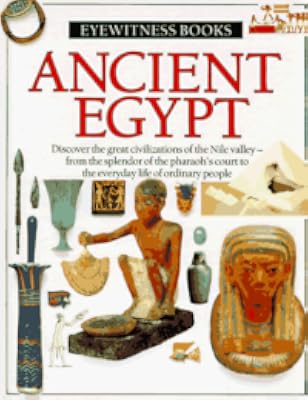
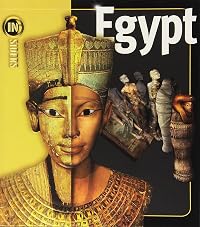
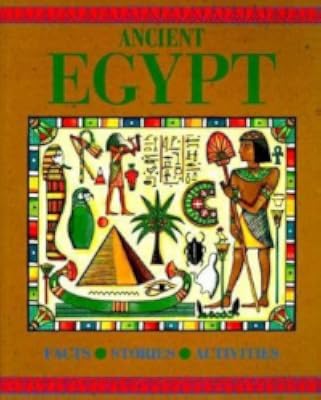
A photo essay on ancient Egypt and the people who lived there, documented through the mummies, pottery, weapons, and other objects they left behind. Describes their society, religion, obsession with the afterlife, and methods of mummification.Tags
Recommendations












Member Reviews
I enjoyed simply scrutinizing the various illustrations: weapons, foods, toys, a strainer for drinking beer through.
My favorite illustration is a photograph of a Roman sculpture of the Egyptian god Horus. Horus is in Roman sandals, a Roman toga, and a scale cuirass that does make you think of feathers, but his head is that of a falcon. That's some real fusion sculpture.
The original author died in 2021, when this book came out in a new revised edition. The original edition was published in 1990. In the chapter, "Weapons of War" a strange transformation has occurred. One of the images shows a painting on the side of a casket taken from the ante-chamber of Tutankhamon's tomb. The caption reads "King at War: This scene from the side of a show more box discovered in Tutankhamun's tomb shows the king attacking enemies from Nubia. His foes are falling in disarray. He rides in a chariot drawn by two horses, followed by fan bearers. In real life the king had a charioteer to drive for him." (Did a king at war, in a chariot, really have a posse of fan bearers chasing after him on foot all the time?!! Probably not. The objects in question do look like fans, but maybe they are military standards instead, like the eagles of the Roman legions? That would make a bit more sense, actually.) In 2021, both image and text have been changed. "This scene from a box discovered in Tutankhamen's tomb shows the king attacking the Nubians. He rides alone in a chariot drawn by two horses, although in real life a charioteer would have driven him. His enemies are falling in disarray." The image in this case is taken from the other side of the box and the king is depicted slaughtering not Nubians, but enemies from the north and east of Egypt, perhaps from a city like Kadesh, that his imperial ancestor, Thutmose III had conquered. Zahi Hawass, who is probably an authority on this, identifies these warriors as Syrians. So, we see two types of deterioration. 1) The captions have become less precise than formerly, because generally shorter. The scene is taken not "from the side of a box" but "from a box". 2) And the caption no longer correctly describes the image. Somebody from the very extensive DK editorial team, with little knowledge of Ancient Egypt, or perhaps no understanding of how to examine ancient artifacts, swapped in the different image from the other side of the box and failed to revise the caption correctly. I wonder what else went wrong with the new edition? show less
My favorite illustration is a photograph of a Roman sculpture of the Egyptian god Horus. Horus is in Roman sandals, a Roman toga, and a scale cuirass that does make you think of feathers, but his head is that of a falcon. That's some real fusion sculpture.
The original author died in 2021, when this book came out in a new revised edition. The original edition was published in 1990. In the chapter, "Weapons of War" a strange transformation has occurred. One of the images shows a painting on the side of a casket taken from the ante-chamber of Tutankhamon's tomb. The caption reads "King at War: This scene from the side of a show more box discovered in Tutankhamun's tomb shows the king attacking enemies from Nubia. His foes are falling in disarray. He rides in a chariot drawn by two horses, followed by fan bearers. In real life the king had a charioteer to drive for him." (Did a king at war, in a chariot, really have a posse of fan bearers chasing after him on foot all the time?!! Probably not. The objects in question do look like fans, but maybe they are military standards instead, like the eagles of the Roman legions? That would make a bit more sense, actually.) In 2021, both image and text have been changed. "This scene from a box discovered in Tutankhamen's tomb shows the king attacking the Nubians. He rides alone in a chariot drawn by two horses, although in real life a charioteer would have driven him. His enemies are falling in disarray." The image in this case is taken from the other side of the box and the king is depicted slaughtering not Nubians, but enemies from the north and east of Egypt, perhaps from a city like Kadesh, that his imperial ancestor, Thutmose III had conquered. Zahi Hawass, who is probably an authority on this, identifies these warriors as Syrians. So, we see two types of deterioration. 1) The captions have become less precise than formerly, because generally shorter. The scene is taken not "from the side of a box" but "from a box". 2) And the caption no longer correctly describes the image. Somebody from the very extensive DK editorial team, with little knowledge of Ancient Egypt, or perhaps no understanding of how to examine ancient artifacts, swapped in the different image from the other side of the box and failed to revise the caption correctly. I wonder what else went wrong with the new edition? show less
Este libro lo tine todo para despertar la curiosidad de los niños a partir de 9 años. Sus magnificas ilustraciones muestran la construcción de una pirámide, la preparación de un sarcófago o el culto de los dioses. Además, el apartado " ¿lo sabías? ", los recuadros temáticos y las preguntas con respuestas sencillas ayudan a comprender cómo se organizaba la sociedad egipcia antigua. ¡Un sorprendente libro divulgativo con el que el niño nunca se cansará de aprender!
Independent Reading Level: Grades 4-6 (ages 9-12)
Awards/Honors: Part of the well-known Eyewitness Books series, praised for its educational value and engaging visuals
Recognized by the American Library Association for its informative content and kid-friendly design.
Awards/Honors: Part of the well-known Eyewitness Books series, praised for its educational value and engaging visuals
Recognized by the American Library Association for its informative content and kid-friendly design.
Good for adults and children!
GR:
GL: 6.5
DRA:
Lexile: 1090L
GL: 6.5
DRA:
Lexile: 1090L
Members
- Recently Added By
Lists


Author Information

George Hart was staff lecturer and educator on the Ancient Egyptian collections in the Education Department of the British Museum.
Some Editions
Awards and Honors
Notable Lists
Series

Belongs to Publisher Series
Ooggetuigen [Standaard] (1991)
Gallimard Jeunesse, Les Yeux de la Découverte (Série Histoire et civilisations, 18)
Common Knowledge
- Canonical title
- Ancient Egypt (Eyewitness Books) (Eyewitness Books)
- Original title
- Ancient Egypt (Eyewitness Books) (Eyewitness Books)
- Alternate titles*
- Mémoire de l'Egypte
- Original publication date
- xxxx (1e édition originale anglaise, Eyewitness, Dorling Kindersley Publishing) (1e édition originale anglaise, Eyewitness, Dorling Kindersley Publishing); 1990 (1e traduction et édition française sous le titre "Mémoire de l'Egypte", Les yeux de la découvertes, Gallimard jeunesse) (1e traduction et édition française sous le titre "Mémoire de l'Egypte", Les yeux de la découvertes, Gallimard jeunesse); 2002-09-18 (Nouvelle édition reformatée sous le titre "Mémoire de l'Egypte", Les yeux de la découvertes,N° 23, Gallimard jeunesse) (Nouvelle édition reformatée sous le titre "Mémoire de l'Egypte", Les yeux de la découvertes,N° 23, Gallimard jeunesse); 2007-10-18 (Nouvelle édition reformatée sous le titre "Mémoire de l'Egypte", Les yeux de la découvertes, N° 7, Gallimard jeunesse) (Nouvelle édition reformatée sous le titre "Mémoire de l'Egypte", Les yeux de la découvertes, N° 7, Gallimard jeunesse); 2015-09-17 (Nouvelle édition reformatée sous le titre "L'Egypte des pharaons", Les yeux de la découvertes , N° 18, Gallimard jeunesse) (Nouvelle édition reformatée sous le titre "L'Egypte des pharaons", Les yeux de la découvertes , N° 18, Gallimard jeunesse)
- Important places
- Ancient Egypt; Egypt
- First words
- Egypt Before the Pharaohs: The period we normally think of as as "ancient Egypt" is the time when Egypt was ruled by the pharaohs - after c. 3000 B.C.
- Last words
- (Click to show. Warning: May contain spoilers.)Eventually Egypt was conquered by the Turks and it was not until the 1960's that the country was again governed by a native Egyptian.
- Original language*
- ingles
*Some information comes from Common Knowledge in other languages. Click "Edit" for more information.
Classifications
Statistics
- Members
- 1,687
- Popularity
- 13,199
- Reviews
- 8
- Rating
- (4.00)
- Languages
- 11 — Dutch, English, Finnish, French, German, Italian, Norwegian (Bokmål), Polish, Portuguese, Spanish, Swedish
- Media
- Paper, Audiobook, Ebook
- ISBNs
- 91
- UPCs
- 11
- ASINs
- 11