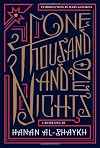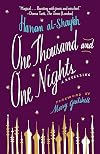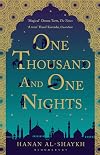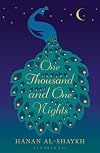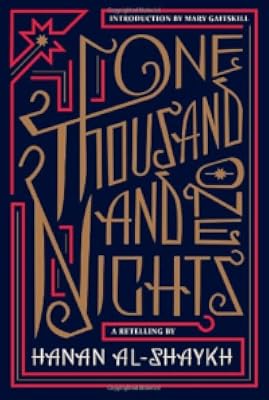
One Thousand and One Nights: A Retelling
by Hanan Al-Shaykh
On This Page
Description
An evocative reimagining of nineteen tales from the classic story about young queen Shahrazad's efforts to save her life from a brutal husband focuses on female characters at the heart of each tale in a woven sequence that incorporates humor and sensuality.Tags
Recommendations











Member Reviews
I'd been circling closer and closer to this book for a while. I'd never read any version of One Thousand and One Nights, and given my recent reading interests, it seemed inevitable that I do so, but what translation? Then I heard somewhere that Al-Shaykh, one of my favorite authors, had done a recent interpretation (along with another woman, I believe) for the stage. I was of course excited, but I pretty much detest reading plays, so I hadn't gone looking for it. When I saw this translation at the library, I had to check it out immediately.
I had nearly no idea what to expect. Sinbad, Aladdin and his lamps, maybe. Not even The Wrath and The Dawn had really given me much idea of what to expect. At first, there was a lot about this text show more that I found jarring, largely in the framing story, with its murderous cuckolded kings, whose wives had dallied with strangely racially caricatured slaves. It took me a while to realize that the stories hadn't really been modernized, or sanitized, just translated, and joyously celebrated as the source of so many stories, so much tradition. And the stories seemed deliberately chosen to complicate any ideas of who is the fairer, weaker, more honest, or more lustful sex.
When the stories ended I was sad, not because I disagreed with the way Al-Shaykh somewhat ambiguously concluded them, but just that I wanted more stories, all of the stories, for the book to go on and on.
A wonderful book. show less
I had nearly no idea what to expect. Sinbad, Aladdin and his lamps, maybe. Not even The Wrath and The Dawn had really given me much idea of what to expect. At first, there was a lot about this text show more that I found jarring, largely in the framing story, with its murderous cuckolded kings, whose wives had dallied with strangely racially caricatured slaves. It took me a while to realize that the stories hadn't really been modernized, or sanitized, just translated, and joyously celebrated as the source of so many stories, so much tradition. And the stories seemed deliberately chosen to complicate any ideas of who is the fairer, weaker, more honest, or more lustful sex.
When the stories ended I was sad, not because I disagreed with the way Al-Shaykh somewhat ambiguously concluded them, but just that I wanted more stories, all of the stories, for the book to go on and on.
A wonderful book. show less
It's REALLY difficult to figure out just how to rate this. On one hand, the storytelling is masterful; it's bawdy and action-packed, full of demons and lovers and vengeance. Most of the stories end very poorly for everyone involved, which is kind of awesome. However, even though I've become relatively familiar with many of the Arabian Nights stories over the years and thought myself fairly prepared for any old-fashioned notions couched in these ancient tales, I had an incredibly hard time getting over the abject misogyny of many of the stories...so much so that I wasn't sure if I could continue on. I was so enthralled though, curious to see just how the plot might twist in each individual story. This kept me going. al-Shaykh's phrasing show more certainly helped make it more accessible, too--I may just have to check out more of her own work. show less
I loved this book of Arabian tales for grownups. The stories begin when King Shahrayar is cheated on by his wife. He vows to defeat the treachery of women by marrying a virgin every night, deflowering her, and killing her in the morning. Shahrazad, the daughter of the King's Vizier has a plan to end the bloodshed and she asks her father to marry her to the king. Every night after they copulate Shahrazad tells the King a story that is so fantastic that he decides not to kill her in the morning so he can hear the continuation the next night.
Shahrazad's stories beget more stories. In this way story is spun from story into another story. A story will have six characters who will each have stories of their own. Each story is relative short show more and fits into the arc of a larger story. This is a book that you want to read through as much as possible in siting so you can keep track of everything that is going on. Some of the stories end up relating to other stories through a series of coincidences.
The stories are tales full of violence, adventure, and romance. The treatment of women is far from politically correct. They are depicted as lustful whores who cheat on their husbands and are executed in gruesome ways while men get what they deserve in the end. A time or two women are even able to get the upper hand. A favorite was The Woman and her Five Lovers. The story of the Hunchback also had me laughing out loud. The stories are graphic, R rated, but not explicit in sexual detail.
I only had a peripheral knowledge of the Arabian Nights Tales. The ones I was familiar with, Aladin and his Lamp and Ali Baba and the Forty Thieves were not included. Sinbad the sailor was in a tale briefly at the end. It seems that some of the more well known stories were not part of the original translation and so were not included here. I enjoyed getting to know the lesser known stories and found them very entertaining. The translation made the tales very accessible and the book ends up on a cliffhanger. Since there are many more stories to tell I hope there will be a sequel. show less
Shahrazad's stories beget more stories. In this way story is spun from story into another story. A story will have six characters who will each have stories of their own. Each story is relative short show more and fits into the arc of a larger story. This is a book that you want to read through as much as possible in siting so you can keep track of everything that is going on. Some of the stories end up relating to other stories through a series of coincidences.
The stories are tales full of violence, adventure, and romance. The treatment of women is far from politically correct. They are depicted as lustful whores who cheat on their husbands and are executed in gruesome ways while men get what they deserve in the end. A time or two women are even able to get the upper hand. A favorite was The Woman and her Five Lovers. The story of the Hunchback also had me laughing out loud. The stories are graphic, R rated, but not explicit in sexual detail.
I only had a peripheral knowledge of the Arabian Nights Tales. The ones I was familiar with, Aladin and his Lamp and Ali Baba and the Forty Thieves were not included. Sinbad the sailor was in a tale briefly at the end. It seems that some of the more well known stories were not part of the original translation and so were not included here. I enjoyed getting to know the lesser known stories and found them very entertaining. The translation made the tales very accessible and the book ends up on a cliffhanger. Since there are many more stories to tell I hope there will be a sequel. show less
Shahrayer’s wife betrayed him by taking part in massive orgies. She was seen by Shahrayer’s brother Shahaman who duly reported it. In an act of retribution, Shahrayer not only executed his wife but vowed to take a new untouched virgin each night, deflower her and execute her at dawn.
Until, of course, Shahrazad volunteered to become one of the doomed virgins. She mesmerized the king with her storytelling who agreed to let her finish her story before she was executed.
Stories within stories within stories. It’s a bit like the Noel Harrison song Windmills of your Mind: “like a circle in a spiral, like a wheel within a wheel - Never ending or beginning on an ever spinning reel”.
Author Hannan Al-Shayk chose to beautifully retell show more nineteen of these stories. According to Wikipedia she chose to leave the stories continuing while the traditional ending is that after one thousand and one nights the stories end, and Shahrazad presented Shahrayer with the three children she had borne during the telling of the tales.
A few quotes:
Foreward by Mary Gaitskill:”The action of the stories in One Thousand and One Nights is dark and full of cruelty – especially toward women who are constantly being accused of adultery and then murdered or beat up. But the animating spirit here is light and full of play, especially on the part of the female characters, who are consistently resourceful and witty”. P.x
Author’s Preface : “I heard that a girl in my class had Alf Layl wa layl, (One Thousand and One Nights) and I hurried with her to peer at a few volumes in a glass cabinet, next to a carved tusk of an elephant. The volumes were leather- bound, their titles engraved in gold. I asked my friend if I might touch one, but she said that her father always locked the cabinet and kept the key in his pocket, because he said he feared that if anyone finished the stories they would drop dead. Of course I didn’t know then, and neither did my friend, that the reason her father didn’t want any of the women of the house to read Alf Layla wa Layla was because of its explicit sexuality.” Pxvii
“I felt as if I had opened the door of a carriage which took me back into the heart of my Arab heritage, and to classical Arab language, after a great absence. I was astonished at how our forebears had shaped our societies, showing us how to live our daily lives, through these tales which were filled with insights and moral and social rules and laws, without the influence of religion, but derived from first hand experience and deepest natural feelings towards every living thing. The effect of Alf Layl wa layl was so strong and real that Arab societies shaped themselves around it; the names of its characters were embedded in our language, becoming proverbs, adjectives and eve modes of speech. I was in awe of the complex society the stories evoked, which allowed relationships between humans and jinnis and beasts, real and imaginary.” P xviii show less
Until, of course, Shahrazad volunteered to become one of the doomed virgins. She mesmerized the king with her storytelling who agreed to let her finish her story before she was executed.
Stories within stories within stories. It’s a bit like the Noel Harrison song Windmills of your Mind: “like a circle in a spiral, like a wheel within a wheel - Never ending or beginning on an ever spinning reel”.
Author Hannan Al-Shayk chose to beautifully retell show more nineteen of these stories. According to Wikipedia she chose to leave the stories continuing while the traditional ending is that after one thousand and one nights the stories end, and Shahrazad presented Shahrayer with the three children she had borne during the telling of the tales.
A few quotes:
Foreward by Mary Gaitskill:”The action of the stories in One Thousand and One Nights is dark and full of cruelty – especially toward women who are constantly being accused of adultery and then murdered or beat up. But the animating spirit here is light and full of play, especially on the part of the female characters, who are consistently resourceful and witty”. P.x
Author’s Preface : “I heard that a girl in my class had Alf Layl wa layl, (One Thousand and One Nights) and I hurried with her to peer at a few volumes in a glass cabinet, next to a carved tusk of an elephant. The volumes were leather- bound, their titles engraved in gold. I asked my friend if I might touch one, but she said that her father always locked the cabinet and kept the key in his pocket, because he said he feared that if anyone finished the stories they would drop dead. Of course I didn’t know then, and neither did my friend, that the reason her father didn’t want any of the women of the house to read Alf Layla wa Layla was because of its explicit sexuality.” Pxvii
“I felt as if I had opened the door of a carriage which took me back into the heart of my Arab heritage, and to classical Arab language, after a great absence. I was astonished at how our forebears had shaped our societies, showing us how to live our daily lives, through these tales which were filled with insights and moral and social rules and laws, without the influence of religion, but derived from first hand experience and deepest natural feelings towards every living thing. The effect of Alf Layl wa layl was so strong and real that Arab societies shaped themselves around it; the names of its characters were embedded in our language, becoming proverbs, adjectives and eve modes of speech. I was in awe of the complex society the stories evoked, which allowed relationships between humans and jinnis and beasts, real and imaginary.” P xviii show less
A very readable selection and arrangement of stories from Alf layla wa layla which after the standard introduction brings together both characters of and storytellers of the tales in the home of sisters who have had all sorts of misfortunes at the hands of husbands but who remain in the prime of life. The chosen stories are almost all centered more around lovers and spouses rather than powerful magic and stirring adventure.
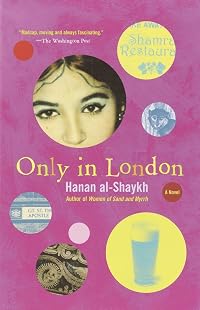
Everybody knows about the Alf Layla wa Layla, how a king would marry a young woman each day and then have her executed the following morning, until Scheherazade asks to marry him and then spends the night telling stories but ending on a cliff-hanger – so he keeps her alive to find out how the story ends. Most people probably also know some of the 1001 Nights’ more popular stories, such as Ali Baba and the Forty Thieves. I actually have a copy of the Penguin Classic edition of Tales from the Thousand and One Nights, although I’ve yet to read it. I am, however, a fan of Al-Shaykh’s novels, ever since reading Only in London back in 2002. I believe Al-Shaykh’s version of the One Thousand and One Nights – and it’s only the show more first few stories of the first volume – started life as a play, but happily it doesn’t read like a play. One thing I hadn’t known until I read this book was how… bawdy the stories are. And how inter-nested. While Scheherazade opens the book, the story she tells contains characters who tell stories which contain characters who tell stories… I enjoyed this a lot more than I expected to. There are that many levels of framing narratives it can get a little confusing, but the individual tales are amusing and well-told. Recommended. show less
Lebanese author Hanan Al-Shaykh provides us with a retelling of the Arabian Nights, ancient stories collected from across India, Persia and the Arab empire that date back to the 14th Century. Hanan has chosen 19 tales, a bawdy, humorous collection that is part myth and part folk tale with jinnis, princesses and adventurers. The frame story is that of the courageous and clever Shaharazad (Scheherazade), who chooses to marry King Shahrayar, risking her life in doing so. The King, after discovering his wife’s infidelity, has sworn to marry a virgin every night, then every morning to have her executed. After their marriage, Shaharazad begins telling the King a story, stopping each night at a gripping point, and then continuing the tale show more the next day if he does not execute her. She is such a powerful storyteller that every morning the King refuses to execute her so he can hear the end of the story.
The stories themselves are told with simplicity, almost childlike at times, despite the often sexual nature of them. They usually revolve around the interaction between men and women. The stories very cleverly interlock almost like a set of Babushka dolls, a story within a story within a story…I enjoyed the rich imagery: beautiful women, juicy dates, opulent palaces, and lush fabrics. Traditionally the stories return to the frame story of Shaharazad and the King but in this version the ending felt rushed and Shaharazad does not quite seem to get her dues for the amazing stories of which she is the teller. 4 stars. show less
The stories themselves are told with simplicity, almost childlike at times, despite the often sexual nature of them. They usually revolve around the interaction between men and women. The stories very cleverly interlock almost like a set of Babushka dolls, a story within a story within a story…I enjoyed the rich imagery: beautiful women, juicy dates, opulent palaces, and lush fabrics. Traditionally the stories return to the frame story of Shaharazad and the King but in this version the ending felt rushed and Shaharazad does not quite seem to get her dues for the amazing stories of which she is the teller. 4 stars. show less
Members
- Recently Added By
Lists

wish list
61 works; 3 members

Diverse Reading Challenge 2020
31 works; 1 member

Author Information

22+ Works 1,982 Members
Hanan al-Shaykh was born & raised in Lebanon. She is the author of three novels - "Women of Sand & Myrrh", "The Story of Zahra" & "Beirut Blues" - as well as a collection of short stories, "I Sweep the Sun off Rooftops". She currently lives in London with her husband & two children. (Bowker Author Biography)
Some Editions
Awards and Honors
Distinctions
Notable Lists
Common Knowledge
- Original publication date
- 2011
- Dedication
- For Shahrazad and her daughters
- Blurbers
- Tartt, Donna; Kureishi, Hanif; Satrapi, Marjane
- Original language
- Arabic
Classifications
Statistics
- Members
- 341
- Popularity
- 92,947
- Reviews
- 11
- Rating
- (3.65)
- Languages
- English
- Media
- Paper, Ebook
- ISBNs
- 8
- ASINs
- 2