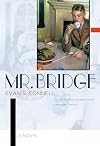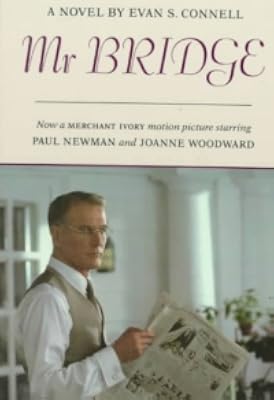
On This Page
Description
Walter Bridge is an ambitious lawyer who redoubles his efforts and time at the office whenever he sense that his family needs something, even when what they need is more of him and less of his money. Affluence, material assets, and comforts create a cocoon of community respectability that cloaks the void within-not the skeleton in the closet but a black hole swallowing the whole household. The Bridge novels have been recognized as classics during their author's lifetime. With their shared show more ability to capture the manners and mores of the American upper middle class, Connell has done for the late thirties what Sinclair Lewis did for the twenties. show lessTags
Recommendations






















Member Reviews
A joyless life rendered so plaintively and pathetically.
Mr Bridge could've just been another typical angry, miserable story of the mid-century, upper-middle class, white American man genre, as written by some of Connell's well-known contemporaries.
But somehow Connell imbues Mr Bridge with a hyper-realism - for example, instead of a blustery self-righteousness of a cartoon family man of the period, the contradictory self-righteousness that explains and summarises his entire personality, humanises him without excusing him - that makes this a frustratingly brilliant read.
Just as Mrs Bridge's pristine suitcase covers encapsulates her whole personality for me, Mr Bridge's showily understated Christmas "present" of stocks to the whole show more family+Harriet which he then takes back in the name of safekeeping just punched me through the page.
It has been ages since I've read Mrs Bridge, but I find Mr Bridge to be just as good a standalone novel. And seeing as I've forgotten most of the incidents that Mrs covered, I look forward to one day reading them both together as I'm sure there're some two-sided gems to uncover. show less
Mr Bridge could've just been another typical angry, miserable story of the mid-century, upper-middle class, white American man genre, as written by some of Connell's well-known contemporaries.
But somehow Connell imbues Mr Bridge with a hyper-realism - for example, instead of a blustery self-righteousness of a cartoon family man of the period, the contradictory self-righteousness that explains and summarises his entire personality, humanises him without excusing him - that makes this a frustratingly brilliant read.
Just as Mrs Bridge's pristine suitcase covers encapsulates her whole personality for me, Mr Bridge's showily understated Christmas "present" of stocks to the whole show more family+Harriet which he then takes back in the name of safekeeping just punched me through the page.
It has been ages since I've read Mrs Bridge, but I find Mr Bridge to be just as good a standalone novel. And seeing as I've forgotten most of the incidents that Mrs covered, I look forward to one day reading them both together as I'm sure there're some two-sided gems to uncover. show less
How does somebody write a novel this perfect? The author takes us inside the head of a Kansas City attorney during the Depression era, as he confronts the challenges of raising a family and making correct decisions for himself and them, invariably congratulating himself on the wisdom of the path he has chosen for everybody, and dismissing their occasional suggestions that he might be cold or bigoted only after giving their hypotheses careful consideration. The book begins as a lightly humorous treatment of his thought processes and his perceptions of the foibles of the people and society which surround him, and gradually becomes a bit darker as his children force him to confront such perils of modernity as bohemianism and golf. The book show more is funny and wise, every character beautifully drawn, and also serves as an incisive portrait of the Kansas City of bygone days. show less
"He himself did not care what happened at the house during the day. There was no more reason for her to be curious about his work than for him to be concerned with the groceries, laundry, getting the children to school, and whatever else she did. Yet it would seem rude, almost brutal, to drop the pretense and admit that neither particularly cared what the other was doing. A display of interest, however shallow, made life easier." (p 9)
Mr. Bridge is the converse to the earlier novel, Mrs. Bridge, written ten years earlier by Evan Connell. The story chronicles the life of Walter Bridge and his family, wife India, daughters Carolyn and Ruth, and son Douglas. Just as Mr. Bridge did not play a large role in the earlier novel Mrs. Bridge show more recedes into the background in this story. The difference is in part one of perspective, as you see the world from the view of Mrs. Bridge in the earlier book. In this one you begin to get some understanding of the reason why, in spite of being set during the depression, the family seems well-to-do which, as we find in the story of Mr. Bridge, is due in large part to the conservative investment habits of Walter Bridge. These are demonstrated again and again and his fixation on preserving a financial legacy for his family would seem a good thing if it was not one more brick in the wall that he has built around himself and his ordered life.
Walter Bridge's conservatism is not his primary defining characteristic. In a certain sense he appears to be a stoic. But he is neither a seriously thoughtful nor a happy stoic in the mold of men like Marcus Aurelius and Henry David Thoreau. They exemplify the thoughtful and contemplative life of the stoic who accepts this world but yearns to understand it. Sadly, Walter Bridge's thoughtfulness falls short of understanding just as he falls short of any true sort of stoicism. His true character, rather, can be defined in two words: He is a "consummate Puritan". (p 249) That outlook determines Walter's world both for better and for worse.
Much of the story takes place during the depression years leading up to World War II and while everything's not so up-to-date in Kansas City, there are symptomatic signs of transition--the encroachment of Jews in the neighborhood; or the possibility that their colored servant's nephew will attempt to enter Harvard; or that their own children will be doing unlikely things with unsuitable people. None of these are more unsuitable than his daughter Ruth's intellectual friends in New York whose magazine, "Houyhnhnm", he hides on a upper shelf in his library. Afraid to throw it out in case his daughter should look for it, he is unable to stand the sight of it and what it represents. Swiftian satire was seldom any sharper than this.
Mr Bridge can also be seen as living his life of the edge of feeling. He is out of touch with his wife and children in part because of his taciturn personality, but also because of his inability to communicate. One aspect of this is demonstrated in the scene where he attempts to play ball with his son Douglas and some of his fellow schoolmates. Walter feels that he should do this against his own preference not to and the resulting failure is painful and made only moreso by Walter's attempt to rationalize away that failure. It is emblematic of much of his family life.
Mr. Bridge is also out of touch with the world around him. He is fascinated with the bright yellow socks worn by Dr. Sauer. He thinks: What is it about those yellow socks? Likewise why am I uncomfortable with the young male ballet dancers? His inability to successfully answer these and other questions about the changes in his world leaves him once again on the edge of feeling. The effect of this, and the events that are chosen by the author and portrayed in the short vignettes that comprise the novel make this a darker work than its predecessor. At the end, Mr. Bridge is seen as the bewildered, beleaguered midcult man unable to cross the chasm of the generations and changing times. show less
Mr. Bridge is the converse to the earlier novel, Mrs. Bridge, written ten years earlier by Evan Connell. The story chronicles the life of Walter Bridge and his family, wife India, daughters Carolyn and Ruth, and son Douglas. Just as Mr. Bridge did not play a large role in the earlier novel Mrs. Bridge show more recedes into the background in this story. The difference is in part one of perspective, as you see the world from the view of Mrs. Bridge in the earlier book. In this one you begin to get some understanding of the reason why, in spite of being set during the depression, the family seems well-to-do which, as we find in the story of Mr. Bridge, is due in large part to the conservative investment habits of Walter Bridge. These are demonstrated again and again and his fixation on preserving a financial legacy for his family would seem a good thing if it was not one more brick in the wall that he has built around himself and his ordered life.
Walter Bridge's conservatism is not his primary defining characteristic. In a certain sense he appears to be a stoic. But he is neither a seriously thoughtful nor a happy stoic in the mold of men like Marcus Aurelius and Henry David Thoreau. They exemplify the thoughtful and contemplative life of the stoic who accepts this world but yearns to understand it. Sadly, Walter Bridge's thoughtfulness falls short of understanding just as he falls short of any true sort of stoicism. His true character, rather, can be defined in two words: He is a "consummate Puritan". (p 249) That outlook determines Walter's world both for better and for worse.
Much of the story takes place during the depression years leading up to World War II and while everything's not so up-to-date in Kansas City, there are symptomatic signs of transition--the encroachment of Jews in the neighborhood; or the possibility that their colored servant's nephew will attempt to enter Harvard; or that their own children will be doing unlikely things with unsuitable people. None of these are more unsuitable than his daughter Ruth's intellectual friends in New York whose magazine, "Houyhnhnm", he hides on a upper shelf in his library. Afraid to throw it out in case his daughter should look for it, he is unable to stand the sight of it and what it represents. Swiftian satire was seldom any sharper than this.
Mr Bridge can also be seen as living his life of the edge of feeling. He is out of touch with his wife and children in part because of his taciturn personality, but also because of his inability to communicate. One aspect of this is demonstrated in the scene where he attempts to play ball with his son Douglas and some of his fellow schoolmates. Walter feels that he should do this against his own preference not to and the resulting failure is painful and made only moreso by Walter's attempt to rationalize away that failure. It is emblematic of much of his family life.
Mr. Bridge is also out of touch with the world around him. He is fascinated with the bright yellow socks worn by Dr. Sauer. He thinks: What is it about those yellow socks? Likewise why am I uncomfortable with the young male ballet dancers? His inability to successfully answer these and other questions about the changes in his world leaves him once again on the edge of feeling. The effect of this, and the events that are chosen by the author and portrayed in the short vignettes that comprise the novel make this a darker work than its predecessor. At the end, Mr. Bridge is seen as the bewildered, beleaguered midcult man unable to cross the chasm of the generations and changing times. show less
Poor Mr. Bridge, he has built his life based on respectability and stability and forgotten to truly enjoy it. He sees danger everywhere and, while loving and protecting his family, seeks to control everything they experience. He can't succeed, of course, and when events threaten to intrude on the cocoon he has woven, he responds by becoming numb. Eventually he is so numb, he cannot conceive of what it would be like to fully live.
I received this recorded copy of Mr. Bridge from Early Reviewers and was very happy to get it to accompany my copy of Mrs. Bridge, which I read several years ago. It has been a while since I read Mrs. Bridge but I remember loving the book and hating the character. I was curious about how I would feel about Mr. Bridge. At first I thought I might like him better but then I found he was the same product of his time and position (1940's, Kansas City, lawyer) in life as his racist, narrow-minded, naïve wife. The thing that makes this a good book, despite terrible characters, is the author's ability through dialogue and insight into Mr. Bridge's thought processes, to allow the reader to vividly picture this man and his encounters with his show more family and people in his daily routines. It was difficult to listen to some of his diatribes about the "Negros" learning to stay in their places, but it was essential to hear to understand the kind of man he was.
I think I would put the writing of Evan S. Connell almost up there with Flannery O'Connor because, like all the books I have read by her, I hated the despicable characters, but I couldn't get enough of the writing. I felt the same about Mr. & Mrs. Bridge. show less
I think I would put the writing of Evan S. Connell almost up there with Flannery O'Connor because, like all the books I have read by her, I hated the despicable characters, but I couldn't get enough of the writing. I felt the same about Mr. & Mrs. Bridge. show less
 This review was written for LibraryThing Early Reviewers.
"Saga of sweet joylessness and blunted sensibility...marriage and middle-age on the plains of Protestantism",, April 18, 2015, 19 April 2015
The companion volume to Mrs Bridge, written ten years earlier, which looked at a marriage principally from the point of view of the wife . In that volume we never fully understood the husband, a largely absent lawyer, although we had little hints as to his personality: hard-working, determined to provide for his family, sometimes apparently more able to cultivate a 'normal' relationship with his children than his bright, correct wife could manage.
Now in this book, we live through the marriage from the point of view of Mr Bridge. Narrated, like its prequel, in the form of short vignettes; many of show more these are new but some will be remembered by readers of the former, where we see two entirely different viewpoints on the same incident: when daughter Ruth is associating with a homosexual man, her mother utterly fails to comprehend the situation, while her more worldly (and adoring) father tries to stop it.
Mr Bridge, a self-made man, is somewhat miserly at times with his hard-earned wealth. He has an irritating need to always be right. Like his wife he is intrinsically racist in his views although neither of them would publically own to such feelings.
And as we follow this couple and their three growing children, all individuals with their own personalities, we see how people grow apart while living in the same house.
As brilliant as its prequel, definitely 4.5* show less
The companion volume to Mrs Bridge, written ten years earlier, which looked at a marriage principally from the point of view of the wife . In that volume we never fully understood the husband, a largely absent lawyer, although we had little hints as to his personality: hard-working, determined to provide for his family, sometimes apparently more able to cultivate a 'normal' relationship with his children than his bright, correct wife could manage.
Now in this book, we live through the marriage from the point of view of Mr Bridge. Narrated, like its prequel, in the form of short vignettes; many of show more these are new but some will be remembered by readers of the former, where we see two entirely different viewpoints on the same incident: when daughter Ruth is associating with a homosexual man, her mother utterly fails to comprehend the situation, while her more worldly (and adoring) father tries to stop it.
Mr Bridge, a self-made man, is somewhat miserly at times with his hard-earned wealth. He has an irritating need to always be right. Like his wife he is intrinsically racist in his views although neither of them would publically own to such feelings.
And as we follow this couple and their three growing children, all individuals with their own personalities, we see how people grow apart while living in the same house.
As brilliant as its prequel, definitely 4.5* show less
I really liked "Mr. Bridge", but not as much as its companion piece "Mrs. Bridge". Connell's crisp, elegant writing and careful portraiture were no less wonderful, the literary equivalent of Albrecht Durer's finely-drawn engravings. The problem, I suppose, was that Mr. Bridge was not as interesting or sympathetic a character as his wife. He is portrayed as a very private, withdrawn, and unswerving individual. Rarely do we see glimpses of how and with whom he spends his days. India interested me because she was uncertain about herself and so many habits and customs around her. Walter, on the other hand, rarely wavered in his views or considered alternative possibilities -- which, of course, he regarded as a self-defining virtue. Walter's show more stiffness suppresses, but fortunately does not completely stifle, his humanity and the deep love he holds for his family. It's a testament to Connell's wonderful writing that we're able to see both sides of Mr. Bridge so clearly. The two books are a great read. You really need to read both of them to get the most out of either one. show less
Members
- Recently Added By
Lists

Great American Novels
158 works; 40 members

Best Love Stories
107 works; 14 members

Books Set in Missouri
29 works; 4 members

A Novel Cure
742 works; 23 members

Books Read in 2021
5,361 works; 114 members
Talk Discussions
Past Discussions
August 2013: Mr. Bridge in Missouri Readers (September 2013)
Author Information

30+ Works 5,297 Members
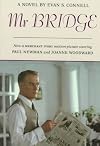
Evan S. Connell was born August 17, 1924 in Kansas City, Missouri. He graduated from the University of Kansas in 1947. His first work, The Anatomy Lesson and Other Stories, was published in 1957. His first novel, Mrs. Bridge, was published in 1959. The sequel, Mr. Bridge, was published ten years later. In 1990, both novels were adapted into the show more film Mr. and Mrs. Bridge starring Paul Newman and Joanne Woodward. He wrote more than 15 books during his lifetime including Son of the Morning Star: Custer and the Little Bighorn, The Patriot, The Diary of a Rapist, The Connoisseur, Deus Lo Volt!, and Lost in Uttar Pradesh. He died on January 10, 2013 at the age of 88. (Bowker Author Biography) show less
Some Editions
Awards and Honors
Notable Lists
Series

Work Relationships
Is contained in
Common Knowledge
- Canonical title
- Mr. Bridge
- Original publication date
- 1969
- People/Characters
- Walter Bridge; India Bridge; Ruth Bridge; Carolyn Bridge; Douglas Bridge
- Important places
- Kansas City, Missouri, USA; Missouri, USA
- Related movies
- Mr. & Mrs. Bridge (1990 | IMDb)
Classifications
Statistics
- Members
- 692
- Popularity
- 41,275
- Reviews
- 24
- Rating
- (3.80)
- Languages
- 7 — Danish, Dutch, English, French, Italian, Spanish, Swedish
- Media
- Paper, Audiobook, Ebook
- ISBNs
- 27
- ASINs
- 13