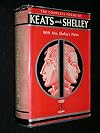
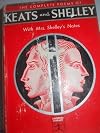
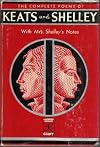
Complete Poems of Keats and Shelley
by John Keats (Author), Percy Bysshe Shelley (Author)
On This Page
Description
The complete poems of John Keats and Percy Shelley. ISBN 0-394-60466-0Tags
Recommendations

















Member Reviews
John Keats (1795-1821, 25 years).
Ratings
Members
- Recently Added By
Lists

F. Scott Fitzgerald's 22 Essential Books (1936)
22 works; 3 members
Author Information

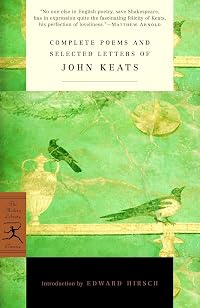
John Keats was born in London, the oldest of four children, on October 31, 1795. His father, who was a livery-stable keeper, died when Keats was eight years old, and his mother died six years later. At age 15, he was apprenticed to an apothecary-surgeon. In 1815 he began studying medicine but soon gave up that career in favor of writing poetry. show more The critic Douglas Bush has said that, if one poet could be recalled to life to complete his career, the almost universal choice would be Keats, who now is regarded as one of the three or four supreme masters of the English language. His early work is badly flawed in both technique and critical judgment, but, from his casually written but brilliant letters, one can trace the development of a genius who, through fierce determination in the face of great odds, fashioned himself into an incomparable artist. In his tragically brief career, cut short at age 25 by tuberculosis, Keats constantly experimented, often with dazzling success, and always with steady progress over previous efforts. The unfinished Hyperion is the only English poem after Paradise Lost that is worthy to be called an epic, and it is breathtakingly superior to his early Endymion (1818), written just a few years before. Isabella is a fine narrative poem, but The Eve of St. Agnes (1819), written soon after, is peerless. In Lamia (1819) Keats revived the couplet form, long thought to be dead, in a gorgeous, romantic story. Above all it was in his development of the ode that Keats's supreme achievement lies. In just a few months, he wrote the odes "On a Grecian Urn" (1819), "To a Nightingale" (1819), "To Melancholy" (1819), and the marvelously serene "To Autumn" (1819). Keats is the only romantic poet whose reputation has steadily grown through all changes in critical fashion. Once patronized as a poet of beautiful images but no intellectual content, Keats is now appreciated for his powerful mind, profound grasp of poetic principles, and ceaseless quest for new forms and techniques. For many readers, old and young, Keats is a heroic figure. John Keats died in Rome on February 23, 1821 and was buried in the Protestant Cemetery, Rome. His last request was to be placed under a tombstone bearing no name or date, only the words, "Here lies One whose Name was writ in Water." (Bowker Author Biography) show less

Born in Field Place, near Horsham in Sussex, Shelley was educated at Syon House Academy and Eton, where he acquired the sobriquet "Mad Shelley" for his independent spirit. While at Eton he published Zastrozzi (1810), a Gothic novel. Expelled from Oxford because he refused to retract his atheistic beliefs, Shelley quarreled with his wealthy father show more and was banished from home. Shelley married impulsively and then abandoned his young wife to run off to Italy with the 16-year-old Mary Wollstonecraft Godwin (the daughter of the radical feminist and the anarchist philosopher, who was eventually to write Frankenstein). While in Italy, Shelley became close friends with Byron, and the two became objects of endless, notorious rumor. Shelley's personal character was revered by almost everyone who knew him. Extremely generous toward others, frugal with himself, he strove tirelessly for the betterment of humanity. Prometheus Unbound (1820), a lyrical drama in four acts, calls for the regeneration of society through love and for the destruction of all repressive institutions. The Cenci (1819), a verse drama based on real events, is one of the few plays from the romantic period still produced. Shelley's lyrics are marvelously varied and rich in sound and rhythm. Wordsworth regarded him as the best artist among living poets.Adonais (1821), written to honor the memory of John Keats, is one of the supreme elegies in English.The Triumph of Life, which was left incomplete at his death, has been hailed by T. S. Eliot as the nearest approach in English to Dante (see Vol. 2). The "Ode to the West Wind" and "To a Skylark" are anthologized everywhere. Shelley's early death by drowning ended his career just as it was coming into full flower. A revolutionary in his art and life, Shelley is considered by many to be an inspired polemicist and poetic genius. As one of his contemporaries wrote in Etonian (1821), "He is one of the many whom we cannot read without wonder, or without pain. . . ." (Bowker Author Biography) show less
Some Editions
Series
Belongs to Publisher Series
Modern Library Giant (G4)
Work Relationships
Common Knowledge
- Quotations
- Do not all charms fly
At the mere touch of cold philosophy?
There was an awful rainbow once in heaven:
We know her woof, her texture; she is given
In the dull catalogue of common things.
Classifications
Statistics
- Members
- 344
- Popularity
- 91,932
- Reviews
- 1
- Rating
- (4.41)
- Languages
- English
- Media
- Paper
- ISBNs
- 2
- ASINs
- 16