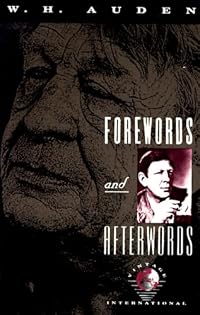
Forewords and Afterwords
by W. H. Auden 
On This Page
Description
Critical essays illuminate Auden's thoughts on literature, civilization, and human vision.Tags
Recommendations
















Member Reviews
Done! This was my traditional Christmas Eve book from my mother, and I've been picking at it since then. I finally gave myself permission to skim essays about books I hadn't read, which made it much more enjoyable. I've loved Auden's poetry since I was about thirteen, but I hadn't read much of his prose until now.
There are some real gems here. Auden's essays on Wilde, Houseman, Kipling, Wagner, Poe, Pope, Cavafy, and Caroll are all highlights for me (the Wagner is even very funny), and some of the lines have been familiar to me out of context for years: "From the beginning Wilde performed his life and continued to do so even after fate had taken the plot out of his hands."
There are also essays that pointed me towards interesting books; show more The Art of Eating by M. F. K. Fisher is intriguing (and his way of referring to her as "Mrs. Fisher" throughout the essay is so period, and so characteristic of him). I'm also very curious about Henry Mayhew's research among the London poor of the 19th century; London Labour and the London Poor is the volume mentioned, and Auden makes it sound absolutely riveting.
Auden's Freudian bias pops up sometimes. I mean, is it really true that when a man becomes a chef, he's imitating women's breastfeeding, but if a woman becomes a chef, it's because she's establishing that her worth doesn't rely on her ability to breastfeed? What, Wystan? Really?
Then, there are the times he feels himself qualified to make sweeping statements - for example, about the characters and motivations of all gay men everywhere. He says that it is "very rare for a homosexual to remain faithful to one person for long" because they can't have children, and lack that common interest. This is, frankly, just plain wrong from where I'm sitting, but then Auden had his own troubles with Chester Kallman, etc. Earlier in that same essay he writes that "few, if any homosexuals can honestly boast that their sex-life has been happy." I can imagine that in mid-centry America, a time of rampant hatred of gay men and women, when homosexuality was considered among the mainstream population to be truly depraved, this was more true than I can imagine.
And, if his essays tend to have a magesterial tone and to betray some personal quirks, well, so much the better. They're interesting, illuminating, and no-one else could have written them. show less
There are some real gems here. Auden's essays on Wilde, Houseman, Kipling, Wagner, Poe, Pope, Cavafy, and Caroll are all highlights for me (the Wagner is even very funny), and some of the lines have been familiar to me out of context for years: "From the beginning Wilde performed his life and continued to do so even after fate had taken the plot out of his hands."
There are also essays that pointed me towards interesting books; show more The Art of Eating by M. F. K. Fisher is intriguing (and his way of referring to her as "Mrs. Fisher" throughout the essay is so period, and so characteristic of him). I'm also very curious about Henry Mayhew's research among the London poor of the 19th century; London Labour and the London Poor is the volume mentioned, and Auden makes it sound absolutely riveting.
Auden's Freudian bias pops up sometimes. I mean, is it really true that when a man becomes a chef, he's imitating women's breastfeeding, but if a woman becomes a chef, it's because she's establishing that her worth doesn't rely on her ability to breastfeed? What, Wystan? Really?
Then, there are the times he feels himself qualified to make sweeping statements - for example, about the characters and motivations of all gay men everywhere. He says that it is "very rare for a homosexual to remain faithful to one person for long" because they can't have children, and lack that common interest. This is, frankly, just plain wrong from where I'm sitting, but then Auden had his own troubles with Chester Kallman, etc. Earlier in that same essay he writes that "few, if any homosexuals can honestly boast that their sex-life has been happy." I can imagine that in mid-centry America, a time of rampant hatred of gay men and women, when homosexuality was considered among the mainstream population to be truly depraved, this was more true than I can imagine.
And, if his essays tend to have a magesterial tone and to betray some personal quirks, well, so much the better. They're interesting, illuminating, and no-one else could have written them. show less
Most of these pieces, especially the first half, are long and detailed synopses of the books with added facts and points of view from Auden's immense knowledge. Shakespeare and Goethe can especially detailed examination. Other people I had not heard of are worthy of Auden's detailed introduction. This includes Sidney Smith from whom comes this interesting quote about "nice people"
Of course, Auden does not merely entertain use with quotes. He shares much of his intelligence and trove of facts, putting that together such as in this detailed definition of the subtle nature of the English Whig from his introduction to The Selected Writings of Sydney Smith:
...another from his trove that resonated with me:
...Sydney Smith's use of bourgeois terms to define A Nice Person:show more
A nice person is neither too tall nor too short, looks clean and cheerful, has no prominent features, makes no difficulties, is never displaced, sits bodkin, is never foolishly affronted, and is void of affectations. ... A nice person is clear of trumpery little passions, acknowledges superiority,
delights in talent, shelters humility, pardons adversity, for- gives deficiency, respects all men's rights, never stops the bottle, is never long and never wrong, always knows the day of the month, the name of everybody at table, and never gives pain to any human being.... A nice person never knocks over wine or melted butter, does not tread upon the dog's foot, or molest the family cat, eats soup without noise, laughs in the right place, and has a watchful and attentive eye.
Of course, Auden does not merely entertain use with quotes. He shares much of his intelligence and trove of facts, putting that together such as in this detailed definition of the subtle nature of the English Whig from his introduction to The Selected Writings of Sydney Smith:
The historical experience with which the Whigs of 1688 and their successors had to cope was a century and a half of bitter quarrels and drastic changes imposed upon the public by individuals or minorities. The most fundamental notion in English Liberalism, therefore, is the notion of limited sovereignty and its characteristic way of thinking goes something like this:
1. All people differ from each other in character and temperament so that any attempt to impose an absolute uniformity is a tyranny. On the other hand there can be no social life unless the members of a society hold certain beliefs in common, and behave in certain commonly accepted ways
2. The beliefs which it is necessary to hold in common must therefore be so defined that differences of emphasis are possible and the laws which regulate social conduct must be such that they command common consent. Insofar as conformity has to be enforced, this should be in matters of outward behavior not of private belief, firstly because there can be no doubt whether an individual does or does not conform, and secondly because men find behaving in a way with which they are not in complete sympathy more toler- able than being told to believe something they consider false. Thus, in the English Prayer Book the rules for con- ducting the Liturgy are precise, while the meaning of the Thirty-Nine Articles is purposely left vague.
3. The way in which a reform is effected is just as important as the reform itself. Violent change is as injurious to free- dom as inertia.
4. Utopians are a public menace. Reformers must concern themselves with the concrete and the possible.
...another from his trove that resonated with me:
Dag Hammerskjöld, in a diary found after his death and just recently published in Sweden, makes an observation to which both the above types would do well to listen.show lessHow easy Psychology has made it for us to dismiss the perplexing mystery with a label which assigns it a place in the list of common aberrations.
so many pp bookmarked - must make a day of it - or a week - could designate 1 day a week - or month - for this - each book mark discovered reveals a marvel of wit
Ratings
Members
- Recently Added By
Published Reviews
ThingScore 100
As a volume conveying Auden’s European magnitude as an artist, this collection of his ancillary prose could scarcely be bettered. In its casual way (casual in the happenstance of its occasions and compilation: there is, of course, nothing casual whatever about its thought and craft) it is a testament not just to Auden’s culture but to culture – the European artistic civilization which, show more we can now see, Auden was as effective as Eliot in comprehending and maintaining. And he was more at ease in it than Eliot. In every sense he was at home...
On top of these things there is the insistence that the facts of art are concrete and practical, and that educating yourself in them is a matter of finding out about them, and that years might go by before the truth reveals itself. By returning to this point over and over – by always insisting that of finding things out there is no end – Auden creates, unbeatably, the feeling that education is lifelong, addictive, playful. In him there is no element of the self-immolating drudge. He would never have been capable of Eliot’s sermon on the necessity for the student to embrace boredom. show less
On top of these things there is the insistence that the facts of art are concrete and practical, and that educating yourself in them is a matter of finding out about them, and that years might go by before the truth reveals itself. By returning to this point over and over – by always insisting that of finding things out there is no end – Auden creates, unbeatably, the feeling that education is lifelong, addictive, playful. In him there is no element of the self-immolating drudge. He would never have been capable of Eliot’s sermon on the necessity for the student to embrace boredom. show less
added by SnootyBaronet
Author Information

306+ Works 14,499 Members
W. H. Auden, who was born in York, England, on February 21, 1907, is one of the most successful and well-known poets of the 20th century. Educated at Oxford, Auden served in the Spanish Civil War, which greatly influenced his work. He also taught in public schools in Scotland and England during the 1930s. It was during this time that he rose to show more public fame with such works as "Paid on Both Sides" and "The Orators." Auden eventually immigrated to the United States, becoming a citizen in 1946. It was in the U.S. that he met his longtime partner Chester Kallman. Stylistically, Auden was known for his incomparable technique and his linguistic innovations. The term Audenesque became an adjective to describe the contemporary sounding speech reflected in his poems. Auden's numerous awards included a Bollingen Prize in Poetry, A National Book Award for "The Shield of Achilles," a National Medal for Literature from the National Book Committee, and a Gold Medal from the National Institute of Arts and Letters. Numerous volumes of his poetry remain available today, including "About the House" and "City Without Walls." W.H. Auden died on September 28, 1973 in Vienna. (Bowker Author Biography) show less
W. H. Auden has a Legacy Library. Legacy libraries are the personal libraries of famous readers, entered by LibraryThing members from the Legacy Libraries group.
Series
Belongs to Publisher Series
Common Knowledge
- First words
- Once upon a time there was a little boy.
- Quotations
- Idle curiosity is an ineradicable vice of the human mind. All of us like to discover the secrets of our neighbors, particularly the ugly ones. This has always been so, and, probably, always will be. What is relatively new, ho... (show all)wever—it is scarcely to be found before the latter half of the eighteenth century—is a blurring of the borderline between the desire for truth and idle curiosity, until, today, it has been so thoroughly erased that we can indulge in the latter without the slightest pangs of conscience. A great deal of what today passes for scholarly research is an activity no different from that of reading somebody’s private correspondence when he is out of the room, and it doesn’t really make it morally any better if he is out of the room because he is in his grave.
In our culture, we have good reason to be skeptical when anyone claims to have experienced the Vision of Eros, and even to doubt if it ever occurs, because half our literature, popular and highbrow, ever since the Provencal p... (show all)oets made the disastrous mistake of trying to turn a mystical experience into a social cult, is based on the assumption that what is, prohably, a rare expcri-ence, is one which almost everybody has or ought to have; if they don’t, then there must be something wrong with them. We know only too well how often, when a person speaks of having “fallen in love” with X, what he or she really feels could be described in much cruder terms. - Last words
- (Click to show. Warning: May contain spoilers.)How can we contemplate the not so distant future with anything but alarm when no method both morally tolerable and practically effective has as yet been discovered for reducing the population of the world to a tenth of its present size and keeping it there?
Classifications
- Genres
- Nonfiction, Literature Studies and Criticism, Fiction and Literature
- DDC/MDS
- 809 — Literature & rhetoric Literature, rhetoric & criticism History, description, critical appraisal of more than two literatures
- LCC
- PN511 .A78 — Language and Literature Literature (General) Literature (General) Literary history Collections
- BISAC
Statistics
- Members
- 249
- Popularity
- 129,886
- Reviews
- 3
- Rating
- (4.33)
- Languages
- English, Spanish
- Media
- Paper
- ISBNs
- 6
- ASINs
- 2