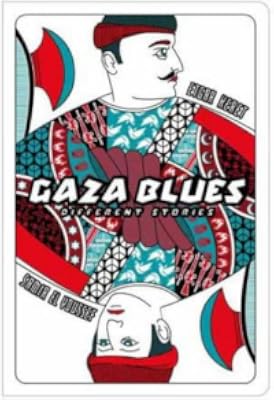
Gaza Blues: Different Stories
by Samir El-Youssef, Etgar Keret
On This Page
Description
Two writers, Israeli Etgar Keret and Palestinian Samir El-youssef, have engaged in a challenging and provocative artistic collaboration, producing a book of short stories and a novella exploring different aspects of a fraught and complex situation. Their darkly humorous tales reflect the dreams and nightmares of living in Israel today and during the first Intifada. All of Keret's collections have been best-sellers in Israel and have been translated to high acclaim around the world - into show more seventeen languages so far - and now, for the first time into English in the UK. show lessTags
Recommendations




































Member Reviews
This is a bizarre, but brave little book. Etgar Keret begins it with his strange short fiction, some stories of which I have read elsewhere. My favorite story of Keret's was "Shoshi 3", a clever, unfinished story in the very middle of the book. A longish story by Samir El-Youssef ends the book. That was an odd read for me because it was almost as if I had to have an Israeli give me permission to read a story about angry Palestinians. I actually liked that story ("The Day The Beast Got Thirsty") the best, most likely because it was the most developed of all those short stories in this book. It told of a Palestinian living in Lebanon who wanted to get a visa to any other country, but who deep down knew he'd never get one.
This book is an show more interesting experiment in Israeli-Palestinian cooperation. I'd like to see more of this. Learning about one another, in all of our humanity and with all of our dirt, is what will eventually bring us together. show less
This book is an show more interesting experiment in Israeli-Palestinian cooperation. I'd like to see more of this. Learning about one another, in all of our humanity and with all of our dirt, is what will eventually bring us together. show less
A combination of deadpan/throwaway sketches, by an Israeli author, and one long short story by a Palestinian author. Haven't read the palestinian short story yet, but I was disappointed by the Israeli sketches - there were some interesting ideas (eg a pathologist discovers that a woman who died in a suicide bombing had advanced cancer and would have died soon in any case - should he tell her husband?) - but these are never developed - the author seems to care more about maintaining a flip, throwaway tone in the face of all the violence. Which I am sure makes him very cool, but doesn't do a lot for the stories...
Update: The story by Samir El-Youssef is different in style from the first part of the book - one longer story instead of the show more sketches. But it does make sense to put them together in one book - they share a similar tone - disjointed, affectless and cynical. show less
Update: The story by Samir El-Youssef is different in style from the first part of the book - one longer story instead of the show more sketches. But it does make sense to put them together in one book - they share a similar tone - disjointed, affectless and cynical. show less
This book consists of 15 of Keret's short stories and one novella by El-Youssef. Of the Keret stories, only the "Shoshi" stories do not appear in Keret's previously published collections (in English), but the "Shoshi" ones are interesting in that they culminate in a bit of meta-fiction, which I have not seen from Keret before. El-Youssef's story, "The Day the Beast Got Thirsty," is slow-moving compared to Keret's flash fiction, but it manages to say something important about the mental state of a group of people who feel displaced, unwelcome, and impotent. It's not a cohesive collection as such, but the collaboration between the two writers is what's really interesting here and their effort should be not only applauded but repeated.
"Gaza Blues" is an interesting idea for a book. It contains 15 short stories by the Israeli writer Etgar Keret and a novella by Samir el-Youssef, who grew up in a Palestinian refugee camp and now lives in London. First published in Israel, its significance there is obvious. I bought it after Keret appeared at Jewish Book Week earlier this year, and I am mightily impressed by his writing.
Keret is a practitioner of the short short story. The longest tale in this book is 14 pages, the shortest three. The longest, "For Only $9.99 (Incl. Tax and Postage)", is one of the best, describing what happens to a man who answers a newspaper small ad promising to reveal the meaning of life to him for this price.
Other stories are told from children's show more perspective, such as "The Son of the Head of the Mossad", who thinks his father owns an earth moving business, or "Shoes", the story of a boy who learns much from the purchase of a pair of adidas trainers.
There is a deadpan humour at work in many of Keret's stories. At JBW he expressed an admiration for Kurt Vonnegut, whose influence shows in stories like "Crazy Glue", in which a wife superglues herself to the ceiling to try and get her husband to pay more attention to her.
Some of the stories are more thoughtful, such as "Surprise Egg", the musings of a doctor who discovers the body of a victim of a suicide bombing is so riddled with cancerous tumours they would have died shortly anyway.
Samir el-Youssef's contribution, "The Day the Beast Got Thirsty" is more rambling, and not just because its 60 pages long rather than 6. It follows Bassem, a pot smoking resident of a Lebanese refugee camp, his encounters with various other residents, and his efforts to get a visa to live in Germany. Bassem's habits give him a very laidback, cynical air compared to his friend the political firebrand Ahmad and give the whole story a slightly unreal quality. Overall, its perhaps a little too rambling, but not bad.
I'd recommend Keret's work to those who like quirky short stories. If you can't find this, three other collections exist: "The Nimrod Flip Out", "Missing Kissinger" and the splendidly titled "The Bus Driver Who Wanted to be G-d". show less
Keret is a practitioner of the short short story. The longest tale in this book is 14 pages, the shortest three. The longest, "For Only $9.99 (Incl. Tax and Postage)", is one of the best, describing what happens to a man who answers a newspaper small ad promising to reveal the meaning of life to him for this price.
Other stories are told from children's show more perspective, such as "The Son of the Head of the Mossad", who thinks his father owns an earth moving business, or "Shoes", the story of a boy who learns much from the purchase of a pair of adidas trainers.
There is a deadpan humour at work in many of Keret's stories. At JBW he expressed an admiration for Kurt Vonnegut, whose influence shows in stories like "Crazy Glue", in which a wife superglues herself to the ceiling to try and get her husband to pay more attention to her.
Some of the stories are more thoughtful, such as "Surprise Egg", the musings of a doctor who discovers the body of a victim of a suicide bombing is so riddled with cancerous tumours they would have died shortly anyway.
Samir el-Youssef's contribution, "The Day the Beast Got Thirsty" is more rambling, and not just because its 60 pages long rather than 6. It follows Bassem, a pot smoking resident of a Lebanese refugee camp, his encounters with various other residents, and his efforts to get a visa to live in Germany. Bassem's habits give him a very laidback, cynical air compared to his friend the political firebrand Ahmad and give the whole story a slightly unreal quality. Overall, its perhaps a little too rambling, but not bad.
I'd recommend Keret's work to those who like quirky short stories. If you can't find this, three other collections exist: "The Nimrod Flip Out", "Missing Kissinger" and the splendidly titled "The Bus Driver Who Wanted to be G-d". show less
Ratings
Members
- Recently Added By
Lists

Jewish Books
367 works; 24 members

jewish themed novels
25 works; 5 members

Best Israeli Reading
55 works; 12 members

Middle East Fiction
179 works; 15 members
Author Information

3+ Works 166 Members

64+ Works 4,000 Members
Etgar Keret was born on August 20, 1967 in Israel. He is an Israeli-Polish writer known for his short stories, graphic novels, and scriptwriting for film and television. He is a lecturer at Ben-Gurion University of the Negev in Beer Sheva, and at Tel Aviv University. Keret's first published work was Pipelines, a collection of short stories. His show more second book, Missing Kissinger, a collection of fifty very short stories, caught the attention of the general public. He has also co-authored several comic books, among them Nobody Said It Was Going to Be Fun with Rutu Modan and Streets of Fury with Asaf Hanuka. In 1998, Keret published Kneller's Happy Campers, He also wrote a children's book Dad Runs Away with the Circus. In 2016 his title The Seven Good Years made the New Zealand Best Seller List. (Bowker Author Biography) show less
Series
Belongs to Publisher Series
Sammlung Luchterhand (62100)
Common Knowledge
- Canonical title*
- Alles Gaza
- Original title
- Gaza blues
- Original publication date
- 2004
- Important places
- Gaza Strip; Lebanon; Israel
- First words*
- Gaza Blues / Etgar Keret: Weissmann hatte einen trockenen Husten, der klang wie der Husten eines Tbc-Kranken, den ganzen Weg hustete er nur und spuckte in Papiertaschentücher.
Schuhe / Etgar Keret: Am Holocaust-Gedenktag fuhren wir mit der Lehrerin Sara mit dem 57er zum Haus der Juden von Wolhyn, und ich fühlte mich ungemein bedeutend.
Menstruationsbeschwerden / Etgar Keret: Ich träumte in der Nacht, ich sei eine vierzigjährige Frau und mein Mann Oberst der Reserve.
Der Sohn des Chefs vom Mossad / Etgar Keret: Der Sohn des Chefs vom Mossad wusste nicht einmal, dass er der Sohn des Chefs vom Mossad war.
Nylon / Etgar Keret: Der Feldwebel nahm Alons nylonverpacktes Verbandszeug und stopfte es in den Eimer.
Der höfliche Junge / Etgar Keret: Der höfliche Junge klopfte an die Tür. (show all 14)
Simion / Etgar Keret: An der Tür standen zwei.
Asthmaanfall / Etgar Keret: Wenn du einen Asthmaanfall hast, kriegst du keine Luft.
Der Stich / Etgar Keret: Es fing mit einem Kuss an.
Pudding / Etgar Keret: Bei dieser ganzen Geschichte mit Avichai Avudi hätte es meiner Meinung nach bei allen schrecklich rot aufleuchten müssen.
Mein Bruder ist deprimiert / Etgar Keret: Es ist nicht so, wie wenn dir irgendein Typ auf der Strasse erzählt, dass er deprimiert ist.
Überraschungsei / Etgar Keret: Dies ist eine wahre Geschichte.
Schlechtes Karma / Etgar Keret: Fünfzehn Schekel im Monat können deiner Tochter hunderttausend einbringen für den Fall - was wir nicht hoffen wollen -, dass du stirbst.
Der Tag, an dem die Bestie Durst bekam / Samir El-youssef: Ich hörte Ahmad gern zu. - Quotations*
- "Kunst! Kunst! Das ist es, was uns aus dem Zustand der Verkommenheit retten wird, in dem wir leben!" erklärte er, und seine Stimme überschlug sich fast vor Glück.
Samir El-youssef
Die Frau war tot, ihr Mann Witwer, ihre Kinder waren verwaist, das war von Bedeutung, das war das Traurige, und der ganze Rest war Geschwätz.
Etgar Keret - Last words*
- (Click to show. Warning: May contain spoilers.)Gaza Blues / Etgar Keret: Wir hätten nur Blues gesungen.
(Click to show. Warning: May contain spoilers.)Schuhe / Etgar Keret: Grossvater sagte nichts, aber dem Auftreten nach hatte ich das Gefühl, dass auch er zufrieden war.
(Click to show. Warning: May contain spoilers.)Menstruationsbeschwerden / Etgar Keret: Jetzt bin ich hier der Kommandant.
(Click to show. Warning: May contain spoilers.)Der Sohn des Chefs vom Mossad / Etgar Keret: Auch wenn sie gefragt hätten, hätte er ohnehin nicht geantwortet.
(Click to show. Warning: May contain spoilers.)Nylon / Etgar Keret: "Die Rekrutenzeit ist zu Ende", flüsterte er, "das Nylon kann aufgetrennt werden."
(Click to show. Warning: May contain spoilers.)Der höfliche Junge / Etgar Keret: "Ja", nickte der höfliche Junge und begann, die Tür hinter sich zuzuziehen, "ich weiss. Danke."
(Click to show. Warning: May contain spoilers.)Simion / Etgar Keret: "Es ist in Ordnung, wenn Sie weinen", sagte die Offizierin, "es hat keinen Sinn, es zurückzuhalten."
(Click to show. Warning: May contain spoilers.)Asthmaanfall / Etgar Keret: Ein Wort ist eine Menge, denn so ein Wort kann "hinsetzen", "Seretide" oder sogar "Ambulanz" sein.
(Click to show. Warning: May contain spoilers.)Der Stich / Etgar Keret: Ihr schien das schrecklich schmerzhaft.
(Click to show. Warning: May contain spoilers.)Pudding / Etgar Keret: Es dauert nicht länger als ein paar Minuten.
(Click to show. Warning: May contain spoilers.)Mein Bruder ist deprimiert / Etgar Keret: Er darf das, er ist deprimiert.
(Click to show. Warning: May contain spoilers.)Überraschungsei / Etgar Keret: Würde hier bei mir in der Küche sitzen.
(Click to show. Warning: May contain spoilers.)Schlechtes Karma / Etgar Keret: Im Radio meldeten sie starke Verkehrsbelastung auf der Autobahn, und als er wieder in den Spiegel spähte, sah er, wie Meital lächelte und dem Mann auf der Bahre zum Abschied winkte.
(Click to show. Warning: May contain spoilers.)Der Tag, an dem die Bestie Durst bekam / Samir El-youssef: Doch statt dessen rief ich: "Ich wollte, ich könnte dieses Land verlassen!"
*Some information comes from Common Knowledge in other languages. Click "Edit" for more information.
Classifications
- Genres
- General Fiction, Fiction and Literature
- DDC/MDS
- 892.437 — Literature & rhetoric Asian Literature Afro-Asiatic literatures Jewish, Israeli, and Hebrew Hebrew fiction 2000–
- LCC
- PJ5054 .K375 .A2 — Language and Literature Oriental languages and literatures Oriental philology and literature Hebrew Literature Individual authors and works
Statistics
- Members
- 96
- Popularity
- 334,583
- Reviews
- 5
- Rating
- (3.63)
- Languages
- 7 — Dutch, English, German, Greek, Italian, Norwegian (Bokmål), Turkish
- Media
- Paper
- ISBNs
- 8
- ASINs
- 1