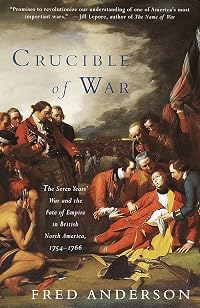
Crucible of War: The Seven Years' War and the Fate of Empire in British North America, 1754-1766
by Fred Anderson
On This Page
Description
In this vivid and compelling narrative, the Seven Years' War-long seen as a mere backdrop to the American Revolution-takes on a whole new significance. Relating the history of the war as it developed, Anderson shows how the complex array of forces brought into conflict helped both to create Britain's empire and to sow the seeds of its eventual dissolution. Beginning with a skirmish in the Pennsylvania backcountry involving an inexperienced George Washington, the Iroquois chief Tanaghrisson, show more and the ill-fated French emissary Jumonville, Anderson reveals a chain of events that would lead to world conflagration. Weaving together the military, economic, and political motives of the participants with unforgettable portraits of Washington, William Pitt, Montcalm, and many others, Anderson brings a fresh perspective to one of America's most important wars, demonstrating how the forces unleashed there would irrevocably change the politics of empire in North America. show lessTags
Recommendations








Member Reviews
While Fred Anderson's main goal is to put the contingency back in the history of the American Revolution, as the last thing that men like Benjamin Franklin and George Washington could have imagined at the conclusion of the French & Indian Wars is that they would be leading a revolution against London in the not-so-distant future, the pivot of this story would appear to be "blowback" to empire.
Consider that the last round of the game of empire between France and Britain had more to do with the Iroquois Nation losing their hold on their satellite nations in the Ohio County, having compromised the interests of those peoples one time too many. Thus leading to the situation where a subject leader of the Iroquois overrides George Washington show more to stage a sanguinary massacre against French captives to try and regain his authority, thus leading to a great war.
Or look at how British Empire quickly runs upon the rocks at the end of the Seven Years' War, as differing understandings of what it means to be a British subject could no longer be fudged, between the American attitude that empire was a collaborative effort, and the British effort to forge an efficient system in keeping with their understanding of what constituted proper order. This is while in a maelstrom of demographic changes and economic dislocation, the affects of which would have challenged the most daring of political leaders.
That last point might be the key issue, as the dislocations of empire, even in a winning cause, did open the door to daring leadership in America, and these are the men who swept away the old British order in the 13 Colonies; men who realized that popular sovereignty could now only be disregarded at one's own risk. The thing is that Anderson does not interpret this turn of events in a romantic "great man" fashion, but as a wave of chaos that could only be channeled, not held back. show less
Consider that the last round of the game of empire between France and Britain had more to do with the Iroquois Nation losing their hold on their satellite nations in the Ohio County, having compromised the interests of those peoples one time too many. Thus leading to the situation where a subject leader of the Iroquois overrides George Washington show more to stage a sanguinary massacre against French captives to try and regain his authority, thus leading to a great war.
Or look at how British Empire quickly runs upon the rocks at the end of the Seven Years' War, as differing understandings of what it means to be a British subject could no longer be fudged, between the American attitude that empire was a collaborative effort, and the British effort to forge an efficient system in keeping with their understanding of what constituted proper order. This is while in a maelstrom of demographic changes and economic dislocation, the affects of which would have challenged the most daring of political leaders.
That last point might be the key issue, as the dislocations of empire, even in a winning cause, did open the door to daring leadership in America, and these are the men who swept away the old British order in the 13 Colonies; men who realized that popular sovereignty could now only be disregarded at one's own risk. The thing is that Anderson does not interpret this turn of events in a romantic "great man" fashion, but as a wave of chaos that could only be channeled, not held back. show less
Detailed analysis of the French and Indian (F&I) Wars, also known as the Seven Years War, and its influence on the course of history. Anderson contends the F&I Wars laid the groundwork for the American Revolution and his case is compelling. It points out that cultural misunderstandings started very early, and there were many cultures involved, including the English, the Anglo-Americans, the French, the Franco-Americans (including those in Canada), the many American Indian tribes that joined alliances, and the tribes who desired to remain independent.
It is structured around groupings of most impact. It starts with the colonial and imperial situations at the beginning of the war. It then moves into the phases of fighting on the North show more American continent, follow-on fighting in other places in the world, and the aftermath of adjustment to the British Empire’s victory. It contains one of the best explanations of the Stamp Acts, and their consequences, that I have read.
The author excels at explaining the context in which these events took place, the battles (strategy, tactics, participants, and outcomes), and is one of the best examples of portraying the American Indian tribes as astute participants in the politics of the era (rather than the old-fashioned treatment as mostly ignorant “savages.”) For example, the American Indian tribes knew about the value of land ownership and the power it entails, which is often discounted in older histories of this period.
I cannot even imagine how much research went into this book. It is hard to complain that a book is too thorough, but at over 900 pages, the author seems to have covered all the vital material (and more). Anderson’s aim is far-reaching – he wanted to create a book that would appeal to historians and scholars, as well as us “regular readers” who are interested in history. It highlights a period of time that is often overlooked. It is written in a storytelling style and tries to avoid dry factual recitations (which it mostly achieves). I learned a lot from this book and recommend it to fellow history lovers. show less
It is structured around groupings of most impact. It starts with the colonial and imperial situations at the beginning of the war. It then moves into the phases of fighting on the North show more American continent, follow-on fighting in other places in the world, and the aftermath of adjustment to the British Empire’s victory. It contains one of the best explanations of the Stamp Acts, and their consequences, that I have read.
The author excels at explaining the context in which these events took place, the battles (strategy, tactics, participants, and outcomes), and is one of the best examples of portraying the American Indian tribes as astute participants in the politics of the era (rather than the old-fashioned treatment as mostly ignorant “savages.”) For example, the American Indian tribes knew about the value of land ownership and the power it entails, which is often discounted in older histories of this period.
I cannot even imagine how much research went into this book. It is hard to complain that a book is too thorough, but at over 900 pages, the author seems to have covered all the vital material (and more). Anderson’s aim is far-reaching – he wanted to create a book that would appeal to historians and scholars, as well as us “regular readers” who are interested in history. It highlights a period of time that is often overlooked. It is written in a storytelling style and tries to avoid dry factual recitations (which it mostly achieves). I learned a lot from this book and recommend it to fellow history lovers. show less
WOW! Just WOW!
This is one of the clearest, and most concise books on history I have ever read. Fred Anderson takes a little talked about time in not only American but world history and spreads a web across the globe. Who would have known what the events taking place in this short amount of time would lead to. The author brings out so many situations that are pure foreshadowing to not only the American Revolution but the Civil War as well. The players on this stage fly off the page and shake you. Wolfe, Washington, Montcalm, Pitt, Braddock... and many others. As you read this book these men are standing right in front of you. Washington with his calm expression of surprise and his ability to absorb the events unfolding around him with show more reluctant surprise. Wolfe in his manic OCD mannerisms. Braddock's one track mind. Pitt's desire for over achievement and the melancholy distrusting mind of Montcalm. My favorite chapter is probably the battle of Quebec between Wolfe and Montcalm. This book is highly recommended and you can smell it. It is amazing what History writers like Anderson bring to the table. Anderson is in good company with, Asbridge, Bauer and Dan Jones. It is quite obvious how much a labor of love this book is. My hats off to Mr. Anderson for sharing it with us.
Having finished this book only a few days ago It is still lingering in my mind. The last half of the book goes into detail in regards to the events that would eventually lead to revolution: The Stamp act and other events that ruffled the feathers of the Colonist. The author really shows us the way they looked at the world around them. The ghosts of men like Wolfe and Braddock and their deeds (or misdeeds, accomplishments or failures) regardless, their actions teetered like ghosts as the road to change went from one lane to a super highway in a very short period of time. show less
This is one of the clearest, and most concise books on history I have ever read. Fred Anderson takes a little talked about time in not only American but world history and spreads a web across the globe. Who would have known what the events taking place in this short amount of time would lead to. The author brings out so many situations that are pure foreshadowing to not only the American Revolution but the Civil War as well. The players on this stage fly off the page and shake you. Wolfe, Washington, Montcalm, Pitt, Braddock... and many others. As you read this book these men are standing right in front of you. Washington with his calm expression of surprise and his ability to absorb the events unfolding around him with show more reluctant surprise. Wolfe in his manic OCD mannerisms. Braddock's one track mind. Pitt's desire for over achievement and the melancholy distrusting mind of Montcalm. My favorite chapter is probably the battle of Quebec between Wolfe and Montcalm. This book is highly recommended and you can smell it. It is amazing what History writers like Anderson bring to the table. Anderson is in good company with, Asbridge, Bauer and Dan Jones. It is quite obvious how much a labor of love this book is. My hats off to Mr. Anderson for sharing it with us.
Having finished this book only a few days ago It is still lingering in my mind. The last half of the book goes into detail in regards to the events that would eventually lead to revolution: The Stamp act and other events that ruffled the feathers of the Colonist. The author really shows us the way they looked at the world around them. The ghosts of men like Wolfe and Braddock and their deeds (or misdeeds, accomplishments or failures) regardless, their actions teetered like ghosts as the road to change went from one lane to a super highway in a very short period of time. show less
This history opens with an argument: that the French and Indian War (or Seven Years War) was not the prologue to the American Revolution, but rather that the American Revolution was the epilogue to the French and Indian War. The author recenters this war as the pivotal event of the 18th century, and no more was this true than in North America. While the conflict in Europe and the rest of the world is covered (the Seven Years War was a global war), the role and battles in North America are delved into in detail. Figures like George Washington come up frequently, although I was left more intrigued by the role played by multiple native groups, who switched sides and rebelled in attempts to assert their rights. Overall, a book that enhanced show more my understanding of American history and a war that likely deserves more attention. show less
Though long overshadowed in the traditional historical narrative by the American Revolution, the Seven Years’ War, as Fred Anderson argues, is the most important event in the eighteenth-century North American history. Fought in the untamed wilderness which both France and Britain claimed, the struggle brought an end to the French empire in North America. Yet ironically in doing so, it sowed the seeds for the eventual collapse of Britain’s own empire in the Americas by expanding it beyond a manageable size and creating pressures that ultimately led the thirteen colonies to rebel. This war and its legacy is the subject of this superb book, one that offers a complex and inter-layered narrative of the origins, conduct, and consequences show more of this often-ignored conflict.
Anderson begins by examining the interaction between the British, the French, and the Iroquois in the Ohio Valley. Sandwiched between the two European empire, the Iroquois Confederacy played one off the other successfully for many years. Yet land concessions to the British in the 1740s soon paved the way for growing encroachment of the Ohio Valley by British colonists, prompting the French to assert their own claims to the region. When war erupted in 1754 (as a result of a clash between a French force and a party of Virginians and Indians, one carefully reconstructed and dramatically retold by Anderson), it expanded gradually into a general conflict between Britain and France, with fighting taking place on nearly every continent.
The war is the dominant focus of Anderson’s book, and he supplies a readable and insightful narrative of the course of the war. While his focus is predominantly on the political and military struggles in North America, he also provides an description of the relevant British politics and a summary of the war in Europe. Particularly notable is his coverage of the Native Americans, which he depicts not as opportunistic savages but as canny political operators who saw themselves as free agents involved in a web of relationships with each other as well as with the colonial powers. Though the book bogs down in his subsequent examination of the postwar adjustments to British victory, these chapters make for fascinating reading by demonstrating just how close the link was between the problems posed by Britain’s triumph and the protests that ultimately would lead to rebellion.
By the end of the book, it is hard to deny the merits of Anderson’s argument. Through his expert analysis and deft interweaving of people and events, he succeeds in restoring the Seven Years’ War to the pivotal place it deserves in American history. Clearly written and supplemented with numerous images and maps, it is a masterful study of the war, one unlikely to be surpassed in its breadth of coverage or quality of its analysis. For anyone seeking a history of the war and its legacy for American history, this is the book to read. show less
Anderson begins by examining the interaction between the British, the French, and the Iroquois in the Ohio Valley. Sandwiched between the two European empire, the Iroquois Confederacy played one off the other successfully for many years. Yet land concessions to the British in the 1740s soon paved the way for growing encroachment of the Ohio Valley by British colonists, prompting the French to assert their own claims to the region. When war erupted in 1754 (as a result of a clash between a French force and a party of Virginians and Indians, one carefully reconstructed and dramatically retold by Anderson), it expanded gradually into a general conflict between Britain and France, with fighting taking place on nearly every continent.
The war is the dominant focus of Anderson’s book, and he supplies a readable and insightful narrative of the course of the war. While his focus is predominantly on the political and military struggles in North America, he also provides an description of the relevant British politics and a summary of the war in Europe. Particularly notable is his coverage of the Native Americans, which he depicts not as opportunistic savages but as canny political operators who saw themselves as free agents involved in a web of relationships with each other as well as with the colonial powers. Though the book bogs down in his subsequent examination of the postwar adjustments to British victory, these chapters make for fascinating reading by demonstrating just how close the link was between the problems posed by Britain’s triumph and the protests that ultimately would lead to rebellion.
By the end of the book, it is hard to deny the merits of Anderson’s argument. Through his expert analysis and deft interweaving of people and events, he succeeds in restoring the Seven Years’ War to the pivotal place it deserves in American history. Clearly written and supplemented with numerous images and maps, it is a masterful study of the war, one unlikely to be surpassed in its breadth of coverage or quality of its analysis. For anyone seeking a history of the war and its legacy for American history, this is the book to read. show less
This is a masterful work of history. Anderson seamlessly blends scholarship with clear and engaging writing. When I first picked the book up I was concerned that it would be a slog, but the pages just flew by.
While providing an excellent history of the French and Indian War, Anderson also tracks the larger trends shaping 18th Century North America, putting the war in the context of relations between the European colonists and the Native Americans as well as the relations between the colonists and Europe.
While providing an excellent history of the French and Indian War, Anderson also tracks the larger trends shaping 18th Century North America, putting the war in the context of relations between the European colonists and the Native Americans as well as the relations between the colonists and Europe.
Anderson presents and elegantly defends the thesis that the American Revolution is founded in American experiences directly related to the Seven Years' War. Utilizing historical documents, the author shows how the conflict in the colonies lead to a war England did not want to fight and could not afford to fight; how the taxation measures intended to pay the colonists' part of the war lead to the fight against taxation without representation; how the treatment of British soldiers was in direct conflict with what the colonists' saw as their rights as Englishmen; and how the freedoms generally taken for granted by the colonists were is conflict with the realities in England and what the rulers (governors, etc) saw as their roles.
One other show more thing brought forth very clearly in his discourse is that the Seven Years' War really was a 'world war' as it was fought around the globe by the English and the French.
I found the book to be a very good read and very stimulating. While I may have had minor quibbles with some points, I think the author has done a very good job of presenting, defending and proving his thesis. show less
One other show more thing brought forth very clearly in his discourse is that the Seven Years' War really was a 'world war' as it was fought around the globe by the English and the French.
I found the book to be a very good read and very stimulating. While I may have had minor quibbles with some points, I think the author has done a very good job of presenting, defending and proving his thesis. show less
Members
- Recently Added By
Published Reviews
ThingScore 100
Fred Anderson's study of the Seven Years' War synthesizes several lines of scholarship and offers many new insights into that complex event and the decade that followed. His fundamental argument is that the war initiated a dispute about the nature of the British Empire that continued after the peace treaty and led directly to American Revolution. Here Anderson picks up the venerable debate show more between historians who argue that the Revolution was the "aftermath" of the Seven Years' War and others who emphasize the Stamp Act and regulations. The former concentrate on the financial burden and the new western migration that the War brought in its train. Those who finger the Stamp Act portray the Revolution as a conflict over principle or at least ideology; they view the Revolutionaries as deeply committed to the idea that the central government was subject to principled limitations.
Anderson believes that these two interpretations can be reconciled. show less
Anderson believes that these two interpretations can be reconciled. show less
added by private library
Lists

Best U.S. History Books (1754-1828)
363 works; 18 members

SantaThing 2014 Gifts
299 works; 17 members

r/AskHistorians' Recommended Books
1,068 works; 18 members
Author Information

6 Works 2,372 Members
Fred Anderson is Professor of History at the University of Colorado, Boulder.
Some Editions
Awards and Honors
Awards
Distinctions
Common Knowledge
- Canonical title
- Crucible of War: The Seven Years' War and the Fate of Empire in British North America, 1754-1766
- Original publication date
- 2000-02-11
- People/Characters
- George Washington; William Pitt the Elder (1st Earl of Chatham); George II, King of Great Britain and Ireland; Louis-Joseph de Montcalm-Gozon; General James Wolfe; James Abercromby (or Abercrombie, British Army officer, 1706 to 1781) (show all 60); Jeffrey Amherst; Edward Braddock; George III, King of the United Kingdom; George Grenville; William Johnson (1st Baronet); John Campbell, Earl of Loudon; George Anson, 1st Baron Anson (1697 to 1762); Isaac Barre (1726 to 1802); John Russell, 4th Duke of Bedford; Francis Bernard (1st Baronet, 1712-1779); Louis-Antoine de Bougainville (Comte de Bougainville, 1729-1811); John Bradstreet, Major General (b. Jean-Baptiste Bradstreet, 1714-1774); John Stuart, 3rd Earl of Bute; Cadwallader Colden; Claude-Pierre Pecaudy, seigneur de Contrecoeur; Henry Seymour Conway (Field Marshal); George Croghan (fur trader, c 1718 to 1782); William Augustus, Duke of Cumberland; William Denny; Jean Erdman, Baron Dieskau; Robert Dinwiddie, Governor of Virginia; Charles Wyndham, 2d Earl of Egremont; Francis Fauquier; Ferdinand of Brunswick-Wolfenbuttel; John Forbes (British Army officer); Henry Fox, 1st Baron Holland; Benjamin Franklin; Frederick II, King of Prussia; Thomas Gage; George Montagu Dunk, 2d Earl of Halifax; Hendrick Theyanoguin (Chief Hendrik); Thomas Hutchinson; Joseph Coulon de Jumonville; François-Gaston de Lévis, 1st Duke of Lévis (previously chevalier de Levis); John Ligonier, 1st Earl Ligonier; Louis XV, King of France; Robert Monckton (British Army Officer, 1726 to 1782); James Murray (British Army officer); Thomas Pelham-Holles, 1st Duke of Newcastle-upon-Tyne and 1st Duke of Newcastle-under-Lyne; James Otis, Jr.; Israel Pemberton (Jr., 1715 to 1779); Pontiac (Obwaandi'eyaag); Thomas Pownall; Charles Watson-Wentworth, 2nd Marquess of Rockingham; Shingas; William Shirley; Tamaqua (or Tamaque); Tanaghrisson (or Tanacharison); Teedyuscung; Charles Townshend (1725 to 1767); George Townshend, 1st Marquess Townshend (1724 to 1807); Pierre de Rigaud, marquis de Vaudreuil-Cavagnial; Daniel Webb; John Wilkes
- Important places
- British North America; Cape Breton Island, Nova Scotia, Canada; Fortress of Louisbourg, Louisbourg, Nova Scotia, Canada; Nova Scotia, Canada; Montréal, Québec, Canada; New France (show all 12); Lake George, New York, USA; Fort William Henry, New York, USA; Fort Ticonderoga, New York, USA; St. John's, Newfoundland, Canada; Louisbourg, Nova Scotia, Canada; Fort Duquesne, Pittsburgh, Pennsylvania, USA
- Important events
- Georgian Era (1714 | 1837); Seven Years' War (1754 | 1766); French and Indian War (1754 | 1763); Treaty of Paris (1763)
- Dedication
- To Virginia, at last
- First words
- Few reveries haunt history professors more insistently than the dream of writing a book accessible to general readers that will also satisfy their fellow historians' scholarly expectations. (Introduction)
The rain had fallen all night, a steady, miserable rain; and when at last the light grew to the point that he could see his troops, George Washington realized that seven of them were lost in the forest, God knew where. (Prolo... (show all)gue)
Wars between France and England (or after the Act of Union in 1707, Great Britain) dominated European politics between 1689 and 1815. - Last words
- (Click to show. Warning: May contain spoilers.)And the great Indian war had shown, as the Stamp Act crisis had demonstrated, the both the sufferance of the supposedly conquered and the allegiance of the colonists had limits that were all too easy to exceed.
(Click to show. Warning: May contain spoilers.)For ours is, in the end, an inheritance shaped no less by the quest for power than by the pursuit of happiness. (Epilogue) - Publisher's editor
- Christopher Rogers (first editor); Peter La Bella (2d editor)
- Blurbers
- Lepore, Jill; Higginbotham, Don; Shy, John; Faragher, John
- Original language
- English
- Disambiguation notice
- Full title (2000): Crucible of war : the Seven Years' War and the fate of empire in British North America, 1754-1766 / Fred Anderson ; with illustrations fro... (show all)m the William L. Clements Library
Classifications
- Genres
- History, Nonfiction, General Nonfiction
- DDC/MDS
- 973.26 — History & geography History of North America United States Colonial period (1607-1775) Extension of English rule (1732-63)
- LCC
- E199 .A59 — History of the United States United States Colonial history (1607-1775) By period 1689-1775 French and Indian War, 1755-1763
- BISAC
Statistics
- Members
- 1,307
- Popularity
- 18,451
- Reviews
- 12
- Rating
- (4.30)
- Languages
- English
- Media
- Paper, Audiobook, Ebook
- ISBNs
- 7
- ASINs
- 7