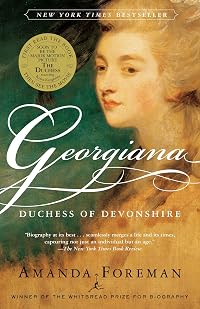
Georgiana, Duchess of Devonshire
by Amanda Foreman
On This Page
Description
Lady Georgiana Spencer was the great-great-great-great-aunt of Diana, Princess of Wales, and was nearly as famous in her day. In 1774 Georgiana achieved immediate celebrity by marrying William Cavendish, fifth duke of Devonshire, one of England's richest and most influential aristocrats. She became the queen of fashionable society and founder of the most important political salon of her time. But Georgiana's public success concealed an unhappy marriage, a gambling addiction, drinking, show more drug-taking, and rampant love affairs with the leading politicians of the day. With penetrating insight, Amanda Foreman reveals a fascinating woman whose struggle against her own weaknesses, whose great beauty and flamboyance, and whose determination to play a part in the affairs of the world make her a vibrant, astonishingly contemporary figure.--From publisher description. show lessTags
Recommendations








Member Recommendations

Member Reviews
This is a terrific biography of a remarkable woman. The Duchess was born Georgiana Spencer, is the great-great-great-great aunt of Princess Diana, and was just as famous in her day. She married early and unhappily, but was the standard-bearer for fashion; wrote novels, poetry, and plays; was a scholar of chemistry and mineralogy; and was the backbone of the Whig party, actively campaigning, influencing policy, and directing political strategy. Her early married life was a whirlwind of social and political activity, during which she developed a massive gambling addiction, amassed staggering debt, and sustained her breakneck lifestyle and personal woes (among them her loveless marriage and numerous miscarriages) with non-stop parties, show more alcohol, and laudanum. Particularly interesting is her relationship with Bess (Lady Elizabeth Foster) who enters the Devonshire household as a friend and something of a financial ward, and begins a long term affair with the Duke.
This book is a well-researched and fascinating glimpse into 18th century life, where Georgiana always seemed to be in the thick of everything, including the Regency Crisis of the late 1780s, and the French Revolution. The political history in the book was a little dense and hard-to-follow at times, but given her political influence, passion, and acumen, it is absolutely necessary to the book. The current climate of political mudslinging and celebrity worship/vitriol appeared to be no different in her day, and Georgiana was the regular target of all of it. At times it was tempting to dismiss her life of parties and gambling, yet her accomplishments are astounding for a woman of that (or any) era, and I wept at her death in 1806. Hollywood could not have scripted her life any better, and now I am keen to see The Duchess, the Keira Knightley adaptation of this book. show less
This book is a well-researched and fascinating glimpse into 18th century life, where Georgiana always seemed to be in the thick of everything, including the Regency Crisis of the late 1780s, and the French Revolution. The political history in the book was a little dense and hard-to-follow at times, but given her political influence, passion, and acumen, it is absolutely necessary to the book. The current climate of political mudslinging and celebrity worship/vitriol appeared to be no different in her day, and Georgiana was the regular target of all of it. At times it was tempting to dismiss her life of parties and gambling, yet her accomplishments are astounding for a woman of that (or any) era, and I wept at her death in 1806. Hollywood could not have scripted her life any better, and now I am keen to see The Duchess, the Keira Knightley adaptation of this book. show less
With many historical figures the problem is to place the character in context for the life and time of the reader. Sometimes the smartphone internet cafe moccachino user just does not ‘get’ the medieval monk. With Georgiana, Duchess of Devonshire (1757-1806) we have no such problems. She is a woman as suited to the 21st century as she was (and was not) to the 18th century.
With many historical figures the problem is to place the character in context for the life and time of the reader. Sometimes the smartphone internet cafe moccachino user just does not ‘get’ the medieval monk. With Georgiana, Duchess of Devonshire (1757-1806) we have no such problems. She is a woman as suited to the 21st century as she was (and was not) to the show more 18th century.
Georgiana blasted her way to prominence through force of personality. No great beauty, she was adored by almost all who met her and dominated the London smart set, the ton, for most of her life. She all but ran the Whig party during the crucial years at the turn of the 19th century. She had everything that we would call desirable today: fame, adulation, power and money. Think of her as a sublime mix of Kim Kardashian, Beyonce, the Duchess of Cambridge and Hillary Clinton.
There was also a dark side. She had a gambling addiction and never really understood the value of money. Her gambling and other debts almost bankrupted her husband, the Duke. She took lovers and her illegitimate child almost ruined her marriage; that it did not says much about the infidelity of the Duke and the mores of the time. She almost certainly had a long-term lesbian love affair with Lady Elizabeth Foster, ‘Bess’, who shared her home and her husband.
Throughout this book, no matter how reprehensible, shocking or unacceptable (to our eyes) her actions, we cannot help but fall a little in love with Georgiana and root for her to succeed as we would any fictional heroine.
Amanda Foreman has written a magnificent biography. Intimate, exciting and always driving forwards as we want to learn more about this woman and what she did next. show less
With many historical figures the problem is to place the character in context for the life and time of the reader. Sometimes the smartphone internet cafe moccachino user just does not ‘get’ the medieval monk. With Georgiana, Duchess of Devonshire (1757-1806) we have no such problems. She is a woman as suited to the 21st century as she was (and was not) to the show more 18th century.
Georgiana blasted her way to prominence through force of personality. No great beauty, she was adored by almost all who met her and dominated the London smart set, the ton, for most of her life. She all but ran the Whig party during the crucial years at the turn of the 19th century. She had everything that we would call desirable today: fame, adulation, power and money. Think of her as a sublime mix of Kim Kardashian, Beyonce, the Duchess of Cambridge and Hillary Clinton.
There was also a dark side. She had a gambling addiction and never really understood the value of money. Her gambling and other debts almost bankrupted her husband, the Duke. She took lovers and her illegitimate child almost ruined her marriage; that it did not says much about the infidelity of the Duke and the mores of the time. She almost certainly had a long-term lesbian love affair with Lady Elizabeth Foster, ‘Bess’, who shared her home and her husband.
Throughout this book, no matter how reprehensible, shocking or unacceptable (to our eyes) her actions, we cannot help but fall a little in love with Georgiana and root for her to succeed as we would any fictional heroine.
Amanda Foreman has written a magnificent biography. Intimate, exciting and always driving forwards as we want to learn more about this woman and what she did next. show less
Georgiana Cavendish (1757-1806) became Duchess of Devonshire when she married William Cavendish, the fifth Duke, at the age of 17. As the daughter of an Earl, Georgiana was accustomed to moving among the privileged class; as Duchess she took on an even greater role as pre-eminent hostess and trend-setter. But to label her a “socialite” (as Wikipedia has done) is selling her short. Georgiana was a natural leader with a keen interest in government and politics. She successfully organized national election campaigns for the Whigs, and mediated controversial disputes involving the Royal Family. She had a strong intellect, and in her spare time wrote fiction and studied science, in particular chemistry and mineralogy.
And yet, show more Georgiana’s personal life was a bit of a mess. Her marriage was less than satisfying, and while she bore three children she also had numerous miscarriages before at last producing an heir. Her lifelong best friend, Lady Elizabeth Foster, had far too much power over the Duchess and her household. And Georgiana had a severe gambling addiction that repeatedly took its toll on the family finances.
This biography weaves together all of these threads and more into a fascinating story of a woman who, in many ways, was way ahead of her time. show less
And yet, show more Georgiana’s personal life was a bit of a mess. Her marriage was less than satisfying, and while she bore three children she also had numerous miscarriages before at last producing an heir. Her lifelong best friend, Lady Elizabeth Foster, had far too much power over the Duchess and her household. And Georgiana had a severe gambling addiction that repeatedly took its toll on the family finances.
This biography weaves together all of these threads and more into a fascinating story of a woman who, in many ways, was way ahead of her time. show less
http://nhw.livejournal.com/613533.html
I'm not in principle a big fan of the 18th century, but I read McCullough's John Adams just over a year ago and have spent today in bed with the Duchess of Devonshire, as it were. They were contemporaries (she was born just over twenty years after him, and he died just over twenty years after her) but neither book actually mentions the other's subject, though they must surely have met when Adams was in London in the 1780s, given her interest in America.
The fact that Foreman's book is two hundred pages shorter than McCullough's has nothing to do with its subject's shorter lifespan. Their public careers were in fact close to contemporaneous. Adams, aged forty, was thrust into prominence by the show more Constitutional Convention in 1776; Georgiana, aged only 23, had become a national figure by 1780. Adams' career ended with his presidency in 1801, though he lived another quarter century; Georgiana succeeded in putting together the Ministry of All the Talents, which took office in February 1806, just a few weeks before she died.
Foreman's is much the better book. I confess that I had very little idea who Georgiana was before I picked it up from the lower recesses of my "to read" pile. As I said above, I don't especially care for the 18th century. But Foreman made me care much more about the politics of the time, the factionalism between Fox, Pitt, Burke, Addington, Grenville, and the rest, far more than McCullough's rather blasé treatment of the Federalist/Republican split.
It must also be said that Georgiana had much the more interesting love life of the two. There is not even the faintest whiff of suspicion about Adams' fidelity to his wife Abigail. Georgiana had three children by her own husband and a fourth by one of her lovers, and Foreman concludes, having tantalisingly raised the question, that we will never know quite how physical her passionate friendships with other women were.
But an interesting subject doesn't guarantee a good biography. Foreman has done the legwork, seeking out primary sources and secondary sources, not ashamed to tell us when she feels she has got something especially new (as in her account of Georgiana's construction of the new government in 1804-06), and stringing it all together to form a coherent and compassionate account of a complicated life. And she makes a convincing call, based on her research, for women's history not to be segregated from men's history. Georgiana's indirect influence was considerable. On one or two occasions she exercised direct influence, as in 1783 when (aged 26!) she persuaded the Prince of Wales not to push his luck with the government lest it fall. Her impact on election campaigning methodology in 1779 and 1784 seems to have been considerable, and largely her own idea. The tragedy was that her male political allies were so useless, shown most clearly by their screwing up in the Regency crisis in 1789.
Her experiences in Paris and Belgium during the revolutionary years would be material enough for a book on their own, but are just an interlude here. (She was on intimate terms with Marie Antoinette, and left Paris just before the Bastille was stormed.) In 1792 she was back in France again, to give birth to Charles Grey's child, exiled from England by her husband in an episode which seems to have resulted in her taking up science rather than sex as a diversion. Georgiana's own expertise in mineralogy and chemistry, we are told, was recognised by her male contemporaries, and she also sponsored the discovery of nitous oxide (actually this is one poiont where I would have liked a few more details).
She had her faults. Addiction to gambling, most obviously; a certain amount of wishful thinking as well, both in her personal life and in politics (her trust was often betrayed, by her husband's lover Lady Elizabeth Foster, and on a wider political level by Fox and indirectly by Napoleon). But I find it possible to comprehend and forgive. In particular, she stuck her neck out in 1798 to insist that the minimum of force be used to oppose the Rising in Ireland that year, and did her best to get Catholic Emancipation (though that foundered on the rock of George III's intransigence). I wish there were more biographies like this. show less
I'm not in principle a big fan of the 18th century, but I read McCullough's John Adams just over a year ago and have spent today in bed with the Duchess of Devonshire, as it were. They were contemporaries (she was born just over twenty years after him, and he died just over twenty years after her) but neither book actually mentions the other's subject, though they must surely have met when Adams was in London in the 1780s, given her interest in America.
The fact that Foreman's book is two hundred pages shorter than McCullough's has nothing to do with its subject's shorter lifespan. Their public careers were in fact close to contemporaneous. Adams, aged forty, was thrust into prominence by the show more Constitutional Convention in 1776; Georgiana, aged only 23, had become a national figure by 1780. Adams' career ended with his presidency in 1801, though he lived another quarter century; Georgiana succeeded in putting together the Ministry of All the Talents, which took office in February 1806, just a few weeks before she died.
Foreman's is much the better book. I confess that I had very little idea who Georgiana was before I picked it up from the lower recesses of my "to read" pile. As I said above, I don't especially care for the 18th century. But Foreman made me care much more about the politics of the time, the factionalism between Fox, Pitt, Burke, Addington, Grenville, and the rest, far more than McCullough's rather blasé treatment of the Federalist/Republican split.
It must also be said that Georgiana had much the more interesting love life of the two. There is not even the faintest whiff of suspicion about Adams' fidelity to his wife Abigail. Georgiana had three children by her own husband and a fourth by one of her lovers, and Foreman concludes, having tantalisingly raised the question, that we will never know quite how physical her passionate friendships with other women were.
But an interesting subject doesn't guarantee a good biography. Foreman has done the legwork, seeking out primary sources and secondary sources, not ashamed to tell us when she feels she has got something especially new (as in her account of Georgiana's construction of the new government in 1804-06), and stringing it all together to form a coherent and compassionate account of a complicated life. And she makes a convincing call, based on her research, for women's history not to be segregated from men's history. Georgiana's indirect influence was considerable. On one or two occasions she exercised direct influence, as in 1783 when (aged 26!) she persuaded the Prince of Wales not to push his luck with the government lest it fall. Her impact on election campaigning methodology in 1779 and 1784 seems to have been considerable, and largely her own idea. The tragedy was that her male political allies were so useless, shown most clearly by their screwing up in the Regency crisis in 1789.
Her experiences in Paris and Belgium during the revolutionary years would be material enough for a book on their own, but are just an interlude here. (She was on intimate terms with Marie Antoinette, and left Paris just before the Bastille was stormed.) In 1792 she was back in France again, to give birth to Charles Grey's child, exiled from England by her husband in an episode which seems to have resulted in her taking up science rather than sex as a diversion. Georgiana's own expertise in mineralogy and chemistry, we are told, was recognised by her male contemporaries, and she also sponsored the discovery of nitous oxide (actually this is one poiont where I would have liked a few more details).
She had her faults. Addiction to gambling, most obviously; a certain amount of wishful thinking as well, both in her personal life and in politics (her trust was often betrayed, by her husband's lover Lady Elizabeth Foster, and on a wider political level by Fox and indirectly by Napoleon). But I find it possible to comprehend and forgive. In particular, she stuck her neck out in 1798 to insist that the minimum of force be used to oppose the Rising in Ireland that year, and did her best to get Catholic Emancipation (though that foundered on the rock of George III's intransigence). I wish there were more biographies like this. show less
This is a well-written and well-researched biography of a fascinating woman, Georgiana, Duchess of Devonshire. She was a tabloid celebrity in the late 18th century, the leader of the ton who set the fashions and partied and gambled excessively. She was also a strong supporter of politics and canvassed for Whig party candidates in a public fashion that inspired a backlash. Political meetings were regularly held in Devonshire House and she helped maintain the unity of the party, though she couldn’t prevent it from falling apart due to internal squabbles. Through family connections and friendships, she kept abreast of the events of the day – the French revolution and Irish rebellion – and tried to push policies that she supported show more through her favored politician, Charles Fox, and her brother, a member of William Pitt’s opposition cabinet. Georgiana had a wide variety of interests. She supported the arts and developed a passion for mineralogy - at her death, she had amassed a museum-quality collection. She wrote poetry and novels as well as musical compositions.
Her personal life was often unhappy. Married to one of the richest men in the land, with a lofty title, she was never loved by the Duke, who took multiple mistresses. Her parents had had a loving marriage and she strove to be a good wife, but her husband was generally cold to her. Foreman provides a good explanation of his character – he never had an affectionate upbringing as his wife did, was naturally reserved and thought of marriage as more of a duty – his mistress was the one to who he showed affection. Georgiana also had massive debts and for years did not produce a male heir. The vicious reports of her behavior could not help. Georgiana sought love in other quarters. Various affairs were attributed to her – with Charles Fox, the politician she supported for years, and her close female friends. After meeting Lady Elizabeth Foster, Georgiana and her husband became close to her and she lived with them on-and-off until Georgiana’s death (Bess married the Duke soon after). Bess became the Duke’s mistress though speculations arose about her relationship with Georgiana. Whether the relationship was physical or not, Foreman notes, the more important part was Georgiana’s emotional dependence on her. Foreman delineates the motives of the characters skillfully and provides excerpts from letters and documents. The story reads like a good novel. She mentions in the intro that she grew attached to Georgiana and perhaps the one quibble would be in the way she writes Bess and, to a lesser extent, Georgiana’s sister-in-law, Lavinia, who disliked her. Foreman often describes negative feelings – jealousy, schadenfreude – for both women when it’s not clearly supported by evidence (though they could clearly be imagined). Bess is not a sympathetic woman but in a way, she was acting just like others in the ton – having affairs, stealing other women’s husbands, out for money. She did seem to care about her children (legitimate and illegitimate) but, for example, when she’s able to bring her illegitimate daughter to live with the Devonshires, Foreman notes how she must have felt triumph at spiting Georgiana’s mother, who had a longtime grudge against her.
Georgiana’s documented affairs were with another member of the ton, the Duke of Dorset, and another Whig politician, Charles Grey. She gave birth to his daughter but had to give her up after her husband threatened to deny her access to their children. Foreman creates an excellent portrait of high society in the late 18th century. Everyone knew everyone and had affairs with each other, even wives. The only scandal came when a couple would run off together – then the ton would have to ostracize the woman. Of course a husband still controlled the marriage, leading to situations like Georgiana’s, where her husband’s illegitimate children were brought into their household, but he forced her to give up Grey’s daughter. Georgiana’s sister Harriet married Duncannon, a relative of the Duke’s. He was a much worse husband, cruel and abusive. When he found out that Harriet was cheating on him with the playwright and Whig politician Richard Brinsley Sheridan, he wanted to divorce her. That would create a public scandal so the Duke, acting for the family, prevented him from moving forward. Georgiana portrayed this society in The Sylph – probably the most interesting part of the book. High society is often glamorized in movies and pop culture, but Foreman accurately shows the unhappiness, loneliness and rigidity of that life. Georgiana was constantly under the eye of her family – her mother always advised or nagged her – and her in-laws, who disliked her and blamed her for the lack of a male heir. Even all the parties exhausted her and were prime reasons for her gambling and debt, her lifelong weakness.
Foreman spends a lot of time on British politics. I found this to be very interesting, mostly due to my love of Anthony Trollope, but I could see that some might find this tedious. The author covers several important elections and the formation of opposition governments. Georgiana was usually in the background, holding meetings, suggesting strategies, keeping up morale and using her friendships with the leading Whigs to hold the party together. The Whig party was anti-Royalist, though they did have the Prince of Wales on their side. He was unstable and needy but a great friend of Georgiana’s and in several cases she was able to convince him to support the Whigs and keep things under control. Her public campaigning in 1784 helped the Whigs keep their seats (this was the period where the aristocrats had favored candidates though they couldn’t campaign themselves, so their wives would). It raised the censure of the opposition, who tried to portray Georgiana as trading favors for votes – though, as Foreman notes, Pitt’s party would go on to have their own aristocratic figurehead and campaigner, the Duchess of Gordon. Foreman includes a number of portraits of the various characters as well as political cartoons showing negative caricatures of Georgiana. She analyzes the tactics that were used – some of them being the same as today in that they were not as concerned with the truth as appearance and political scoring. Georgiana did understand the power of propaganda as she set fashions utilizing the Whig colors and held spectacular events in support of the party. She died the same year as Fox and Pitt, 1806, and during the 19th century, as politics became less about aristocrats wielding power and middle-class career politicians rose, women would be excluded from politics.
I would highly recommend this biography – well-written and entertaining, it creates a fascinating portrait of society in the late 18th/early 19th century as well as one of a contradictory, tragic and influential woman. show less
Her personal life was often unhappy. Married to one of the richest men in the land, with a lofty title, she was never loved by the Duke, who took multiple mistresses. Her parents had had a loving marriage and she strove to be a good wife, but her husband was generally cold to her. Foreman provides a good explanation of his character – he never had an affectionate upbringing as his wife did, was naturally reserved and thought of marriage as more of a duty – his mistress was the one to who he showed affection. Georgiana also had massive debts and for years did not produce a male heir. The vicious reports of her behavior could not help. Georgiana sought love in other quarters. Various affairs were attributed to her – with Charles Fox, the politician she supported for years, and her close female friends. After meeting Lady Elizabeth Foster, Georgiana and her husband became close to her and she lived with them on-and-off until Georgiana’s death (Bess married the Duke soon after). Bess became the Duke’s mistress though speculations arose about her relationship with Georgiana. Whether the relationship was physical or not, Foreman notes, the more important part was Georgiana’s emotional dependence on her. Foreman delineates the motives of the characters skillfully and provides excerpts from letters and documents. The story reads like a good novel. She mentions in the intro that she grew attached to Georgiana and perhaps the one quibble would be in the way she writes Bess and, to a lesser extent, Georgiana’s sister-in-law, Lavinia, who disliked her. Foreman often describes negative feelings – jealousy, schadenfreude – for both women when it’s not clearly supported by evidence (though they could clearly be imagined). Bess is not a sympathetic woman but in a way, she was acting just like others in the ton – having affairs, stealing other women’s husbands, out for money. She did seem to care about her children (legitimate and illegitimate) but, for example, when she’s able to bring her illegitimate daughter to live with the Devonshires, Foreman notes how she must have felt triumph at spiting Georgiana’s mother, who had a longtime grudge against her.
Georgiana’s documented affairs were with another member of the ton, the Duke of Dorset, and another Whig politician, Charles Grey. She gave birth to his daughter but had to give her up after her husband threatened to deny her access to their children. Foreman creates an excellent portrait of high society in the late 18th century. Everyone knew everyone and had affairs with each other, even wives. The only scandal came when a couple would run off together – then the ton would have to ostracize the woman. Of course a husband still controlled the marriage, leading to situations like Georgiana’s, where her husband’s illegitimate children were brought into their household, but he forced her to give up Grey’s daughter. Georgiana’s sister Harriet married Duncannon, a relative of the Duke’s. He was a much worse husband, cruel and abusive. When he found out that Harriet was cheating on him with the playwright and Whig politician Richard Brinsley Sheridan, he wanted to divorce her. That would create a public scandal so the Duke, acting for the family, prevented him from moving forward. Georgiana portrayed this society in The Sylph – probably the most interesting part of the book. High society is often glamorized in movies and pop culture, but Foreman accurately shows the unhappiness, loneliness and rigidity of that life. Georgiana was constantly under the eye of her family – her mother always advised or nagged her – and her in-laws, who disliked her and blamed her for the lack of a male heir. Even all the parties exhausted her and were prime reasons for her gambling and debt, her lifelong weakness.
Foreman spends a lot of time on British politics. I found this to be very interesting, mostly due to my love of Anthony Trollope, but I could see that some might find this tedious. The author covers several important elections and the formation of opposition governments. Georgiana was usually in the background, holding meetings, suggesting strategies, keeping up morale and using her friendships with the leading Whigs to hold the party together. The Whig party was anti-Royalist, though they did have the Prince of Wales on their side. He was unstable and needy but a great friend of Georgiana’s and in several cases she was able to convince him to support the Whigs and keep things under control. Her public campaigning in 1784 helped the Whigs keep their seats (this was the period where the aristocrats had favored candidates though they couldn’t campaign themselves, so their wives would). It raised the censure of the opposition, who tried to portray Georgiana as trading favors for votes – though, as Foreman notes, Pitt’s party would go on to have their own aristocratic figurehead and campaigner, the Duchess of Gordon. Foreman includes a number of portraits of the various characters as well as political cartoons showing negative caricatures of Georgiana. She analyzes the tactics that were used – some of them being the same as today in that they were not as concerned with the truth as appearance and political scoring. Georgiana did understand the power of propaganda as she set fashions utilizing the Whig colors and held spectacular events in support of the party. She died the same year as Fox and Pitt, 1806, and during the 19th century, as politics became less about aristocrats wielding power and middle-class career politicians rose, women would be excluded from politics.
I would highly recommend this biography – well-written and entertaining, it creates a fascinating portrait of society in the late 18th/early 19th century as well as one of a contradictory, tragic and influential woman. show less
A re-read, to confirm that the fiction of the recent film with Keira Knightley bears little or no resemblance to the facts of Amanda Foreman's biography.
Knightley's role portrays Georgiana as a victim of circumstance, cruelly treated by her husband and his mistress, when there was much more to her life than that. She did not resent Lady Elizabeth Foster, but valued her friendship, despite Bess' calculating insinuation into her social circle ('Racky', as she was known by Georgiana and the Duke, wanted the wealth and position that her friend enjoyed, more than she was after her husband!) Bess had two children with the Duke, and was able to maintain contact with both - whereas her husband kept both their sons in Ireland until they were show more much older (the film suggests she hooked up with the Duke for purely noble, maternal motives). Neither did Georgiana forsake a girlish romance with Charles Grey to marry into the peerage - he was her 'toyboy', and their affair began later in life. The film also glibly skips over Georgiana's influential role in the complicated politics of the day, supporting Charles Fox and the Whigs by actively campaigning on the party's behalf and by cajoling the fickle Prince of Wales. She was far more powerful than a mere mascot dressed in party colours. The incredible personal debts she amassed (over £50, 000) - mostly from gambling, but also a misplaced generosity with friends - are strangely absent from her big screen adaptation. In watering down the film to explain history to Hollywood, Georgiana's exceptional story has been cruelly diluted; this book is a must for anyone interested in a true representation of her character.
That said, the necessary but laborious exposition in Amanda Foreman's biography can sometimes act as a drag on the narrative, particularly towards the latter years of Georgiana's life, when she was bravely struggling to form and hold together a coalition of the famous Whig names of the day - Fox, Grenville, Grey and Pitt. The background to the French Revolution is rather surplus to requirements, when a personal perspective - Georgiana was good friends with Marie Antoinette and the 'Little Po' - would have sufficed.
The best summary of this amazing woman is as follows: 'an acknowleged beauty yet unwanted by her husband, a popular leader of the ton who saw through its hypocrisy, and a woman whom people loved who was yet so insecure in her ability to command love that she became dependent on the suspect devotion of Lady Elizabeth Foster. [...] a generous contributor to charitable causes who nevertheless stole from her friends, [...] a politician without a vote and a skilled tactician a generation before the development of professional party politics.'
Georgiana's Victorian descendents censored her copious correspondence and personal diaries to project an acceptable public reputation for a complex character; nearly all references to her domestic life with Bess, her affairs and her illegitimate daughter with Grey were erased. Sadly, 'The Duchess' seems to have been written with the same intention, despite Amanda Foreman's advisory role on set. show less
Knightley's role portrays Georgiana as a victim of circumstance, cruelly treated by her husband and his mistress, when there was much more to her life than that. She did not resent Lady Elizabeth Foster, but valued her friendship, despite Bess' calculating insinuation into her social circle ('Racky', as she was known by Georgiana and the Duke, wanted the wealth and position that her friend enjoyed, more than she was after her husband!) Bess had two children with the Duke, and was able to maintain contact with both - whereas her husband kept both their sons in Ireland until they were show more much older (the film suggests she hooked up with the Duke for purely noble, maternal motives). Neither did Georgiana forsake a girlish romance with Charles Grey to marry into the peerage - he was her 'toyboy', and their affair began later in life. The film also glibly skips over Georgiana's influential role in the complicated politics of the day, supporting Charles Fox and the Whigs by actively campaigning on the party's behalf and by cajoling the fickle Prince of Wales. She was far more powerful than a mere mascot dressed in party colours. The incredible personal debts she amassed (over £50, 000) - mostly from gambling, but also a misplaced generosity with friends - are strangely absent from her big screen adaptation. In watering down the film to explain history to Hollywood, Georgiana's exceptional story has been cruelly diluted; this book is a must for anyone interested in a true representation of her character.
That said, the necessary but laborious exposition in Amanda Foreman's biography can sometimes act as a drag on the narrative, particularly towards the latter years of Georgiana's life, when she was bravely struggling to form and hold together a coalition of the famous Whig names of the day - Fox, Grenville, Grey and Pitt. The background to the French Revolution is rather surplus to requirements, when a personal perspective - Georgiana was good friends with Marie Antoinette and the 'Little Po' - would have sufficed.
The best summary of this amazing woman is as follows: 'an acknowleged beauty yet unwanted by her husband, a popular leader of the ton who saw through its hypocrisy, and a woman whom people loved who was yet so insecure in her ability to command love that she became dependent on the suspect devotion of Lady Elizabeth Foster. [...] a generous contributor to charitable causes who nevertheless stole from her friends, [...] a politician without a vote and a skilled tactician a generation before the development of professional party politics.'
Georgiana's Victorian descendents censored her copious correspondence and personal diaries to project an acceptable public reputation for a complex character; nearly all references to her domestic life with Bess, her affairs and her illegitimate daughter with Grey were erased. Sadly, 'The Duchess' seems to have been written with the same intention, despite Amanda Foreman's advisory role on set. show less
This biography is a great example of a celebrity tell-all biography done in a very thorough academic way. Georgiana Cavendish was born in 1757 into the family of the Earl's Spencer and married the Duke of Devonshire in 1774. She was a political mover and shaker for the Whig party, who was in opposition to George III and his policies of absolute rule of the monarch. She was a leader of society and famous for partying and supposed affairs who had an odd acceptance of her husbands peccadilloes as well. However, her biggest scandals involved in her gambling debts. In fact, she and her sister, who also married into the Cavendish family, practically ruined the Cavendish family financially. She and her husband lived openly with her husband's show more lover, Lady Elizabeth Foster, in a mutual friendship society and she openly accepted her husbands illegitimate children. He did not return the favor when Georgiana had an illegitimate daughter by her last lover. She left voluminous papers and letters that were mutilated and highly redacted by her later Victorian ancestors, leaving historians with an incomplete accounting of this fascinating social and political hostess with the mostest. Ah, such were the times.
The author of this biography was sympathetic to her subject and stated at the end of the biography that Georgiana never got her just accolades for all she did for the Whig party because she as a woman. That goes without saying. Even today. What bugs me the most, however, is that all the reviews of this, and other biographies of this paradoxical woman, is the constant mention that she was a Great Aunt of Lady Diana Spencer, who was the Princess of Wales. To that I say, Georgiana, was just is illustrious and worthy of attention as is Lady Di, and probably did more of substance for England than her modern day relative.
This was a very interesting, but academic, biography that was surprisingly easy to read about a formidable and extremely complex woman, who was a great anomaly, even in her times. show less
The author of this biography was sympathetic to her subject and stated at the end of the biography that Georgiana never got her just accolades for all she did for the Whig party because she as a woman. That goes without saying. Even today. What bugs me the most, however, is that all the reviews of this, and other biographies of this paradoxical woman, is the constant mention that she was a Great Aunt of Lady Diana Spencer, who was the Princess of Wales. To that I say, Georgiana, was just is illustrious and worthy of attention as is Lady Di, and probably did more of substance for England than her modern day relative.
This was a very interesting, but academic, biography that was surprisingly easy to read about a formidable and extremely complex woman, who was a great anomaly, even in her times. show less
Members
- Recently Added By
Lists

Best Biographies
216 works; 26 members

Hot Gossip from Another Century
25 works; 3 members

Books To Get From The Library
115 works; 5 members

BBC Radio 4 Bookclub
340 works; 13 members

Best Biographies of Notable Women
277 works; 101 members

In Our Time books
4,934 works; 2 members
Author Information

6+ Works 4,021 Members
Some Editions
Awards and Honors
Awards
Distinctions
Work Relationships
Is contained in
Has the adaptation
Common Knowledge
- Canonical title
- Georgiana, Duchess of Devonshire
- Alternate titles
- The Duchess
- Original publication date
- 1998
- People/Characters
- Georgiana Cavendish, Duchess of Devonshire; William Cavendish, 5th Duke of Devonshire; Lady Elizabeth Foster (Bess); The Immortal Seven; Robert Adair; Henry Addington, 1st Viscount Sidmouth (show all 103); Elizabeth Armistead; Georgiana Gordon, Duchess of Bedford; Francis Russell, 5th Duke of Bedford; John Russell, 6th Duke of Bedford; Frederick Ponsonby, 3rd Earl of Bessborough; Harriet Spencer Ponsonby, Countess of Bessborough; William Ponsonby, 2nd Earl of Bessborough; Augustus Hervey, 3rd Earl of Bristol; Elizabeth Hervey, Countess of Bristol; Frederick Augustus Hervey, 4th Earl of Bristol; Edmund Burke; Fanny Burney; Lord Byron (George Gordon, 6th Lord Byron, the poet); Charles Alexandre de Calonne; George Canning; Frederick Howard, 5th Earl of Carlisle; Lady Margaret Howard, Countess of Carlisle; Caroline of Brunswick, Queen Consort of the United Kingdom; Lord Frederick Cavendish; Lady George Cavendish; Lord George Cavendish; Georgiana Cavendish / Little G; Harriet Cavendish / Harryo; Henry Cavendish; Lord John Cavendish; Lord Richard Cavendish; Princess Charlotte of Wales; Charlotte of Mecklenburg-Strelitz, Queen Consort of the United Kingdom; Frances Fortescue, Countess of Clermont; William James Clifford; Lady Mary Coke; Thomas Coutts; Anne Seymour Damer; John Damer; Erasmus Darwin; Edward Stanley, 12th Earl of Derby; Elizabeth Stanley, Countess of Derby; John Frederick Sackville, 3rd Duke of Dorset; Eliza Courtney Ellice; Maria Fitzherbert; Augustus Foster; Frederick Foster; John Thomas Foster; Charles James Fox; Thomas Gainsborough; George III, King of the United Kingdom; George IV, King of the United Kingdom (as George, The Prince Regent); Lord George Gordon; Jane Maxwell, Duchess of Gordon; Mary Graham; Charles Grey; Mary Hamilton; James Hare; William Cavendish, 6th Duke of Devonshire / Hart; Carr Hervey, Lord Hervey; John Augustus Hervey, Lord Hervey; Lady Hervey; Elizabeth Lady Holland; Henry Fox, 1st Baron Holland; Henry Richard Vassall Fox, 3rd Baron Holland; Frances Villiers, Countess of Jersey; Marquis de Lafayette; Lady Caroline Lamb; Sir James Langham; Louis XVI, King of France; Marie Antoinette; Marie Therese; Elizabeth Lamb, Viscountess Melbourne; Napoleon Bonaparte; Frederick North, 2nd Earl of Guilford, Lord North; Henry Temple, 2nd Viscount Palmerston; William Pitt the Elder (1st Earl of Chatham); William Pitt the Younger; Duc de Polignac; Yolande Martine Gabrielle de Polastron, Duchess of Polignac (Little Po); Dorothy Cavendish, Duchess of Portland; William Henry Cavendish-Bentinck, 3rd Duke of Portland; Daniel Pultney; Charles Lennox, 2nd Duke of Richmond; Charles Lennox, 3rd Duke of Richmond; Mary, Duchess of Richmond; Mary Darby Robinson; Charles Watson-Wentworth, 2nd Marquess of Rockingham; Rousseau, Jean-Jacques, 1712-1778; Charles Manners, 4th Duke of Rutland; Mary Isabella, Duchess of Rutland; Caroline Rosalie St. Jules; Mary Amelia Cecil, Countess of Salisbury; George Selwyn; William Petty, 1st Marquess of Lansdowne and 2nd Earl of Shelbourne; Elizabeth Linley Sheridan; Hecca Sheridan; Richard Brinsley Sheridan; George John Spencer, 2nd Earl Spencer; John Spencer, 1st Earl Spencer; Margaret Georgiana Poyntz, Countess Spencer; Erasmus Alvey Darwin
- Important places
- Spa, Liège, Belgium; Chatsworth House, Derbyshire, England, UK; London, England, UK; Devonshire House, Piccadilly, London, England, UK; Ranelagh Gardens, Chelsea, London, England, UK; Versailles, Île-de-France, France (show all 11); White's, Westminster, London, England, UK; Drury Lane, London, England, UK; Northampton, Northamptonshire, England, UK; Brooks's, Westminster, London, England, UK; Chiswick House, Chiswick, London, England, UK
- Important events
- Georgian Era (1714 | 1837); Gordon Riots (1780); American Revolution (1775 | 1783); French Revolution (1789 | 1799)
- Related movies
- The Duchess (2008 | IMDb)
- First words
- I know I was handsome...and have always been fashionable, but I do assure you," Georgiana, Duchess of Devonshire, wrote to her daughter at the end of her life, "our negligence and omissions have been forgiven and we have be... (show all)en loved, more from our being free from airs than from any other circumstance."
- Original language
- English
Classifications
- Genres
- Biography & Memoir, History, General Nonfiction, Nonfiction
- DDC/MDS
- 941.07092 — History & geography History of Europe British Isles Historical periods of British Isles 1714-1837 Period of House of Hanover
- LCC
- DA522 .D5 .F68 — History of Europe, Asia, Africa and Oceania Great Britain History of Great Britain England History By period Modern, 1485- George III, 1760-1820
- BISAC
Statistics
- Members
- 3,269
- Popularity
- 5,216
- Reviews
- 66
- Rating
- (3.77)
- Languages
- 7 — English, French, German, Italian, Portuguese, Spanish, Swedish
- Media
- Paper, Audiobook, Ebook
- ISBNs
- 41
- ASINs
- 25