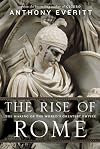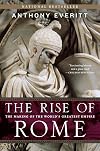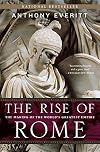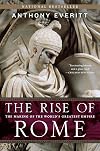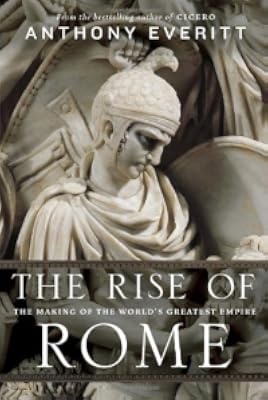
The Rise of Rome: The Making of the World's Greatest Empire
by Anthony Everitt
On This Page
Description
Rome's decline and fall have long fascinated historians, but the story of how the empire was won is every bit as compelling. Emerging as a market town from a cluster of hill villages in the eighth and seventh centuries B.C.E., Rome grew to become the ancient world's preeminent power. Historian Anthony Everitt fashions the story of Rome's rise to glory into an erudite page-turner filled with lessons for our time. He paints indelible portraits of the great Romans--and non-Romans--who left show more their mark on the Roman world. He chronicles the clash between patricians and plebeians that defined the politics of the Republic. He shows how Rome's shrewd strategy of offering citizenship to her defeated subjects was instrumental in expanding the reach of her burgeoning empire. And he outlines the corrosion of constitutional norms that accompanied Rome's imperial expansion, as old habits of political compromise gave way, leading to violence and civil war. In the end, unimaginable wealth and power corrupted the traditional virtues of the Republic, and Rome was left triumphant everywhere except within its own borders.--From publisher description. show lessTags
Recommendations




Member Recommendations
Member Reviews
3.5
"The city's constitution had served it well for centuries. A lawmaking citizens' assembly balanced a small ruling class of nobles. But for the system to work effectively, a capacity for compromise was essential--- and now this capacity had been lost."
The Rise of Rome traces Rome's history from its origins through the Civil War between Sulla and Marius in the 1st century BC, documenting the evolution of the democratic Roman Republic and the gradual transition that laid the groundwork for the autocratic empire. Anthony Everitt's lively, clear writing makes for an accessible text for the general reader. Based on the amount of historical evidence available for a given period, he divides the book into three sections: legend, story, and show more history.
Legend refers to the "Age of Kings," the period of Rome's beginning as depicted in literature, myth, and art but for which little historical evidence exists--- the founding tales that people believe to be true. Here Everitt describes Rome's origin myths: its Trojan genesis through Aeneas a la Virgil, Romulus, and Remus, the rape of the Sabines, and the Tarquinn Kings.
Story falls into the 50/ 50 camp ( half legend and half historical evidence.) This section examines the conquest of the neighboring areas on the Italian peninsula, as well as the class struggles surrounding the constitution and the power of the three branches of government: executive (2 consuls), senate (nobles), and assembly (people). Everitt claims that the events are primarily evidenced-based but include stories of many protagonists that appear exaggerated or mythologized. His analysis of the contradictions in both Legend and Story is often illuminating.
Based on evidence, the third section, History, chronicles Rome's expansion and conquest throughout the Mediterranean. It demonstrates how its imperialist agenda rooted in a desire for personal glory (gloria) led to the erosion of democracy at home. Although Everitt includes a chapter on Social History, this section's primary emphasis is military history and its internal consequences. While military history is not generally an area of personal interest, I felt that Everitt's examination of the three Punic Wars provided a fascinating lens into Roman and Catheginian societies. However, I found his depictions of the Roman military campaigns in the aftermath of the Third Punic War confusing, overly detailed, and lacking an analytic lens.
This lengthy text segment detracted from an overall interesting and well-designed introductory history. Despite this glitch, I recommend The Rise of Rome for anyone looking for a thoughtful general overview of this historical period. show less
"The city's constitution had served it well for centuries. A lawmaking citizens' assembly balanced a small ruling class of nobles. But for the system to work effectively, a capacity for compromise was essential--- and now this capacity had been lost."
The Rise of Rome traces Rome's history from its origins through the Civil War between Sulla and Marius in the 1st century BC, documenting the evolution of the democratic Roman Republic and the gradual transition that laid the groundwork for the autocratic empire. Anthony Everitt's lively, clear writing makes for an accessible text for the general reader. Based on the amount of historical evidence available for a given period, he divides the book into three sections: legend, story, and show more history.
Legend refers to the "Age of Kings," the period of Rome's beginning as depicted in literature, myth, and art but for which little historical evidence exists--- the founding tales that people believe to be true. Here Everitt describes Rome's origin myths: its Trojan genesis through Aeneas a la Virgil, Romulus, and Remus, the rape of the Sabines, and the Tarquinn Kings.
Story falls into the 50/ 50 camp ( half legend and half historical evidence.) This section examines the conquest of the neighboring areas on the Italian peninsula, as well as the class struggles surrounding the constitution and the power of the three branches of government: executive (2 consuls), senate (nobles), and assembly (people). Everitt claims that the events are primarily evidenced-based but include stories of many protagonists that appear exaggerated or mythologized. His analysis of the contradictions in both Legend and Story is often illuminating.
Based on evidence, the third section, History, chronicles Rome's expansion and conquest throughout the Mediterranean. It demonstrates how its imperialist agenda rooted in a desire for personal glory (gloria) led to the erosion of democracy at home. Although Everitt includes a chapter on Social History, this section's primary emphasis is military history and its internal consequences. While military history is not generally an area of personal interest, I felt that Everitt's examination of the three Punic Wars provided a fascinating lens into Roman and Catheginian societies. However, I found his depictions of the Roman military campaigns in the aftermath of the Third Punic War confusing, overly detailed, and lacking an analytic lens.
This lengthy text segment detracted from an overall interesting and well-designed introductory history. Despite this glitch, I recommend The Rise of Rome for anyone looking for a thoughtful general overview of this historical period. show less
A pretty typical popular book on Roman history. Think Beard's SPQR but with a focus from the founding of Rome to around the time of the rise of Augustus. Nothing too exceptional, but that may be because I have less interest in this period than the late republican period. I suspect (though I cannot confirm) that the book is mostly a summary and synthesis of Polybius, Livy, and Sallust. The book's description of the fall of the republic is pretty orthodox, making allusions to the Marian reforms, to Sulla and the collapse of the oligarchical consensus necessary for republican rule. An aspect of the book that I thought was inventive and positive was the separation of the book into story, legend, and history. Roughly the first third of the show more book is dedicated to the Aeneid retelling of Rome's origins up to the end of reign of kings. It was interesting to see how the Romans assigned each king a specific role in Rome's historical development and to see the stories of each king fleshed out in one place. I was surprised to learn that of the seven kings, there were foreign ones. Everitt takes the now popular view of interpreting the stories as expressions of the anxieties and concerns of the story tellers, so there's some interpretation of these founding legends as exemplars of a lost Roman virtue or the shadow of fratricidal violence. It was interesting to learn about the practices of devotion (where a self sacrifice or devotion would cause the ruin of an enemy), evocatio (calling the gods of a foreign enemy to abandon them and make their home in Rome), and the rituals involving causi belli (the Romans were very legalistic and thought their wars required a legal purpose to be waged, this was accompanied by religious ritual, of sending emissaries to explain the cause of the war and symbolically throwing a spear into the land of the enemy). I was also interested in the traditional role of the king, who balanced the nobles and the common people, a conception of the rule of orders that survived until John Adams. Additionally interesting was the traditional concept of the tyrant, who using demagoguery used the power of the people ruled over the polity (instead of oligarchical rule) and the various fears Romans had about the Gracchi trying to replicate the Greek tyrant.
The second section runs from the expulsion of the kings, into the beginning of recorded/verifiable history. Included in this second is Brutus's execution of his sons who conspired to return the king (which even some ancient commentators thought was unnecessarily cruel) to the conflict of the orders, and the controversy of the 12 tables (Everitt advances a theory that the Decemviri were an experimental form of government that failed). Everitt notes that throughout the conflict, there was give/take and compromise which collapse near the end. Also described are the various wars Rome had with its neighbors gradually growing into the dominant power in the area and but also assimilating past enemies into to the polity with tiers of citizen rights.
The third section of the book summarizes what is well trodden ground. From the three carthaginian wars (which show the injustice of Rome when it seized Sardinia after the conclusion of the first war in violation of the peace treaty, and the third unprovoked war where Rome attacked Carthage), to the social wars, the Gracchi, the eastern campaigns, Marius, Sulla and the fall of the republic. Nothing too novel or original here, though a good summary of the era in the traditional telling of history. I was interested to learn of some of the unlikely bed fellows made between enemies of rome (one of the cities was citizen ruled and did not like Rome's typical support of local aristocracies [an interesting application of Dictator's Handbook, Rome prefered to deal with a small coalition when it came to foreign affairs] and called for help from an oriental style tyrant). Rome's involvement with the Greeks was interesting as well, from it's "liberation" of Greece, to the destruction of Corinth, and the various clashes with Alexander's successors, cumulating with the defeat of the Macedonian phalanx by the Roman offset three lined maniple. show less
The second section runs from the expulsion of the kings, into the beginning of recorded/verifiable history. Included in this second is Brutus's execution of his sons who conspired to return the king (which even some ancient commentators thought was unnecessarily cruel) to the conflict of the orders, and the controversy of the 12 tables (Everitt advances a theory that the Decemviri were an experimental form of government that failed). Everitt notes that throughout the conflict, there was give/take and compromise which collapse near the end. Also described are the various wars Rome had with its neighbors gradually growing into the dominant power in the area and but also assimilating past enemies into to the polity with tiers of citizen rights.
The third section of the book summarizes what is well trodden ground. From the three carthaginian wars (which show the injustice of Rome when it seized Sardinia after the conclusion of the first war in violation of the peace treaty, and the third unprovoked war where Rome attacked Carthage), to the social wars, the Gracchi, the eastern campaigns, Marius, Sulla and the fall of the republic. Nothing too novel or original here, though a good summary of the era in the traditional telling of history. I was interested to learn of some of the unlikely bed fellows made between enemies of rome (one of the cities was citizen ruled and did not like Rome's typical support of local aristocracies [an interesting application of Dictator's Handbook, Rome prefered to deal with a small coalition when it came to foreign affairs] and called for help from an oriental style tyrant). Rome's involvement with the Greeks was interesting as well, from it's "liberation" of Greece, to the destruction of Corinth, and the various clashes with Alexander's successors, cumulating with the defeat of the Macedonian phalanx by the Roman offset three lined maniple. show less
This is a good beginner's guide to the history of ancient Rome, without getting too worked up about it. There is nothing particularly special about it, but then again the aim of the book is to provide a chronological overview of how the Romans really came about without having the reader take on several different historical sources. It's the Starbucks coffee version of a much bigger undertaking...fast-food with some CDs at the counter.
Everitt has broken up the book into Legend, Story, and History, which makes it easy on the reader (and very logical). Now, when it comes to 'legend', ancient Rome has it over everyone else. Any nation that can start their beginnings with the Trojan War is going to be pretty illustrious. However, the author show more has a hard time bringing the magic alive for that section. Virgil, of course, would be a better read but I expected more. Whether it's the Romans who migrated from Troy or the Etruscans (I vote for Tuscany), we DO know there was a migration from the geographic area of ancient Troy, thanks to DNA analysis. So why isn't the first chapter more, um, "alive"?
The second chapter gets going a bit, as there are better historical sources to base the evidence. Still, I yearned for more and started thinking of the Starbucks comparison. The third chapter picks up dramatically and saves the book from a lower rating. Even though he could have done so much more, Everitt has some zingers for the latter portion of the Republic, and I applaud him for his new thinking about the Gracchi, who are usually portrayed as dangerous revolutionaries. It is here that we begin to see the corrosion of the ideals of Cincinnatus and when Gaius Marius and Sulla ("Sulla is a mulberry sprinkled with barley meal") step into the picture, it's okay to forget time and space and just concentrate on the book.
There is a brief afterword focusing on Cicero and Varro...so brief I don't know why it's there except to quote The Whiner (Cicero) on the loss of the Republic. The Sources, Bibliography, and Notes are excellent and quite helpful. Still, I wanted more. So much more.
"His words have won me more cities than my own military campaigns."
(Pyrrhus on Cineas)
I wanted more cities, not a tall latte.
Book Season = Autumn (Hannibal is at the gates) show less
Everitt has broken up the book into Legend, Story, and History, which makes it easy on the reader (and very logical). Now, when it comes to 'legend', ancient Rome has it over everyone else. Any nation that can start their beginnings with the Trojan War is going to be pretty illustrious. However, the author show more has a hard time bringing the magic alive for that section. Virgil, of course, would be a better read but I expected more. Whether it's the Romans who migrated from Troy or the Etruscans (I vote for Tuscany), we DO know there was a migration from the geographic area of ancient Troy, thanks to DNA analysis. So why isn't the first chapter more, um, "alive"?
The second chapter gets going a bit, as there are better historical sources to base the evidence. Still, I yearned for more and started thinking of the Starbucks comparison. The third chapter picks up dramatically and saves the book from a lower rating. Even though he could have done so much more, Everitt has some zingers for the latter portion of the Republic, and I applaud him for his new thinking about the Gracchi, who are usually portrayed as dangerous revolutionaries. It is here that we begin to see the corrosion of the ideals of Cincinnatus and when Gaius Marius and Sulla ("Sulla is a mulberry sprinkled with barley meal") step into the picture, it's okay to forget time and space and just concentrate on the book.
There is a brief afterword focusing on Cicero and Varro...so brief I don't know why it's there except to quote The Whiner (Cicero) on the loss of the Republic. The Sources, Bibliography, and Notes are excellent and quite helpful. Still, I wanted more. So much more.
"His words have won me more cities than my own military campaigns."
(Pyrrhus on Cineas)
I wanted more cities, not a tall latte.
Book Season = Autumn (Hannibal is at the gates) show less
W/CW: Violence, brutality, torture, slavery, murder, suicide, sexual assault
RATING: 4/5
REVIEW: The Rise of Rome follows the history of Rome from its foundation myths with Aeneas, Romulus and Remus, to the fall of the Roman Republic in the 1st century BC. It examines not only the history, but also the myths the Romans created about their own history and the ways that they justified their more brutal actions to themselves and to the world.
I enjoyed this book, and learned a lot from it about times in Roman history that I do not know well. It was a little dry at points, but they felt necessary to the story. It was also frustrating to hear of all the great works of literature that have been lost, but of course that is the fault of time and show more not the author! The book is written for a general audience, and not just historians.
I recommend this book to history lovers and those interested in Roman culture and history. show less
RATING: 4/5
REVIEW: The Rise of Rome follows the history of Rome from its foundation myths with Aeneas, Romulus and Remus, to the fall of the Roman Republic in the 1st century BC. It examines not only the history, but also the myths the Romans created about their own history and the ways that they justified their more brutal actions to themselves and to the world.
I enjoyed this book, and learned a lot from it about times in Roman history that I do not know well. It was a little dry at points, but they felt necessary to the story. It was also frustrating to hear of all the great works of literature that have been lost, but of course that is the fault of time and show more not the author! The book is written for a general audience, and not just historians.
I recommend this book to history lovers and those interested in Roman culture and history. show less
The first section on Rome's origin myths is good, but the book then becomes a catalogue of names and dates--exactly what people who dislike history point to and say, "See?" There's no sense of the "making of the world's greatest empire," since Caesar is killed on page 399 and the book ends on page 403. There's also no real sense of how the battles with Pyrrhus or the Punic Wars led to an empire. Read the opening and then listen to Dan Carlin's three-part podcast Punic Nightmares, which covers exactly the same ground as a large portion of this book, but in a much more engaging manner.
One of the finest books on the history of Rome I have read. Highly recommended.
This book covers the origins of Rome from its earliest days of the semi historic kings through the fall of the republic. The author has a simple, concise and easy reading style which is both interesting and informative. His narrative flows extremely well, something not often found in a book which is essentially a historical survey spanning many centuries.
While a book of this scope cannot go into great depth, the author succinctly covers all important persons and historical developments. Highly recommended for those like myself with a significant background in this area, and for a novice just beginning his interest in Roman history.
This book covers the origins of Rome from its earliest days of the semi historic kings through the fall of the republic. The author has a simple, concise and easy reading style which is both interesting and informative. His narrative flows extremely well, something not often found in a book which is essentially a historical survey spanning many centuries.
While a book of this scope cannot go into great depth, the author succinctly covers all important persons and historical developments. Highly recommended for those like myself with a significant background in this area, and for a novice just beginning his interest in Roman history.
This book gave me exactly what I wanted: an understanding of how the literary histories of the Roman Republic worked as a single narrative. For example, how the founding legends of Aeneas and Romulus cohere and how the city-state grew. I thought the earlier chapters were superior to the later, post-Hannibal sections. The conquest of the Hellenistic east could have used a bit more detail. The writing is straightforward, rather than distinctive, but the book is recommended for anyone who'd like an organized presentation of the facts.
Members
- Recently Added By
Published Reviews
ThingScore 75
"An engrossing history of a relentlessly pugnacious city’s 500-year rise to empire."
added by bookfitz
Lists

Rome
5 works; 1 member
Author Information

11+ Works 5,464 Members
Anthony Everitt was secretary-general of the Arts Council for Great Britain. He lives in London.
Common Knowledge
- Original publication date
- 2012
- People/Characters
- Publius Cornelius Scipio Africanus; Hannibal Barca; Lucius Quintus Cincinnatus; Tiberius Sempronius Gracchus
- Important places
- Rome, Italy; Roman Empire; Carthage
- Important events
- Rise of the Roman Empire; Punic Wars; Battle of Cannae
- Epigraph
- L'aube d'un jour sinistre a blanchi les hauteurs.
Le camp s'éveille. En bas roule et gronde le fleuve
Où l'escadron léger de Numides s'abreuve.
Partout sonne l'appel clair de buccinateurs.
Car m... (show all)algré Scipion, les augures menteurs,
La Trebbia débordée. Et qu'il vente et qu'il pleuve,
Sempronius Consul, fier de sa gloire neuve,
A fait lever la hache et marcher les licteurs.
Rougissant le ciel noir de flamboîments lugubres,
A l'horizon brûlaient les villages Insubres;
On entendait au loin barrir un éléphant.
Et là-bas, sous le pont, adossé contre une arche,
Hannibal écoutait, pensif et triomphant,
Le piétinement sourd de légions en marche.
J-M H - Dedication
- On memory of
the poet
José-Maria de Heredia,
my forebear
and
another student of Rome - First words
- From Edward Gibbon onward, historians have pondered the decline and fall of the Roman Empire. (Preface)
Two old friends, now getting on in years, were looking forward to meeting each other again. (Introduction)
The origin of Rome can be traced back to a giant of a wooden horse. - Last words
- (Click to show. Warning: May contain spoilers.)Like the inexorable plot of a Greek tragedy, the consequences of the constitutional breakdown they brought about had finally worked themselves out.
(Click to show. Warning: May contain spoilers.)Our own time has not only neglected to freshen it by renewing its original colors, but has not even gone to the rouble of preserving its design and portrayal of figures. (Afterword)
Classifications
- Genres
- History, Nonfiction, General Nonfiction
- DDC/MDS
- 937.63 — History & geography History of ancient world (to ca. 499) Italian Peninsula to 476 and adjacent territories to 476 Latium, Rome Rome
- LCC
- DG276 .E84 — History of Europe, Asia, Africa and Oceania City History of Italy Ancient Italy. Rome to 476 History By period Empire, 27 B.C. - 476 A.D. Constitutional Empire, 27 B.C. - 284 A.D.
- BISAC
Statistics
- Members
- 581
- Popularity
- 50,734
- Reviews
- 10
- Rating
- (3.62)
- Languages
- Dutch, English, Italian, Polish
- Media
- Paper, Audiobook, Ebook
- ISBNs
- 23
- ASINs
- 5