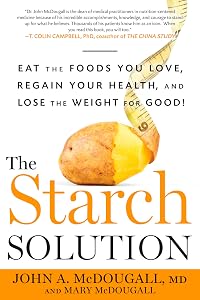
The Starch Solution: Eat the Foods You Love, Regain Your Health, and Lose the Weight for Good!
by John McDougall
On This Page
Description
From Atkins to Dukan, fear of the almighty carb has taken over the diet industry for the past few decades-even the mere mention of a starch-heavy food is enough to trigger an avalanche of shame and longing. But the truth is, carbs are not the enemy. Now, bestselling author John A. McDougall, MD, and his kitchen-savvy wife, Mary, prove that a starch-rich diet can actually help us lose weight, prevent a variety of ills, and even cure common diseases. By fueling the body primarily with show more carbohydrates rather than proteins and fats, listeners will feel satisfied, boost energy, and look and feel their best. Including a 7-Day Sure-Start Plan, helpful weekly menu planner, and nearly 100 delicious, affordable recipes, The Starch Solution is a groundbreaking program that will help listeners shed pounds, improve their health, save money, and change their lives. show lessTags
Recommendations


Member Reviews
Most important: do not just skip to the recipes in this book! As good as they are, I believe it's important to read and understand the detailed information on the basic building blocks of nutrition and the even more essential information on the health benefits and dangers of individual food types.
I bought and read the first McDougall book many years ago, in the 1980s. At that time I read it straight through and followed the plan for a while. Unfortunately I slid away from the basics and my health suffered as a result. Although I was a lacto-ovo vegetarian since the end of 1982 and have been a vegan since the middle of 2007, and although I have read a great many articles on veganism and tried to maintain a reasonably healthy version of a show more vegan plan, I found when I read this book that I had forgotten some elements and that likely McDougall knows even more now than he did then. For example:
* When he says starches he really means starches. Potatoes, rice, bread, pasta, legumes, among others. These types of foods need to take over at least half of your plate. Non-starchy vegetables take up another segment and fruit the rest. The evidence is in the book in the form of several studies over many years.
* Isolated soy protein is as bad for you as animal protein. This I didn't know. I love my Gardein cutlets and Tofurky sausages but from here on these items have got to be for special occasions only. Foods made from isolated soy protein or, for that matter, isolated wheat protein, have significant impacts on the development of cancers and other serious diseases. The name of the game here is protein. Do not overdo it. It's dangerous.
* Fish oils do not protect us from heart disease. They do provide us with dangerous levels of mercury. This is something I did know, but it's good to see it stated here, with evidence.
* Supplements are not only not necessary (except possibly B12 and, in rare instances, small amounts of Vitamin D) but can be dangerous. When these nutrients are separated from the rest of the whole food they come from they cause our systems to react to the concentrated form and this reaction can be lethal. Don't be fooled into thinking "can't hurt, might help" because it's more likely that they can hurt.
* Calcium! Interestingly, those who consume less calcium make better use of it. Those who consume large amounts do not benefit from the extra. We know this is true of the calcium in milk products, but it's important to realize it's also true of calcium supplements. Get your calcium from vegetables.
There is a great deal more to read and absorb. For those who are new to a plant-based diet McDougall offers answers you can offer to your concerned meat-eating friends. Knowledge is power and it's also stress-reducing.
Now, to the recipes. In the early McDougall books the recipes were very simple and I had the impression that the majority of them called for canned tomatoes or sauce. Understandable, given how useful and low-fat these foods are. Now, however, Mary McDougall has developed far more interesting and sophisticated recipes that continue to be easy to understand and prepare, and that call for familiar ingredients for most of us. I am excited to try them, and have committed myself to starting over, armed with a wealth of knowledge and enthusiasm. I hope you join me. show less
I bought and read the first McDougall book many years ago, in the 1980s. At that time I read it straight through and followed the plan for a while. Unfortunately I slid away from the basics and my health suffered as a result. Although I was a lacto-ovo vegetarian since the end of 1982 and have been a vegan since the middle of 2007, and although I have read a great many articles on veganism and tried to maintain a reasonably healthy version of a show more vegan plan, I found when I read this book that I had forgotten some elements and that likely McDougall knows even more now than he did then. For example:
* When he says starches he really means starches. Potatoes, rice, bread, pasta, legumes, among others. These types of foods need to take over at least half of your plate. Non-starchy vegetables take up another segment and fruit the rest. The evidence is in the book in the form of several studies over many years.
* Isolated soy protein is as bad for you as animal protein. This I didn't know. I love my Gardein cutlets and Tofurky sausages but from here on these items have got to be for special occasions only. Foods made from isolated soy protein or, for that matter, isolated wheat protein, have significant impacts on the development of cancers and other serious diseases. The name of the game here is protein. Do not overdo it. It's dangerous.
* Fish oils do not protect us from heart disease. They do provide us with dangerous levels of mercury. This is something I did know, but it's good to see it stated here, with evidence.
* Supplements are not only not necessary (except possibly B12 and, in rare instances, small amounts of Vitamin D) but can be dangerous. When these nutrients are separated from the rest of the whole food they come from they cause our systems to react to the concentrated form and this reaction can be lethal. Don't be fooled into thinking "can't hurt, might help" because it's more likely that they can hurt.
* Calcium! Interestingly, those who consume less calcium make better use of it. Those who consume large amounts do not benefit from the extra. We know this is true of the calcium in milk products, but it's important to realize it's also true of calcium supplements. Get your calcium from vegetables.
There is a great deal more to read and absorb. For those who are new to a plant-based diet McDougall offers answers you can offer to your concerned meat-eating friends. Knowledge is power and it's also stress-reducing.
Now, to the recipes. In the early McDougall books the recipes were very simple and I had the impression that the majority of them called for canned tomatoes or sauce. Understandable, given how useful and low-fat these foods are. Now, however, Mary McDougall has developed far more interesting and sophisticated recipes that continue to be easy to understand and prepare, and that call for familiar ingredients for most of us. I am excited to try them, and have committed myself to starting over, armed with a wealth of knowledge and enthusiasm. I hope you join me. show less
It's about time I've read a book by Dr. McDougall. I've been hearing about him and seeing random tidbits from him here and there ever since I went vegan five years ago. This book just might be a life-changer for me. Even though I have never bought into low-carb diets and would always defend healthy carbs in whole grains, beans, fruits, and vegetables, I still held onto some carb-phobia, thinking I needed more fat and more protein to be healthy and satisfied. Now once and for all, I am convinced by the scientific evidence in this book, Dr. McDougall's decades of experience with his own/his patients' diets, and my own recent experimentation with my diet that a healthy high carb/starch diet will not make you fat, will not give you show more diabetes, and is, indeed, satisfying. That last part about it being satisfying is a huge deal for someone like me to say. I'm a lifelong food addict and have been overweight or obese (mostly obese) since I was 8 years old. I am rarely satisfied; I either go hungry after a meal if I eat a "normal" sized portion, or I stuff myself to discomfort. There is almost never middle ground, but I've noticed that eating starches gets me to that nice, physically, and most importantly for me, psychologically satisfied middle ground.
A low-fat mostly whole foods plant-based diet with no calorie counting has worked for me in the past, but I wasn't satisfied often enough, so I went back to old habits even though I had lost 20 pounds. I realize now I wasn't satisfied because I was avoiding eating rice or potatoes or other high starch foods with my meals, and I was skipping out on fruit almost entirely. The only reason I was avoiding these things was because of some pseudo-science metabolic type diet book and just the general carb-phobia in our culture.
I am glad Dr. McDougall included a chapter called The Fat Vegan. I can't stand when some writers mislead people when they say stuff like, "If you go vegan, I promise you will lose weight." or "Fat vegans are extremely rare." Yeah, right! Maybe I lost like 2 pounds when I went vegan, but I then quickly gained it back plus about another 20 when I figured out where to buy all the fatty vegan products (nondairy sour cream, cream cheese, cheese, butter, cookies, etc.) and how to eat for comfort just like I used to with nonvegan food. It's about time that writers start making the distinction between a low fat plant-based diet that can help you lose weight and a vegan diet done solely for ethical reasons (which can include chips, vegan cookies, cakes, pie, ice cream, french fries, tater tots, dark chocolate, and the list goes on). show less
A low-fat mostly whole foods plant-based diet with no calorie counting has worked for me in the past, but I wasn't satisfied often enough, so I went back to old habits even though I had lost 20 pounds. I realize now I wasn't satisfied because I was avoiding eating rice or potatoes or other high starch foods with my meals, and I was skipping out on fruit almost entirely. The only reason I was avoiding these things was because of some pseudo-science metabolic type diet book and just the general carb-phobia in our culture.
I am glad Dr. McDougall included a chapter called The Fat Vegan. I can't stand when some writers mislead people when they say stuff like, "If you go vegan, I promise you will lose weight." or "Fat vegans are extremely rare." Yeah, right! Maybe I lost like 2 pounds when I went vegan, but I then quickly gained it back plus about another 20 when I figured out where to buy all the fatty vegan products (nondairy sour cream, cream cheese, cheese, butter, cookies, etc.) and how to eat for comfort just like I used to with nonvegan food. It's about time that writers start making the distinction between a low fat plant-based diet that can help you lose weight and a vegan diet done solely for ethical reasons (which can include chips, vegan cookies, cakes, pie, ice cream, french fries, tater tots, dark chocolate, and the list goes on). show less
This is an easy to read and understand book that challenges many long held ideas in the field of diet and nutrition. This is a lifestyle-change book rather than a diet book and I think the most compelling aspect of it is that Dr Mcdougall 'eats his own words' as it were. If ever there was a case of 'Physician heal thyself' this is it - because he did and may do the same for others seeking to "Eat the Foods You Love, Regain Your Health, and Lose the Weight for Good!"
This style of eating is completely vegan (no eggs or dairy) with the emphasis on whole grains, complex carbohydrates and no added oils - plant or otherwise. A typical plate would be half complex starch or grains and half veggies or fruit.
This is supposed to help with many of the lifestyle problems that plague Americans – obesity, diabetes, heart disease, high blood pressure, as well as be a help in losing weight and increasing energy levels.
The physician author asserts that complex carbohydrate foods in unprocessed forms, may increase blood sugars in the short time frame, but then actually produce lower blood sugars over the long time frame. Potatoes, with a relatively high GI (Glycemic Index) are an example of this.
Some of the FB show more followers shock start this plan by eating only potatoes for 30 days to get their bodies ‘weaned away’ from cravings and to get faster benefits.
Intriguing - show less
This is supposed to help with many of the lifestyle problems that plague Americans – obesity, diabetes, heart disease, high blood pressure, as well as be a help in losing weight and increasing energy levels.
The physician author asserts that complex carbohydrate foods in unprocessed forms, may increase blood sugars in the short time frame, but then actually produce lower blood sugars over the long time frame. Potatoes, with a relatively high GI (Glycemic Index) are an example of this.
Some of the FB show more followers shock start this plan by eating only potatoes for 30 days to get their bodies ‘weaned away’ from cravings and to get faster benefits.
Intriguing - show less
The man's a rare genius and makes more sense than I've heard in a long time. Highly recommended for everyone.
One of the rare times in my life that I will buy a book, i checked this out from the library to see if I like the recipes, and, as I do, i will buy it as a reference book for my Kindle.
Ratings
Members
- Recently Added By
Author Information
18 Works 322 Members
John McDougall is a U.S. Army Chaplain and a veteran of Both Iraq and Afghanistan. A West Point graduate, he as has served more than years in Airborne and Ranger assignment including 173rd Airborne Brigade, the 82nd Airborne Division, and the 75th Ranger Ragiment John has a masters of divinity from Multnomah Biblical Seminary. He is stationed at show more Joint Base Lewis-McChord Washington, with his wife, Bree, and their children. show less
All Editions
Common Knowledge
- Original publication date
- 2012
Classifications
- Genres
- Nonfiction, Food & Cooking, Health & Wellness, General Nonfiction
- DDC/MDS
- 641.5 — Applied science & technology Home economics & family management Food, Cooking & Recipes / Meals, Picnics Cooking; cookbooks
- LCC
- RM237.59 .M33 — Medicine Therapeutics. Pharmacology Therapeutics. Pharmacology Diet therapy. Dietary cookbooks
- BISAC
Statistics
- Members
- 240
- Popularity
- 136,053
- Reviews
- 6
- Rating
- (4.13)
- Languages
- English
- Media
- Paper, Audiobook, Ebook
- ISBNs
- 7
- ASINs
- 3