On This Page
Description
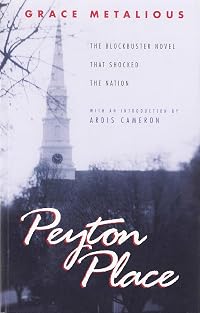
"When it first appeared in 1956, Grace Metalious's Peyton Place unbuttoned the straitlaced New England of the popular imagination, transformed the publishing industry, and made its young author one of the most talked-about people in America. Metalious's debut novel - which topped the bestseller lists for more than a year and spawned a feature film and long-running television series - reveals the intricate social anatomy of a small New England town. This new paperback edition, which show more celebrates the seventy-fifth anniversary of Grace Metalious's birth, will reintroduce readers to a landmark of American popular culture. An introduction by Ardis Cameron explores Peyton Place's influential role in American literary and cultural history."--Jacket. show lessTags
Recommendations
























Member Recommendations

Member Reviews
Wow. How did I not know about this book? Actually, I can tell you: it sounds like a boring book about a town where nothing happens. But what simmers beneath the nothing is like a look into the deep, dark corners of your soul. It illuminates the "dirty" corners that people were so worried about in 1956, but more importantly the thin veneers of respectability and tolerance we still struggle with 60 years later and which makes it so powerful today.
Six-word review (1): Ah, for a more innocent time.
or
Six-word review (2): Okay, let's get this over with.
The novel Peyton Place created a sensation when it first appeared in 1956. I had an extremely sheltered religious upbringing in the 1950s and 1960s, and it was barely whispered about in that setting, but even I was aware of it.
The 1957 movie was likewise verboten (or perhaps even more so, because all movies were verboten, whereas books came in a wide range of flavors and degrees of waywardness). From my present vantage point, and knowing some things about my parents that I didn't know then, I'd guess they probably read it secretly and maybe even saw the movie; for which their good colleagues would have briskly commended them to show more hellfire. But I never read it, never saw it, never even saw a single episode of the TV series that ran from 1964 to 1969 and made Mia Farrow a star. I had no interest and wasn't even curious; naughtiness for its own sake didn't appeal to me. I took it for cheap trash, the novel equivalent of "true romance" magazines, and left it alone.
(I made an important distinction between sheer naughtiness and principled rebellion, which was known territory to me, whether it meant long hair, bare feet, and musical protests or simply testing whether M&Ms would melt in my hand.)
So now, here, in January of 2019, Peyton Place turned up in the neighborhood Little Free Library box when I was dropping off a Murakami novel, and I thought, "Why not?"
This edition is a 1999 reissue, by Northeastern University Press, no less, with a cover tag "Fiction/Popular Culture" and an introduction that labels it "America's first blockbuster." There's a certain wry amusement in conjecturing that this might be assigned reading in some college course. I guess I'm not numb yet, even after decades of hearing Bob Dylan tunes transmogrified into elevator music.
And now I've read it.
Truthfully, it was a bit of a slog. I had to push myself to wade on through the dozens of characters, whose amplified backgrounds and omniscient-author internal monologues made me think they were going to be important characters. They commanded my sympathy, but in the end they just stood there with nothing to do, no more than a tree that just stands and waits for the seasons to change. The schoolteacher, for instance. I also waited for some dramatic moments that never came--that felt as if they were part of a suspenseful buildup (would Allison meet her father in New York?) but that just slipped away unrealized. It was more like a dense collection of character vignettes giving a fly's compound-eye view of the spectacle. I was about 150 pages in, about 40 percent, before something happened, and even at that it seemed pretty tame by 21st-century standards.
And after all that, the ending seemed abrupt.
There were a few semi-pithy passages and vivid lines, particularly those depicting a small-town New England way of life of bygone days that is still halfway familiar to me, just by osmosis, even though I grew up in a suburb close to Boston. I don't think I've heard anyone use "ride" as a transitive verb in this manner since I was a little girl: "You'd better let me ride you home." We used to say to one another, "Will you ride me on your bike?" The phrase hit my inner ear somewhere close to the place where I store the fragrance of burning leaves in autumn.
So I read it and read it for a while, and eventually I came to the end of it. And that's the kind of book it was, for me.
More than anything else, I'd say it made me nostalgic for a time when this would have been shocking--heaven knows it isn't now--and also for a touch of that New England quirkiness and odd little habits of speech that once seasoned my youth.
I did pick up a few lines for my reading journal, and here's one of them. Allison is sure she knows how Ted would have behaved if he had really loved Selena, and Tom says: "There is such a thing as love not meeting a test, but that does not mean that it was not a kind of love to begin with." More insights like this and less overt courting of the "scandalous" label would have made it more of a novel. show less
or
Six-word review (2): Okay, let's get this over with.
The novel Peyton Place created a sensation when it first appeared in 1956. I had an extremely sheltered religious upbringing in the 1950s and 1960s, and it was barely whispered about in that setting, but even I was aware of it.
The 1957 movie was likewise verboten (or perhaps even more so, because all movies were verboten, whereas books came in a wide range of flavors and degrees of waywardness). From my present vantage point, and knowing some things about my parents that I didn't know then, I'd guess they probably read it secretly and maybe even saw the movie; for which their good colleagues would have briskly commended them to show more hellfire. But I never read it, never saw it, never even saw a single episode of the TV series that ran from 1964 to 1969 and made Mia Farrow a star. I had no interest and wasn't even curious; naughtiness for its own sake didn't appeal to me. I took it for cheap trash, the novel equivalent of "true romance" magazines, and left it alone.
(I made an important distinction between sheer naughtiness and principled rebellion, which was known territory to me, whether it meant long hair, bare feet, and musical protests or simply testing whether M&Ms would melt in my hand.)
So now, here, in January of 2019, Peyton Place turned up in the neighborhood Little Free Library box when I was dropping off a Murakami novel, and I thought, "Why not?"
This edition is a 1999 reissue, by Northeastern University Press, no less, with a cover tag "Fiction/Popular Culture" and an introduction that labels it "America's first blockbuster." There's a certain wry amusement in conjecturing that this might be assigned reading in some college course. I guess I'm not numb yet, even after decades of hearing Bob Dylan tunes transmogrified into elevator music.
And now I've read it.
Truthfully, it was a bit of a slog. I had to push myself to wade on through the dozens of characters, whose amplified backgrounds and omniscient-author internal monologues made me think they were going to be important characters. They commanded my sympathy, but in the end they just stood there with nothing to do, no more than a tree that just stands and waits for the seasons to change. The schoolteacher, for instance. I also waited for some dramatic moments that never came--that felt as if they were part of a suspenseful buildup (would Allison meet her father in New York?) but that just slipped away unrealized. It was more like a dense collection of character vignettes giving a fly's compound-eye view of the spectacle. I was about 150 pages in, about 40 percent, before something happened, and even at that it seemed pretty tame by 21st-century standards.
And after all that, the ending seemed abrupt.
There were a few semi-pithy passages and vivid lines, particularly those depicting a small-town New England way of life of bygone days that is still halfway familiar to me, just by osmosis, even though I grew up in a suburb close to Boston. I don't think I've heard anyone use "ride" as a transitive verb in this manner since I was a little girl: "You'd better let me ride you home." We used to say to one another, "Will you ride me on your bike?" The phrase hit my inner ear somewhere close to the place where I store the fragrance of burning leaves in autumn.
So I read it and read it for a while, and eventually I came to the end of it. And that's the kind of book it was, for me.
More than anything else, I'd say it made me nostalgic for a time when this would have been shocking--heaven knows it isn't now--and also for a touch of that New England quirkiness and odd little habits of speech that once seasoned my youth.
I did pick up a few lines for my reading journal, and here's one of them. Allison is sure she knows how Ted would have behaved if he had really loved Selena, and Tom says: "There is such a thing as love not meeting a test, but that does not mean that it was not a kind of love to begin with." More insights like this and less overt courting of the "scandalous" label would have made it more of a novel. show less
Details the lives of three women mainly, along with various other characters, living in a small New England town in the late 1930s-early 1940s. It was banned many times over for its sexual content, and while I suspect it was fairly salacious for its time, it's pretty tame now. That doesn't make the story any less interesting or well told, though. I enjoyed how all the characters - well drawn, to a one - interacted and influences each other's lives, and while the book is arguable not high literature, I thought it was a great read.
This book can easily be taken out of context of its original closeted 50s: domestic abuse considered normal as long as you pay your taxes, alcoholism with no consequences but unwanted pregnancies and homosexuality hidden at all costs. For this, Cameron's introduction is a must read because it sets the stage: this novel is a shocker to be sure, full of terrible secrets, but it's also a critique of the times - the hypocrisy, the lies, the un-lived lives due to shame.
Passages of the book are lengthy (book 3 with Allison's pseudo-emancipation, notably), the weather imagery is rather heavy, but there are also some terrible, cruel remarks which resonate today still, including Harrington's buy-off of Betty Anderson or Swain's torment over his show more act.
This novel is a mix: soap opera and social critism - either way, the reader will be rewarded. show less
Passages of the book are lengthy (book 3 with Allison's pseudo-emancipation, notably), the weather imagery is rather heavy, but there are also some terrible, cruel remarks which resonate today still, including Harrington's buy-off of Betty Anderson or Swain's torment over his show more act.
This novel is a mix: soap opera and social critism - either way, the reader will be rewarded. show less
If you read this, you'll see why it was so controversial in 1956. I suspect it gained such attention because it is also extremely well written and insightful. In the course of a few hundred pages, Metalious covers every major human vice. She also builds an engaging storyline about life in a small New England town. The characters debate the complexity of modern times through the simple ways these issues affect them. For example, the new school principal, a rare outsider, becomes a local and yet continues to challenge his friends' views about religion and relationships. What I like most about this book is the way the dialogue and character portrayals reflect the nuance of human psychology. Metalious efficiently shows us their inner show more conflict, and, as in reality, gives only some of them a life-changing moment where they are forced to resolve their own inner turmoil. show less
Peyton Place, a landmark of a book. Most people are familiar with at least the name and core concept of gossipy small town folks and their scandals, even if they aren’t aware of the novel’s existence.
The book covers roughly ten years in the life of an isolated, sleepy New England town from 1935 to 1945. There is no single central character. Instead, the book follows the intricate web between a large number of Peyton Place’s residents and the back-biting, bad mouthing and general hypocrisy that runs rampant through the town.
The book is much better written than I was expecting. It is rich in incidental details, showing an intimate portrait of an isolated New England town in the late 1930’s. Some of my favorite parts were throwaway show more details about ringing the bells for school or the old men sitting on the wooden benches in front of the court house. Peyton Place itself is probably the most prominent character in the book. Often Metalious uses quotes from unnamed characters to act as the ‘voice’ of Peyton Place.
Regardless, the book is not literary fiction. Rather, it revels in titillating details. I noticed over the course of the book that the narrative tended to wallow in the more salacious bits. At first, shocking secrets are presented pretty matter-of-factly. I got the feeling that the author felt more and more comfortable with her narrative as she wrote, because while the soap opera-like twists were always pretty breathtaking, as the story wound on they were presented more and more sensationally. I have to admit, it really did make the book more fun to read. Who doesn’t like tut-tutting over other folk’s dirty laundry?
I do think that the book is a cut above Jackie Collins/Danielle Steele trash fiction though. While Metalious crammed Peyton Place with enough hot details to fill an issue of the National Enquirer, she was also very clear in pointing out the hypocrisy in the way that New England was presenting itself to the rest of the country back then. The book was clearly at least semi-autobiographical (as the character Allison MacKenzie seems to closely resemble the author) and you can see that as gleeful as the author was in dragging out scandal of the place, she clearly had some fondness for her roots.
Lots of bad stuff happens in Peyton Place, but it is not all bad. There are still picnics in the woods, drowsy Indian summer days and townspeople helping each other out.
Whatever reputation it earned when originally published, the book is some kind of classic now. Fifty-plus years later, the book still holds a reader's interest. It is unquestionably dated, but it is a novel portraying a particular time and place, so that is not a strike against it. The only reason I didn't rate this one at five stars is that some of the dialog is stilted (though some of it is fantastic) and I felt toward the end that the story was getting a little long in the tooth.
All these years after the original publication of Peyton Place I was still often shocked while reading. The novel really does go for the sensational. But like Jean Shepherd’s purposely ‘anti-nostalgic’ reminiscences or the movie Pleasantville, it also tries to make you see that maybe the 'good old days' weren't so good for those that lived them. show less
The book covers roughly ten years in the life of an isolated, sleepy New England town from 1935 to 1945. There is no single central character. Instead, the book follows the intricate web between a large number of Peyton Place’s residents and the back-biting, bad mouthing and general hypocrisy that runs rampant through the town.
The book is much better written than I was expecting. It is rich in incidental details, showing an intimate portrait of an isolated New England town in the late 1930’s. Some of my favorite parts were throwaway show more details about ringing the bells for school or the old men sitting on the wooden benches in front of the court house. Peyton Place itself is probably the most prominent character in the book. Often Metalious uses quotes from unnamed characters to act as the ‘voice’ of Peyton Place.
Regardless, the book is not literary fiction. Rather, it revels in titillating details. I noticed over the course of the book that the narrative tended to wallow in the more salacious bits. At first, shocking secrets are presented pretty matter-of-factly. I got the feeling that the author felt more and more comfortable with her narrative as she wrote, because while the soap opera-like twists were always pretty breathtaking, as the story wound on they were presented more and more sensationally. I have to admit, it really did make the book more fun to read. Who doesn’t like tut-tutting over other folk’s dirty laundry?
I do think that the book is a cut above Jackie Collins/Danielle Steele trash fiction though. While Metalious crammed Peyton Place with enough hot details to fill an issue of the National Enquirer, she was also very clear in pointing out the hypocrisy in the way that New England was presenting itself to the rest of the country back then. The book was clearly at least semi-autobiographical (as the character Allison MacKenzie seems to closely resemble the author) and you can see that as gleeful as the author was in dragging out scandal of the place, she clearly had some fondness for her roots.
Lots of bad stuff happens in Peyton Place, but it is not all bad. There are still picnics in the woods, drowsy Indian summer days and townspeople helping each other out.
Whatever reputation it earned when originally published, the book is some kind of classic now. Fifty-plus years later, the book still holds a reader's interest. It is unquestionably dated, but it is a novel portraying a particular time and place, so that is not a strike against it. The only reason I didn't rate this one at five stars is that some of the dialog is stilted (though some of it is fantastic) and I felt toward the end that the story was getting a little long in the tooth.
All these years after the original publication of Peyton Place I was still often shocked while reading. The novel really does go for the sensational. But like Jean Shepherd’s purposely ‘anti-nostalgic’ reminiscences or the movie Pleasantville, it also tries to make you see that maybe the 'good old days' weren't so good for those that lived them. show less
This is the book that set the benchmark for every soap opera and drama of small town America that followed, and it’s almost shocking to find that it’s so well written. I’m not going to dwell on the plot – I’ll leave you to discover that if you decide to read it – it has big themes and it’s got a little of everything; and although people will always dwell on the bad things that are going on behind the town’s closed doors, there is good too.
The three main characters are all women and they’re all very believable and well-drawn. Constance MacKenzie returned to Peyton Place from New York where she had an illegitimate daughter Allison and now she poses as a widow and runs a dress shop. Allison who is somewhat of a shy and show more swotty type wants to be a writer. Her best friend is Selena Cross, who is a ‘shack-dweller’ from the poor side of town where she lives with her mad mother, nasty step-father, and younger brother. When the story starts Allison and Selena are just teenagers, and it follows them over a period of several years as they blossom into young women – most of the book centres around one or more of the three.
The two other stand-out characters are Doctor Swain who is a good-hearted man, and Tomas Makris – the exotic new school headmaster, who falls for Constance. A whole cast of others support them as we hear all the stories about the townsfolk – from the town drunks who lock themselves in a cellar full of booze for winter, to the teenager who is maimed when a fairground ride goes wrong, and then there are the Harringtons – the richest family in town. Our book group liked the episodic feel of the stories – as if she’d had TV rights in mind when she wrote it – the town drunks, and with the fairground maiming it would end with a da-da-DAH! as you don’t find out what happened to the girl until later.
What was almost as interesting as the book itself was reading some background about Metalious. My 2002 edition had an essay by an American academic which was fascinating. Metalious was the product of a broken home and grew up in poverty but she always wanted to write. She married and had kids, then aged thirty started to write the book that would make her world-famous in 1956, followed by three other novels. She died aged 39 of cirrhosis of the liver.
The book is clearly autobiographical – Metalious is Allison. Other characters were also rather real – she got into trouble over the character of Tomas Makris, and Selena was based on a real young woman too. As for the town of Peyton Place itself, it appears to be an amalgamation of several towns in the vicinity of Manchester and Gilmanton in New Hampshire where they lived. We holidayed in New Hampshire some years ago, stopping off in these very towns – I was very taken by one of them, Laconia, finding its lakeside location very pretty, and as she would say very ‘Ye Olde New Hampshire’. I thought that somewhere like that, just over an hour outside Boston would be a lovely place to live … However I’m know that every small town or community has its secrets and busybodies – twas ever thus. I suppose the fact that it was set in New England, where the strictly Puritan descendants of the Mayflower settled, makes the numbers of skeletons in closets more shocking.
This is a fantastic book – I’m very glad to have read this quintessential novel of 1950s America – Do read it! show less
The three main characters are all women and they’re all very believable and well-drawn. Constance MacKenzie returned to Peyton Place from New York where she had an illegitimate daughter Allison and now she poses as a widow and runs a dress shop. Allison who is somewhat of a shy and show more swotty type wants to be a writer. Her best friend is Selena Cross, who is a ‘shack-dweller’ from the poor side of town where she lives with her mad mother, nasty step-father, and younger brother. When the story starts Allison and Selena are just teenagers, and it follows them over a period of several years as they blossom into young women – most of the book centres around one or more of the three.
The two other stand-out characters are Doctor Swain who is a good-hearted man, and Tomas Makris – the exotic new school headmaster, who falls for Constance. A whole cast of others support them as we hear all the stories about the townsfolk – from the town drunks who lock themselves in a cellar full of booze for winter, to the teenager who is maimed when a fairground ride goes wrong, and then there are the Harringtons – the richest family in town. Our book group liked the episodic feel of the stories – as if she’d had TV rights in mind when she wrote it – the town drunks, and with the fairground maiming it would end with a da-da-DAH! as you don’t find out what happened to the girl until later.
What was almost as interesting as the book itself was reading some background about Metalious. My 2002 edition had an essay by an American academic which was fascinating. Metalious was the product of a broken home and grew up in poverty but she always wanted to write. She married and had kids, then aged thirty started to write the book that would make her world-famous in 1956, followed by three other novels. She died aged 39 of cirrhosis of the liver.
The book is clearly autobiographical – Metalious is Allison. Other characters were also rather real – she got into trouble over the character of Tomas Makris, and Selena was based on a real young woman too. As for the town of Peyton Place itself, it appears to be an amalgamation of several towns in the vicinity of Manchester and Gilmanton in New Hampshire where they lived. We holidayed in New Hampshire some years ago, stopping off in these very towns – I was very taken by one of them, Laconia, finding its lakeside location very pretty, and as she would say very ‘Ye Olde New Hampshire’. I thought that somewhere like that, just over an hour outside Boston would be a lovely place to live … However I’m know that every small town or community has its secrets and busybodies – twas ever thus. I suppose the fact that it was set in New England, where the strictly Puritan descendants of the Mayflower settled, makes the numbers of skeletons in closets more shocking.
This is a fantastic book – I’m very glad to have read this quintessential novel of 1950s America – Do read it! show less
Members
- Recently Added By
Published Reviews
ThingScore 75
Peyton Place has something over its heirs. It takes us to that time when there were still sordid secrets; when there were still boundaries to be broken; when something could still sneak up behind you and give you a fast and dirty shock.
added by Shortride
Lists

Read the book and saw the movie
1,170 works; 195 members

New York Public Library's Books of the Century
120 works; 20 members

New York Public Library's Books of the Century - All
170 works; 14 members

Female Author
1,234 works; 66 members
1950s
340 works; 22 members

Favourite Books
1,820 works; 316 members

New England Books
101 works; 10 members

Books Featured on Gilmore Girls
307 works; 21 members
Small Town Fiction
66 works; 13 members
LibraryThingers' 1001 Books You Must Read Before You Die
442 works; 29 members
Page Turners
185 works; 11 members

Best books read in 2011
200 works; 50 members

Publisher's Weekly Bestsellers - Part II - 1940 - 1979
355 works; 6 members

Discontinued
19 works; 4 members

Five star books
1,767 works; 110 members

Mothers and Daughters
114 works; 11 members
Overdue Podcast
808 works; 9 members
Books Set in Small Towns and Villages
278 works; 16 members
Best Books of the 20th Century
193 works; 5 members

Favorite Books from the 1950s
33 works; 2 members

Books Read in 2016
4,666 works; 197 members
Nifty Fifties
129 works; 14 members

Books Read in 2011
684 works; 19 members

The Atlantic's The Great American Novel
136 works; 12 members

Books Read in 2024
4,727 works; 128 members
Books in Riverdale
123 works; 3 members

The Complete Rory Gilmore Reading List
506 works; 5 members
Author Information

Some Editions
Awards and Honors
Distinctions
Series

Belongs to Publisher Series
Pan Books (M261)
Virago Modern Classics (480)
rororo (406-407)
Work Relationships
Is contained in
Has the adaptation
Inspired
Common Knowledge
- Canonical title*
- Peyton Place
- Original title
- Peyton Place
- Original publication date
- 1956 (USA) (USA); 1957 (UK) (UK)
- People/Characters
- Selena Cross
- Important places
- Peyton Place, New Hampshire, USA; New Hampshire, USA
- Related movies
- Peyton Place (1957 | IMDb); Peyton Place (1964 | IMDb)
- Dedication
- To GEORGE-
For all the reasons
he knows so well - First words
- Indian summer is like a woman. Ripe, hotly passionate, but fickle, she comes and goes as she pleases so that one if never sure whether she will come at all, nor for how long she will stay. -Chapter 1
- Quotations
- But the doctor would not laugh with his friend. There were three things which he hated in this world, he said often and angrily: death, venereal disease and organized religion. “In that order,” the doctor always amended.
Scandalous occurrences, of a public nature that is, do not often take place in small towns. Therefore, although the closets of small-town folk are filled with such a number of skeletons that if all the bony remains of small-t... (show all)own shame were to begin rattling at once they would cause a commotion that could be heard on the moon, people are apt to say that nothing much goes on in towns like Peyton Place. While it is true, no doubt, that the closets of city dwellers are in as sad disorder as those of small-town residents, the difference is that the city dweller is not as apt to be on as intimate terms with the contents of his neighbor's closet as is the inhabitant of a smaller community. The difference between a closet skeleton and a scandal, in a small town, is that the former is examined behind barns by small groups who converse over it in whispers, while the latter is looked upon by everyone, on the main street, and discussed in shouts from rooftops. In Peyton Place there were three sources of scandal: suicide, murder and the impregnation of an unmarried girl. There had not been a suicide in the town since Old Doc Quimby had put his gun to his head and shot himself many years before. By killing herself, Nellie Cross caused more of a sensation in the town than she had ever done in her life. The town buzzed with talk, and when it came out the day after she killed herself that Nellie had been a baptized Catholic, the talk went from a buzz to a roar. Everyone speculated about what Father O'Brien would say and do, but the time of speculation was short, for the Catholic priest did what he had to do and he did it quickly. He refused to bury Nellie in the consecrated ground of the Catholic cemetery. The Catholic members of the local population nodded to each other and said that Father O'Brien was a man of principle, a man with the courage of his convictions. While it was true that the Church had rules to keep priests in line, Father O'Brien had not shilly-shallyed when it came time to do his duty. He had not hemmed and hawed as some men might have done. - Last words
- (Click to show. Warning: May contain spoilers.)She hurried, and when she reached Beech Street she ran all the way up the block to her house.
- Original language
- English
- Canonical DDC/MDS
- 813.54
- Canonical LCC
- PS3525.E77
*Some information comes from Common Knowledge in other languages. Click "Edit" for more information.
Classifications
Statistics
- Members
- 1,858
- Popularity
- 11,699
- Reviews
- 40
- Rating
- (3.58)
- Languages
- 7 — Dutch, English, Finnish, French, Italian, Spanish, Swedish
- Media
- Paper, Audiobook, Ebook
- ISBNs
- 42
- ASINs
- 48