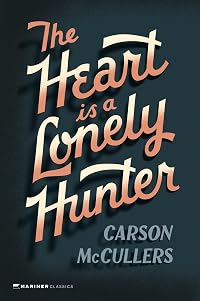
The Heart Is a Lonely Hunter
by Carson McCullers 
On This Page
Description
Story centers around a deaf-mute in a southern town, who, because of his affliction, must "listen" and so receives the confidences of many.Tags
Recommendations



Member Recommendations
BonnieJune54 a more hopeful novel of a girl coming of age in the south. Bonds are formed between divergent people.
46
Member Reviews
I was never smitten like many readers*, but it wasn't a full loss. I glimpsed its power and I’m thinking on it. This is a book on the American deep south about ten years into Great Depression. Race, poverty, cultural tensions live here, as does world chaos, Communism (or Communist idealism), and our personal isolation. Our author was 23 when it was published, and she maybe wrote from close awareness of these social tensions. But it's maybe a book that is more about our need for connection and understanding, and for acknowledgment.
It’s a simple story structure the follows five characters in a small southern town of about 30,000 people (based a lot on Columbus, GA). Each character represents an element of tension within the cities show more populace, except Singer, a deaf-mute orphan from Chicago who lives quietly. Singer’s muteness and ability to read lips and his kind patience acquires him a following of people who need someone to listen. He gives them a kind of symbolic spiritual totem, someone who understands in a malleable variety of ways individual to each speaker. But his muteness also means he doesn’t say much and no one really knows who he is or what his state of mind is. The other four main characters are each memorable. Biff Brannon owns The New York Cafe, and quietly and kindly observes his city, staying open all night because he personally likes that late-night clientele. Mick Kelly is a teenage girl in a big, impoverished family who takes in boarders, including John Singer. Jake Bount is an alcoholic mechanic preaching Communism, reading Marx over and over again. Doctor Benedict Mady Copeland is a negro doctor who hates the white supremacy, and the black lack of agency, who reads Spinoza by himself, and preaches Communism in the sense that blacks are the ultimate victims of American capitalism. And when Jake and Dr. Copeland speak, they argue bitterly.
The draping all of this on the simple story bones, through our five characters, leads to some extended simple narratives necessary to fill it the details of who and what these people are - individually and cumulatively. I found this made tough going. But other readers don't seem to mind. But this may be also what gives the book a very simple power that can run deep. I'll try to keep the idea of John Singer in my mind, and the idealism of Copeland and Jake Blount.
*rant:Among my problems with this book is the back cover that tells me Tennessee Williams called Carson "the greatest prose writer the South produced", which was a deranged thing to say. And Richard Wright admiring her ability to "embrace white and black humanity", which is iffy, kind but too worshipping. They broughy out my inner critic, gasping and ranting. And I couldn't quiet it down. I was annoyed at them and the book designer who put so much weight on this book. /rant
2026
https://www.librarything.com/topic/384249#9211941 show less
It’s a simple story structure the follows five characters in a small southern town of about 30,000 people (based a lot on Columbus, GA). Each character represents an element of tension within the cities show more populace, except Singer, a deaf-mute orphan from Chicago who lives quietly. Singer’s muteness and ability to read lips and his kind patience acquires him a following of people who need someone to listen. He gives them a kind of symbolic spiritual totem, someone who understands in a malleable variety of ways individual to each speaker. But his muteness also means he doesn’t say much and no one really knows who he is or what his state of mind is. The other four main characters are each memorable. Biff Brannon owns The New York Cafe, and quietly and kindly observes his city, staying open all night because he personally likes that late-night clientele. Mick Kelly is a teenage girl in a big, impoverished family who takes in boarders, including John Singer. Jake Bount is an alcoholic mechanic preaching Communism, reading Marx over and over again. Doctor Benedict Mady Copeland is a negro doctor who hates the white supremacy, and the black lack of agency, who reads Spinoza by himself, and preaches Communism in the sense that blacks are the ultimate victims of American capitalism. And when Jake and Dr. Copeland speak, they argue bitterly.
The draping all of this on the simple story bones, through our five characters, leads to some extended simple narratives necessary to fill it the details of who and what these people are - individually and cumulatively. I found this made tough going. But other readers don't seem to mind. But this may be also what gives the book a very simple power that can run deep. I'll try to keep the idea of John Singer in my mind, and the idealism of Copeland and Jake Blount.
*rant:
2026
https://www.librarything.com/topic/384249#9211941 show less
Carson McCullers wrote her first novel when she was just 23. The Heart is a Lonely Hunter is a series of character studies of five lonely people living in a mill town in Georgia in the closing years of the Great Depression. Singer is a deaf mute whose companion, another deaf mute, is institutionalized. Moving into a boarding house, he is befriended by a motley collection of loners, all who see him as understanding and sympathetic. Mick Kelly is entering her teenage years and is often responsible for the care of her two younger siblings. She is passionate about music and would love nothing more than to own a piano or even to have music lessons, but her family's financial situation, already precarious, becomes more and more desperate as show more time goes on. Dr. Copeland is the town's African American doctor and he fights everyday for the health and future of his people, even as he fears that no one is listening. His relationship with his children is tenuous and his own health is failing. Biff Brannon is the owner of a cafe, one that stays open at all hours. Brannon is a listener and a compassionate man, willing to let a debt slide or to help out someone who needs a place to stay. Jake Blount is perhaps the most interesting of the characters here. He sees and feels too strongly the suffering of the people around him and knows that if they would just rise up or even just understand what is going wrong, they could be saved. His passion has made him into a drunk, leaving him with nothing. These four lonely people look to Singer for solace and understanding, failing utterly to see Singer's own pain.
This is no heart-warming story of friendship and fried green tomatoes. There's no happy ending for anyone to be found. McCullers has written a brilliant book about suffering and loneliness. It's beautifully written and utterly heart-breaking. show less
This is no heart-warming story of friendship and fried green tomatoes. There's no happy ending for anyone to be found. McCullers has written a brilliant book about suffering and loneliness. It's beautifully written and utterly heart-breaking. show less
Carson McCullers has a gift for writing about people’s inner monologs and desires, and how life very seldom, if ever, matches those things. The novel, and its language, are cemented in a 1930s rural mill town. The central character, John Singer, is a deaf mute, who is widely respected as someone who listens to others, but is he? The opening lines of the song from Midnight Cowboy come to mind, “Everybody is talking at me, I don’t hear a word they are saying”. Mr Singer is attentive, polite, agreeable, and sometimes writes a short note to explain himself. He offers crummy advice to Mick, a teenage girl who idolizes Mr. Singer. The foil to John Singer is the inflexible Dr. Copeland, who speaks eloquently, but nobody, not even his show more family, is listening. Mick is musical genius, who is not able to express herself, not even by making her own violin. Everybody is lonely, more so at the end, than at the start of the book, but great insights into our plight as humans. show less
To his friends, John Singer is the perfect confidant, the one person who really understands them; he’s the best listener they’ve ever known. He’s also deaf, and by his own choice, mute. A skilled lip reader, he reflects back to them, by expression, gesture, and a silver pencil and pad of paper, his sympathy and understanding. It’s an unusual assortment of people that befriend Singer: the owner of an all night restaurant, a disgruntled drunk, the town’s African American doctor, and his landlord’s teenage daughter. Except for Singer they don’t see that they have anything in common, as chapter by chapter their stories are revealed and their longings for each other are revealed to the reader, but never spoken to each other. show more
McCullers presents, without piteous or ironic commentary, a tragedy and social commentary set in an unnamed town, “in the middle of the deep South,” just before the outbreak of the Second World War. Her prose is clear and her characterization extraordinary. show less
McCullers presents, without piteous or ironic commentary, a tragedy and social commentary set in an unnamed town, “in the middle of the deep South,” just before the outbreak of the Second World War. Her prose is clear and her characterization extraordinary. show less
What a fantastic book! I could write whole essays about this book and its presentation of the failure of American capitalism, the failure of interpersonal relationships, the tendency towards self-delusion, the death of the dream, the effects of trauma and intergenerational trauma, etc etc. It is terrifying that McCullers was only 23 when this book was published and yet the quality of the prose are way beyond anything I could have done at 23 (indeed, could do now I expect). Often described as 'southern gothic', for me this book is a literary version of 'socialist realism' - every word in its right place, revealing the cold realities of a brutal system that grinds to dust almost every man and woman. What a terrible time to be alive - show more American poverty worse than serfdom, fascism winning power in Europe, and Stalin's brutal purges systematically liquidating those who had already brought down one tyrant. show less
The young Carson McCullers could write, and draw characters, but an idea that would be spirited and worthwhile as a literary short story or novella becomes excruciating when drawn out to novel length. The well-named The Heart is a Lonely Hunter (the title comes from a turn-of-the-century Scottish poem) is a long, plotless display of earnest literary noodling; a collection of benign, banal and bracing interactions between a handful of characters in a town in the American South in the 1930s.
The book swirls the interactions of four characters (only one of whom, the young girl Mick Kelly, is memorable) around a fifth: a pleasant, placid deaf-mute named John Singer. Each of the four are strangely drawn to this man for reasons they don't show more know, only that he has some quality; he is "thoughtful and composed", with "gentle eyes" (pg. 87). He understands them intuitively, they think, but part of the author's aim here seems to be that they are projecting; they each describe "the mute as he [or she] wished him to be" (pg. 197) and fail to realise that this man is reluctant to communicate in kind. He doesn't unburden himself on them as they do on him, and while they are each wrapped up in their own dramas – the novel's title leading us to believe they are the directionless and lonely hunters – it eventually becomes apparent that John Singer is the loneliest and the most burdened. "She likes music," Singer writes of Mick Kelly in a letter to the one (unreciprocated) friendship he tries to cultivate. "I wish I knew what it is she hears. She knows I am deaf but she thinks I know about music." (pg. 190)
Now, McCullers' book is one of those where this sort of literary architecture only becomes clear after you have finished it, and perhaps studied it. It is a noble theme, and McCullers is sometimes a bit too aware of the nobility, overegging the portentousness of her prose (particularly the internal monologues of the characters) and the earnest sentimentality of the interactions. The totemic role of John Singer is an unsteady device; some have compared him to Christ, the gentle man who redeemed others by taking on their burden, but the device isn't seamless enough to overcome the reader's doubts about it. In uncharitable moments, I wondered whether Singer could be considered a rare white incarnation of the 'magic Negro' trope. A lot of goodwill is lost throughout the novel by the fact it doesn't seem to be going anywhere; even more is lost when the book descends into a tedious preachiness about race and socialism.
Some reviewers have compared the book to Steinbeck (perhaps in part because of the overt socialism), but this comparison doesn't sit well with me. Their writing styles are similar (though McCullers has none of the humour that Steinbeck deployed in, for example, Cannery Row), but in truth Steinbeck never used his characters as pawns in the way McCullers does (at least not as clumsily: the characters in East of Eden could be considered pieces placed on a chessboard). A more suitable comparison might be Faulkner, because of the Southern meandering, but I've not read enough of Faulkner to be able to state this with any conviction.
Perhaps the best way to conceptualise my disappointment in The Heart is a Lonely Hunter is to place it in a trifecta with Harper Lee's To Kill a Mockingbird and Betty Smith's A Tree Grows in Brooklyn. Three female writers drawing characters from 1930s America and delivering a sense of humanity with warmth and homespun prose. But the Lee-Smith-McCullers triangle is isosceles rather than equilateral, and McCullers' novel is by far the least of the three. The other two are just a class above in delivering character, theme and, most importantly, depth. Too much of McCullers' book feels unearned – Singer's enigmatic qualities, his fondness for Antonapoulos, the other four characters' fondness for him – whereas the other two books can resist any sort of critical harrying. The comparison shows that, competent as it is, The Heart is a Lonely Hunter's play for literary greatness fell rather short. show less
The book swirls the interactions of four characters (only one of whom, the young girl Mick Kelly, is memorable) around a fifth: a pleasant, placid deaf-mute named John Singer. Each of the four are strangely drawn to this man for reasons they don't show more know, only that he has some quality; he is "thoughtful and composed", with "gentle eyes" (pg. 87). He understands them intuitively, they think, but part of the author's aim here seems to be that they are projecting; they each describe "the mute as he [or she] wished him to be" (pg. 197) and fail to realise that this man is reluctant to communicate in kind. He doesn't unburden himself on them as they do on him, and while they are each wrapped up in their own dramas – the novel's title leading us to believe they are the directionless and lonely hunters – it eventually becomes apparent that John Singer is the loneliest and the most burdened. "She likes music," Singer writes of Mick Kelly in a letter to the one (unreciprocated) friendship he tries to cultivate. "I wish I knew what it is she hears. She knows I am deaf but she thinks I know about music." (pg. 190)
Now, McCullers' book is one of those where this sort of literary architecture only becomes clear after you have finished it, and perhaps studied it. It is a noble theme, and McCullers is sometimes a bit too aware of the nobility, overegging the portentousness of her prose (particularly the internal monologues of the characters) and the earnest sentimentality of the interactions. The totemic role of John Singer is an unsteady device; some have compared him to Christ, the gentle man who redeemed others by taking on their burden, but the device isn't seamless enough to overcome the reader's doubts about it. In uncharitable moments, I wondered whether Singer could be considered a rare white incarnation of the 'magic Negro' trope. A lot of goodwill is lost throughout the novel by the fact it doesn't seem to be going anywhere; even more is lost when the book descends into a tedious preachiness about race and socialism.
Some reviewers have compared the book to Steinbeck (perhaps in part because of the overt socialism), but this comparison doesn't sit well with me. Their writing styles are similar (though McCullers has none of the humour that Steinbeck deployed in, for example, Cannery Row), but in truth Steinbeck never used his characters as pawns in the way McCullers does (at least not as clumsily: the characters in East of Eden could be considered pieces placed on a chessboard). A more suitable comparison might be Faulkner, because of the Southern meandering, but I've not read enough of Faulkner to be able to state this with any conviction.
Perhaps the best way to conceptualise my disappointment in The Heart is a Lonely Hunter is to place it in a trifecta with Harper Lee's To Kill a Mockingbird and Betty Smith's A Tree Grows in Brooklyn. Three female writers drawing characters from 1930s America and delivering a sense of humanity with warmth and homespun prose. But the Lee-Smith-McCullers triangle is isosceles rather than equilateral, and McCullers' novel is by far the least of the three. The other two are just a class above in delivering character, theme and, most importantly, depth. Too much of McCullers' book feels unearned – Singer's enigmatic qualities, his fondness for Antonapoulos, the other four characters' fondness for him – whereas the other two books can resist any sort of critical harrying. The comparison shows that, competent as it is, The Heart is a Lonely Hunter's play for literary greatness fell rather short. show less
Well, that was eviscerating. I am not sure that should not be my whole review, but I will say a bit more.
I know that Faulkner is considered to be the Dean of Southern Despair, but I would argue that Carson McCullers' depictiion of hollowness seems more honest and both more personal and somehow more universal than Faulkner's. When her people soldier on in the face of despair it somehow seems a less noble option than ending it all. It feels like they are chickens running around with their heads cut off. Already dead but beholden to their reflexes and maybe a dab of muscle memory. There is a discussion to be had about this topic, but it would be spoiler-laden, and I don't want to go there. It would be a hell of a book club discussion.
An show more extraordinary novel improbably written by a woman in her early 20s (she was 23 when it was published.) Read it if you want to be reminded of the power of literature. Don't read it if you want to feel good.
One note -- I read this on my Kindle, but in the last 1/3 switched off between text and audio. The audiobook is read by Cherry Jones, and it is exceptionally good. I am still glad I read this, the language is too good to not spend time with, but I think when I feel the need to be gutted again I will listen to the whole on audiobook. show less
I know that Faulkner is considered to be the Dean of Southern Despair, but I would argue that Carson McCullers' depictiion of hollowness seems more honest and both more personal and somehow more universal than Faulkner's. When her people soldier on in the face of despair it somehow seems a less noble option than ending it all. It feels like they are chickens running around with their heads cut off. Already dead but beholden to their reflexes and maybe a dab of muscle memory. There is a discussion to be had about this topic, but it would be spoiler-laden, and I don't want to go there. It would be a hell of a book club discussion.
An show more extraordinary novel improbably written by a woman in her early 20s (she was 23 when it was published.) Read it if you want to be reminded of the power of literature. Don't read it if you want to feel good.
One note -- I read this on my Kindle, but in the last 1/3 switched off between text and audio. The audiobook is read by Cherry Jones, and it is exceptionally good. I am still glad I read this, the language is too good to not spend time with, but I think when I feel the need to be gutted again I will listen to the whole on audiobook. show less
Members
- Recently Added By
Published Reviews
ThingScore 100
No matter what the age of its author, "The Heart Is a Lonely Hunter" would be a remarkable book. When one reads that Carson McCullers is a girl of 22 it becomes more than that. Maturity does not cover the quality of her work. It is something beyond that, somthing more akin to the vocation of pain to which a great poet is born. Reading her, one feels this girl is wrapped in knowledge which has show more roots beyond the span of her life and her experience. How else can she so surely plumb the hearts of characters as strange and, under the force of her creative shaping, as real as she presents—two deaf mutes, a ranting, rebellious drunkard, a Negro torn from his faith and lost in his frustrated dream of equality, a restaurant owner bewildered by his emotions, a girl of 13 caught between the world of people and the world of shadows.
Carson McCullers is a full-fledged novelist whatever her age. She writes with a sweep and certainty that are overwhelming. "The Heart Is a Lonely Hunter" is a first novel. One anticipates the second with something like fear. So high is the standard she has set. It doesn't seem possible that she can reach it again. show less
Carson McCullers is a full-fledged novelist whatever her age. She writes with a sweep and certainty that are overwhelming. "The Heart Is a Lonely Hunter" is a first novel. One anticipates the second with something like fear. So high is the standard she has set. It doesn't seem possible that she can reach it again. show less
added by kidzdoc
Lists

The Guardian's 1000 Novels Everyone Must Read
1,005 works; 549 members

Classics you know you should have read but probably haven't
421 works; 407 members

501 Must-Read Books
529 works; 71 members

Recommend the 20 best books you've read in the last five years
2,168 works; 604 members

Novels from The Guardian's Great American Novelist Tournament
148 works; 24 members

Southern Fiction
212 works; 52 members
Newsweek's Top 100 Books: The Meta-List
100 works; 18 members

The Top Ten: Writers Pick Their Favorite Books
240 works; 33 members

Mental health fiction
55 works; 18 members
1940s
221 works; 25 members

Great American Novels
158 works; 42 members

Oprah's Book Club (original and 2.0)
91 works; 21 members
20th Century Literature
1,161 works; 55 members

Female Author
1,234 works; 65 members

Unread books
1,063 works; 87 members

Best Gothic Fiction
110 works; 31 members

child hero ~ adult novel
60 works; 12 members
Favourite Books
1,820 works; 310 members
Time Magazine's "All-Time 100"
113 works; 15 members

Canon de la narrativa universal del siglo XX
254 works; 6 members

Love and Marriage
93 works; 10 members
Harold Bloom - The Western Canon: D. The Chaotic Age
833 works; 24 members
LibraryThingers' 1001 Books You Must Read Before You Die
442 works; 30 members
Fictional Characters With Disabilities
43 works; 9 members

Top Five Books of 2017
757 works; 230 members

Top Five Books of 2022
736 works; 272 members

Publishing Triangle 100 Best Lesbian and Gay Novels
97 works; 6 members

Dark Books for Winter Reading
71 works; 11 members

Books You Read During High School (For School)
301 works; 52 members
Best First Lines
133 works; 8 members
Time's All-Time 100 Novels
100 works; 27 members
Mensa for Kids Excellence in Reading Award Program (Grades 9-12)
116 works; 5 members
Literature About Women and Girls
426 works; 40 members
Books tagged favorites
390 works; 30 members
Readable Classics
110 works; 15 members
Best of American Literature
146 works; 9 members

Top Five Books of 2015
811 works; 240 members
Phi Beta Kappa reading list
260 works; 8 members

One Book, Many Authors
441 works; 40 members
Blue Pyramid 1,276 Best Books of All Time
1,248 works; 32 members

A Novel Cure
742 works; 23 members
Best Domestic Fiction
77 works; 6 members

Amanda's Guaranteed Books
110 works; 5 members
Mensa for Kids Excellence in Reading Award Program (Grades 9-12)
116 works; 3 members
College Reads (Lit Edition)
75 works; 5 members
The Modern Library's 100 Best Novels: The Board's List
85 works; 6 members

Carole's List
445 works; 13 members
Five star books
1,767 works; 109 members
Books Set in Small Towns and Villages
278 works; 16 members

Books Read in 2023
5,638 works; 147 members

Most Depressing Books
69 works; 16 members

A's favorite novels
100 works; 3 members

To Read
6 works; 1 member
Racism and Race Relations in Literature
48 works; 9 members
First Novels
373 works; 17 members

Favorite Books from the 1940s
38 works; 3 members
Overdue Podcast
808 works; 9 members
Best Books of the 20th Century
193 works; 5 members
My Favourite Books
86 works; 5 members

Willoyd's Tour of the USA
25 works; 1 member

Cooper
79 works; 1 member

Romans
49 works; 1 member

Books Read in 2022
5,226 works; 115 members

Books Set in Georgia
11 works; 4 members

Most Frequently Tagged "Read in 2015"
70 works; 1 member
2021 - List of books read
53 works; 1 member
American Lit for Eng 11 Research Project
368 works; 6 members
Best Audiobooks
240 works; 114 members
Ten Before The End
10 works; 1 member

Recommended Reading : 600 Classics Reviewed, Editors of Salem Press, 2015
634 works; 6 members
20th-Century American Women Writers Reading List
15 works; 1 member
Canon de la narrativa universal del s. XX (cicutadry)
499 works; 3 members

Gen X Library
245 works; 4 members

Books You Read For University
184 works; 3 members

Retrospective of 20th- and 21st-century literature
154 works; 1 member

Emo Books
14 works; 1 member

.
194 works; 2 members
.
396 works; 1 member
Modern Library's 100 Best Novels
100 works; 2 members

The Atlantic's The Great American Novel
136 works; 12 members

Books With Complete Sentence Titles
501 works; 17 members

Reading Glasses Podcast
410 works; 3 members

Books With the Most Memorable Titles
478 works; 158 members

Mustich's 1000 Books to Read Before You Die: A Life Changing List
1,001 works; 20 members

Favorite Childhood Books
1,651 works; 515 members

Books Featuring Teens
25 works; 4 members

Books With Body Parts in the Title
153 works; 9 members
Read These Too
458 works; 9 members

Literary Works Read in College
316 works; 15 members

Authors from the United States
245 works; 3 members

Books Read in 2010
631 works; 11 members

BingoDOG - Language in Fiction
35 works; 12 members

Books Read in 2021
5,361 works; 114 members

Books About Girls
219 works; 17 members

Ryan's Books
34 works; 1 member

thinking of reading in 2016
99 works; 1 member

You Couldn't Pay Me to Read That (Take 2)
213 works; 87 members
Talk Discussions
Past Discussions
GROUP READ: [The Heart is a Lonely Hunter] in 2013 Category Challenge (September 2013)
Author Information

98+ Works 22,774 Members
Carson McCullers was born in Columbus, Georgia, on February 19, 1917. She died at age fifty in Nyack, New York, on September 29, 1967. A promising pianist, she had hoped to enroll at the Juilliard School of Music when she was seventeen, but when she arrived in New York, she attended writing classes at Columbia University instead. In December 1936 show more her first story, "Wunderkind," was published in "Story" magazine. That winter she began work on "The Mute," which would become her enduring masterpiece, "The Heart Is a Lonely Hunter." (Publisher Provided) Carson McCullers was born Lula Carson Smith on February 19, 1917 in Columbus, Georgia. At the age of seventeen, desiring to become a famous concert pianist, she went to New York City to attend the Julliard School of Music. Her family sacrificed and raised money for her tuition to go to Julliard, but she lost all of her money when she left her pocketbook on the subway. Unable to tell her family what had happened, she took writing classes at Columbia University and New York University from 1935-1936. Her first novel, The Heart Is a Lonely Hunter, was published in 1940. Her other novels included Reflections in a Golden Eye, The Ballad of the Sad Café, The Member of the Wedding, and Clock Without Hands. With the help of Tennessee Williams, The Member of the Wedding was adapted into a play, which won the New York Drama Critics Circle Award in 1950. She died from a stroke and subsequent brain hemorrhage on September 29, 1967at the age of 50. (Bowker Author Biography) show less
Carson McCullers has a Legacy Library. Legacy libraries are the personal libraries of famous readers, entered by LibraryThing members from the Legacy Libraries group.
Some Editions
Awards and Honors
Series
Belongs to Publisher Series
Work Relationships
Is contained in
Has the adaptation
Has as a student's study guide
Common Knowledge
- Canonical title
- The Heart Is a Lonely Hunter
- Original title
- The Heart Is a Lonely Hunter
- Alternate titles*
- Het hart is een havik
- Original publication date
- 1940
- People/Characters
- Spiros Antonapoulos (heavy mute); John Singer (thin mute); Charles Parker (Spiros Antonapoulos' cousin); Biff Brannon (cafe owner); Jake Blount (drunk); Mick Kelly (girl) (show all 9); Dr. Benedict Copeland (black physician); Alice Brannon (Biff's wife); Willie (cafe kitchen worker)
- Important places
- New York Cafe; Southern States, USA; Georgia, USA
- Related movies
- The Heart Is a Lonely Hunter (1968 | IMDb)
- Dedication
- To Reeves McCullers and to Marguerite and Lamar Smith
- First words
- In the town there were two mutes, and they were always together. Early every morning they would come out from the house where they lived and walk arm in arm down the street to work. -Chapter 1
- Quotations
- Because in some men it is in them to give up everything personal at some time, before it ferments and poisons—throw it to solve human being or some human idea. They have to.
He listened, and in his face there was something and Jewish, the knowledge of one who belongs to a race that is oppressed.
Today we are not put up on the platforms and sold at the courthouse square. But we are forced to sell our strength, our time, our souls during almost every hour that we live. We have been freed from one kind of slavery only t... (show all)o be delivered into another. Is this freedom? Are we yet free men?
All white people looked similar to Negroes but Negroes took care to differentiate between them. On the other hand, all Negroes looked similar to white men but white men did not bother to fix the face of a Negro in their minds... (show all).
The whole system of capitalistic democracy is—rotten and corrupt. There remain only two roads ahead. One: Fascism. Two: reform of the most revolutionary and permanent kind.
And how can the dead be truly dead when they still live in the souls of those who are left behind?
Myself—I’m a conservative and of course I think your opinions are radical. But at the same time I like to know all sides of a matter. - Last words
- (Click to show. Warning: May contain spoilers.)And when at last he was inside again he composed himself soberly to await the morning sun.
- Blurbers
- Mann, Klaus; Sarton, May; Pritchett, V. S.; Williams, Tennessee; Trilling, Diana; Wright, Richard (show all 8); Bowen, Elizabeth; Vidal, Gore
- Original language
- English US
- Canonical DDC/MDS
- 813.52
- Canonical LCC
- PS3525.A1772
*Some information comes from Common Knowledge in other languages. Click "Edit" for more information.
Classifications
Statistics
- Members
- 12,025
- Popularity
- 730
- Reviews
- 272
- Rating
- (3.98)
- Languages
- 22 — Catalan, Czech, Danish, Dutch, English, Estonian, Finnish, French, German, Hebrew, Hungarian, Indonesian, Italian, Norwegian (Bokmål), Polish, Portuguese, Croatian, Slovak, Slovenian, Spanish, Swedish, Turkish
- Media
- Paper, Audiobook, Ebook
- ISBNs
- 128
- UPCs
- 2
- ASINs
- 83