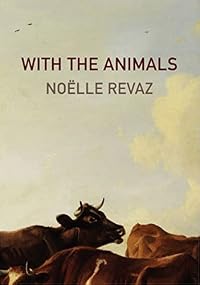
With the Animals
by Noëlle Revaz
On This Page
Description
Considered the standard-bearer for the great Franco-Swiss literary tradition, exemplified by authors such as Jacques Chessex and C. F. Ramuz, No'lle Revaz may also remind English-language readers of Louis-Ferdinand C'line: "With the Animals," her shocking debut, is a novel of mud and blood whose linguistic audaciousness is matched only by its brutality, misanthropy, and gallows humor. Narrated by the singular Paul--a violent, narrowminded farmer whose unceasing labor leaves him with more show more love for his livestock than his family--"With the Animals" is at once a fantastically exaggerated and entirely honest portrait of masculinity gone mad. With his mute and detested wife and children huddled at his side, Paul is only roused from his regimen of hard labor and casual cruelty when a farmhand, Georges, comes to work on his property for the summer. His sovereignty seemingly threatened, an element of unwanted humanity now injected into his universe, Paul's little kingdom seems ripe at last for a revolution. show lessTags
Recommendations









































Member Reviews
Vulva. This is what Paul, the illiterate farmer-narrator of Revaz's With the Animals calls his wife. Lest you think it's a form of tenderness when he calls her "my Vulva," rest assured, "it's not often I call her 'my,' and more often it's 'that big lump,' or 'that floozy,' or 'that sow,' except when the opportunity comes up when you need to show your ownership, that you've a stake in the matter and you're master over her." Paul is unsure of the names and number of their offspring, but each of his animals has a name and a history.
Such is Paul's relationship to his metonym of a wife. His physically and sexually abusive relationship to her is complicated by two potentially life-altering situations. The first, the arrival of the summer's show more farmhand (or intern), Jorge--immediately renamed "Georges" by Paul--and second, the discovery that Vulva has cancer. Georges is a former medical student who fancies himself an expert of female nature. He undertakes to soften Paul, to humanize "Vulvia" (Georges' accent). When Vulva leaves the farm for the hospital to receive radiation treatment, Georges finds himself alone with Paul, in other words, alone with the animals.
SPOILER (or at least this reader's speculation):
It seems to me this would make an incredibly disturbing horror film in the vein of "students get more than they bargain for when they study abroad." Vulva is essentially kidnapped, raped and impregnated against her will (over and over). Her physical and social isolation prolong the abuse. When Jorge arrives, he seems to understand her situation and endeavors to rescue her. This attempt is successful so long as Vulva remains in hospital, but alas, Georges' tenure at the farm comes up in September, and Vulva once again finds herself vulnerable and unprotected. She's survived only to endure further abuse. But does she? Curious whether other readers speculated that Vulva was responsible for the outbreak of illness that decimates the farm? Was Paul's mother responsible for the illness that nearly destroyed it years before Vulva's arrival? What to make of this: "That time on the farm, long before Georges ever set foot on it, after the fridge broke down, after that meat gave us the big stomach upset, Vulva never felt a thing in her bacon and ate by herself alone at the table that night with a smile on her mug just like we was all there"? show less
Such is Paul's relationship to his metonym of a wife. His physically and sexually abusive relationship to her is complicated by two potentially life-altering situations. The first, the arrival of the summer's show more farmhand (or intern), Jorge--immediately renamed "Georges" by Paul--and second, the discovery that Vulva has cancer. Georges is a former medical student who fancies himself an expert of female nature. He undertakes to soften Paul, to humanize "Vulvia" (Georges' accent). When Vulva leaves the farm for the hospital to receive radiation treatment, Georges finds himself alone with Paul, in other words, alone with the animals.
SPOILER (or at least this reader's speculation):
It seems to me this would make an incredibly disturbing horror film in the vein of "students get more than they bargain for when they study abroad." Vulva is essentially kidnapped, raped and impregnated against her will (over and over). Her physical and social isolation prolong the abuse. When Jorge arrives, he seems to understand her situation and endeavors to rescue her. This attempt is successful so long as Vulva remains in hospital, but alas, Georges' tenure at the farm comes up in September, and Vulva once again finds herself vulnerable and unprotected. She's survived only to endure further abuse. But does she? Curious whether other readers speculated that Vulva was responsible for the outbreak of illness that decimates the farm? Was Paul's mother responsible for the illness that nearly destroyed it years before Vulva's arrival? What to make of this: "That time on the farm, long before Georges ever set foot on it, after the fridge broke down, after that meat gave us the big stomach upset, Vulva never felt a thing in her bacon and ate by herself alone at the table that night with a smile on her mug just like we was all there"? show less
Ratings
Members
- Recently Added By
Lists

CH-Autoren (Swiss Authors)
265 works; 9 members

Les 50 meilleurs livres de langue française de 1900 à aujourd’hui
69 works; 2 members
Author Information

Awards and Honors
Series
Belongs to Publisher Series
Common Knowledge
- Canonical title*
- Rapport aux bêtes
- Original title
- Rapport aux bêtes
- Original publication date
- 2002-01-16 (1e édition originale française ∙ Blanche ∙ Gallimard) (1e édition originale française ∙ Blanche ∙ Gallimard); 2009-09-03 (Réédition française ∙ Folio ∙ Gallimard) (Réédition française ∙ Folio ∙ Gallimard)
- Epigraph*
- /
- Dedication*
- /
- First words*
- 1
Devant quand je sors le matin, j’avale déjà une bonne rasade, et les choses se prennent aux autres, comme de la paille. Avant j’ai la trogne mauvaise et l’ail en bouche et je supporte pas qu’on veuille se f... (show all)aire câliner comme les chiots qui ont la morve. [...] - Original language
- French
*Some information comes from Common Knowledge in other languages. Click "Edit" for more information.
Classifications
Statistics
- Members
- 64
- Popularity
- 483,438
- Reviews
- 1
- Rating
- (3.89)
- Languages
- English, French, German, Italian
- Media
- Paper, Ebook
- ISBNs
- 7