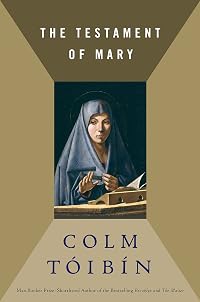
The Testament of Mary
by Colm Tóibín
On This Page
Description
A provocative imagining of the later years of the mother of Jesus finds her living a solitary existence in Ephesus years after her son's crucifixion and struggling with guilt, anger, and feelings that her son is not the son of God and that His sacrifice was not for a worthy cause.Tags
Recommendations






Member Recommendations

Member Reviews
The Testament of Mary - Toibin
Audio performance by Meryl Streep
4 stars
This is a very sad story. It’s a very powerful piece of writing. It is a very moving, imagined, first person account of an aging Mary, mother of Jesus. (Although, If I remember correctly, neither Jesus or any of the disciples is mentioned by name.) This Mary of Nazareth is a fugitive, living in Ephesus under the protective custody of her ‘keepers’ who are presumably followers of her son. This novella records the private thoughts of a woman who is traumatized by the death of her son. She is haunted by her memories of that death. She is cynical about everything pertaining to her son’s ministry, his followers, and the events leading to his death. She show more understands that she is being used to further the message of his followers and that she will continue to be used after her death. This woman’s grief at her loss and her guilt at leaving her son before his final moments are more than heart wrenching. Along with that grief, she is testifying to her complete lack of power. She cannot testify to the truth of the story as she saw it. She knows her words will be distorted.
I thought this was a very interesting interpretation of a well known story. It would be thought provoking even without the excellent prose. It’s a plausible take on how events could be rewritten into a desired mythology. I knew it was not much more than a short story when I started it, but I’m still left with a wish for a more detailed account. Toibin imagined the testament that might of been given by a woman. There isn’t an actual historical record by any woman. It can only be imagined. show less
Audio performance by Meryl Streep
4 stars
This is a very sad story. It’s a very powerful piece of writing. It is a very moving, imagined, first person account of an aging Mary, mother of Jesus. (Although, If I remember correctly, neither Jesus or any of the disciples is mentioned by name.) This Mary of Nazareth is a fugitive, living in Ephesus under the protective custody of her ‘keepers’ who are presumably followers of her son. This novella records the private thoughts of a woman who is traumatized by the death of her son. She is haunted by her memories of that death. She is cynical about everything pertaining to her son’s ministry, his followers, and the events leading to his death. She show more understands that she is being used to further the message of his followers and that she will continue to be used after her death. This woman’s grief at her loss and her guilt at leaving her son before his final moments are more than heart wrenching. Along with that grief, she is testifying to her complete lack of power. She cannot testify to the truth of the story as she saw it. She knows her words will be distorted.
I thought this was a very interesting interpretation of a well known story. It would be thought provoking even without the excellent prose. It’s a plausible take on how events could be rewritten into a desired mythology. I knew it was not much more than a short story when I started it, but I’m still left with a wish for a more detailed account. Toibin imagined the testament that might of been given by a woman. There isn’t an actual historical record by any woman. It can only be imagined. show less
The Testament of Mary is an account of the death of Jesus from the point of view of the one who knew him best, his mother Mary.
Toibin's Mary is an aged woman preparing herself for the end of her life and seeking to clarify in her own mind the events surrounding her son's death. She recounts her son's inexorable slide into the clutches of his political enemies and gives us a grim eyewitness account of the crucifixion. Mary's account of the aftermath varies dramatically from the traditional account.
Toibin's novella is ridden with heresies that are subtly and gently delivered in a way that is absolutely believable, although the book will no doubt ruffle many feathers. It is however a succinct and beautiful account of a mother's special show more bonds to her child, and a very human portrayal of a person who tradition has presented as more of a semi-divine figure. show less
Toibin's Mary is an aged woman preparing herself for the end of her life and seeking to clarify in her own mind the events surrounding her son's death. She recounts her son's inexorable slide into the clutches of his political enemies and gives us a grim eyewitness account of the crucifixion. Mary's account of the aftermath varies dramatically from the traditional account.
Toibin's novella is ridden with heresies that are subtly and gently delivered in a way that is absolutely believable, although the book will no doubt ruffle many feathers. It is however a succinct and beautiful account of a mother's special show more bonds to her child, and a very human portrayal of a person who tradition has presented as more of a semi-divine figure. show less
Toibin focuses on Mary instead of Jesus, but it's not a Mary invited to the secret teachings, but a stranger to her son and the rather dismal multitudes. She follows him from afar and indirectly through some of the highlights, like raising Lazarus. But there's something sickly and off with the miracles, Lazarus is back to life but not restored. Water turning to wine looks more like a magic trick of confusion. The masses are always there around him, shutting him off, demanding more. It's an interesting portrait of estrangement, and a gospel from the ground level (my mind turns to Brian stuck at the back of the Sermon on the Mount struggling to hear the teachings). With Jesus having a target on his back, his followers and her turn into show more targets, and on the run Mary doesn't get to fulfill the traditional roles, only dream about them. The circle of disciples and early leaders are painted more as conniving people concocting the right stories that they promise will change the world, but none of it interests her, she denies their tales, the miracles, certainly a virgin birth, and is found praying to an altar of Artemis bookending the story and cementing it as something blasphemous, but more interesting for it.
If there's a flaw here it's the emptiness of her husband gone, along with his perspective, as well as the absent brothers, then again with such a short book focusing on her story makes sense.
Alternatives: I'm starting to have read quite a collection of these 'alternate gospels'. The Gospel According to Jesus Christ, for a nobel prize winner this is a pretty sophomoric sarcastic take on Jesus.
The Gospel According to the Son, Mailer sticks pretty close to the gospel but doesn't add much either.
The Man Born to Be King, another one that amounts to a retelling, but done so with fervor.
The Last Temptation of Christ, the best by far, managing to be both blasphemous and faithful. show less
If there's a flaw here it's the emptiness of her husband gone, along with his perspective, as well as the absent brothers, then again with such a short book focusing on her story makes sense.
Alternatives: I'm starting to have read quite a collection of these 'alternate gospels'. The Gospel According to Jesus Christ, for a nobel prize winner this is a pretty sophomoric sarcastic take on Jesus.
The Gospel According to the Son, Mailer sticks pretty close to the gospel but doesn't add much either.
The Man Born to Be King, another one that amounts to a retelling, but done so with fervor.
The Last Temptation of Christ, the best by far, managing to be both blasphemous and faithful. show less
I was not raised a Christian, but of course I know the conventional story of the New Testament. This shows a completely different perspective, of a mother robbed of her son, a woman almost broken with horror and despair. Her view of the disciples: misfits who cannot meet a woman's eyes. Her view of the rabble: sheep, following instructions.
Toibin's language is straightforward - you can hear the woman talking to you, scorning her keepers (I assume his disciples), refusing to give them the stories and details she cannot give them because they want what is not true. She is tough, practical, bitter, scoffing at the worth of the sacrifice she has witnessed.
Mary was once a devout Jew, loving the Sabbath, loving the prayers. Now living in show more Ephesus, if she follows any god, it is Artemis, goddess of childbirth (among other things). She waits, alone, silent, for her own death. show less
Toibin's language is straightforward - you can hear the woman talking to you, scorning her keepers (I assume his disciples), refusing to give them the stories and details she cannot give them because they want what is not true. She is tough, practical, bitter, scoffing at the worth of the sacrifice she has witnessed.
Mary was once a devout Jew, loving the Sabbath, loving the prayers. Now living in show more Ephesus, if she follows any god, it is Artemis, goddess of childbirth (among other things). She waits, alone, silent, for her own death. show less
Gentle, stoical, visceral pain leaches from every page, into my fingers, till my very blood is charged with it.
The agony of wounds and guilt, yes, but the balm of forgiveness, too, I hope.
“I did not think that the cursed shadow of what had happened would ever lift… It pumped darkness… It was a heaviness in me that often became a weight which I could not carry.”
Image: Statue of weeping woman in a cemetery (Source)
Who is this for?
I expect this novel provokes the strongest reactions in those who can tick at least one of the following:
• A parent, especially a mother.
• Raised with New Testament stories.
• Lost a loved-one prematurely, especially a child.
• Burdened with guilt and "what if?" about a situation that ended, or show more looks as if it will end, badly.
The devout may find it too heretical.
Militant atheists and followers of other faiths may find this too steeped in the New Testament.
I read it as neither.
I read it as a mother, sharing the agonies of another mother: grief, pain, and guilt to a degree I hope I will never have to face.
Mary looks back
Mary, mother of Jesus, is looking back at the life and death of her beloved son.
She remembers how her beautiful, thoughtful child was transformed and lost to her, lost to life.
The first, innocuous loss, was at the temple, when he was twelve, staying behind in his “Father’s house”.
In later years, she lost him to delusions and dodgy friends that turned him into a dangerous demagogue.
Ultimately she lost him to a gruesome and humiliating death that left her vulnerable to shadowy principalities and powers.
She examines his faults, questions his miracles, and agonises over what she could have done differently: how she might have saved the life of the one she gave life to, how she might have saved the Saviour of mankind.
Her greatest pain is that there was nothing.
Nothing she could have done to save him.
And now all she has are memories.
Memories which hurt as much as they heal.
Memories which are milked and curdled by protective predators with a new religion to start.
She looks back for solace, to the virginal ancient goddess Artemis, even as she looks ahead, in answer to the whispered call of death.
What use a mother who cannot help her child at their time of greatest need?
I weep for the times when I have failed my own child, and humbly seek forgiveness - not from God, but from the flesh of my flesh, my beloved, precious child.
I first read and reviewed this book in 2016, when I was worried about my 22-year old child. It hit hard. I updated it on 1 January 2019, when I was able to relax a great deal about that. My child was happy, healthy, and beginning to thrive again: working productively and enjoyably, and planning the future.
But that joy and relief coincided with the shock and grief of my father unexpectedly ending his life. And then a loved one said how cathartic they'd found this book when they were in a deep depression a few years ago. So I turned to this review, and read it with generations reversed:
What use a child who cannot help their parent at their time of greatest need?
So I wept for the times when I failed my own father, and would humbly seek his forgiveness, were it not too late.
A few years on, I merely weep for all my many failings.
Quotes
• “It would not be long before all the life in me, the little left, would go, as a flame goes out on a mild day, easily, needing only the smallest hint of wind, a sudden flicker and then out, gone, as though it had never been alight.”
• “Their brother grew easily towards death in the same way as a source for a river, hidden under the earth, begins flowing and carries water across a plain to the sea. They would have done anything to divert the stream, make it meander on the plain and dry up under the weight of the sun… his last breath, when he was fully part of the waves of the sea, an invisible aspect of their rhythm.”
• “Moving as though his spirit was still full with the thunderous novelty of its own great death, like a pitcher of sweet water, filled to the brim, heavy with itself.”
• “The wildness that was in the very air… this great disturbance in the world made its way like creeping mist or dampness into the two or three rooms I inhabit.”
• “What was to occur weighed on me. At times, however, I forgot about it, I let my mind linger over anything at all only to find that what I was moving towards was waiting to spring as a frightened animal will spring… And then it came more slowly, more insidiously. It entered my consciousness, it edged its way into me as something poisonous will crawl along the ground.”
• “Now that the days are shorter and the nights are cold… There is a richness in the light. It is as if, in becoming scarce… it lets loose something more intense, something that is filled with a shivering clarity. And then, when it begins to fade, it seems to leave raked shadows on everything. And during that hour, the hour of ambiguous light, I feel safe to slip out and breathe the dense air when colours are fading and the sky seems to be pulling them in, calling them home.”
See also
• The painful memories this novella stirred in me were stirred again by Claire Oshetsky's brilliant, raw, and disturbing novel, Chouette, which I reviewed HERE.
• Doris Lessing's The Fifth Child was partial inspiration for Chouette, and overlaps with Tóibín's themes. See my review HERE.
• I was surprised to be reminded of this novella by a story in Daisy Johnson's Fen, which is a collection of mythic, mystical short stories, focused on young women, and set in the Fens of contemporary England. See my review HERE.
• Vladimir Nabokov's short story, Symbols and Signs, features parents struggling to cope with an adult child's mental health issues. See my review HERE. show less
The agony of wounds and guilt, yes, but the balm of forgiveness, too, I hope.
“I did not think that the cursed shadow of what had happened would ever lift… It pumped darkness… It was a heaviness in me that often became a weight which I could not carry.”
Image: Statue of weeping woman in a cemetery (Source)
Who is this for?
I expect this novel provokes the strongest reactions in those who can tick at least one of the following:
• A parent, especially a mother.
• Raised with New Testament stories.
• Lost a loved-one prematurely, especially a child.
• Burdened with guilt and "what if?" about a situation that ended, or show more looks as if it will end, badly.
The devout may find it too heretical.
Militant atheists and followers of other faiths may find this too steeped in the New Testament.
I read it as neither.
I read it as a mother, sharing the agonies of another mother: grief, pain, and guilt to a degree I hope I will never have to face.
Mary looks back
Mary, mother of Jesus, is looking back at the life and death of her beloved son.
She remembers how her beautiful, thoughtful child was transformed and lost to her, lost to life.
The first, innocuous loss, was at the temple, when he was twelve, staying behind in his “Father’s house”.
In later years, she lost him to delusions and dodgy friends that turned him into a dangerous demagogue.
Ultimately she lost him to a gruesome and humiliating death that left her vulnerable to shadowy principalities and powers.
She examines his faults, questions his miracles, and agonises over what she could have done differently: how she might have saved the life of the one she gave life to, how she might have saved the Saviour of mankind.
Her greatest pain is that there was nothing.
Nothing she could have done to save him.
And now all she has are memories.
Memories which hurt as much as they heal.
Memories which are milked and curdled by protective predators with a new religion to start.
She looks back for solace, to the virginal ancient goddess Artemis, even as she looks ahead, in answer to the whispered call of death.
What use a mother who cannot help her child at their time of greatest need?
I weep for the times when I have failed my own child, and humbly seek forgiveness - not from God, but from the flesh of my flesh, my beloved, precious child.
I first read and reviewed this book in 2016, when I was worried about my 22-year old child. It hit hard. I updated it on 1 January 2019, when I was able to relax a great deal about that. My child was happy, healthy, and beginning to thrive again: working productively and enjoyably, and planning the future.
But that joy and relief coincided with the shock and grief of my father unexpectedly ending his life. And then a loved one said how cathartic they'd found this book when they were in a deep depression a few years ago. So I turned to this review, and read it with generations reversed:
What use a child who cannot help their parent at their time of greatest need?
So I wept for the times when I failed my own father, and would humbly seek his forgiveness, were it not too late.
A few years on, I merely weep for all my many failings.
Quotes
• “It would not be long before all the life in me, the little left, would go, as a flame goes out on a mild day, easily, needing only the smallest hint of wind, a sudden flicker and then out, gone, as though it had never been alight.”
• “Their brother grew easily towards death in the same way as a source for a river, hidden under the earth, begins flowing and carries water across a plain to the sea. They would have done anything to divert the stream, make it meander on the plain and dry up under the weight of the sun… his last breath, when he was fully part of the waves of the sea, an invisible aspect of their rhythm.”
• “Moving as though his spirit was still full with the thunderous novelty of its own great death, like a pitcher of sweet water, filled to the brim, heavy with itself.”
• “The wildness that was in the very air… this great disturbance in the world made its way like creeping mist or dampness into the two or three rooms I inhabit.”
• “What was to occur weighed on me. At times, however, I forgot about it, I let my mind linger over anything at all only to find that what I was moving towards was waiting to spring as a frightened animal will spring… And then it came more slowly, more insidiously. It entered my consciousness, it edged its way into me as something poisonous will crawl along the ground.”
• “Now that the days are shorter and the nights are cold… There is a richness in the light. It is as if, in becoming scarce… it lets loose something more intense, something that is filled with a shivering clarity. And then, when it begins to fade, it seems to leave raked shadows on everything. And during that hour, the hour of ambiguous light, I feel safe to slip out and breathe the dense air when colours are fading and the sky seems to be pulling them in, calling them home.”
See also
• The painful memories this novella stirred in me were stirred again by Claire Oshetsky's brilliant, raw, and disturbing novel, Chouette, which I reviewed HERE.
• Doris Lessing's The Fifth Child was partial inspiration for Chouette, and overlaps with Tóibín's themes. See my review HERE.
• I was surprised to be reminded of this novella by a story in Daisy Johnson's Fen, which is a collection of mythic, mystical short stories, focused on young women, and set in the Fens of contemporary England. See my review HERE.
• Vladimir Nabokov's short story, Symbols and Signs, features parents struggling to cope with an adult child's mental health issues. See my review HERE. show less
Beautiful and thought-provoking depiction of Mary's experience as the mother of Christ. Emphasis on mother, with emotion-filled, tender memories of giving birth, breastfeeding, and raising a little son who becomes unreachable in his adulthood. Don't read it if you can't bear to have your ideas of saintly Mary cracked wide open. Mary here is a flesh-and-blood woman, not a saint.
⭐⭐⭐⭐¼ s - A perspective I never knew I needed
I'm not Christian, but I know the story—or thought I did. Jesus is always the main character, and Mary? She's just... there. An icon. A symbol. I'd honestly never really known her as a person before this book.
Tóibín completely alters that. This isn't a biblical retelling—it's a brutally human one. Mary here isn't serene or accepting. She's a mother who watched her son get tortured to death in public, and she's traumatized, angry, confused. She doesn't understand why it happened or why everyone around her keeps trying to make it mean something grand when to her it was just horror.
The crucifixion scene especially—it's visceral and awful in a way that made me realize I'd never show more actually considered what that would be like to witness as his mother. Not as a sacred moment, but as a real event happening to a real person you love.
At first, this felt like a 3-star read to me—quiet, literary, a bit distant. But the more I sat with it and thought about what Tóibín was doing, the more moving it became. He gives Mary back her humanity, her right to grieve and question and not be okay with any of it. It's a simple shift in perspective, but it transforms a story I thought I knew completely.
‘I was there,’ I said. ‘I fled before it was over but if you want
witnesses then I am one and I can tell you now, when you say that
he redeemed the world, I will say that it was not worth it. It was not
worth it.’ show less
I'm not Christian, but I know the story—or thought I did. Jesus is always the main character, and Mary? She's just... there. An icon. A symbol. I'd honestly never really known her as a person before this book.
Tóibín completely alters that. This isn't a biblical retelling—it's a brutally human one. Mary here isn't serene or accepting. She's a mother who watched her son get tortured to death in public, and she's traumatized, angry, confused. She doesn't understand why it happened or why everyone around her keeps trying to make it mean something grand when to her it was just horror.
The crucifixion scene especially—it's visceral and awful in a way that made me realize I'd never show more actually considered what that would be like to witness as his mother. Not as a sacred moment, but as a real event happening to a real person you love.
At first, this felt like a 3-star read to me—quiet, literary, a bit distant. But the more I sat with it and thought about what Tóibín was doing, the more moving it became. He gives Mary back her humanity, her right to grieve and question and not be okay with any of it. It's a simple shift in perspective, but it transforms a story I thought I knew completely.
‘I was there,’ I said. ‘I fled before it was over but if you want
witnesses then I am one and I can tell you now, when you say that
he redeemed the world, I will say that it was not worth it. It was not
worth it.’ show less
Members
- Recently Added By
Published Reviews
Unlike other writers who, in rendering the historical past, leave their poetic and image-making gifts at the door, Toibin is at his lyrical best in “The Testament of Mary.” . . . Atmosphere is powerfully created; we share the bodily realities of events that, through repetition, have become almost generic and so, abstract . . We learn the psychological implications of events through the show more precise evocation of their physical manifestations. show less
added by lilithcat
It is no surprise, then, to discover more than a hint of that determination to face down authority and to have one's opinion heard in Tóibín's depiction of the most famous mother of all . . . we are left in little doubt that its narrator, a woman mourning the death of her son and called upon to give an account of his life to two unnamed visitors, is more angry than she is accepting.
added by lilithcat
Lists

Favourite Booker Prize contenders
73 works; 21 members
Booker Prize
491 works; 62 members

Top Five Books of 2018
802 works; 264 members

Female Protagonist
1,056 works; 57 members

Short and Sweet
245 works; 23 members

Man Booker Prize Longlist 2013
13 works; 3 members

Books Read in 2014
2,343 works; 89 members

Fiction with Women's Names in the Title
378 works; 15 members

Booker Prize Shortlist: Titles Not Yet Read
161 works; 4 members

IMPAC Dublin Literary Award 2014 longlist
150 works; 3 members

Books Read in 2013
1,630 works; 51 members

Books Read in 2019
4,052 works; 110 members
Talk Discussions
Past Discussions
2013 Booker longlist: The Testament of Mary by Colm Tóibín in Booker Prize (March 2014)
Author Information

87+ Works 25,375 Members
Colm Tóibín was born in Enniscorthy, Ireland in 1955. He studied history and English at University College Dublin, earning his B.A. in 1975. After graduating he moved to Barcelona for three years and taught at the Dublin School of English. In 1978 he returned to Dublin and began working on an M.A. in Modern English and American Literature. He show more wrote for In Dublin, Hibernia, and The Sunday Tribune. He became the Features Editor of In Dublin in 1981, and then a year later accepted the position of Editor for the Irish current affairs magazine Magill. His first book, Walking Along the Border, was published in 1987 and his first novel, The South, was published in 1990. He wrote for The Sunday Independent as a drama or television critic and political commentator. He writes regularly for The London Review of Books. He has written several other novels including The Story of the Night, The Blackwater Lightship, Brooklyn, The Testament of Mary, and Nora Webster. The Heather Blazing received the 1993 Encore Award and The Master received the 2006 International IMPAC Dublin Literary Award, the Stonewall Book Award, and the Lambda Literary Award. In 2015 he made The New Zealand High Profile Titles List with All The Light We Cannot See. He was short listed for the 2015 Folio Prize for his title Nora Webster. (Bowker Author Biography) show less
Some Editions
Awards and Honors
Awards
Common Knowledge
- Canonical title*
- Marias testamente
- Original title
- The Testament of Mary; The long winter
- Original publication date
- 2012
- People/Characters
- Mary, mother of Jesus; Jesus Christ; Lazarus
- Important places
- Judea; Ephesus; Jerusalem; Cana, Galilee; Nazareth, Israel
- Important events
- Crucifixion of Jesus of Nazareth
- Dedication
- For Loughlin Deegan and Denis Looby
- First words
- They appear more often now, both of them, and on every visit they seem more impatient with me and with the world.
- Last words
- (Click to show. Warning: May contain spoilers.)And I am whispering the words, knowing that the words matter, and smiling as I say them to the shadows of the gods of this place who linger in the air to watch me and hear me.
- Original language
- English
- Canonical DDC/MDS
- 823.914
- Canonical LCC
- PR6070.O455
- Disambiguation notice
- "Originally published in 2012 in Great Britain by Viking Penguin." T.p. verso
"Some of this novel was used as the basis for the play "Testament," performed at the Dublin Theatre Festival in October 2011." T.p. verso
*Some information comes from Common Knowledge in other languages. Click "Edit" for more information.
Classifications
Statistics
- Members
- 1,531
- Popularity
- 14,991
- Reviews
- 122
- Rating
- (3.61)
- Languages
- 11 — Catalan, Chinese, Danish, Dutch, English, French, German, Italian, Portuguese, Spanish, Swedish
- Media
- Paper, Audiobook, Ebook
- ISBNs
- 40
- ASINs
- 12